Showing posts with label Nature. Show all posts

Monday, July 13, 2020

Bird Brains: Gulls on the Chemung River

by Erin Doane, Curator

In 2009, ring-billed gulls were the scourge of downtown Elmira. The nearly 800 nesting pairs that called the small island between the Main Street and Clemens Center Parkway bridges home did not stay on the river. They flew over shops and restaurants, landed on roofs and stoops, wandered parking lots, and left their calling cards everywhere they went. Business owners and residents demanded that the city do something about the gull invasion. The birds had been coming to Elmira for over 100 years with no trouble. Why was 2009 different? 

Ring-billed gull, from Wikimedia.com
The Chemung River has not always been the nesting grounds for hundreds of gulls. In 1893, they were such a rare sight in the area that when one was shot by a boy while he was out hunting, it was big enough news to make it into the Star-Gazette. In February 1904, the newspaper ran another story when a flock of gulls came to Elmira. They were still seen near the river in March and a local reporter was pleased that no one had shot any while they were visiting.

By the 1910s, gulls were a regular, seasonal sight in Elmira. They would come back to their old haunts in early winter. If they were late, locals would grow concerned, and would then heave a sigh of relief when their feathered friend finally arrived. Pedestrians on the bridges would stop to watch the birds “describing graceful circles in the air or floating, peacefully down the river with the current.” It appeared that most residents and business owners in downtown were quite fond of the gull’s annual visits.

An amusing article from the Star-Gazette about negotiating to keep the birds in Elmira, March 21, 1910
The gulls were typically just daytime visitors to Elmira. They spent the night in Watkins Glen and flew down to the Chemung River every day to find food. When the river froze over, locals became concerned that the gulls may starve, so they threw food scraps out onto the ice for the birds. During World War I, the gulls were treated particularly well because it was thought that they could be used to detect submarines during their season at sea. The birds followed the trails of refuse dumped by the submersibles. Elmirans were encouraged to continue feeding the gulls during their short stay on the Chemung River “for every little bit helps when the nation is trying hard to win the war.”

The gulls were considered harbingers of winter. It was thought that when the birds arrived, cold weather was right behind them. Their late arrival predicted a mild winter, and their absence for a season was a sign of an early spring. The number of birds that arrived was also seen as an indicator of how harsh the season would be. If large numbers of birds showed up, then it was going to be a particularly severe winter. In 1931, very few gulls visited Elmira and it was “almost unprecedentedly mild.”

After the 1930s, reports of the gulls’ seasonal visits to the Chemung River stopped appearing in the local newspaper. They were likely such a common sight by then that their arrival was no longer considered news. It wasn’t until the new millennium that the birds again became newsworthy. In the early 2000s, some dredging was done in the river. As a result, a small island, roughly 100 yards long made of dirt and stone, was left in the river between the Main Street and Clemens Center Parkway bridges. The gulls found it a perfect place to nest. Within a few years Gull Island, as it was dubbed, was home to one of the most accessible ring-billed gull breeding colonies in the Northeast. Birders flocked to the area to get an up-close look at the birds as they nested then raised their young in the middle of the city.

Portrait of a ring-billed gull, from Wikimedia.org
Many locals and visitors were still quite fond of the gulls as their short winter visits became long summer stays. Gull Island was mentioned when the American Institute of Architects was working to recognize “hidden gems” in the area in 2006. The island also showed up on lists of reasons why Elmira was a great place to live in 2005 and 2007. Unfortunately, that many birds in one place also created a huge nuisance. The scavengers were drawn into downtown by food sources. They had the potential to carry diseases and were not shy about leaving droppings whenever and wherever the urge came upon them. By 2009, the frustrations of downtown businesses and residents had come to a head and they demanded that the city do something about the gulls.

Many suggestions were presented for ways to get rid of, or at least lessen, the gull population on the river. Some suggested playing sounds of fireworks to scare them away. Others proposed moving the island on which they nested farther down the river to a more wooded area. Those who suggested killing the birds or destroying the eggs were quickly shot down, however. Ring-billed gulls are designated a protected species by the federal Migratory Bird Treaty Act. In September 2009, the city approved a $4,160, three-year contract with the USDA’s Animal and Plant Health Inspection Service and Wildlife Services for the removal of gull nests and eggs from the island. Those efforts helped to some extent, but gulls tend to return to the same nesting site year after year.

In 2011, the Elmira City Council adopted an innovative new way to deal with the birds. Sammi, a 7-year-old female Border Collie, donated by Elmira Animal Control Director Craig Spencer, went to work harassing the gulls into leaving. The plan to use Sammi for bird control was such a novel idea that the story was picked up by newspapers throughout the country. Sammi’s exploits appeared in the Rochester Democrat and Chronicle, Northwest Herald (Woodstock, Illinois), Sioux City Journal (Sioux City, Iowa), The Burlington Free Press (Burlington, Vermont), Wisconsin State Journal (Madison Wisconsin), Daily News (New York, New York), The Signal (Santa Clarita, California), and Kenosha News (Kenosha, Wisconsin).

Ring-billed gull in Elmira, April 2020
Today, ring-billed gulls can still be spotted on the Chemung River, but there are not nearly as many as there were 10 years ago.

Monday, July 20, 2015

How Did a Lake Disappear?

by Erin Doane, Curator

On the morning of April 7, 1990, the Chemung County Sheriff’s Department received an odd telephone call. They were told that the lake behind the Sullivanville Dam had disappeared. They thought it was an April fool’s joke until they saw that the 26-acre lake was, indeed, dry. This strange occurrence brought up a whole host of questions. How was the lake drained? Who emptied it? Why did they do it? And, most importantly, would the lake be refilled by May 26 when the $4.7 million dam project was scheduled to be dedicated?

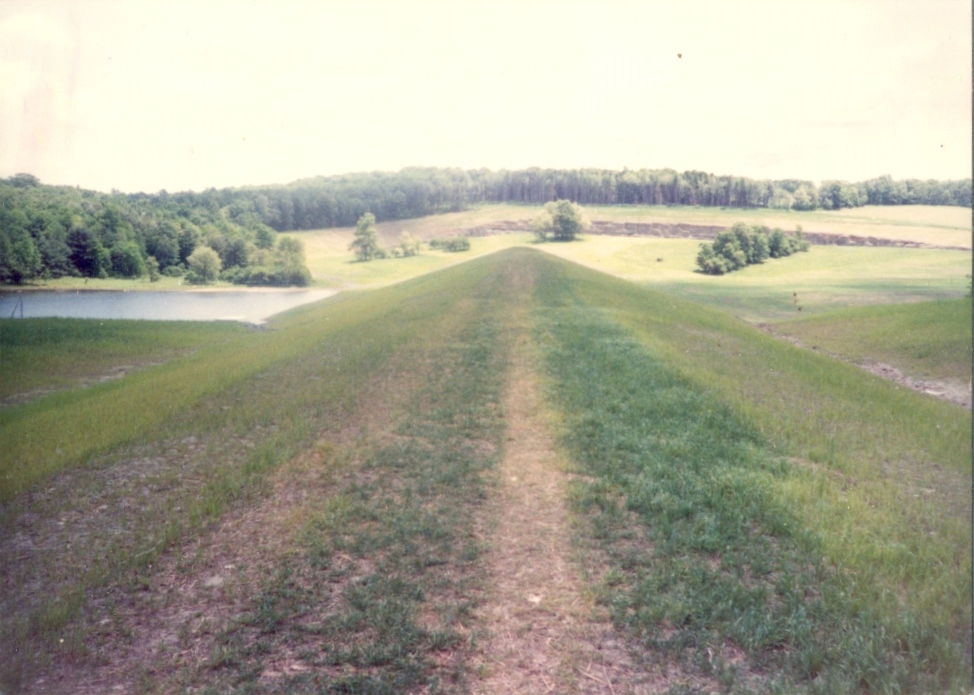
Panorama of Sullivanville Dam, July 15, 2015
 The Sullivanville Dam was a highly debated project that suffered many delays before its eventual construction. In the late 1960s, Chemung County, the federal government, and the New York State Department of Environmental Conservation (NYSDEC) began plans for flood control in the Newtown-Hoffman Creek Watershed. The project included the Marsh Dam east of Breesport, the Park Station Dam in Erin, the Hoffman Dam on Elmira’s north side, and the Sullivanville Dam in Horseheads. The Sullivanville Dam is the largest in the Newtown-Hoffman network. The earthen dam is 70 feet high, 450-feet wide, and 2,400-feet long with a 26-acre surface area. It reduced the risk of flooding in Horseheads and the east side of Elmira by an estimated 80 percent and provided protection to 530 people, 151 homes, and 73 commercial, industrial and public buildings when it was completed in 1988. But it was almost never built.


In 1979 the U.S. Soil Conservation Service declared that no more flood control projects in the Newtown-Hoffman Creek Watershed program should be built because the cost of the projects, including the Sullivanville Dam, could not be justified by flood control benefits. While it was estimated that the Sullivanville Dam would significantly reduce flooding in Elmira and Horseheads, the $4.5 million cost would only result in an estimated benefit of $3.3 million.


There was also local opposition to the Sullivanville Dam. When the project moved forward again in 1984 local legislators argued that it was not cost-effective. For the project, Chemung County had to acquire a total of 230 acres of private land made up of 32 properties in the towns of Horseheads and Veteran including eight family homes. Several homeowner did not want to give up their homes and land, delaying the project further. Even as the bulldozers were starting to move earth in 1988, protesters were seeking a federal court injunction to stop construction. The project also forced a portion of Route 13 to be rerouted.

On May 31, 1988, after nearly 25 years of arguments and delays, a contingent of local, state, and federal officials ceremoniously dug the first shovelfuls of dirt. The U.S. Soil Conservation Service designed the dam and paid the Cold Spring Construction Co. of Akron, New York $4.73 million to construct it. Less than two years later, the dam was finished. Its official dedication was held on May 26, 1990 and, yes, the lake had refilled with water by then. Natural runoff and snow in the watershed refilled the lake in less than a week.

Sullivanvilled Dam when it was completed, 1990
It took at least two strong people to break into the valve mechanism on top of the dam to drain the lake. They used a hacksaw to cut the lock on the manhole and a pry bar to lift the lid and access the valves. Fortunately, whoever perpetrated this prank/crime did not damage the valves. Once opened, the valves released a slow but steady stream of water from the lake. It is thought that the valves may have been opened on Thursday night or Friday morning and that the water level dropped so slowly that no one noticed until Saturday morning.

Manhole on the top of the dam
I never found a report of who emptied the lake or even if anyone had been caught. For some time before the Dam’s dedication there had been requests for the sheriff to increase patrols of the area. Neighbors had complained of cars drag racing on the closed stretch of Route 13 and people holding wild parties. Perhaps it was thoughtless vandals who opened the dam’s valves. Perhaps it was done as a continued protest against the construction of the dam.

July 15, 2015
Today, you can fish and hike at the Sullivanville Dam. It is one of 73 parks within Chemung County. This summer CCHS is celebrating public green spaces, like the Sullivanville Dam, with the exhibit Parks and Recreation and the Parks and Recreation Contest. By offering prizes like wristbands and backpacks, we hope to encourage people to visit all parts of the county and enjoy some of the wide variety of parks this area has to offer. Click here for more information about the contest