Monday, February 25, 2013

African-American History Reading List


The Chemung County Library District in conjunction with the Southern Tier Library System, offer a large number of items about African American History for library patrons of all ages in all formats. Please join Owen Frank, Head of Adult & Reference Services at Chemung County Library District--Central Branch (Steele Memorial) on Thursday, February 28th at the Chemung County Historical Society as we explore the variety and depth of your library's collection of African American Historical Resources. We will also include a brief demonstration of how to use our online catalog STARCat.


Tuesday, February 19, 2013

The Civil Rights Movement


by John Liquori
 
“The Long Civil Rights Movement” is a period that Historians have been writing about only recently. When asked about the Civil Rights Movement, most people think of milestones that happened mainly in the South beginning in 1954 with the Brown v. Board of Education ruling that made segregated schools unconstitutional. Historians now debunk that historical stereotype and have moved toward arguing that the LCRM happened all across the United States and had roots far before 1954. In fact, Historians have now agreed that the LCRM was made of local struggles that happened at different times which makes giving the movement a begin date and place almost impossible.

Elmira, NY was no exception and had its own Civil Rights legacy. On Thursday, February 21, I will tell the stories of local Blacks who lived the struggle for racial equality. One of these stories is of Mr. Roland Coleman. Mr. Coleman was a sailor in the United States Navy during and after WWII. His military service was unique and extraordinary because he was part of the integration plan that President Harry Truman implemented in 1948. One experience he remembers vividly during the integration in the military was going to see a movie with his division. Seating was segregated, with the black seating roped off from the where the whites sat. Against seating rules, Mr. Coleman decided to sit in the middle of the white section. His decision drew an awkward response as he felt unwelcome by the whites and was viewed as a traitor by the blacks.

 Mr. Coleman’s story is one of many that will be told for the first time in the discussion on the history of Elmira. My presentation will begin the conversation on Civil Rights history in Elmira. For the first time, the struggle for racial equality will be a part of the discussion on local history. The struggle was difficult and racism was deeply engrained in Elmira. I will use stories, testimonies, and other primary sources from the locals who lived the struggle to paint a picture of Elmira that has never before been seen—a history that should not be ignored. The stories and the narration of the Civil Rights era are ones that defined a generation of struggle, sacrifice, and an extraordinary movement that changed Elmira, the United States, and the entire world.

Please join us Thursday night at 7pm to hear these stories and much more. The lecture is the third part of our African American History Month lecture series.

Monday, February 11, 2013

The Frederick Douglas Memorial A.M.E. Zion Church


On Thursday, February 14th, Rev. Michael Bell will be presenting a History of the Frederick Douglas A.M.E. Zion Church as part of our African-American History Month lecture series.  Elmira’s A.M.E. Zion Church has over 100 years of history within our community.  Listen to Rev. Bell as he shares the history of his church on the birthday of its namesake.  The lecture will be held at 7:00pm at the Chemung Valley History Museum.  It is free and open to the public.
A.M.E. Zion Church in Elmira
The Church was established by a group of escaped slaves who had found refuge in Elmira.  The founding was inspired by an anti-slavery lecture given here in 1840 by Frederick Douglass, also an escaped slave, after whom the Church was named.  Early religious services were held in private homes but as the mission quickly grew and more space was needed, a church was built.  The primary goals of the Douglass Memorial A.M.E. Zion Church are to promote Christianity, good will, and to serve the needs of the community in every capacity.

Historic Marker erected in 2010
1894 Handbill
126th Anniversary Booklet
Commemorative Plate, 1967


Monday, February 4, 2013

John Denny and the Buffalo Soldiers


By Rachel Dworkin, Archivist

After the exemplary conduct shown by Colored units during the Civil War, the United States Congress created several all African-American peacetime regiments.  These regiments included the 9th and 10th Cavalries and the 24th and 25th Infantries.  Although the nickname Buffalo Soldiers was originally given to the men of the 10th Cavalry, it later came to be used for all of the all-black regiments formed in 1866. 
         
The Buffalo Soldiers saw service throughout the Plains States and the American Southwest as well as the Spanish-American War (1898), the Philippine-American War (1899-1903) and the Mexican Expedition (1916).  They are most famously know for their role in the so-called Indian Wars during the country’s westward expansion.  Although they faced systemic discrimination from the army as a whole and were sometimes attacked by the very people they were fighting to protect, 19 Buffalo Soldiers were awarded the Medal of Honor for their valiant service.

         
One of those men was local hero John Denny.  Born in 1846, Denny was the oldest son of a family who owned and operated at 75-acre tobacco farm on the Olcott Road in Big Flats.  He joined the army at the Elmira army recruitment station at age 21 in 1867 and seemingly never looked back.  On  September 18, 1879, Denny  was serving as a Sergeant in Company C of the 9th Cavalry Regiment.  The company   was ambushed by a band of Apaches in Las Animas Canyon, New Mexico.  They were trapped under heavy sniper fire for most of the day and, as darkness fell and ammunition started to run dry, the Captain ordered a retreat.  One man, Pvt. Freeland, lay injured nearly 400 yards from both his fellow soldiers and the nearest cover.  Denny broke cover and ran to retrieve the other man, hauling him back to safety under heavy fire. 

Although Denny was recommended for a citation soon after, it wouldn’t be until December 1894 when he was issued the Medal of Honor and another month until he was formally presented with it.  Denny continued to serve in the army until he retired after 30 years in uniform in 1897.  He settled in Maryland rather than return to Big Flats.  He died in 1901 and is buried in the Unites States Soldiers’ Home Cemetery in Washington, D.C.   

Join us Thursday night at 7pm to see The Buffalo Soldiers an award winning documentary on the history of the brave men who served with the 9th and 10th Cavalries.  The film is part of our African-American History Month lecture series happening each Thursday this month at 7pm.

Monday, January 28, 2013

Death in the Arctic

by Erin Doane, Curator
The cold, snowy weather lately has gotten me thinking about Ross Gilmore Marvin who was very well-acquainted with this type of weather.  Ross was only 29 years old when he died on the ice as part of Admiral Robert E. Peary’s 1908-1909 expedition to reach the North Pole.  The circumstances surrounding his death are still a mystery.
Ross Gilmore Marvin
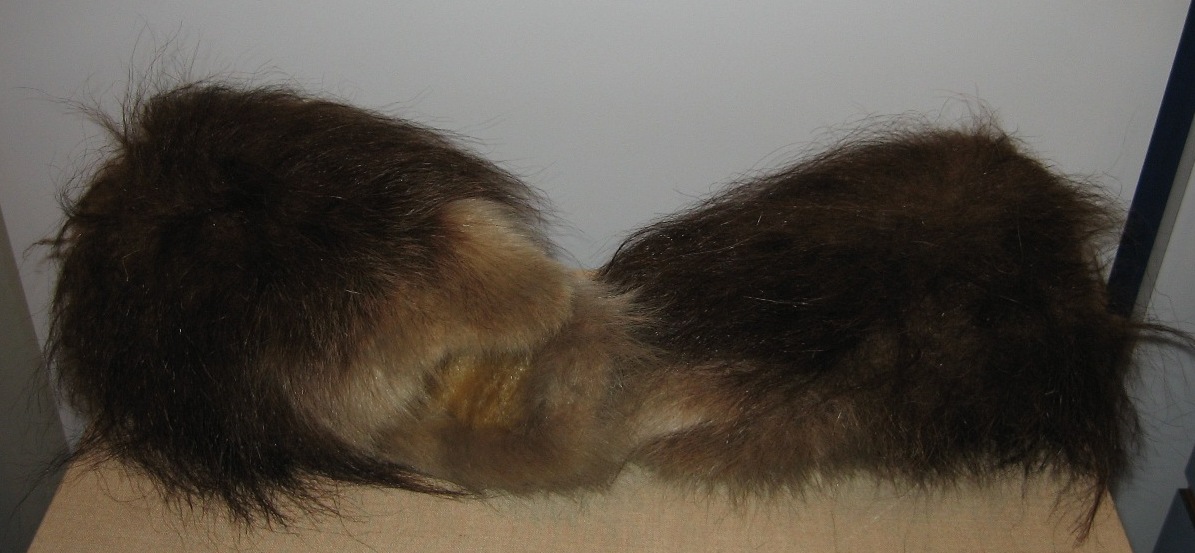
Born in 1880, Ross was the youngest of six.  While he was never an outstanding student in grade school, he did earn a scholarship to Cornell University.  On the day he graduated with his degree in engineering, he received a letter from Admiral Peary inviting him on his 1905-1906 Polar expedition.  The team was not successful in reaching the North Pole that time because they ran out of supplies and had to turn back.  Ross returned home with souvenirs from the voyage and he would let the neighborhood children come over and try on his fur coat and mittens.   
Fur Mittens worn by Ross Marvin
Ross joined Admiral Peary’s next expedition to the North Pole in 1908-1909, this time as chief scientist and Peary’s first assistant.  Admiral Peary successfully reached the pole but on April 10, 1909, about 45 miles north of Cape Columbia near the northern tip of Greenland, Ross went through the ice and died.  A telegram reporting his death reached his family on September 12.  It read: “Marvin drowned eighty-six degrees north latitude, April 10th.  Party very sad. Notify mother before press dispatches.”  His mother took the news very hard, even denying its truth for many years.  It is said that following Ross’s death that she existed only in the memory of her son.  Her love for Ross, and her worry for him, was expressed in a poem she wrote during his first expedition.
Poem written by Mary Marvin
Seventeen years after Ross Marvin was lost on the ice, one of his Eskimo guides named Kudlooktoo confessed to killing him.  He said that Ross went crazy and tried to abandon another Eskimo named Harrigan on the ice.  Knowing that Harrigan would die if he was left behind, Kudlooktoo shot Ross.  As the Arctic was a sort of no-man’s land with no laws or governance, Kudlooktoo was never tried for the murder.  Some doubt the man’s stories, including Admiral Peary’s daughter who thought the guide’s confession was “induced by religious hysteria and an attempt to please the white man by having a ‘sin’ to confess.”  Whether Ross’s death was an accident or murder will probably never be known for sure.  James Vinton Stowell tells the story of Ross Marvin in A Tragedy in the Arctic.  The booklet includes transcripts of pages of Ross’s journal from the 1908-1909 expedition. 
Available to purchase at the Museum's Gift Shop

Monday, January 21, 2013

Historic Fashion on Display


by Erin Doane, Curator

Historic textiles are one of the more fragile types of objects to put on display in museums. Special care is needed to support delicate fabrics when they are on exhibit.  I love historic clothing and believe that it is meant to be seen.  Textiles should certainly be kept and preserved by museums for future generations but I also think it is pointless to just pack them away, out of sight forever.  People need to see historic items to appreciate them and want to protect them.  There needs to be a balance between preservation and making these wonderful items available to the public.


Cotton day dress (1880s-1890s), porter’s uniform (1890s), 
suit with morning jacket (1890s), child’s dress (1880s)
Recently, the Arnot Art Museum borrowed some historic clothing from us for an exhibit commemorating its 100th anniversary.  CCHS archivist Rachel Dworkin and I went to the art museum to help them dress the mannequins. The process is fairly simple, but very important to ensure that the clothing is not damaged while on display.  As preparation before going to the museum, we took our standard mannequins and used batting to pad out the forms to the size needed for the clothing.  This ensures that the weight of the clothing is evenly disturbed and there is no undue stress on any part of the garment.  The rest of the actual dressing of the mannequins took place onsite.

Normally a Victorian lady would wear at least six undergarments including a corset to get the right silhouette for her dress (you can read our post from September 24, 2012 for details about the undergarments) but most of those foundation garments are unnecessary on a mannequin.  We did use one petticoat to help shape and support the skirt.  The skirt of the gorgeous late-1880’s two piece dress is rather complicated with draping, lace and interior ties.  It is also somewhat heavy with its train and took two people to carefully set into place on the mannequin.


Padded mannequin --- Mannequin with petticoat --- Mannequin with skirt
Once the skirt was set, the bodice of the dress was placed on the mannequin.  Most museum objects should be handled while wearing white cotton gloves to protect them from damage.  In this case, clean hands are more appropriate because the gloves can actually cause damage by catching on hooks or trim.  Additional batting was added to the shoulders for support then the lace collar and velvet tie were arranged.  Because of the way it had been stored and the type of fabric, this particular dress had very few wrinkles.  We did give the lace and train a light steaming to ease what wrinkles there were.  Steaming, not ironing, is the best way to smooth historic garments.  You must be cautious, however, as some silks are very prone to water damage and should never be steamed.  After finishing the first dress we repeated these steps with the remaining four garments.  The entire process of getting five mannequins properly dressed took just about two hours.  


Adding the bodice                       Finishing touches