One of the coolest things about historical research is that one small question or one tiny scrap of evidence can lead you down a totally unexpected rabbit hole. For example, the genesis of this blog post came from a discussion I was having with curator Erin as we prepped for CCHS's new candy exhibit, Sweet! The exhibit features a drawing of J. Benjamin's candy store in Elmira, which on its roof, appears to have a giant statue of "Aunt Susan," the character he used to promote his candy. This made us want to know if there really was a huge Aunt Susan on the roof or if this was just an artistic flourish. I love a good puzzle, so I went into detective mode. And so, on my hunt to find out more about the mysterious Aunt Susan, I actually uncovered the even more interesting story of the man behind the marketing ploy.
.jpg) |
| The building and the giant rooftop Aunt Susan in question. |
Joseph
Augustus Benjamin was born on August 9, 1852 in Canadaigua, NY and came to
Elmira at some point in his early life. Benjamin
made a name for himself early on as "Jolly Joe Benjamin". As a young man in the 1870s, "Jolly Joe,"
a natural performer, began travelling with the DeGraff Minstrels, and later the
Queen City Minstrels. Minstrel shows
featured white actors performing in blackface, a popular form of entertainment
in the 1800s that we now recognize as racist.
He performed with and befriended other Elmirans, including the famous costumer Matt Lockwood. With the DeGraff
Minstrels, Benjamin peddled his "comicalities without vulgarity" in
"every hamlet within a radius of fifty or sixty miles of Elmira." The men had many adventures, including stealing
chestnuts in Mecklenburg, NY and performing for coal miners in Arnot, PA (which
went poorly when the miners stole their seats off the stage and "drank up
the water that we were keeping to wash up in after the performance"). In Mainesburg, PA, Benjamin joked with a farm
wife who was feeding them that her pies were very affectionate. The confused farm wife didn't understand, so
Benjamin delivered the punch line: because "the upper crust hugs the lower
one so tightly." Apparently that
joke was wildly popular with minstrel audiences. The farm wife was not impressed.
 |
| Jolly Joe Benjamin, c. 1894 |
The
minstrel troops weren't Benjamin's only performing experience. He was a member of Asa LaFrance's band which
performed all across the region.
Benjamin began as a "cymbal smasher," but eventually was
promoted to drum major. As drum major,
Benjamin wore "brass from the soles of his feet to the top of his bear
skin hat." The elaborately plumed
hat is now a part of CCHS' collection.
 |
| Benjamin's epic LaFrance Band drum major hat. Those feathers! |
During a
stormy parade in Rochester, conditions were so poor that he had to leave his
hat back at the hotel. He "had hard
enough work swinging his wet baton, tossing it up in the rain, in an official
manner, and retaining the damp document as it descended through the saturated
skies into his equally well saturated gloves.
He was some drum major, let me tell you."
At this
time, Benjamin maintained a day job as a tinsmith. However, he still found a way to incorporate
his passion for performance into his trade.
According to a report, "the clown, Benjamin, was a musician by
birth and a tinsmith by trade. He had
constructed a long tin musical machine that looked and sounded like a clarionet
[sic]. By pushing a valve, and turning
the thing the other way, it sounded exactly like a flute."
Benjamin's
work as a tinsmith didn't last for long, and by 1878, he operated a fruit
business. His fruit trade soon evolved
into a candy business. He first sold
candy from a wagon, where he also sold sandwiches, creating one of the first
lunch wagons in the city. In the 1880s,
he opened a candy store on the corner of Water and Exchange Streets. The elaborate building was said to contain
all modern conveniences.
.jpg) |
| A small selection of his many candy offerings. |
Benjamin's
was known for it's Aunt Susan's Butternut Taffy. The advertising featured a drawing of the
supposed namesake maker, but as a newspaper succinctly put it, "Joe was
Aunt Susan."
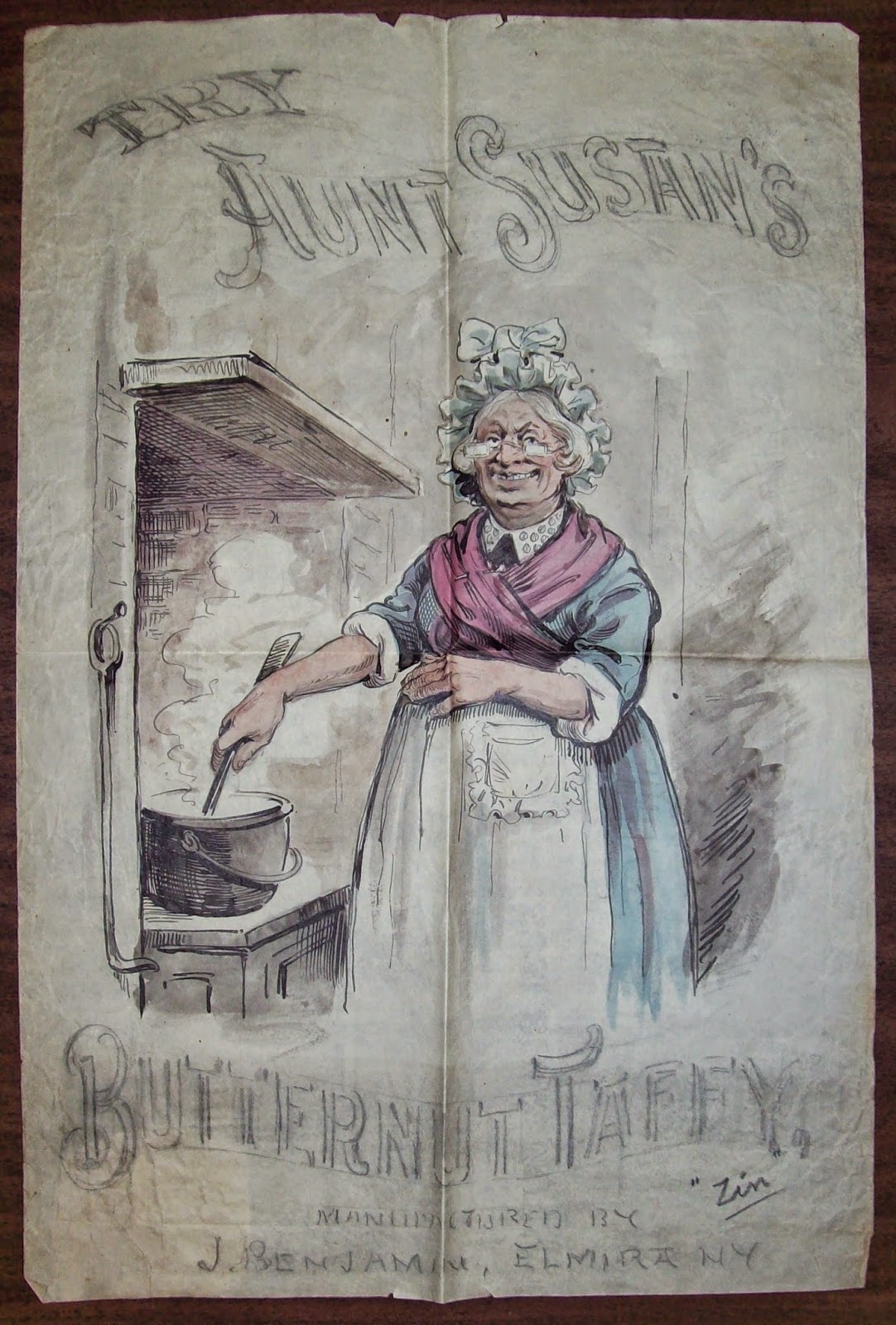 |
| Caricature of Aunt Susan drawn by artist Eugene "Zim" Zimmerman. Courtesy of the Horseheads Historical Society. |
.jpg)
.jpg)
Benjamin was a natural
salesman. When the US government
introduced, and then quickly reversed course and eliminated, their redesigned nickel
with the letter "V" on the back in 1883, Benjamin saw an opportunity. He acquired a couple thousand and sold them
at ten cents each as souvenirs. Benjamin
was also a prolific advertiser. CCHS has
many of his trade cards.
.jpg)
.jpg)
.jpg)
In this
period, "Jolly Joe" was a fixture in the news in a series of other
eccentric endeavors. In during the 1889
flood, he rowed a boat around the flooded Rathbun Hotel. In 1894, he was trying to return a
Confederate Civil War relic and soldier photograph that he discovered to a
rightful family member. In 1897, he and
another man found an eel pond in Binghamton that was projected to be able to
provide over a ton of eels to local hotel restaurants.
Eventually,
Benjamin left the confections business to sell cash registers. He successfully maintained the business in
Elmira for years (despite incidents that caused him to declare that he would
"never sell another cash register to an undertaker," which sounds
like it has a great story behind it!).
However, in 1894, Benjamin left Elmira for a position with the National
Cash Register Company in Rochester. In
Rochester, Benjamin quickly rose up the company ranks. He was considered "king of sales agents
and the king bee of cash register men."
By 1914, he was the manager of the company. When he
retired, one of his sons (one of his six children with wife Julie) took over
his position. According to one record,
Benjamin lived to be 95, dying in 1948.
So, if
you're still reading (or skimming) this lengthy post at this point, you'll
notice that I haven't answered the question that started this whole project:
was there or wasn't there a giant Aunt Susan on the top of the building?!? Well, unfortunately despite all of the
considerable effort I have put into this, I can't answer that question. I have found no mentions of it in the
newspapers and we have no photographs of that building from the era the store
was operating. Frustrating, I know. For what it's worth, my best historical guess
is yes, there actually was a giant Aunt Susan (but perhaps that is just wishful
thinking on my part). I think that the
evidence and narrative that I have presented to you depicts Benjamin as a
knowingly eccentric and creative man. To
me, he is definitely the kind of guy who would put a large figure atop his
building. In my mind, giant Aunt Susan
was a reality, and she was awesome.
.jpg) |
| That mysterious minx, Aunt Susan |


