Showing posts with label labor history. Show all posts

Monday, April 21, 2025

An American Manufacturing Story: American LaFrance

 By Rachel Dworkin, archivist

Last week I spent two days cataloging a collection of 163 photographs of the final assembly process for an American LaFrance fire truck. Paul Walker, the company’s Director of Engineering from 1983 to 1985, had taken the photos in January 1985 in order to document the process and see how it might be improved. It wasn’t like a modern auto plant with robots on an assembly line. It was just a team of guys working together to assemble a series of pre-fabricated parts to make a fire truck. 


The LaFrance Manufacturing Company, founded by Truckson LaFrance, built its first fire engine in late 1873. In those early days, the company made all sorts of things: rail fence machines, cotton pickers, corn shellers, and even railroad locomotives. By the 1880s, however, it was strictly focused on fire engines. In 1903, the company merged with serval other companies to found the American LaFrance Fire Engine Company. For the next 80 years, the company was the premier name in American firefighting equipment and a major Chemung County employer. Then the company left Elmira in 1985 for points south. For the next few decades, it dwindled in size and quality before being picked apart by vulture capitalists. The once-proud company filed for bankruptcy in 2008 and ceased operation altogether in 2014.

At its peak, the American LaFrance plant covered over 48 acres on Elmira’s Southside. The plant included a machine shop, paint shop, warehouses and a main office, plus buildings for pump assembly, cab & body assembly, frame and ladder assembly, engine assembly, and truck assembly. In 1957, 975 people worked at the plant itself with another 1,200 employed as salesmen throughout the country. At the time, they had an annual payroll of $6,500,000 (approximately $73,974,857 today). They completed two trucks a day.

Given the company’s long history in Elmira, it’s no surprise we have quite a bit of it. Here’s a quick rundown of our collections related to the American LaFrance Company:

  1.    Two motorized and one horse-drawn fire engines
  2.    Collection of 150th American LaFrance anniversary celebration material, 1982
  3.     4.5 linear feet of American LaFrance promotional literature and product guides
  4.     2 linear feet of Blazes, the American LaFrance newsletter from 1919-1928, 1940-1954
  5.    2 linear feet of photographs of American LaFrance facilities, products, and employees
  6.      2 linear feet of glass-plate negatives of American LaFrance products, 1890s-1910s
  7.      Nearly 100 technical drawings of American LaFrance products
  8.     Papers of former American LaFrance employees including Carol A. Hall, Marshall Cecce, and John Darrow

While none of this material is currently on display, most are available upon request during our regular research hours from 1pm to 5pm, Monday through Friday. The fire engines are stored off-site and researchers must make an appointment at least a week in advance if they want to see them.

The last American LaFrance truck produced in Elmira rolled off the line on June 28, 1985. Paul Walker had a photo of that too. Thank you to his son who donated it along with all the others. If you have American LaFrance material or stories you’d like to share, we would love to hear from you. Contact me at (607) 734-4167 ex. 207 or archivist@chemungvalleymuseum.org. 

Last fire truck from the Elmira American LaFrance plant & team who built it, June 28, 1985


Monday, March 10, 2025

A Bit of History Repeating

 By Rachel Dworkin, Archivist

Since February 17th, prison guards across New York State, including at Elmira Correctional, have been engaged in an illegal wildcat strike in an effort to improve working conditions. They are demanding that the state increase pay, address chronic understaffing, and repeal the HALT Act, which banned the use of long-term solitary confinement for difficult prisoners. Under the New York’s Public Employees Fair Employment Act (1967), more commonly known as the Taylor Law, public employees are prohibited from striking. Despite the penalties associated with the law, that hasn’t stopped the guards. It didn’t stop them in 1979 either.

On April 18, 1979, union contract negotiations broke down and guards across the state walked off the job. Striker’s demands included higher pay and a roll-back of the post-Attica Riot prison reforms. The strike involved approximately 7,000 of the state’s 8,500 prison guards, as well as 600 guards at other state buildings and institutions. Among them were the guards from Elmira Correctional and the Elmira Psychiatric Center. In addition to the 385 Elmira corrections officers who went on strike, an almost equal number of prison support staff including clerical workers, teachers, specialists, and others refused to cross the picket line. Prison chaplain Rev. John H. Valk elected to remain at his post inside the prison for over a week in order to see to the spiritual needs of the prisoners while still supporting the strikers.

As with today, the governor was forced to call out the National Guard to take over the management of the prisons at a cost of approximately $400,000 a day. The Guardsmen who filled in at Elmira under the command of Major Richard S. Fidurski were primarily drawn from units based out of Buffalo, Binghamton, and Rochester. None had any experience working in prisons and struggled to make things work. All of them found their regularly scheduled lives disrupted. Two Guardsmen from Co. D, 102 Medical Battalion, Pfc. Levi Coram and Spec. 5 Candice Worthey, ended up having to hold their wedding in the prison’s chapel on May 1, 1979 and taking 24-hours leave for a quick honeymoon in Syracuse before resuming their duties.

Mr. and Mrs. Coram on the way to their honeymoon, May 1, 1979
 

Life inside the prison changed with the guards on strike. All visitation was halted. Parolees had their releases delayed. Prisoners were given more time to hang out on their block outside their cells. They had to eat inside their cells though, as there weren’t enough Guardsmen to manage the mess halls. According to an April 29 Star-Gazette article, inmates seemed to prefer the Guardsmen. “In almost six years, I haven’t been treated so good as I have in the last seven days,” claimed inmate Robert Cmor. Conditions at prisons across the state currently under the supervision of the National Guard vary wildly. Some places are operating almost normally. In others, prisoners are under 24-hour lockdown without showers or medical care. At least four prisoners have died.

On the picket line, the strikers threw rocks, eggs, and insults at National Guardsmen and at one point attempted to block a convoy from entering. Chemung County Sheriff’s deputies and officers from the Elmira and State police worked overtime to help keep peace at the prison gates. Meanwhile, many of the strikers were struggling financially. The strike started at the end of the pay period and strikers had yet to receive their last checks. They were eligible for food stamps, but the Chemung County Department of Social Services refused to offer emergency relief and instead insisted they undergo the usual application process which wouldn’t get them aid until mid-June. 

Sheriff's deputies clear a path through the picket line for National Guard convoy, April 27, 1979

 
Strikers outside Elmira Correctional, April 27, 1979

As the strike dragged on, more and more of the support staff made the decision to cross the picket line to return to work. Across the state, tensions were high between those who chose to strike and those who stayed on the job. The several families of non-striking workers were threatened and one man’s dogs were killed. Nothing like that was going on here, but at least one striking guard did attempt to incite a riot among the prisoners. Superintendent John B. Wilmot, who remained at his post throughout the strike, told reporters he was hurt and disappointed by the 64 non-union supervisors and clerical staff who refused to work.

The strike was finally settled on May 4, 1979 with workers returning to work at midnight. In the end, the strikers won a 7% pay boost the first year and raises of between 3.5-7% the second and third years depending on cost of living. Interestingly, this was the same deal they had rejected before the strike, but they did win a few other things. Guards also won special “training” bonuses of $300 the first year and $200 the next. The state also agreed to make seniority the top factor in determining promotions and begin payouts for on-the-job injuries on the day of the injury and not 30 days later as had previously been the case. The local union rejected the deal by a three-to-one margin, but still returned to work anyway. For violations of the Taylor Law, the union was fined $2.5 million and individual guards lost an average of $1,550 in pay. It was a Pyrrhic victory at best. The union’s demands for the repeal of prison reform were soundly rejected.

On February 27, 2025, a tentative agreement in the current strike was announced but ultimately rejected by the strikers. The state has begun firing some guards and plans to start suspending the health insurance of thousands more. It’s unclear at this point how things will end, but someone at this historical society will probably be writing about it 45 years from now.

***

If you were involved in the 1979 strike or have signs, photos or other material associated with it, please contact me at (607) 734-4167 ex 207 or archivist@chemungvalleymuseum.org. If you have pictures of the current strike, I’d love to hear from you as well.

Monday, December 16, 2024

Working at the Langdon Mansion

 by Rachel Dworkin, Archivist

Wandering through our current exhibit on the Langdon mansion, “Grand, Domestic and Truly Comfy,” it’s tempting to imagine one’s self living there. But what about working there? Can you imagine that? Statistically speaking, it’s the more likely option. After all, the majority of the people who lived there over the years were the family’s employees. From when the Langdon’s purchased the home in 1863 to when it was demolished in 1939, they never employed less than three live-in servants. Some were employed there for decades, others barely made it a month. Who were these people and what were their lives there like?

Grand, Domestic, and Truly Comfy

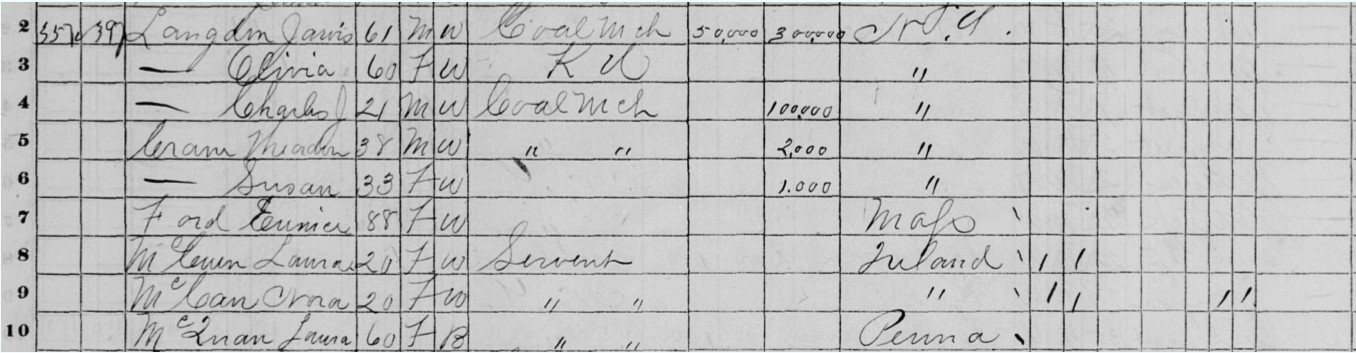
Most of what we know about the servants employed by the Langdon family comes from census records. Conducted every 10 years, the US census provides us with the names and details of 17 of the various women who worked and lived in the Langdon household between 1870 and 1930. For example, in 1870, they employed Laura McCuin, a 20-year-old maid from Ireland, Nora McCan, another 20-year-old maid from Ireland, and Laura McInan, a 60-year-old Black woman from Pennsylvania. McInan was the only Black woman known to have worked at the Langdon mansion. Although her profession is simply listed as servant, given her age, she was likely either the housekeeper or cook. 

Census record for the Langdon home, 1870

Being a housemaid in the 19th century was a young woman’s game. They not only had to dust, sweep, mop, and beat the carpets, they also had to tend the fires and gaslights, and scrub the resulting soot off the walls. In the 1870s and 1880s, the majority of the Langdon’s servants were in their 20s. They had to be in order to handle the strenuous work. Most of them would leave the profession within a few years in order to marry or take better-paying factory jobs. By the 20th century, once the gaslights had been replaced by cleaner electric lighting and modern tools like vacuum cleaners made life easier, the Langdon’s servants tended to be older. These were no longer young women hoping to build a bit of a nest egg before leaving service to marry. These were older women who had decided to make a real career in the profession. One woman, Elizabeth Gagan, was 40-years-old when she appeared in the Langdon household in the 1920 census and was still there 10 years later at age 50 in 1930.

The vast majority of the known Langdon servants, 13 out of 17, were either from Ireland or were the children of Irish immigrants. This was in keeping with national trends. Starting with the Irish Potato Famine from 1845 to 1852, there was a massive influx of Irish immigrants to the United States. Unlike many other countries where women arrived as part of a family unit, many young Irish women immigrated alone so that they could send a portion of their wages home to their families. Irish maids had advantages over other immigrants in that they already spoke English. While immigration guides published in Ireland recommended that men only come in the spring and summer when they were likely to find jobs as seasonal laborers, Irish women could find work year round.

The servant who worked at the Langdon mansion the longest was not Irish, however, but of WASP-y New England stock. Esther C. Burr, worked for the Langdons for over 50 years. She was born Esther Hudson on February 28, 1847 in Alder Run, Pennsylvania near Milerton to parents who had come from Connecticut. She herself had moved to Elmira as a young woman. Here, she found work as a seamstress and a demonstrator at the Singer Sewing Machine store. She also found a husband. After he died, she took a job with Langdon family as a seamstress and lady’s maid for Ida Langdon, wife of Charles Langdon, in 1885. By 1900, she was 53 years old and had worked herself up to become the housekeeper. When her mistress died in January 1935, she willed Esther $500. The other servants got another $500 to split between them. Esther herself died a few months later at age 88 in the Langdon home.


Headline from Star-Gazette June 3, 1935

 The Langdon mansion was demolished in 1939. By then, the era of the live-in servant was largely over. Certainly no one would live and work at the Langdon home again.


Langdon home, ca. 1930s.
 

Monday, April 22, 2024

Stand up for Safety: Aviator Leon "Windy" Smith


 by Susan Zehnder, Education Director

    “It is mighty easy Mr. Praeger for you to sit in your swivel chair in Washington and tell the flyers when they can fly…”

Windy Smith in the cockpit

When Leon D. Smith sent this message, it ended up getting him fired from his job and blacklisted from the post office air service. It also set off the first ever pilots’ strike.

Born in Millerton, PA, in 1889, Leon D. Smith was the youngest son of Dr. Frank W. Smith and Mary Anne Miller Smith. His father was a dentist who opened a practice in Elmira at 328 East Water Street. Leon Smith had been called “Windy” since he was a child, because he talked a lot. In school, he was known as an athlete and excelled in football. 

His two older brothers went into farming, but Windy was looking for something different. It wasn't until he met and became friends with aviation pioneer Glenn Curtiss in nearby Hammondsport, that he discovered his lifelong passion for flying. In 1913, Smith graduated from the Curtiss Aviation School, and immediately became a flight instructor. He was 24 years old. The country had a growing need for more pilots. Less than one year later, World War I broke out, and the demand for skilled pilots increased even more.

Teaching flying in Alabama

Flying was new and people were looking for what aviation could offer including moving the mail farther and faster. The first mail flights were in 1911, but regular service didn’t begin until May 15, 1918. The first issued airmail stamp cost 24 cents. The early routes used government-operated planes, and pilots logged valuable long-distance flying time and aerial navigation experience. Establishing regular service meant the mail could be more reliable. The first flight of scheduled service consisted of six U.S. Army “Jenny” biplanes, piloted by military officers. President Woodrow Wilson and U.S. Postmaster General Albert S. Burleson were two of the dignitaries that attended to witness their take-off. Each of the six planes carried over a hundred pounds of mail from Washington, D.C., to Belmont Park, New York City. The flight was 218 miles, necessitating a brief stopover in Philadelphia. Of these six planes, one didn’t make it. The pilot became disoriented soon after take-off, and he needed to return to earth. Upon landing, the plane was badly damaged, so his payload of mail was loaded on a truck and driven back to Washington.

After four months, the Aerial Mail Service of the U.S. Post Office Department was established and took over mail delivery. Now, the department had a fleet of purpose-built biplanes staffed by a crew of civilian pilots. In December 1918, 28-year-old Leon D. “Windy” Smith was hired as one of those pilots.

Six months later, on June 22, 1919, the weather turned to heavy fog and the pilots complained to each other. Smith took it farther and wrote directly to Second Assistant Postmaster General Otto Praeger with his objections. He pointed out that only a week earlier, Charles Lamborn, whom he called one of the best flyers in the United States, had lost his life while attempting to deliver the mail.

Praeger immediately fired pilots Smith and E. Hamilton Lee for refusing to fly. This motivated all the pilots to go on strike and for weeks, airmail service stopped completely. When it was over, all pilots, except Smith, were rehired. Praeger held fast to his grudge against Smith.

Praeger had been appointed to his position by Postmaster General Burleson, his one qualification being that he was Burleson’s fishing and hunting buddy. Praeger was ambitious but lacked experience and understanding of the new kind of transportation. Between 1918 and 1926, thirty-five pilots lost their lives in service to the U.S. Postal Service. Being denied his job with the Post Office didn’t stop Smith from flying. 

Posing with his stunt woman

He went back to teaching pilots to fly, and he started “Windy Smith’s Air Circus,” an aerial acrobatics and stunt business. One of those daring stunts was covered in another one of our blogs titled FallingWomen: Elmira’s Lady Parachutists.

Leon D. “Windy” Smith, always known as a safe pilot, died in 1960 at the age of 70. He is buried in Woodlawn Cemetery.


Monday, August 7, 2023

Elmira Rolling Mills

By Rachel Dworkin, archivist

There’s something neat about shows like How It’s Made. If you, like me, have never worked in manufacturing, industrial processes can feel like something of a mystery. Over the years, Elmirans have made everything from aluminum cans to woolen cloth. From 1861 to 1883, the Elmira Rolling Mill Co. made iron.

The Elmira Rolling Mill Co. was founded in 1860. On May 16, 1861, the plant, located on Hatch Street between East 5th and East Washington Streets, began operation. The original structure was 180’ by 80’ and had five furnaces and three steam engines. The plant grew substantially during the 1860s with the addition of two new buildings. By 1865, the mill consisted of three buildings housing the original rolling mill, plus two pudding mills, and a merchant bar mill. The equipment included 24 furnaces, 8 steam engines, 5 trains of rolls, two roll lathes, and one Burden squeezer. The company was using all this equipment to manufacture 22,000 tons of iron each year.

Here’s how it all worked.

Step 1 – Arrival of Raw Materials

In order to make their iron, the Elmira Rolling Mills needed massive amounts of raw iron and coal. These materials arrived at the plant on canal boats and on the dedicated rail spurs which ran to the factory. 

Canal boats unloading in front of Elmira Rolling Mills, ca. 1870

 Step 2 – Heating the Materials

The raw iron needed to be heated in order to burn off any impurities and to make it malleable. It was usually heated to somewhere above 462 degrees Fahrenheit. This is iron’s recrystallization temperature, or the point at which the iron’s previous crystalline structure is broken down and reformed anew but not yet melted.

At the Elmira Rolling Mills, this was done in coal-fired pudding furnaces. Pudding is the process of converting raw iron into usable wrought iron by heating it in a special furnace where the metal and the fuel were not in direct contact. The process was first developed in England in the 1780s. I have no idea why it’s called pudding. Heated iron can absorb chemical impurities given off by the burning fuel. Coal, for example, gives off sulfur which can make the metal brittle. By using a pudding mill, the Elmira Rolling Mills could heat their iron using coal without having to worry about introducing sulfur to their iron.

Diagram of a pudding furnace

 Step 3 – Squeezing

Once the iron was removed from the pudding furnace, it needed to be forced into a useable shape. Traditionally, this was done by teams of strong men with big hammers. In 1840, Henry Burden of Troy, New York, invented his rotary concentric squeezer which performed the same task with a lot less time and effort. The Elmira Rolling Mills had a Burden squeezer they used to force their heated iron into shape.

Step 4 – Rolling

Rolling is a metalworking process where heated metal stock is forced through one or more pairs of rollers to reduce thickness or give it a more uniform shape. A series of multiple rollers is known as a train. The first roll produces a plate of metal. A slitting, latte, or bar roller is used to slice the metal up into bars of various widths, shapes, and thicknesses. 


 The Elmira Rolling Mills had five trains of rolls which could produce square bars, round bars, oval bars, half-round bars, and half-oval bars in various thicknesses.  The company used coal-fired steam engines to power their rollers. 

Step 5 – Sale

Initially, the Elmira Rolling Mill’s main clients were railroads for whom they made rails. In 1863, the company added a merchant bar mill so they could offer iron bars in more shapes and sizes to a wide variety of clients.


At its peak, the Elmira Rolling Mills employed around 400 people and was one of the city’s largest employers. By the 1880s, the railroad industry had switched to using steel for their rails. The company was not equipped for steel manufacturing and found it could not keep up with the manufacturing centers of Harrisburg and Pittsburgh. In 1883, the workers went on strike for higher wages. In response, the company permanently shut their doors. Although iron is no longer made in Elmira, the process used at the Elmira Rolling Mills is largely still used today, abet with different power sources.

Monday, March 6, 2023

Hired Girls and Domestic Servants

By Rachel Dworkin, Archivist

In 1847, Miriam Whitcher, wife of the Reverand Benjamin Whitcher of Elmira’s Trinity Episcopal Church, was struggling to find a hired girl. She wanted one who could make bread, wash, and iron and was good natured, but knew her place. In May, she hired Martha and soon became depended on her, but by September she was fed up with how overly familiar Martha was. She fired her and tried to do without for a while, before breaking down and hiring fourteen-year-old Ellen, the daughter of poor Irish immigrants who “had no ideas of equality and does not seem to think of coming to the table with us.” She couldn’t do the work, however, and was soon replaced by Jane, a twenty-five-year-old Black woman, who could both do the work and know her place. Jane worked for the Whitchers for nearly a year. (See this blog post for more on Whitcher)

The Whitcher situation was not unique. During the mid-19th century, the entire concept of domestic labor was in flux. In the early 1800s, the nation was predominantly rural and the average farmwife was responsible not only for cooking, cleaning, and childcare, but also gardening, tending livestock, making cheese, spinning, weaving, making the family’s clothing, and often making extra products to sell. A family might temporarily hire a neighbor’s teenage daughter to help the wife out during the planting or harvest or after childbirth. These hired girls would work alongside and supplement the work of the farmwife for brief periods and were generally not regarded as servants. They were part employee, part guest, living under their employer’s roof and eating with them at the table. They also did not make a career out of it, but rather ‘helped’ during their teen years to gain funds and experience before marriage.

Running parallel to this was a system of unfree unpaid domestic labor in the form of slavery. In 1800, there were two households with slaves in Elmira and, by 1810, there were eleven. Enslaved women performed much of the same work as white hired ‘help,’ but these Black women were understood to be inherently inferior. They would certainly never be welcomed at their master’s table. All slaves in New York State were freed as of July 4, 1827, but a system of Black indentured servitude lingered well into the 1830s.  (see this blog post for additional details) For the rest of the 19th century, domestic service was one of the few careers open to Black women both nationally and in Chemung County.

By the 1840s, a number of compounding factors were beginning to change the nature of paid domestic labor. Increased industrialization shifted textile production from the household to the factory, greatly reducing the amount of work a wife was expected to perform. These same factories offered new, better-paying employment opportunities to young women and girls. The end of slavery in the northern states and the Underground Railroad resulted in a new pool of Black workers who lacked the options enjoyed by white women and could not demand the same levels of pay or respect. The Irish potato famine from 1845 to 1852 resulted in a wave of desperately poor Irish immigrants who were largely in the same boat.

By mid-1800s, 15 to 30% of all urban households had at least one domestic servant. Unlike the old ‘help’ previously employed by farmwives, these women were employed full-time and year-round. A small, middle-class household like the Whitchers might have a single maid-of-all-work who would cook, clean, and do laundry alongside their mistress. A larger, more prosperous household might employ a cook, a laundress, and multiple maids, maybe even a nanny or governess as well. In these households, the lady of the house would act as manager overseeing their labor without performing any of it herself. Having a servant became a sort of status symbol. It also freed up upper class women to become involved in charities, clubs, politics, and self-improvement. 


Nanny employed by the Diven family, ca. 1890s

Locally, there are a couple well-known domestic servants, both associated with Mark Twain. One was Mary Ann Cord (1798-1888), the cook at Quarry Farm. Mary Ann had been born into slavery in Maryland. In 1852, she was sold away from her husband and their seven children and brought to New Bern, North Carolina. It was there she found her youngest son, Henry, during the Civil War. He had escaped to freedom years before and found work as a barber in Elmira. She came to Elmira with him and where she met and married Primus Cord. From 1870 until her death, she and Primus worked for the Cranes of Quarry Farm, her as cook and him as groundskeeper. In 1874, Mark Twain wrote A True Story Word for Word as I Heard It based off of her life story (see this blog post for additional details).


Mary Ann Cord. Image courtesy of Elmira College

Katy Leary (1856-1934), meanwhile, was born and raised in Elmira, the daughter of poor Irish immigrants. In 1880, she took a job with the Clemens family sewing baby clothes. She worked for them for the next thirty years serving as a lady’s maid, housekeeper, nurse, chaperone, traveling companion, seamstress, nursemaid, and nanny. After Samuel Clemens died in 1910, Katy left service and opened a boarding house with her pension money. Interviews with Katy were the basis for the book A Lifetime with Mark Twain, published in 1925. 

Katy Leary, ca. 1925

 The life of a domestic servant in the late-1800s was unpleasant. Pay was low, the hours were long, and the work could be grueling. Servants often lived within their employers which left them with little privacy and made them vulnerable to exploitation. Domestic servants tended to either be young and unmarried, or older widows returning to the workforce. While some women, like Mary Ann and Katy, made careers out of it, most domestics preferred to abandon the field in favor of marriage or other employment.