Monday, October 28, 2013

'Til Death Do Us Part

by Erin Doane, Curator

Weddings and funerals are two events that are universally shared by almost every culture on earth.  Our newest exhibit ‘Til Death Do Us Part presents the various wedding and funeral traditions that are practiced in Chemung County.  Join us for the exhibit’s official opening this Saturday, November 2nd from 1:00 to 3:00pm.

‘Til Death Do Us Part on display at 
CCHS through May 2014
It is surprising how many similarities there are among various wedding and funeral traditions.  Maybe it should not be all that surprising.  When you get right down to it, humans are more alike than they are different.  Food is something that everyone has in common.  Hindu brides and grooms share sweets with each other as part of their wedding, as do Muslims.  Jewish and Christian couples often share the first bites of cake at their wedding receptions.  When a loved one dies, it is traditional for mourners to bring food to the home of the deceased’s family.  Muslims offer help, condolences and food for three days while Jews provide a week’s worth of meals to the grieving family because they are forbidden to cook for seven days.
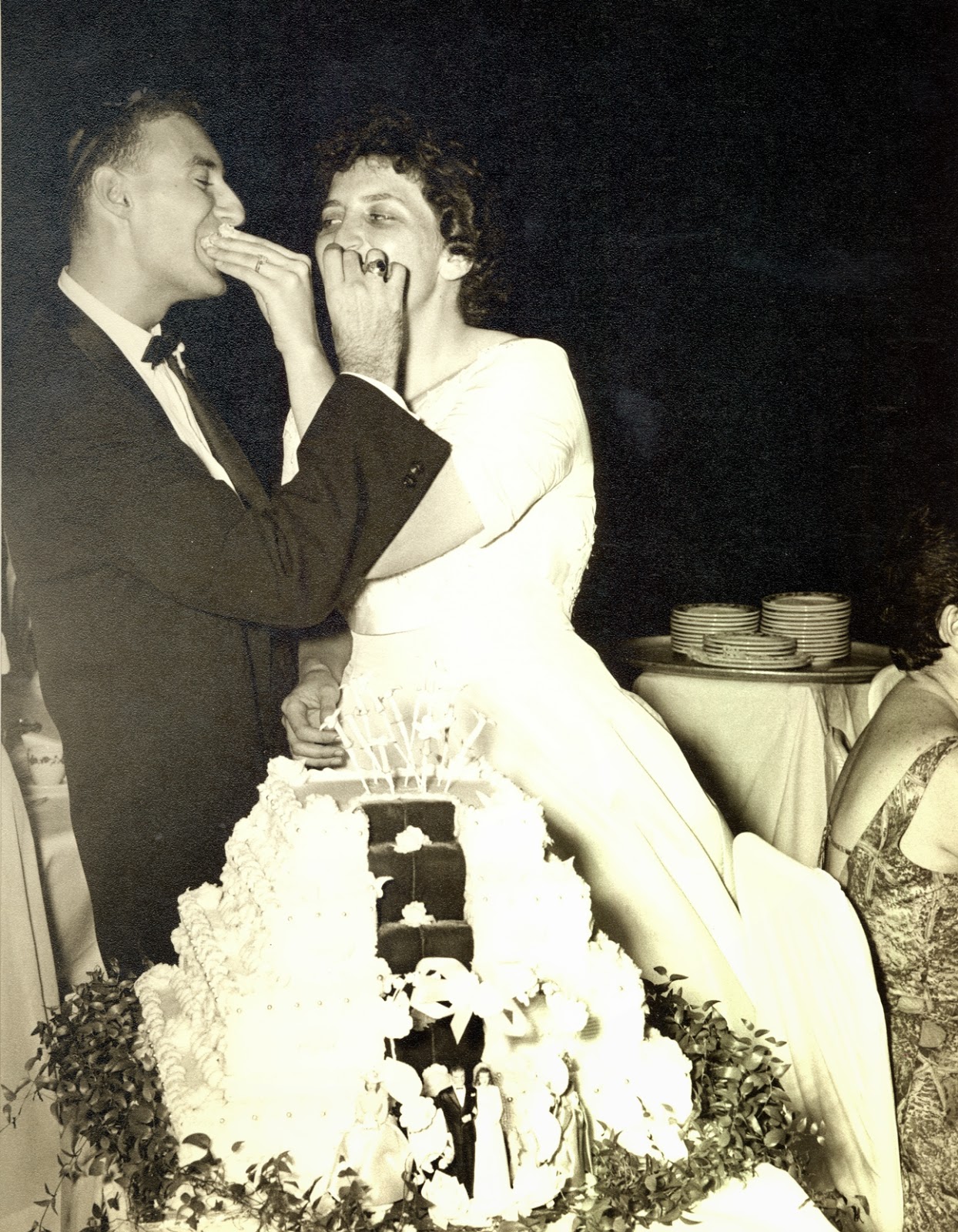
Myra and Jerry Stemerman sharing cake
 at their wedding in 1959
The number seven appears again and again among the traditions.  From the seven days of Jewish mourning and the seven verses of prayer at a Muslim funeral to the seven steps and vows at a Hindu wedding and the seven blessings at a Jewish wedding, the number holds shared cultural significance.
Bride and groom taking the seven steps
together at a Hindu wedding, 2010
In both the Hindu and the Jewish traditions, a bride and groom stand under a canopy during the wedding ceremony.  There is often an exchange of tokens between the bride and the groom.  A Hindu groom gives his bride a necklace of black beads.  The tradition of wedding rings began with Christians and Jews but has also been adopted by modern brides and grooms of other religious backgrounds.  In nearly every tradition the couple signs a marriage contract before witnesses.  For Muslims the nikah is simply a legal document but the Jewish ketuba and the Quaker wedding certificate are often highly decorated and are put on display in the couple’s home.  
 
Ketuba of Joseph and Mindy Gaieski, 2004
 And finally, among nearly all groups regardless of cultural background or religious belief, the overbearing mother-in-law is a shared cliché.  Come see these similarities and more in person at the exhibit opening this Saturday! 

Monday, October 21, 2013

Vintage LOL Cats and Other Funny Felines

By Kelli Huggins, Education Coordinator

Take a picture or video of a cat and slap a funny caption on it and you have Internet gold.   Keyboard Cat, Grumpy Cat, and other so-called LOL Cats have taken the web by storm over the past few years (my personal favorite is Henri, Le Chat Noir, the “French” tuxedo cat in deep existential despair.)  With endless LOL cats to brighten our lives now, how sad it must have been to have lived in a pre-Internet world without cats and their people asking such vital questions as “I can haz cheezburger?”

But alas, we’re not as clever and innovative as we think.  We have merely used our technology to play on a great, eternal, and universal truth: people have always liked funny cat pictures.

As evidence, I would like to bring your attention to the late nineteenth century.  Much like now, this was a cat image golden age.  Due to wider acceptance of the concept of pampered pets, cats with funny sayings adorned trade cards, magazines, and other printed materials.  Below is a series of trade cards from the Great Atlantic and Pacific Tea Company (or A&P as we know them now).  They detail love and violence cat-style.


Funny feline appearances were not limited to cartoons and made-up cats.  The era had its own celebrity cats who received the caption treatment.  Below are images of Mark Twain’s cats Blatherskate, Sourmash, Apollinaris, and Zoroaster with the captions that they were given in an 1899 issue of St. Nicholas: An Illustrated Magazine for Young Folks:


"Mark Twain's Cats, Before the Dog Interfered"

"The Dog Taps on the Window"
Since this is a very visual topic, I will leave you with a few more of my favorite local cat-themed trade cards.  So next time you’re enjoying a video of a cat in a shark costume chasing a duck while riding a Roomba, remember the historic origins of our crazy Internet obsessions.


Tuesday, October 15, 2013

All the World’s a Stage: Elmira Little Theatre

by Erin Doane, Curator

This week we are gearing up for our annual Ghost Walk event that will take place this Friday and Saturday, October 18th and 19th. (Tickets are going fast so call 607-734-4167 asap to reserve yours!)  This is the seventh year of the Ghost Walk and each year just seems to get better and better.  We could not do it on our own.  The Friends of Woodlawn Cemetery allow us access to the cemetery and the wonderful actors of Elmira Little Theatre make the scripts that CCHS staff members write for the “ghosts” come alive.
The Elmira Little Theatre will be celebrating its 70th anniversary next year.  The group started in 1944 with thirty original members called together by Mrs. Eleanor McKinnon Emery.  In December 1944 they presented their first formal production – The Man Who Came to Dinner – at Elmira College’s Cowles Hall.  The organization has had several homes over the years and in 1964 it found a permanent home in the former Southport Volunteer Fire Department building.  In 1977 when the Clemens Center for Performing Arts opened, ELT joined the Center as its resident theater company.

Many local residents have had the opportunity for time in the spotlight thanks to the Elmira Little Theatre.  Local broadcast legend Carl Proper was active in ELT.  While he never played a historic Woodlawn Cemetery resident for any of our Ghost Walks, he did play such roles as Billis in South Pacific, Harold Hill in the Music Man, Enoch Snow in Carousel and the title role in Dracula.  He was also known for his performance of the Abbott and Costello routine “Who’s On First?” along with David Sisken during the Little Theatre’s presentation of “A Visit to the Golden Age of Radio.”
 
Carl Proper, left, and David Siskin
as Abbott and Costello, 2010
Nearly every participant in ELT is a volunteer.  The actors, designers, costumers, builders and the organization’s thirteen board members all donate their time to bring theater to Elmira.  Community and civic participation have always been integral parts of the group and it has been providing much more than just entertainment since its beginning.  In the 1940s ELT participated in war-time fundraising campaigns, servicemen’s canteens and flood relief efforts.  In 1969 ELT created “Black and White Teen Theater” with the Elmira Neighborhood Ministry to improve race relations and encourage theater among the youth of the city.  ELT won an award from the NAACP in 1970 for that effort.

See actors from Elmira Little Theatre in action at the Woodlawn Cemetery Ghost Walk or in one of their upcoming productions: The Hallelujah Girls, Morning’s At Seven and Little Women the Broadway Musical.