Monday, October 27, 2014

Chills Down Your Spine

by Erin Doane, curator

“Where there is no imagination there is no horror.” 
~Arthur Conan Doyle, Sr.

Now and then I come across objects in the collection that make the little hairs on the back of my neck stand up.  The objects themselves are not particularly creepy or scary but they trigger uneasiness within me.  Some objects, like a Ku Klux Klan robe, a gas mask from WWI, or the glasses worn by a guard when he was beaten to death during a jailbreak are so closely associated with violence that it is part of their very existence. 
Glasses worn by Harry M. Swartz when he was murdered, 1938
Other things just have a spookiness about them, like dolls.  I, personally, have no strong feelings about dolls but I know that many people find them completely disturbing.  So, for those of you out there that would not want to be alone in a dark room with a doll, I must warn you that there will be dolls at the end of this post.  There will be several of them, actually, and Kelli has assured me that they are indeed very creepy.  You have been warned. 

So, why do we find certain objects creepy?  I have some theories about that.  First of all, I think people naturally have an aversion to death.  People generally don’t like things that remind them of their own mortality.  Victorians were kind of an anomaly in this area.  It was common for them to keep mementos of their loved ones after they had passed away including jewelry made from their hair or postmortem portraits.  Photographs of deceased children were quite common in the late 19th century.  Today most people find such things very creepy.
Plaster casting of the hand of the deceased 3-year-old girl, 1906
Actual dead things are also pretty creepy.  People have always turned to fur as a way to stay warm but fur is also fashion.  I will admit that I do like fur (it is one of my guilty pleasures) but I only buy vintage so no more little animals are slaughtered.  Peeling the skin off another animal to wear it is rather disturbing.  It makes me think of the skin suit from Silence of the Lambs. It is no wonder that some people get the chills when they see a fur stole, especially if it has little glass eyes.
Mink stole, c. 1930s
Many people fear going to the dentist or the doctor.  Much of that fear is probably caused by the scary tools they might use on you.  Part of the creepiness of medical instruments is just letting your imagination explore how they could be used.  Things that pull teeth, saw bones, drill into skulls, and pierce skin will always give me the shivers.  [As a side note, the official opening of our newest exhibit, To Do No Harm: Medicine in Chemung County, will take place Thursday, November 20th from 5:00 to 7:00 pm.  I hope to see you there!]
Clockwise from top left: trephine, bone saw, syringe, tooth extractor
And now dolls.  I won’t be offended if some folks stop reading here.  I think the reason so many people find dolls unbearably creepy is their faces.  They were meant to look human and that is what is most unsettling.  A human face on something inanimate just makes you wonder if it is going to blink or talk or do something equally terrifying.  All the killer dolls in movies and tv are not the cause of this fear.  They are only the expression of something so universally shared.

Dolls, dolls, dolls, dolls, dolls, dolls, dolls, dolls, dolls….


…and a clown.

Happy Halloween!

Monday, October 20, 2014

On Being Creative in a Changing Museum World

By Kelli Huggins, Education Coordinator

I think we're at the beginning of a museum renaissance.  Museums, both small and large, are being flooded with incredibly creative, well-trained professionals who are continuously challenging the status quo.  Part of this shift is tied directly to the economic crash of 2009 and the ensuing "Great Recession."  Funding is tight and museums have to work with less than in the past.  We're facing greater competition for the money that is still out there.  In order to get ahead, you need to stand out.  In the past few years, I have seen many innovative programs and exhibits come out of the museum world that prove that history is not dusty old stuff and the boring names and dates you learned in high school.  History is awesome stories, new collaborations, and it's fun.

CCHS is a small museum with limited resources, but I know that we have the tools necessary to be an innovative leader in this renaissance.  I'm grateful to have colleagues who have the training, the smarts, and the delightfully offbeat sensibilities that are helping us start some really cutting-edge initiatives for a museum of our size.  I'm going to use this blog post to explain (and brag a little about) some of our new plans to better serve our community and make our mark in the museum world.

Dogapalooza and Catstravaganza
Our collaboration with the Chemung County Humane Society and SPCA is something I really pushed for from the beginning.  I volunteer there and specialize in animal history, so I saw a natural connection between our two organizations (plus they've been in our community since 1891!).  When I posed the idea of doing an event together, fortunately everyone was onboard with trying out this non-traditional idea.  We started with Catstravaganza, a celebration of cat history and contemporary cat issues, in February 2014.  We held it at the museum and had almost 200 people come to the museum in 3 hours.  Those are huge numbers for us.  We also featured artwork by 1,500 local students. 

Enjoying the students' cat-themed art at Catstravaganza.  Come see the dog art at Dogapalooza.
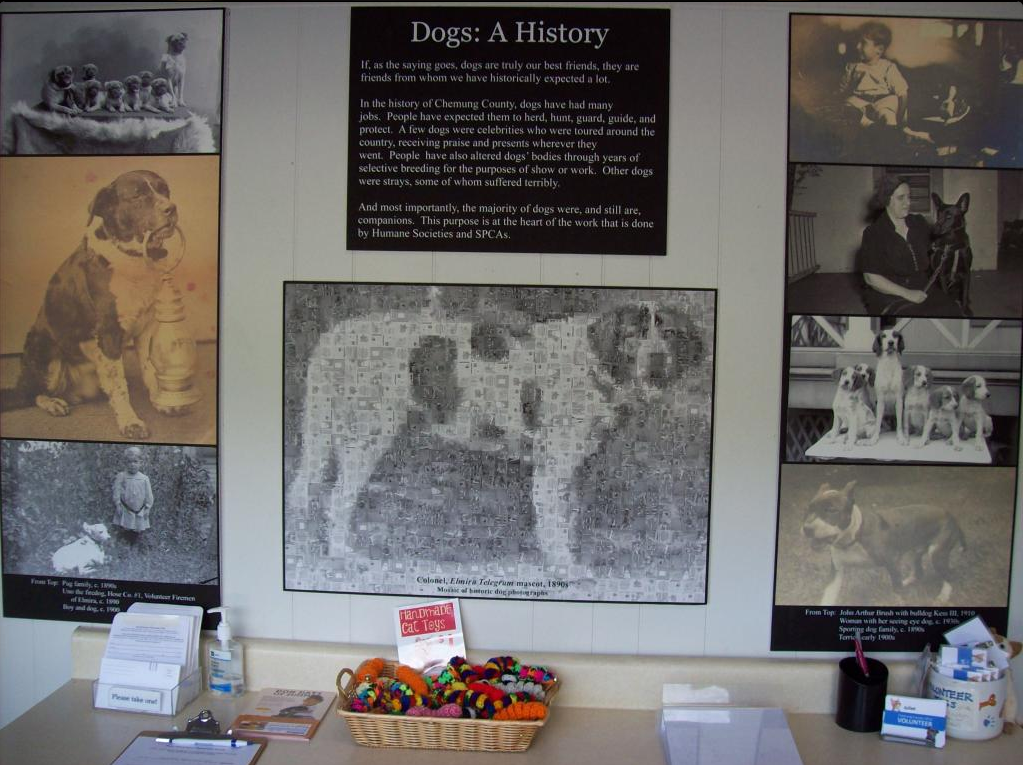
Capitalizing on this success, we're hosting Dogapalooza on November 8, 2014 from 12-3pm.  This will be similar to Catstravaganza, but obviously focusing on canines this time.  We'll have crafts that will teach visitors about local historically famous dogs (like my favorite, Colonel), there will be a police K-9 demonstration, videos, adoptable dogs, artwork by over 2,000 students, and more.
The folks at the SPCA are wonderful and have been great to work with.  So far, we've also put two exhibits in their lobby that you can see when you stop in to visit the dogs and cats. 
Dog history exhibit on display at the Chemung County Humane Society and SPCA
 
History They Didn't Teach You In School
We're starting a new program series, playfully called, "The History They Didn't Teach You in School."  The first installment is "Scandal!" on December 12, 2014 from 5:30-7.  These will be guided tours of the museum where we'll tell visitors all of the fun stories we don't normally get to tell in exhibits.  Like our Ghost Walk, we want our visitors have so much fun learning about history that they don't even realize that it's educational.

Medical Exhibit Interactives
In November, our new exhibit, "To Do No Harm: Medicine in Chemung County," will open.  The exhibit itself will be great because we have many fascinating, sometimes gruesome, medical artifacts that we'll be able to show-off.  However, what I'm personally most excited about is our interactive component.  At the start of the exhibit, you will be able to choose 1 of 9 stories that will guide you through the exhibit.  These are all accounts of a fictional historical resident of Chemung County who faces a medical problem.  Like those great choose-your-own adventure books, your story will guide you through the exhibit as you decide which doctor you will see, what medicines to take, and more.  We're making a push to do more programming and exhibit work that will give visitors an immersive historical experience.
Uh oh, it's the 1800s and you broke a bone! What do you do? Follow our interactive stories in our medical exhibit to find out!

Mark The Mammoth
You may have seen our adorable new Museum Ambassador, Mark the Mammoth, on our social media accounts or in person at the museum.  Mark represents our first foray into Twitter (you can follow him @MarkTheMammoth) and also a fun, informal way to connect with the public.  We put Mark in costumes (we just had staff contest to design a Halloween costume for Mark- congratulations to the winner, Erin) and have him make friends in the community.  Through Twitter, we have been able to join an international community of museums.  Mark routinely talks to other museums and museum mascots (there are surprisingly a lot of them on Twitter) about Chemung County.  Many of these people will never visit the museum, but Mark's Twitter account is a way to share our collections with these folks, anyway.  Mark has chatted about rain boots with a teddy bear mascot for an Estonian toy museum and about exhibit design with a giant extinct Irish deer from a UK museum.  We also participate in the weekly #MewseumMonday, where museums share images of their feline-themed collections. While these encounters may seem small, they are not only telling people about what we're doing, but they are also providing us with an endless source of ideas for programs and exhibits.  Rule #1 for museum creativity: when you see something good that someone else is doing, steal it for yourself!  

Mark pretends to be in Hawaii.  This costume comes courtesy of Mark's summer fashion designer, 9 year-old Ada.
This is just a sampling of the new ideas we're trying.  Now this doesn't mean that our traditional offerings, like lectures or exhibit openings, are disappearing.  These have long been the backbone of museum programming, and for good reason.  However, we are having fun trying to diversify our programs.  Innovation keeps the museum from becoming stale.  We're also always looking for suggestions from you.  What would you like to see offered at the museum?  How can we better serve you?  Be creative!


Monday, October 13, 2014

The Knights Who Say Columbus

by Rachel Dworkin, Archivist


        America is a nation of immigrants but it often has a troubled relationship with them.  During the late-19th century, America experienced a massive influx of immigrants.  Many of them were from predominantly Catholic countries including Italy, Poland and Ireland.  The native born Anglo-Saxon Protestant stock looked upon these new Americans with fear and distrust.  They formed explicitly anti-Catholic fraternal organization including the Junior Order of United American Mechanics and the Scottish Rite Masons.

Father McGivney

             In response, Catholics formed their own society.  The Knights of Columbus were founded by Father Michael McGivney in the spring of 1882 in New Haven, Connecticut.  Their goal was to unite American Catholics and provide financial security to the dependents of workers killed or injured on the job.  In order bolster their patriotic credentials they named themselves after Christopher Columbus, who was both a Catholic and the first white explorer to colonize the Americas. 

Elmira Council centennial program, 1997

            The Knight’s initial growth was slow but by the early 1900s they had chapters in every state in the Union, plus Canada, Mexico, Panama, Cuba and the Philippines.  The Elmira Council #229 of the Knights of Columbus was formed in 1897.  The chapter’s founders included a number of prominent Catholic citizens like Daniel Sheehan (mayor) and Edward J. Dunn (financier and philanthropist).  The Elmira Council hosted New York State Convention in 1911, 1932, 1944 and 1958.  Since their founding, they have been actively involved in charitable giving both locally and nationally.  Members were involved in the creation of St. Joseph’s Church, the Arctic League and the Catholic Charities of Chemung County. 
Daniel Sheehan, 1st Grand Knight of Elmira Council

       Over the years, the Knights of Columbus have been involved in a number of different causes.  My personal favorite is their anti-discrimination work during the 1920s.  During this time, the Ku Klux Klan was on the rise, even in Elmira (see ThingsWe Don’t Like to Talk About for details).  The Klan smeared the Knights of Columbus claiming that they were a violent anti-Protestant group and pushed for an end to parochial schools.  The Knights joined forces with Jews, Blacks and other minorities to protest Klan activities.  They sponsored lecture tours and demonstrations, and by published books on the accomplishments and contributions of Catholic-, Jewish- and African-Americans.  On one occasion, an inter-racial group led by the Knights stormed and broke up a Klan rally in New Jersey. 

             Unfortunately, I have to do a lot more digging before I can say whether or not the Elmira Council of the Knights of Columbus was involved in any anti-Klan activities.  Stay tuned for future blog posts to see if I ever get around to doing that research.


Postcard issued by The Knights of Columbus during World War I

Monday, October 6, 2014

Harvest Time at the Museum

by Erin Doane, curator

The season is wrapping up for our three small garden beds out in front of the museum. There are still a lot of tomatoes slowly turning red and the ornamental corn still has a ways to go but we've harvested nearly everything else. For the size of the gardens, I'd say we had a fairly good harvest.
After finally defeating (or at least strongly discouraging) the squirrels, almost everything grew well. The runner beans didn't do that well and the peas and spinach were just planted too late but otherwise, I'd call it a success. 
Roma tomatoes and ornamental corn
I just love cooking with fresh, home-grown (museum-grown?) vegetables and I made a lot of different things from our little plots. The cucumbers did really well and I think everyone on staff took some home. I sliced some up and mixed in some onion, sour cream, vinegar, salt and pepper, and a bit of sugar.

Chicago pickling cucumbers
We also had an abundance of basil that got shared around. I made a lot of pesto and used some full leaves on a tomato sandwich I made with one of the German Giant tomatoes from the garden. The German Giants are huge, lovely, tasty tomatoes and I’m definitely going to look for them again next year for my own garden.
Sweet basil and pesto
Sliced German Giant tomato and tomato sandwich with fresh basil
The root crops did well in our Victorian garden.  There were enough beets for two or three servings.  I oven roasted them will a little oil, salt and pepper.  The carrots were short and stout but there were a lot of them. I shredded some and combined them with pineapple, raisins and yogurt. While some folks seemed skeptical of the recipe, I thought it was very tasty.  There are still a lot of carrots in the garden bed. Maybe I’ll have to make a carrot cake next. 
Ruby queen beets
Early chantenay red-cored carrots
The pumpkins in the Three Sisters garden had a really good start but the leaves got powdery mildew in the middle of the season.  There was enough time, however, to get two nice little pumpkins before the vines died.  I cooked up one and made it into a pumpkin cheesecake. That was definitely the staff favorite of all the dishes that came out the garden.  If anyone is interested in the recipe you can find it here.  I’m not sure what to do with the second pumpkin.  Suggestions?
Early sweet sugar pie pumpkins and pumpkin cheesecake
Visitors seemed to enjoy seeing the gardens growing outside the museum and it drew people in to see our agriculture exhibit.  We even gave a couple little tours of the gardens where children could touch and smell the plants and herbs.  I am really pleased with the way the gardens turned out and with all the good food we got from them.