Showing posts with label Immigration. Show all posts

Monday, December 8, 2025

Chop Suey and Deportation

by Erin Doane, Senior Curator 

A long-time resident and owner of a local Chinese restaurant is detained by immigration officials. He is a well-known and respected member of the community, but he originally entered the United States illegally. After all legal avenues have been exhausted, he is deported. While this story could be one lifted from today’s headlines, it is actually from 1931. This is the story of Lee Hee, who opened the Peking Restaurant at 106 East Water Street in Elmira in 1926.

East Water Street, Elmira, c. 1932

When I first noticed the Peking Chop Suey sign in a historic photo of East Water Street, I had no idea where my research would lead me. I started by looking into when Chinese restaurants first appeared in the area and ended up with stories of immigration and prohibition raids.

An article in the Star-Gazette in 1899 declared that “Chinese restaurants are querious [sic] places” but by the early 1900s there were several of them in Elmira. That coincides with the “Chop Suey Fad” that appears to have swept the nation around 1902. The origins of chop suey are uncertain. The dish of meat and eggs cooked with vegetables in a thick sauce served with rice is thought to have been developed by Chinese Americans in the late 1800s, but some believe it actually did come from China. Either way, by the early 20th century, it was a well-known dish in Elmira. 

There were already half a dozen Chinese restaurants specializing in chop suey when Lee Hee filed his paperwork with the county clerk in 1926 to operate the Peking Restaurant. Lee had been working as chef at Spaghetti Land, an Italian/Chinese restaurant on the second floor of the Lyceum Theater on Lake Street. His new restaurant was located on East Water Street across from the Regent Theater on the second floor above T.J. Connelley’s grocery store. It offered Chinese, American, and Italian food, including chop suey, from 11 a.m. to 2 a.m. every day. The special businessmen’s lunch was just 40 cents. Over the years, the restaurant and Lee built a reputation for high class, quality food.

Elmira Star-Gazette, February 25, 1926

In 1928, the Peking Restaurant was the target of a raid by federal prohibition agents. They found eighteen bottles of high-powered beer on the premises and arrested Lee. He was released on $1,000 bail and seemingly continued on with his business. The next time he appeared in the local newspaper was in June 1930 when there was a catastrophic collapse of a temporary sidewalk at the Gorton Coy construction site. Two people, including a small girl, were killed in the incident. Lee was on the sidewalk when it collapsed but only sustained a slight injury to his right leg. 

On January 29, 1931, the Peking Restaurant was raided again, this time by the U.S. Immigration Department. It was one of dozens of Chinese businesses – mostly restaurants and laundries – targeted by immigration officials. Lee Hee was among several men who were not able to provide papers showing they were in the U.S. legally. Lee had been a seaman on a Chinese merchantman who had jumped ship in Seattle and entered the country without official documentation. From there he made his way to Elmira in the early 1920s. Lee seemed fairly nonchalant about the arrest telling the reporter that he was planning to return to China anyway and he didn’t mind letting the government deport him and pay the transportation costs. He had been in Elmira for about ten years at that time and had saved thousands of dollars working as an “unusually skillful chef and cook.” 

Lee was released on $3,000 bond and continued working as a chef and restaurateur while his deportation case made its way through the courts. In December 1931, Federal Judge John R. Knight of Buffalo, affirmed the earlier decision of U.S. Commissioner William W. Gregg ordering Lee’s deportation. His last appeal to the U.S. Circuit Court of Appeals was rejected and on August 25, 1932 he was taken into custody again. Finally, on September 6, 1932, nearly two years after his initial arrest, Lee was sent back to China. A year later, several residents of Elmira received Christmas greeting from Lee from his new home in Hong Kong.

Lee Hee (left) pictured with fellow deportee Chu Sun, Elmira Star-Gazette, September 9, 1932

Days before Lee Hee was deported, an advertisement in the Star-Gazette announced that the Peking Chop Suey Chinese Restaurant at 106 East Water Street was under new management. The new proprietor, Lee Tui How, had previously operated laundries on West Water Street and Baldwin Street. Whether from lack of experience running a restaurant or because of a prohibition raid in February 1933, the restaurant had closed for good by 1934.


Monday, March 24, 2025

A Curious Story: Lillian Pagett Hobson

 by Susan Zehnder, Education Director

While our country was founded almost 250 years ago by immigrants, attitudes about immigrants and immigration have always been complicated. In Elmira in 1930, the citizenship of Miss Lillian Pagett Hobson was challenged on the grounds that she hadn’t lived in the country long enough to meet the residency requirements. My research seemed to confirm the objection was valid, but it was overruled, and Hobson became a US citizen on January 31, 1930.


Each country determines by law who is eligible to become a citizen. Requirements for becoming an American citizen have certainly changed over the years. The first US immigration and naturalization act was passed less than 15 years after the United States was founded. It excluded women, Blacks, and Native Americans from becoming citizens. Since then, more than 55 laws and 18 policies have been adopted to regulate who can and who cannot become a citizen.
(Read this blog on a specific immigration law passed in the 19th century.)

Today’s applicants for US citizenship must pay a fee, pass a civics test, meet residency requirements, prove they’re proficient in English, and if it applies, register for selective service. In Hobson’s day, the rules were much the same. Applicant names were printed in the local newspapers. If the person met the requirements, they were given the oath of citizenship. If they did not meet the requirements, reasons were given why not. Hobson’s case revolved around whether or not she had lived in the United States continuously for five years.

Lillian Pagett Hobson was born in Ireland. Her connection to Elmira was through her grandfather, William Pagett, called “one of the oldest of Elmira’s residents.”  In 1847 Pagett had left England for the United States. In 1855 he settled in Elmira. He and his wife, Anna, had a son and a daughter, Lillian’s mother.

Pagett owned and operated a successful tannery business. When the Civil War broke out, he was awarded a lucrative contract to feed prisoners at Elmira’s Civil War Prison Camp. With his earnings, he bought multiple oil wells in Pennsylvania and properties in Elmira, New York City, and Brooklyn. When he died in 1918, the properties passed down to his remaining heirs: his wife, a niece, and his granddaughter, Lillian Pagett Hobson. His wife died two years later.

Ten years after this, Lillian Hobson moved to Elmira. Two years later, she filed for US citizenship, claiming she had been living here with friends for five consecutive years. Her application was challenged by the District Director of Naturalization of Western New York, Leroy N. Kilman. Kilman determined that Hobson had gone back and forth between Ireland and the United States during the years she said she was living in Elmira. His objections were overruled by Supreme Court Justice Joseph D. Senn, and Chemung County Clerk John A. Matthews administered the oath of citizenship to Hobson on January 31, 1930. Right away, she applied for a passport to return to Europe to visit her father.  The district director filed another appeal, and that is the last mention of the issue in the papers.

Hobson’s name does show up again connected to another issue, and it may have influenced the judge’s decision to override the challenge. As one of two heirs to valuable property owned by her grandfather, Hobson already had invested in Elmira.

In early January of that same year, the Gorton clothing store and a nearby pharmacy, located at 105-107 East Water Street, were heavily damaged by fire. While they never determined how the fire began, both businesses continued to operate. Then less than 30 days later, just after Hobson had become a naturalized citizen, the company announced they would be constructing a larger, quarter-million-dollar, state-of-the art building and expanding their business. It would be located on property owned by the Pagett family at the corner of Main and Water Street. The building would be designed by distinguished architects Pierce and Bickford. The Gorton Company had agreed to lease the property from Hobson and her cousin Frederica Pagett Gates for 99 years at the cost of $20,000 per year.


The new building would be an economic boost to the city as the country had just entered into the Great Depression. However, not everyone thought it was a good thing. In April and through the beginning of June there was a contentious controversy over the new building’s footprint. The difference was 3 feet 4 inches and both the city and the developers did not want to budge. It affected how far into the sidewalk the building encroached. The developers claimed that construction was already set in motion and they couldn’t change anything. Opponents insisted that they change, which would mean a $140,000 to $200,000 debt to the city. The hearing was full of accusations, threats, and shouting. Only ten days later, things got much worse.


At rush hour on June 13, the construction’s temporary sidewalk collapsed, killing two people and injuring dozens more. After intensive investigations, the coroner declared that it was an accident and Gorton’s was not at fault. Construction continued. Many of the injured filed civil action suits against the Gorton Company and investors Hobson and Gates. Eventually, all cases were settled out of court.

The Gorton-Pagett building operated for 58 years, closing in February 1975.

Miss Hobson ended up staying in the area. Her name appears periodically in the paper, identified as a donor to charitable causes. Then in 1970 and 1972, two letters to the editor appear in the Star-Gazette. In both she complained about having to pay school taxes when she had no children. She is listed in the Elmira City Directory until 1976. In 1978 her name shows up one last time. It is printed in the paper for failure to pay property taxes on the East Water Street property.


Thursday, March 23, 2023

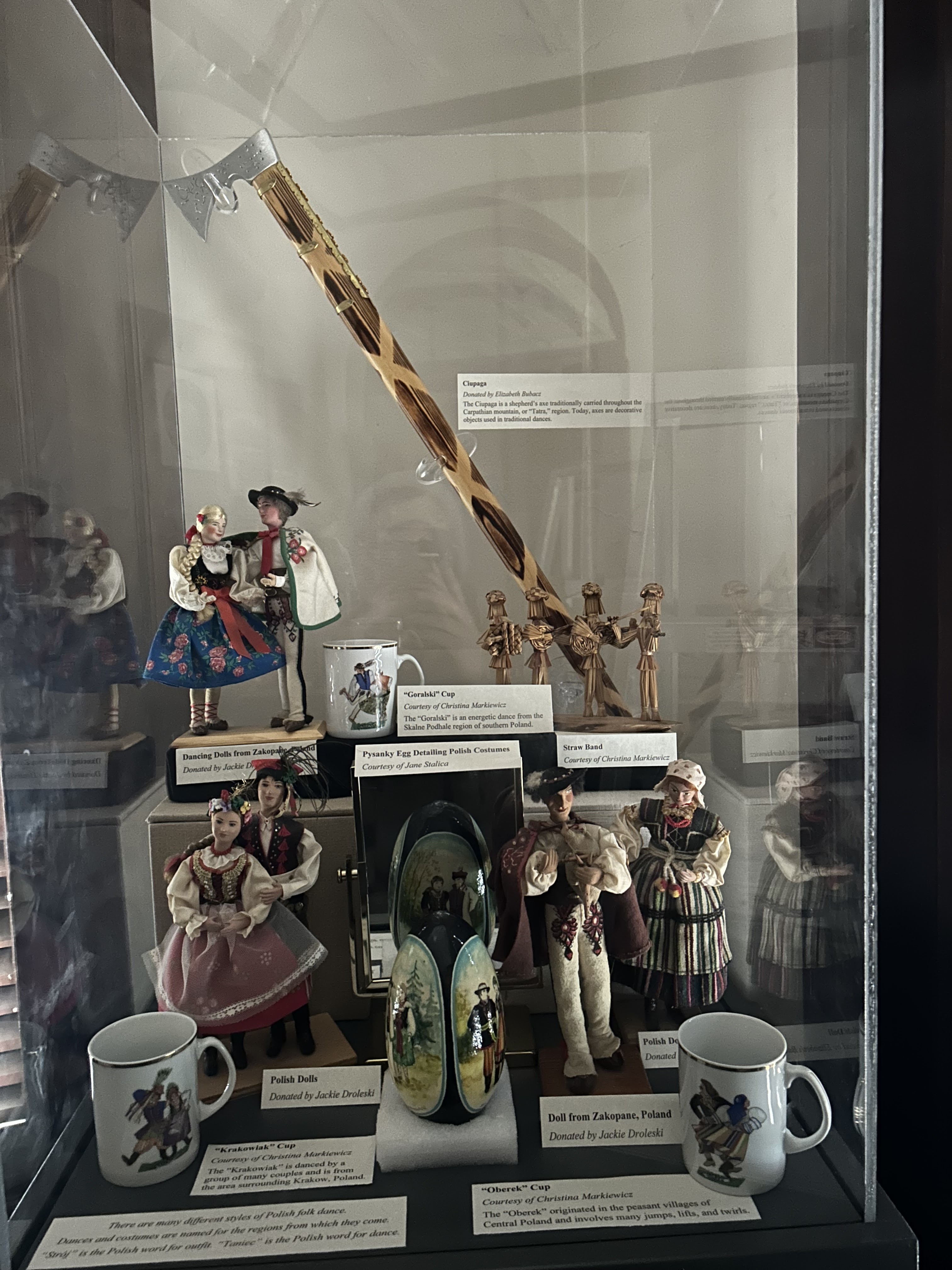
Poles Dancing

 by Monica Groth, Curator

Polish Dolls
Courtesy of Jackie Droleski

In 1983, the Chemung Valley History Museum's Bank Gallery was filled with dancers costumed in bright boots, flower crowns, and intricately embroidered vests.

The Tatra Dancers at CVHM, 1983

That day, the Tatra Dancers, a Polish folk dancing group, performed at the Museum before an excited audience. 

The Tatra Dancers at CVHM, 1983

The Tatra Dancers had been established as a club just seven years earlier with the encouragement of two local Polish cultural organizations: the White Eagle Society and the Polish Arts Club. These organizations were on a mission to revive interest in and appreciation for Polish art and culture among second and third generation Polish-Americans who were losing knowledge of their heritage. 

Polish immigration to Chemung County peaked in the late 19th century. Many immigrants had settled in the coal mining districts of northern Pennsylvania in the decades prior to 1900, but came to Chemung County when jobs in industrializing Elmira and Elmira Heights offered better economic opportunities. Organizations were immediately created to keep Polish culture alive. The earliest Polish organizations were founded through St. Casimir's Church, established in 1890 as the center of the Polish Catholic community. The St. Casimir's Society was founded in 1895, and the White Eagle's Society (which still thrives today and is part of the Polish National Alliance) was established in 1907. The societies generated income for members' sick/death benefits and hosted events within the community. Through the decades, Polish music and language were promoted at St. Casimir's church services and Polish-language classes were taught at St. Casimir's parochial school, run by the Polish-speaking Sisters of St. Joseph. 

St. Casimir's Church, c. 1890.
Image Courtesy of Jackie Droleski. 

St. Casimir's Church, 2002.
A large brick structure was built to replace
the original wood-frame church in 1912.
 The Church stands at 1000 Davis St., Elmira today.  

Over time, however, as Polish-Americans increasingly assimilated into multicultural America, the use of Polish language in church, school, and clubs decreased, nearly disappearing by the early 1950s. 

Minutes of Council 104 of the Polish National Alliance taken in Elmira, NY 1954-1955.
The book is open to the entry where records switch from Polish to English. 

In the early 1970's, the community experienced a cultural Renaissance, as parishioners of St. Casimir's reinitiated Polish music and language in Masses. A new Polish Choir was assembled and the Polish Arts Club was formed in 1973. The Club hosted language and crafts classes as well as lecture and film series on Polish culture. 

As part of this Renaissance, the Tatra Dancers were established in 1976. The name Tatra comes from the name of the Western Carpathian mountain region of Poland where many folk dances originated. 

The Tatra Dancers
Image from Elmira's Poles by Ray Winieski

The group learned and performed traditional Polish folk dances and were dedicated to authenticity. Group instructor George Bacmanski supplied the group with traditional costumes directly from Poland. In 1979, his daughter Rose Bacmanski studied at Poland's Koscuiszko Foundation, and in 1980, the group traveled to Poland to perform in the Rzeszow Folk Festival. 

Embroidered woolen vest made in Poland and
believed to have been worn by a Tatra dancer
Loaned courtesy of Marge Cowulich

There are many different styles of Polish folk dance, each deriving from the distinct culture of the region in which it originated. However, the so-called "national" dances spread throughout the country from their original regions and were danced by all classes. 

The five national dances of Poland include:

The Krakowiak: a fast paced exhibition dance featuring several couples following a lead pair. It hails from the Krakow region of Poland.
The Kujawiak: a slow, smooth dance from the Mazovian plains region of Kujawy. The dance is usually paired with the faster Oberek. 
The Oberek: a dance from the Mazowsze villages of Central Poland. Like many styles, the Oberek originated amongst peasants and spread to the nobility. It's name comes from the Polish word "to spin" or rotate and it is known for its jumps and spins. 
The Mazur: another dance from the Mazovian plains, the mazur has a popular if irregular rhythm and much foot-stomping and heel-clicking.
The Polonez: the aristocratic waltz-like "walking" dance is a slow promenading ballroom dance 

Popular regional dances from the Tatra region of Poland include the Goralski and the Zbojnicki, both known as highland dances. Both dances showcase the acrobatic talents of dancers and can use the ciupaga, or shepherd's axe, though the axe is more popular in the Zbojnicki, an all-male dance modeled after the exploits of the "zbojnik", or mythical robber, of the region.

Watch Polish dances being performed on this YouTube Playlist: https://www.youtube.com/playlist?list=PLR18vxeMSzPSBEsjhKAOkzbBmYM29axyn
 
Cup featuring the Kujawiak 
Courtesy of Christina Markiewicz
Cup featuring the Mazur
Courtesy of Christina Markiewicz
Cup featuring the Polonez
Courtesy of Christina Markiewicz

Today, the exhibit Polonia in Chemung County is on display just off the gallery where the Tatra dancers performed fifty years ago. The exhibit showcases many items having to do with Polish dancing. Christina Markiewicz kindly loaned the Museum a series of porcelain cups displaying multiple dance styles and Bettyann Bubacz donated a ciupaga (dancing axe) to the Museum. Come check it out!

Polish Dancing Case in the exhibit Polonia in Chemung County
 On Display Now at the Chemung Valley History Museum
Objects loaned to the Museum courtesy of Bettyann Bubacz,
Jackie Droleski, Christina Markiewicz, and Jane Stalica 


Friday, July 2, 2021

Jamaica Helps Win the War!

By Rachel Dworkin, Archivist

On a crisp September morning in 1944, 900 arriving Jamaican workers filled a New York pier with song. None of them had ever been to America before, but all were eager to help with the war effort. 111 of them had come to work at the General Electric foundry here in Elmira. The foundry’s purchasing agent, Wilbur R. Simmons, had gone down to the city to meet them. He was awed by the beauty of their music.

Beginning in 1943, the Farm Security Administration began recruiting Jamaican workers to help ease farm labor shortages in the eastern states. Approximately 4,500 were brought to U.S. that summer with 1,250 of them working in New York. All told, the United States government recruited over 38,000 foreign workers from Mexico, Jamaica, the Bahamas, and other parts of the Caribbean and South America to help bring in harvests across the country that year. The practice continued throughout the war.

Agriculture wasn’t the only place where there were wartime worker shortages. Local manufacturers found themselves scrambling to replace workers who had left for military service. In the spring of 1944, John R. Row, the plant engineer for General Electric’s Elmira Foundry, headed to the Caribbean to recruit guest workers. The original plan had been to bring folks from the Bahamas, but that island had put a hold on recruitment due to labor shortages of their own. He ended up going to Jamaica instead.

The first 111 Jamaican guest workers arrived in Elmira on September 24, 1944. They were to be housed at the plant in barracks built specially for them. The barracks featured 2 large halls with bunk beds, a recreation hall, a large kitchen, store house, communal bathroom, and laundry facility. James O’Connor, a former steward for a Kingston cricket club, and Eustace Fothergill, a ship’s cook from Old Harbor, took command of the kitchen. Subsequent guest workers were housed in private apartments or with host families, mostly located in Black community on Elmira’s east side. 

Jamaican worker's arrival, September 26, 1943. Courtesy Elmira Star-Gazette

 The men were initially hired to work a 6-month contract with an option to renew. Although few of them had any experience working in foundries, they were assigned to work in the manufacture of gray-iron castings. The arrangement worked well. Not only was the initial contract renewed through June 1946, additional workers were brought in a few months later. Once the harvest was brought in, Kennedy Valve Manufacturing Company hired 36 Jamaican agricultural laborers to stay in Elmira and work over the winter. Chemung Foundry and Bendix-Eclipse ended up hiring Jamaican workers as well. All told, nearly 300 Jamaicans ended up working in Elmira factories during the course of the war.

Elmira did its best to welcome them. The Council of Social Agencies worked to put together programs and resources to provide them with recreational opportunities in their off hours. Several organizations donated books, magazines, and athletic equipment for the barracks. Elmira College offered a series of lectures and discussion groups on various topics. The Neighborhood House hosted an all-Jamaican choral group. Various churches, including Monumental Baptist Church and St. Luke’s Congregational Church, opened their doors to worshippers. For Christmas 1945, St. John’s Episcopal Church of Elmira Heights held a special concert for them and Trinity Episcopal Church hosted several concerts by the Jamaican Gospel Choir.

The last of the Jamaican workers finally left in 1946. On April 18, Elmira Foundry held a farewell banquet at the Jamaican barracks. Various plant officials came and sang workers’ praises. They presented George Barrett, the chairman of the Jamaican Camp Council, and other workers with scrolls of merit and professional references. The company also presented St. Luke’s Congregational Church with a special bulletin board honoring the Jamaican workers who had worshipped there during their stay. The temporary workers went home in the summer of 1946, but some eventually came back to settle in the community they had come to love. 

Charles Brown's naturalization papers, 1957. Brown was originally from Jamaica.


Monday, July 8, 2019

A Puzzling Response


by Susan Zehnder, Director of Education

Recently, I presented the topic of immigration to second graders, and asked “who is an immigrant?” Ever since, I’ve been thinking about one response I heard. 

Required to study immigration by New York State, second-graders learn who  came to the United States during the late 19th and early 20th centuries, and some of the reasons why. Students easily identify the Statue of Liberty. They understand it was a gift to America from France, and was dedicated in 1886 as a sign of friendship between the two countries. Well over a hundred years old, the statue has been carefully restored three times. She is an important symbol of what America stands for, and continues to hold her torch high over New York's harbor.
Statue of Liberty's recently restored torch.
Nearby, other buildings of a similar age used to process newly arrived immigrants, now house the Ellis Island National Museum of Immigration run by the National Park Service. Operating as a gateway to America and the possibility of a better life, Ellis Island processed over 12 million hopeful people from 1892 until it closed in 1954. Immigration is nothing new.
 
Both the Statue of Liberty and Ellis Island can be seen in this photo from a NYC tourist website.
Immigration is in the news a lot these days. In the United States, the first restrictive federal immigration law was passed 144 years ago in 1875. Called the Page Act after Representative Horace F. Page, a Republican from California, it aimed to prohibit Chinese women entry to the United States. Up until then, immigrants from China were mostly men. Lured by the financial possibilities surrounding the 1848 California Gold Rush, the majority of these men borrowed money to make the trip. Working, they paid back that money plus interest.

However, what they earned was often not enough to bring over their wives or girlfriends. Lacking family life, prostitution, nothing new to the west, grew in this immigrant population. Congressman Page created The Page Act, saying he wanted to address the issue of prostitution and to focus on the plight of poor Chinese girls brought over as prostitutes or slaves. Today, speculation is the restrictions were to keep Chinese laborers from taking jobs that could go to white men, by depriving them of the chance to start families. 

To implement the Page Act, potential immigrant women were subjected to rigorous questioning first by the American consul in Hong Kong. Passing that, they would have to again answer the same questions just before sailing. These answers were carefully compared to their previous ones. Those that were approved, were then asked the same questions by Hong Kong’s harbor master of the British colonial government. Once on board the ship, the women were questioned again, and upon arriving, the women presented their photographs, health records and answered the same questions again. If anyone changed any answer or didn’t match their photo from before, they were returned to Hong Kong and seen as duplicitous.

In 1882, the Chinese Exclusion Act was adopted. This second immigration law suspended immigration of Chinese laborers to America for ten years; permitted those already in the US to remain in the country only after a temporary absence; and barred Chinese from naturalization, among other things.

There weren’t many Chinese in Chemung County at this time. In Elmira there were two Chinese launderers listed in the 1885 City Directory, with an additional three listed in 1896. Notes in our files indicate the number was “stable up to the 1920s.” 

In the immigration unit, the second graders read over copies of original documents to find clues about different characters who lived in our area. We use an advertisement from one of the laundry businesses listed in the Star-Gazette from September 2, 1914. 
Star-Gazette, September 2, 1914

This shows one business that was a successor to another, was open every day, and worked to provide the very best work. Through discussion, the students learn a little more of why hardworking people might have left their home countries and ventured to America. We look at documents on different immigrants who make up the complexity of our area.  
 
Just like in the early days as a nation, today America is a country of immigrants from countries all over the world. 

The answer that I heard when I asked the students “Who is an immigrant?” didn’t make sense until I thought about it. While I suspect he wouldn’t agree, it’s who the kids hear always talking about immigrants.

The puzzling answer I heard to who is an immigrant? The President.

Note: For more information on Chinese immigrants in Chemung County, see Rachel’s blogfrom August 13, 2012. It includes the story of Mr. Yee Lee, owner of the first Chinese laundry business in Elmira.

Monday, July 9, 2018

Theater House Riot

by Rachel Dworkin, archivist


All the young Italian couple wanted to do was see a movie at the Colonial Theater one night in June 1914. Alas, it was not to be. Despite having paid the 5 cents to sit on the first floor, they told they could sit on the second floor or nowhere. There were plenty of open seats on the first floor, so why were they sent upstairs? Because, according to the manager, they were Italian and not fit to sit with respectable people.

Colonial Theater, 1933
At the turn of the 20th century, no one in Elmira much liked Italians. They had begun coming to the area in the 1880s, mostly young, single men working as laborers to send money back home. The Elmira Sunday Telegram described them as an “infestation” which “injured, materially and directly, the chances and prospects of the poor laboring men of the city.” According to the paper, they were “taking the bread form civilized people” by accepting just $1 a day instead of the $1.50 demanded by native-born laborers. Apparently, it has always been popular to scapegoat immigrants rather than confront the rich about their refusal to pay a living wage. By the 1910s, there were nearly 2,000 Italians and their native-born children living in the area. Their neighbors may have seen them as dirty job stealers, but they knew that, as human beings, they were worthy of dignity and respect.

The couple filed a complaint with the police alleging a violation of their civil rights. The police chatted with the management about it, and decided to do nothing. That wasn’t good enough for the Italian community. On the evening of June 29, 1914, a small crowd of nearly 30 Italians went to the Colonial Theater. They all purchased first floor tickets and were all refused entry. A small altercation broke out. Theater owner John J. Farren allegedly assaulted Italian Frank Tress and police arrested Anthony Pronpi for disorderly conduct after he shouted abuse at the theater staff.    

Three men, Patrick Cassetta, Frank Tress, and Louis Muccigrosso filed a series of civil and criminal court cases against the managers of the Colonial Theater charging them with violation of the New York State Civil Rights Act of 1895. The law forbade discrimination in public accommodations, including theaters, on the basis of race, creed, color or nation of origin. Throughout July, there were five separate court cases concerning the incident. The theater managers were acquitted of all criminal charges, but were forced to pay $100 in damages in one of the civil suits.

The Italian community also petitioned the mayor to revoke the Colonial Theater’s operating license based on their repeated violation of the civil rights law. After a series of hearings, Mayor Hoffman sided with the Italians. On November 21, 1914 he issued the following proclamation: 

“I have thoroughly investigated the charges contained in your petition of July 20, 1914, asking for the cancellation of the license of Colonial Theater, and I find that the management of the Elmira Theater Co., Inc. did, in effect, previous to July 1, 1914, exclude respectable people of the Italian race from the first floor of that theatre for no other apparent reason than the fact of their race, and that the management of that theater company did say on various occasions that it was the policy of their company to segregate their patrons. This action is clearly contrary to law and will not be tolerated in any theatre.

However, since the Elmira Theater Co., Inc. no longer holds the license under which the Colonial Theater is conducted, said license having expired and the license for that theater having been taken up by Mr. Buddington, I am unable to take any action at this time.”