Monday, July 8, 2019

A Puzzling Response


by Susan Zehnder, Director of Education

Recently, I presented the topic of immigration to second graders, and asked “who is an immigrant?” Ever since, I’ve been thinking about one response I heard. 

Required to study immigration by New York State, second-graders learn who  came to the United States during the late 19th and early 20th centuries, and some of the reasons why. Students easily identify the Statue of Liberty. They understand it was a gift to America from France, and was dedicated in 1886 as a sign of friendship between the two countries. Well over a hundred years old, the statue has been carefully restored three times. She is an important symbol of what America stands for, and continues to hold her torch high over New York's harbor.
Statue of Liberty's recently restored torch.
Nearby, other buildings of a similar age used to process newly arrived immigrants, now house the Ellis Island National Museum of Immigration run by the National Park Service. Operating as a gateway to America and the possibility of a better life, Ellis Island processed over 12 million hopeful people from 1892 until it closed in 1954. Immigration is nothing new.
 
Both the Statue of Liberty and Ellis Island can be seen in this photo from a NYC tourist website.
Immigration is in the news a lot these days. In the United States, the first restrictive federal immigration law was passed 144 years ago in 1875. Called the Page Act after Representative Horace F. Page, a Republican from California, it aimed to prohibit Chinese women entry to the United States. Up until then, immigrants from China were mostly men. Lured by the financial possibilities surrounding the 1848 California Gold Rush, the majority of these men borrowed money to make the trip. Working, they paid back that money plus interest.

However, what they earned was often not enough to bring over their wives or girlfriends. Lacking family life, prostitution, nothing new to the west, grew in this immigrant population. Congressman Page created The Page Act, saying he wanted to address the issue of prostitution and to focus on the plight of poor Chinese girls brought over as prostitutes or slaves. Today, speculation is the restrictions were to keep Chinese laborers from taking jobs that could go to white men, by depriving them of the chance to start families. 

To implement the Page Act, potential immigrant women were subjected to rigorous questioning first by the American consul in Hong Kong. Passing that, they would have to again answer the same questions just before sailing. These answers were carefully compared to their previous ones. Those that were approved, were then asked the same questions by Hong Kong’s harbor master of the British colonial government. Once on board the ship, the women were questioned again, and upon arriving, the women presented their photographs, health records and answered the same questions again. If anyone changed any answer or didn’t match their photo from before, they were returned to Hong Kong and seen as duplicitous.

In 1882, the Chinese Exclusion Act was adopted. This second immigration law suspended immigration of Chinese laborers to America for ten years; permitted those already in the US to remain in the country only after a temporary absence; and barred Chinese from naturalization, among other things.

There weren’t many Chinese in Chemung County at this time. In Elmira there were two Chinese launderers listed in the 1885 City Directory, with an additional three listed in 1896. Notes in our files indicate the number was “stable up to the 1920s.” 

In the immigration unit, the second graders read over copies of original documents to find clues about different characters who lived in our area. We use an advertisement from one of the laundry businesses listed in the Star-Gazette from September 2, 1914. 
Star-Gazette, September 2, 1914

This shows one business that was a successor to another, was open every day, and worked to provide the very best work. Through discussion, the students learn a little more of why hardworking people might have left their home countries and ventured to America. We look at documents on different immigrants who make up the complexity of our area.  
 
Just like in the early days as a nation, today America is a country of immigrants from countries all over the world. 

The answer that I heard when I asked the students “Who is an immigrant?” didn’t make sense until I thought about it. While I suspect he wouldn’t agree, it’s who the kids hear always talking about immigrants.

The puzzling answer I heard to who is an immigrant? The President.

Note: For more information on Chinese immigrants in Chemung County, see Rachel’s blogfrom August 13, 2012. It includes the story of Mr. Yee Lee, owner of the first Chinese laundry business in Elmira.

Monday, July 1, 2019

Steaming Up the Chemung

by Erin Doane, Curator

In the 1890s, a steam-powered sternwheeler named Bertha Taylor would cruise up and down the Chemung River ferrying passengers from a small dock at the foot of Columbia Street in Elmira to Rorick’s Glen and Hoffman Island. On July 4, 1891, the boat made the trip every two hours starting at 9 o’clock in the morning. The cost of the roundtrip fare was just 20 cents.

The steamer Bertha Taylor on the Chemung River
Bertha Taylor was owned and operated by Isaac Rood Taylor (b. April 16, 1851 - d. December 2, 1921). He named the steamer after his oldest daughter, Bertha, who was born around 1883. It was not a very large boat at only 20 feet long, but the shallow river would not have been able to accommodate a bigger craft. Taylor was captain, purser, engineer, mate, and pilot of the boat, and was fondly referred to as “Captain Taylor,” “Admiral Taylor,” and even “Commodore Taylor.” 

Bertha Taylor just below Mount Zoar’s Mosquito Glen
The little steamer was mentioned in the Star-Gazette on July 23, 1892. A party of about 15 young men and women had planned to take a moonlight cruise up the river, but when they arrived at the dock to board the boat, storm clouds were rolling in. Instead of going out on the river, they decided to hop on the local electric streetcar and take a ride. At about 9 o’clock in the evening, the storm came crashing down on them with lightning and torrential rain. It knocked out the power to the trolley line and the young people found themselves stranded near Eldridge Park for nearly an hour. Their mothers, thinking they were out on the Bertha Taylor during the tremendous storm, “suffered all the terrible suspense that only mothers can experience.”

Bertha Taylor towing a line of flat-bottomed boats
Bertha Taylor made it into the newspaper again on September 16, 1892. This time, it was reported that the steamer had sunk in about five feet of water between Columbia and Davis Streets. It was easy enough to salvage the small boat from the shallow river, but the limited depth of the water was sometimes a problem for Taylor. When the weather was particularly dry, his boat would occasionally get stuck. The men on board would either have to climb out and wade to the shore or help push the small craft into deeper waters. 

Bertha Taylor
Taylor kept operating his steamer on the Chemung River until the enterprise stopped being profitable. Then it is said that he “gave the boat to a man he had a grudge against.” I wasn’t able to find the exact date that he stopped running the Bertha Taylor, but by 1910, an article in the Star-Gazette was asking if people remembered when Rood Taylor had his small boat on the river.


Monday, June 24, 2019

Take Pride: Charles Tomlinson Griffes


By Rachel Dworkin, Archivist

June is national LGBTQ Pride Month. For those who aren’t familiar with the acronym, the L stands for lesbian (women attracted to women), the G for gay (men attracted to men), the B for bisexual (people attracted to both sexes), and the T for transsexual (people who are a gender other than the one assigned to them at birth). The Q stands for queer, a blanket term which helps keep the acronym from becoming too unwieldy. Some of the identities covered under the Q include, but are not limited to, asexual (people who don’t experience sexual attraction), pansexual (those attracted to people regardless of their gender), intersex (people with the physical characteristics of both sexes), and non-binary (people who don’t identify as either gender).

Although a lot of the terms used today are relatively new, LGBTQ people have always existed. One of Chemung County’s most famous queer icons is pianist and composer Charles Tomlinson Griffes (1884-1920). Born in Elmira, Griffes studied piano and organ from a young age under the tutelage of Elmira College professor Mary Selena Broughton. In 1903, he traveled to Berlin where he studied composition. Returning to the United States in 1907, he took a teaching position at the Hackley School for Boys in Tarrytown, New York, where he worked until he died of the Spanish Flu in 1920.

Charles Tomlinson Griffes, ca. 1900
At the time of his death, Griffes was considered an up-and-coming composer with a unique voice which blended German Romanticism, French Impressionism, and Russian and Oriental styles. He composed over 100 songs for orchestra, piano, organ, chamber ensemble, and voice. He also wrote several pieces for stage productions, ballets, and pantomimes. His most famous pieces include White Peacock (1915), Piano Sonata (1917–18, revised 1919), The Pleasure Dome of Kubla Khan (1912, revised in 1916), and Poem for Flute and Orchestra (1918).

Griffes was gay. During his time in Germany, he became romantically involved with Emil Joèl, an older fellow student. During their years together, Joèl introduced Griffes to some of the famous European composures of the day and even supported him financially for a time. Due to the prejudices and laws of the day, Griffes kept his homosexuality a secret from his family and straight friends. Whenever possible, he would leave his lodgings in Tarrytown and head for the gay bathhouses of New York City. From 1907 to 1919, he kept detailed diaries, often in German, describing his experiences in New York City’s gay community. His favorite haunts were the Produce Exchange Baths, the Lafayette Baths, and the YMCA. Although he had two pianos at his home, he preferred to practice at the Y so he could meet other men. At the bath houses, he not only found lovers, but also like-minded friends who helped encourage his music career and find him lodgings. In his later years, he carried on a secret affair with John Meyer, a married New York City policeman.

Advertisement for the LaFayette Baths

After his death, his sister Marguerite destroyed a number of Griffes papers which dealt with his sexuality in order to protect his professional reputation. Despite her best efforts, his surviving diaries have proved invaluable to historians looking to study New York’s gay scene in the early 1900s.


Friday, June 14, 2019

Easy as Pie


by Susan Zehnder, Education Director

This spring, I’ve shared artifacts, documents and stories from our museum with more than 1,500 students. They’re developing a better understanding of what’s inside a History Museum. They’re also learning that everyone and everything has a story. Many stories are known, while some are still waiting to be discovered. These stories are important because they act like glue to stick facts together into a form we can remember, and help us make sense of things. Through these stories, we can also learn more about our own histories.

My own story includes pie. I come from a long line of mid-western pie makers. It doesn’t matter if the pie is sweet or savory, for dessert or as a main dish, pies are popular in my house. Our museum has some great examples of both pie artifacts and documents.  
Segmented pie cutter
 For example, here’s a pie pan and segment cutter to easily and fairly divide slices. This means the slices are all the same, a bust to dieters or those wanting an extra big piece. Bakeries and restaurants use a device like this to eliminate guesswork and make serving slices easy. 

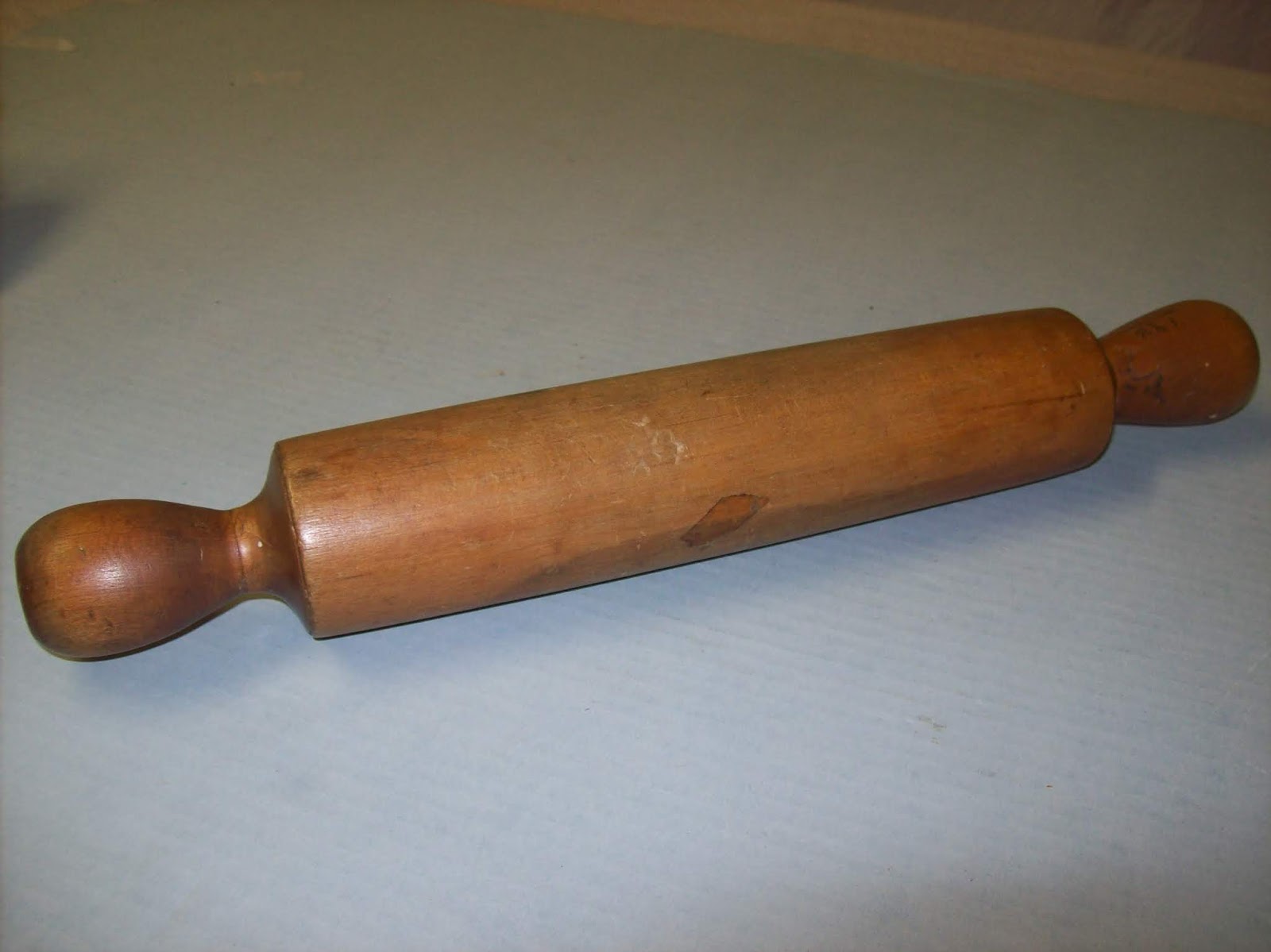
Another artifact from our collection useful in making pies is this wooden rolling pin. The handles are smooth and worn, a testament to a lot of use.
Wooden rolling pin, late 19th Century

While I don’t use a pie segment cutter, I do use a rolling pin and I learned pie making from my Indiana grandmother. Like many women of her time,
Proud Elmira Pie maker, c. 1900
my grandmother was a sturdy, can-do woman, much like the woman pictured here. This image captures that similar attitude well. My grandmother was a homemaker, and her pie-making skills were the stuff of family legend. One legend involved her making over forty Thanksgiving pies and using the hood of my grandfather’s car as a cooling rack.

When it came to making pie crusts, she had two rules she followed. She passed these rules down to my mother, and to me, and in my own family, I’ve insisted both my son and daughter learn how to make a decent pie crust. 

Grandma’s Two Rules
First, one of my grandmother’s rules was, even if making a pie with two crusts, it’s best to mix each crust separately rather than doubling a recipe. She felt this gave a baker more control over the ingredients. Her second rule concerned which ingredients to use. She swore that using solid vegetable oil guaranteed her the best success when it came to making a flaky pie crust, and always used Crisco. Today there are good organic substitutes you can find with similar consistencies that work well. Whichever fat you choose, throw a couple of ice cubes in the water to keep your fat cool as long as possible. This helps make your dough easy to handle and roll out. No worries if it’s a warm day, you can just pop the dough into the refrigerator for 20 minutes to chill before you roll it out. 

I also follow the rule that using the right tools helps.

The Right Tools
In addition to using a large enough bowl to mix in, and a good rolling pin like the example above, use a pastry cutter to cut the solid fat into the flour mixture.
Example of pastry blender
A pastry blender acts like small knives to cut and break up your ingredients. The key to using this tool is to press down, then turn your wrist slightly clockwise as you lift up. Mix in your ice-cold water a tablespoon at a time and keep adding water until the dough starts to clump together. Using your hands, press this into a ball. Next, dust the table surface and your rolling pin with flour. Take your dough and place it in the center of your table. Press it into a fat disc, then begin to roll it flat starting from the center.
The baker in our photograph demonstrates how to lean in and put pressure on her rolling pin while she rolls out her dough. Notice the bowl nearby allowing her to add more flour to dust the dough or rolling pin if either become sticky. 

Another proud Elmira Pie maker, early 1900s
Crusts can seem hard but become easier with practice. If you’d rather just eat pie, you can always pick up a pie from your favorite local bakery. While a search of Elmira’s business directory from 1857 lists four professional bakers, by the early 20th Century there were nineteen bakers listed. Here, this 1901 picture of Rhoades Bakery shows a crew of bakers posing with pies.
Rhoades Bakery workers, Elmira, 1901


Today we have a lot of options. But baking or buying, it's always time for pie!

Basic Pie Dough
(Makes one 9-10 inch crust)
1 cup plus 1-2 Tablespoons all-purpose flour, keep some extra in case things get sticky
1/3 cup solid vegetable shortening
½ teaspoon salt
3-5 Tablespoons ice water
Blend dry ingredients first, then using a pastry blender cut the mixture while adding the ice water a tablespoon at a time until desired consistency. Gather into a ball, and roll out.