Monday, November 30, 2015

Air Raids and Blackouts: Civilian Defense During WWII

by Erin Doane, curator

During the Second World War, Americans feared the threat of aerial attacks. While it was technically possible for the German or Japanese militaries to launch strategic bombing attacks on major cities on the east and west coasts of the United States it was unlikely to happen. It was even more unlikely that small cities like Elmira would be targeted. That did not make the fear go away, though. It was logical to think that this area could be targeted because of all the factories producing materials for the war effort. Many cities and towns across the country were in the same situation. As a way to ease the minds of its citizens, the U.S. government created the Office of Civilian Defense in May 1941. The Air Raid Warden Service was part of that.


Air raid warden helmets were painted white so that they
could be identified more easily during a blackout.

Civilian Defense broke cities and towns into sectors, each containing the homes of about 500 people. Each sector was controlled by an air raid warden’s post that was staffed by a senior warden and three or more assistant wardens. Each post had to have 3 to 6 wardens. From 4 to 15 posts were grouped under a precinct warden who reported to the chief warden. Air raid wardens were members of the community who volunteered for service. They were trained and issued a handbook that served as a reference manual and explained their duties. It contained information on the chain of command, how to equip the warden’s post, how to write reports, and how to respond to attacks using magnesium bombs and war gases.

Handbook for Air Raid Wardens, 1943
An air raid warden’s primary responsibility was “to see that everything possible is done to protect and safeguard those homes and citizens [in their sector] from the new hazards created by attack from the air or by enemies from within our gates,” according to the handbook. To that end, they were trained in first aid, methods of combating incendiary bombs, and protection against gas. They had to have detailed knowledge of their sector’s streets and buildings as well as of the people who lived there. It was important to know if there were firefighters, police officers, or doctors living in the sector. It was also important to know where the elderly or disabled lived as they would need more help in the case of an emergency.


Air raid warden whistle, 1940s
“The whistle is furnished you to use in drawing attention to your
presence in an emergency, not to sound a general warning. Do not
run about blowing it to supplement the siren warning.”
- 1943 Handbook for Air Raid Wardens

Air Raid Wardens were also responsible for overseeing air raid and blackout drills. Blackouts were ordered only on the authority of the War Department and everyone needed to be ready and know what they had to do when that happened. On January 4, 1942 a county-wide blackout drill was held. The local newspapers advertised the drill in the days leading up to it.
Elmira Star-Gazette, January 3, 1942
Horseheads used its fire siren to announce the blackout while Elmira Heights used its factory whistles. Upon hearing the signal, people were asked to stay where they were. If they were in their cars they were to stop and find shelter in the nearest building. People were also asked to make sure that no light could be seen outside their homes, offices, or factories. Any light that was visible from above was a target for airplanes on a bombing run. Street lights were turned off and all traffic lights, except the one on Lake and Church Streets which had a special shade, were turned off as well. Factories only blinked their outside floodlights to show that they could blackout if necessary. They were ordered by the federal government not to interrupt defense production for the drill. WENY was also ordered to keep its flashing beacon lit on it 425-foot transmitter tower in Southport so that airplanes would not be thrown off course during the drill.

Elmira Star-Gazette, January 3, 1942
I’m sure it comforted people to know that there was a corps of well-trained, local air raid wardens ready and able to respond in case of an actual enemy attack. 

Monday, November 23, 2015

The Fascinating History of Garbage in Chemung County

By Kelli Huggins, Education Coordinator

While doing research for our new exhibit “Clean,” to my surprise, I became very invested in learning about the history of garbage and sewage disposal in the county (I’ll save sewage for another time).  These aren’t my usual types of topics, but these histories are full of drama and conflict, and I was hooked.  So even though it might sound boring, stay with me.  I’ll try to make you a trash history convert as well. 

In the 1800s, there was very little municipal garbage removal, so most people threw their unwanted refuse into the streets.  Pigs roamed the streets eating trash and rag pickers and bone collectors gather unwanted scraps from residents.   In 1905, Elmira councilmen began to look for a better solution and sought a site to build an $18,000 garbage incinerator. Local protests stopped the city from doing this and the Bennett Incinerating Co., a private company, took on garbage collection.  Their services, however, were expensive and limited.
A pig in Elmira, 1860s
A more novel solution was offered up in 1918: a piggery.   The Murphy Process Co. of Buffalo proposed a piggery in Elmira to feed trash to pigs, claiming the city could then sell fattened pigs for a profit.  Elmira officials signed the contract but quickly gathered more garbage than the pigs could eat.  As smelly trash piled up on the Southside by the piggery, people protested and company went bankrupt.   The city tried to take over the piggery but it was too expensive.  Instead, they began burying garbage on a farm, City Farm, purchased just outside of the city limits.

A 1926 fire at the City Farm dump sent clouds of smelly smoke over city and reignited calls for a garbage incinerator. Residents of 8th ward complained the garbage dump at City Farm depreciated their property values and supported an incinerator.  The incinerator was built in 1929 and was estimated to cost the city $150,000.  Its two brick-lined furnaces burned trash at a temperature of 1,600-1,900 degrees, processed 10,000 tons of refuse in 1931 at cost of $1.05 per ton, and employed 12 people.
The original garbage incinerator
In November 1968, Elmira terminated operations at its refuse incinerator and an open burning site. The old incinerator layout was not conducive to mechanization and there was too much air pollution with open burns. The city switched to landfills.  The 1969 Chemung County Solid Waste Disposal Study estimated that Chemung County residents would discard 175 million pounds of garbage that year alone.  They also estimated the following trash production figures: 
- Ashland, Baldwin, Catlin, Chemung, Erin, Van Etten, and Veteran- 900 lbs per capita in 1970
-City and Town of Elmira- 1,500 lbs per capita in 1970
- Horseheads- 2,500 lbs (because of industrial waste) per capita in 1970
-Big Flats- 1,200 lbs per capita in 1970
-Projected that County would need 792.3 acres of landfills by 2020

In December 1973, The Chemung County Solid Waste Facility opened to shred and compact refuse to transport to landfill. The landfill was set on 139 acres in Town of Chemung and was given an estimated 20 year lifespan.  That changed on January 22, 1979 when an explosion in the shredders extensively damaged the facility.  It took three years to get the shredders operating again.  In the meantime, the County dumped unshredded trash into the landfill, significantly lessening its lifespan.  In August 1981 the shredders at the Waste Facility went back in action and gas detectors were installed to prevent future issues.  The county then had to look for space to expand the landfill.

In 1991, Chemung County Solid Waste opened a 22,000 square foot recycling center off Lake Road as a part of a $5.5 million commitment to recycling. 75 tons of 27 types of recyclables could be processed each day.  By 1994, Chemung County recycled 29% of its trash, not including bottles (the New York State average was only 16%).  It was estimated that by 2001, the recycling efforts had already removed 85,000 tons of materials that would have been put in the landfill.

Garbage is still a hot button issue for people in the county.  In 2012, Elmira got garbage trucks that have separate compactors for trash and recyclables on one truck.  Recently, Elmira mandated that all trash be put out in only clear bags, causing ire amongst some residents.  Still, Chemung County’s long trash history reminds us that there are no easy solutions to trash removal, particularly as we produce more and more each year.
The new garbage trucks

Monday, November 9, 2015

People Actually Do That?

by Erin Doane, curator

Someone once asked me what I did as a curator. I gave the short answer that I create exhibits in a history museum. The person looked at me incredulously and said, “I didn’t know people actually did that.” My immediate thought was sarcastic. No, people don’t create exhibits. If you believe in history hard enough, exhibits just appear in museums. My actual reply was that yes, I made exhibits and I really enjoyed doing it.

Just this past Friday, we finished the installation of our newest exhibit Clean, which examines what cleanliness is on physical, social, and spiritual levels and how people work to become clean. I say “we” finished it because this exhibit, like all of them at the museum, was very much a group effort. I head the exhibit team that includes our education coordinator Kelli and archivist Rachel. We work together to create educational, entertaining, interactive exhibits. And I think we do a great job.

Our newest exhibit: Clean
So, how exactly is an exhibit created? The first step is picking a topic. Some exhibits are based on the types of objects that are in the museum’s collection. A couple years ago we did an exhibit on wedding traditions because we have a good collection of wedding-related objects. We also did an exhibit on World War I posters because we have so many wonderful examples in the archives. Other exhibits start with an idea and then we work out what to put on display from there. Clean is a good example of this.  We usually have our exhibit topics selected at least a year from the opening date. (We are always looking for suggestions of what people would like to see so if you have an idea, let us know!)

A view of 'Til Death Do Us Part - a previous exhibit on wedding traditions
Once we pick a topic, we start researching and writing. We split up this task among the three of us on the exhibit team. There are usually around 9 to 12 main text panels exploring different aspects of the topic. Each panel has up to 100 words each. After conducting hours of research, it can be a real challenge to boil all that information down to just 100 words but years of experience have made it a fairly painless process. Once we’ve all done our individual research and writing we get together to review and edit the text. This can be a harrowing process at times but better text is always the end result.

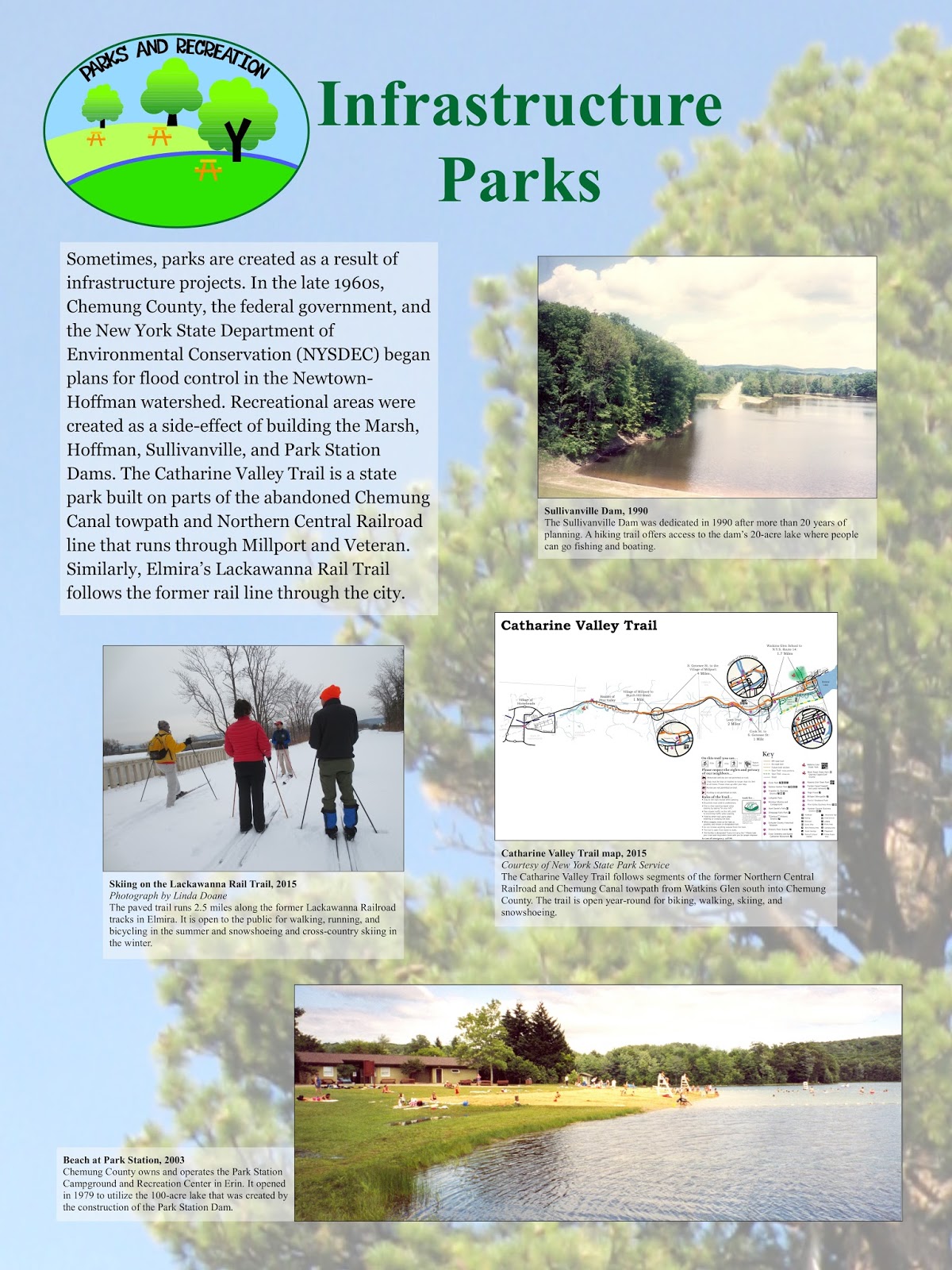
Text panel from Parks and Recreation
Once the main text is written a lot of things start happening all at once. We decide on the general style of the exhibit panels and I work on graphic design. Kelli designs and creates hands-on interactives for the exhibit. Rachel selects photographs and archival documents that will go on display while I select three-dimensional objects. I also work on the floor plan – where all the text panels, display cases, and interactives will go in the gallery. My favorite way to do this is with graph paper. I have scale drawings of all the galleries and little cutouts of display cases and other exhibit furniture. Moving things around on paper is a lot easier than moving them around in real life. I sometimes even dabble in Google SketchUp to get a 3-D view of my layout.

The Howell Gallery in SketchUp
Almost two years ago, we go a large scale printer through a grant from the Community Foundation of Elmira-Corning and the Finger Lakes. I love that printer! We can now produce our own graphics in-house. We can print up to 48” wide on various types of paper including satin photo paper and self-adhesive polypropylene. This has really streamlined the exhibit process. We no longer have to wait on graphics printed by an outside company and if I notice a typo that somehow slipped through our review I can instantly make a reprint. I have actually become quite adept at adhering large graphics onto foam board for display.

An example of a large (32"x60") text panel printed and mounted in-house
After months and months of planning, it’s finally time to install the exhibit. An installation usually takes one very long week to complete. It’s a tiring process to get everything precisely in place and ready for the public but I love doing it (despite the multiple bruises I get along the way). There is something very rewarding about pulling an idea out of the air and making it into a concrete visual experience. Creating exhibits is by far one of my favorite duties as a curator.

Housework-related artifacts in Clean
If anyone is interested in all the other stuff I do on a day-to-day basis as a curator, check out A Curator’s Day on tumblr.

Monday, November 2, 2015

Serious Thoughts on a Ridiculous Photograph

By Kelli Huggins, Education Coordinator

I think that the photograph above is one of the most remarkable pieces in our collection.  Yes, I’m serious.  While on the surface this photo is a little crass, allow me to explain just how unique this piece is.  In other words, this is my attempt to write a mature, thoughtful blog post about one of our most immature collection items. 
The photograph is a part of our collection of materials from Charles Whipple, a Horseheads resident.  We have his diaries, photographs, and other assorted documents.  Tucked in amongst these items is the photograph in question.  There are several photographs of these two dogs, showing them around the yard and in the home (and even on the bed).  The photos are dated 1948. 
This collection is a lovely glimpse at mid-century pet keeping.  Candid photos like these give us a better understanding of how our relationships with our pets have changed and stayed the same over time.  Like Whipple, people today take pictures of their animals playing, sleeping, or being otherwise adorable. 
The dogs look well loved.  But still, the first picture is special. 
First, it is remarkable that this photograph was even taken.  Photographic technology had made great strides in portability and affordability by the 1940s, but film was still a valuable resource.  There were families that took few photos of their children in the 1940s, much less their dogs.  So that someone would use a frame on this scene (and also the fact that they had a camera handy when this went down) is noteworthy.  And, not only was the picture taken, it was developed.
Someone cared enough about this photo to date it on the back (many of the other photos in the collection are not dated).  They also kept it.  Maybe it became a family joke. Eventually, the photograph was donated to the museum in 2009 as a part of the much larger Reverend Donald Roe collection (Whipple was Roe’s parishioner and his possessions were left in Roe's care after his death, thus adding another layer of improbability to the survival of this photograph). 
It is impressive that this small, silly photograph exists.  While it is not typically what most people would deem museum-worthy, I think that it is because it's a great reminder that people in the past were very much like us.  And if anything, this photo shows us that poop jokes have always been funny.