Showing posts with label Business & Industry. Show all posts

Monday, March 23, 2026

Sweet Home Big Flats: The Story of DeMet’s Turtles and Their New York Connection


by Karen Meade, CCHS Volunteer

If you're ever passing through Chemung Valley on 1-86 or walking on the Sperr Memorial Park trail and catch a faint, chocolatey sweetness in the air, you'll know where it's coming from. Big Flats candy lovers have a small piece of American confectionery history, the place where a century-old Chicago dream found a new home in upstate New York.

CCHS Collection
There’s a good chance you’ve bitten into a DeMet’s Turtle at some point in your life, that perfect little cluster of crunchy pecans, gooey caramel, and silky chocolate,and never once wondered where it came from. If you live in the Southern Tier of New York, the answer might be closer than you think.

1929, Chicago Historical Society

The story of DeMet’s Turtles begins not in New York, but in Chicago, Illinois, where candy maker George DeMet opened a shop on Madison Street in 1898. It was a classic American confectionery dream: a candy store and soda fountain where George crafted sweets by hand and built a loyal neighborhood following. By 1916, he had struck upon something truly special. It was a cluster of pecans draped in caramel and dipped in chocolate. The shape, with pecan “legs” poking out from the chocolate shell, reminded someone of a little turtle crawling across a marble board. The name stuck, and an American candy icon was born.

The Turtles brand passed through several hands over the decades, eventually landing with Nestlé in 1988, before being acquired in 2007 by Brynwood Partners, a private equity firm that resurrected the dormant DeMet’s Candy Company name and set about building something new.

When the newly reconstituted DeMet’s Candy Company began searching for a U.S. manufacturing home, they cast a wide net across the northeastern states, looking at New York, New Jersey, Pennsylvania, Connecticut, and Massachusetts. What they found in Big Flats, a small community in Chemung County just outside Elmira, checked every box.

DeMet’s selected a 17-acre parcel in the Airport Corporate Park to construct their 100,000-square-foot facility.  The location offered excellent transportation access, a strong regional labor pool, and critically, was part of New York State’s Empire Zone incentive program. This gave DeMet’s the competitive edge it needed to choose the Southern Tier over other states. To date, the project has created 250 new jobs for the region. This has been a meaningful boost for a community that, like many in upstate New York, had weathered its share of economic headwinds.

 While the iconic original Turtles clusters are primarily produced at DeMet’s facility in Scarborough, Ontario, the Big Flats plant soon became a hub for the company’s broader confectionery portfolio, including Flipz chocolate-covered pretzels and other snack products that DeMet’s brought under its umbrella after Brynwood Partners consolidated several candy brands.


CCHS Collection

It’s worth pausing to appreciate just how enduring the Turtles formula really is. It consists of only three ingredients: crunchy pecans, creamy caramel, and a chocolate shell. This formula has kept candy lovers coming back for more than 100 years.  Just a simple, honest combination that George DeMet figured out more than a century ago on a marble board in Chicago.

 Today, DeMet’s is owned by Yıldız Holding, the Turkish conglomerate that also owns Godiva, and the brand sells tens of millions of units annually. But the soul of the product remains the same — and part of that soul, for the better part of two decades now, has been rooted in the quiet, hardworking community of Big Flats, New York, a local sweet spot


Monday, September 22, 2025

C.H. Wheadon & Son

by Erin Doane, Senior Curator

An April 27, 1893 article in the Elmira Star-Gazette describes the embarrassing business troubles of Henry G. Wheadon, owner of C.H. Wheadon & Son. The shameful news was that Henry had filed not one but two chattel mortgages in the county clerk’s office. It was with “sincere regret and surprise” that Elmirans learned this humiliating news, according to the reporter. As a modern reader, I didn’t understand how taking out a mortgage was newsworthy or brought such public shame. So, I went looking for historical context.

C.H. Wheadon & Son label inside travel trunk, c. 1878

I first became interested in C.H. Wheadon & Son earlier this year when the museum received the donation of a lovely travel trunk from around 1878. Inside the trunk was a label showing that it was originally purchased from C.H. Wheadon & Son at 206 East Water Street in Elmira.

Trunk sold by C.H. Wheadon & Son, closed and open

Charles H. Wheadon, the company’s founder, was born in Hebron, New York in 1812. Charles married Cordelia Short and they had six children together, four of whom survived into adulthood – Frances, Mary, Charles F., and Henry. After years as a successful businessman in Homer, New York, Charles and his family came to Elmira in 1874. Two years later, he opened a new harness shop on Water Street across the street from the Rathbun House.

C.H. Wheadon & Son dvertisement, The Wellsboro Agitator, May 8, 1877

C.H. Wheadon & Son originally manufactured and sold coaches and harnesses. They sold road, track, and farm harnesses, sporting and tack goods, ladies and gentlemen’s riding saddles, trunks, traveling bags, and valises. The business became so successful that it expanded into the storefront next door and occupied 204-206 East Water Street.

C.H. Wheadon & Son advertisement listing all the types of bells available at the store – “All the latest styles. Largest line in the city”
Originally published in the Evening Star, December 1, 1888; reprinted by the Star-Gazette, May 24, 1953
Henry G. Wheadon was the younger of Charles H.’s sons and was the “son” in his father’s company. Henry’s older brother, Charles F., was already in business for himself when Charles H. opened his store on Water Street. He came to Elmira two years before the rest of the family to work for the Richardson Shoe Company. He started his own wholesale produce business before eventually partnering with Robert W. Barton in Barton & Wheadon, wholesale grocers and tea merchants.

Advertising calendar from Barton & Wheadon, 1908
By 1893, Charles H. had gone into retirement and Henry owned and operated C.H. Wheadon & Son. It was under his management that the business foundered. Henry was forced to give his father a chattel mortgage for the sum of $7,700 that covered all goods, wares, and merchandise in the store, including harnesses, leather goods, trunks, satchels, and handbags. He also gave a second chattel mortgage for the sum of $255 to L.M. Baldwin of Montrose, Pennsylvania covering one carriage and one set of coupe harness. A chattel mortgage is a loan secured by moveable personal property rather than real property. This type of mortgage was seen as a sign of poor financial management and was considered an act of desperation. Henry needed the money to pay off creditors in New York and Philadelphia. Many at the time thought it was a character flaw to be so far in debt and Henry certainly would have been looked down upon and pitied for it.  

Henry blamed this great business embarrassment on competition in his trade. C.H. Wheadon & Son sold goods at retail prices but there were jobbers (wholesale dealers) who sold the same things for less. He also lamented his general bad luck in the business. The G.E.S.S. medical company that occupied rooms above C.H. Wheadon & Son reportedly had seven fires in one year. Each time, the store below suffered water damage. The building’s basement had also flooded several times, damaging merchandise. 

Larger, national economic issues were also at play. The Panic of 1893, one of the most severe economic depressions in the U.S. to that time, began in February. The panic was caused by complex, nationwide issues but here’s a very brief, sweeping explanation: Overbuilding and speculation led to financial collapse of major industries including railroads and banks. The stock market crashed, leading to panic and a credit crisis. This all resulted in mass unemployment (up to 20% in some places), farm foreclosures, and more than 15,000 businesses going bankrupt. The failure of C.H. Wheadon & Son was most likely due to Henry’s poor business decisions but by the time he filed the chattel mortgages, the national economy was on the verge of collapse. 

Henry told the reporter that he planned to accept a position as a travelling salesman, something he had done before joining his father’s business. A week later, in early May 1893, the newspaper reported that Henry had left town. I don’t know if he ever came back to Elmira. On August 16, 1903, the Star-Gazette reported that word had been received that Henry G. Wheadon had died in Los Angeles, California at the age of 44. While the report stated that his remains would be taken to Homer, New York for burial with his family, he was actually interred in Evergreen Cemetery in Los Angeles. 

After Henry left town in 1893, his father announced that he would be coming out of retirement to reopen the harness and trunk shop and resume business. This does not appear to have happened. Charles H. Wheadon, one of Elmira’s oldest citizens at nearly 81 years old, passed away on August 24, 1893 after a protracted illness.

Monday, August 11, 2025

Seal of Approval

by Erin Doane, Senior Curator 

There are nearly three dozen embossing seals in the museum’s collection and each one is a unique piece of history. Their purpose was to impress seals on official documents. Government agencies, businesses, organizations, and individuals used embossing seals as their signatures to establish authority and prevent fraud. They are fairly simple machines that were often made to be beautiful as well as functional.

Just a few of the embossing seals in CCHS’s collection
Stamp seals were first used around the 6th millennium BCE in Mesopotamia. They were carved stone dies used to press symbols into the soft clay of business records at the time. Thousands of years later, the basic concept of the stamp seal remains with some added mechanical technology. The embosser holds a custom die set that produces a raised image on paper when pressure is applied to the handle. The embossing seals in our collection range from the late 1800s through the mid-1900s. Most are heavy cast iron with long handles to create enough force to leave an impression. Later seals are lighter metal with mechanical leverage to make embossing easier.

My favorite embossing seals are those made to look like a lion’s head. That seemed to be very popular in the late 1800s. Other examples have decorative floral and geometric patterns painted on the sides. New designs appeared in the early 20th century offering improvements that made them easier and more comfortable to use but their essential function was still the same. I think they’re all wonderful little machines and want to share some of them with you.

Star Gazette Building Company

Star Gazette Building Company embossing seal
The Star-Gazette Building Company was incorporated in Elmira in 1910. It was created to oversee the purchase of property at the Corner of Baldwin and Market Streets and the creation of a building on the site “to be occupied for publishing purposes” according to the incorporation papers. I’m sure the company’s beautiful embossing seal shaped like a lion’s head, which was patented in 1904, came in handy for all its official business dealings. In 1919, after the building was completed, the Star Gazette Building Company and the Star Gazette Company (publisher of newspapers for whom the building was constructed) consolidated to form the Elmira Star-Gazette, Inc. and the seal became obsolete. 

Elmira Consolidated Ice Company, Inc.

Elmira Consolidated Ice. Co., Inc. embossing seal
In 1924, the Elmira Ice Company, the Crystal Ice Company, and Fell’s Ice Company merged to become the Elmira Consolidated Ice Company, Inc. The company’s embossing seal was simple and functional. It was only used until 1930 when the company merged Hygeia Ice to become the Elmira Hygeia Company. 

Fort Hill Land Company

Fort Hill Land Company embossing seal
W. Charles Smith, who was among the organizers of the Bohemia Land Company in 1902, formed the Fort Hill Land Company five years later for the purpose of developing a summer village along the Chemung River near Rorick’s Glen. I was not able to find out much about the company in my research. I didn’t find mention of it in newspapers after 1907. Smith passed away in 1910 but the company must have continued at least through 1912. That’s when the embosser holding its official seal was patented. I plan on doing some more intensive research about the Fort Hill Land Company in the future.

L.J. Houck & Sons, Inc.

L.J. Houck & Sons, Inc. embossing seal
The embosser used for L.J. Houck & Sons’ official corporate seal has a real industrial look to it with its green paint. It was patented in 1920 and included a latch to hold the handle down when it wasn’t in use. L.J. Houck & Sons Dairy began in 1904 and was incorporated in 1926. They delivered milk on routes through Elmira, Horseheads, Elmira Heights, Big Flats, and Breeseport using horses and wagons up until 1965 when the company was purchased by the Dairymen’s League.

First United Church of Christ

First United Church of Christ
One of our most modern embossing seals, patented in 1955, was used by an old institution. The First United Church of Christ was established in Elmira in 1874. It served German American population in the city and was also called Erste Deutsche Evangelische Kirche. The large stone church constructed at 160 Madison Avenue starting in 1898 still stands but the last service was held there on July 10, 2022.

1955 embossing seal patent

 
Notaries Public

A selection of notary public embossing seals in CCHS’s collection
An important subset of embossing seals are those used by notaries public. A notary public is an official appointed by the state government who witnesses and verifies the signing of important documents to prevent fraud. Anyone interested in taking on the duties of a notary public can do so by applying to the Department of the State, passing the official exam, and paying all necessary fees. New York State does not require the use of a notary seal but a notary public is required to print, typewrite, or stamp certain information on every single document they notarize. Embossing seals speed up this process and are thus still available to purchase (with proof of official status). We have several notary public seals used by local residents in the museum’s collection. 

W.S. Gerity

Notary Public embossing seal of W.S. Gerity
William S. Gerity (b.1847-d.1912) had a decades-long career in the drugstore business. He began as a clerk and went on to be the co-owner and operator of the Gerity Bros. drugstore at 126 Lake Street in Elmira. From as early as 1906, he also served as a notary public. His embossing seal is interesting because it reads “Elmira, N.Y.” All of the other notary seals in our collection read “Chemung County, N.Y.” I wasn’t able to find out why his was different. 

J. Raymond Shoemaker

Notary Public embossing seal of J. Raymond Shoemaker
J. Raymond Shoemaker (b.1882-d.1973) worked for many years for the Hygeia Refrigerating Company. He started with the company in 1906 and was vice president and general manager by 1920. He later became chairman of the board of Hygeia and also served as the director of the Elmira Bank and Trust Company. His notary public seal with a beautiful inscribed leaf or feather design was patented in 1900. 

Anna O. McTiernan

Notary Public embossing seal of Anna O. McTiernan
Anna T. O’Hern McTiernan (b.1880-d.1965) came to Elmira to take courses at Meeker’s Business Institute. After completing her studies in 1904, she went to work in the bookkeeping department at the Star-Gazette. She retired in 1950 after 46 years with the newspaper. She served as a notary public from as early as 1910 through at least 1948. She was Anna T. O’Hern when she began as a notary public. In 1924, she wed Bill McTiernan and had a brand new embossing seal made with her married name.  

Ralph E. Fudge

Notary Public embossing seal of Ralph E. Fudge
Ralph E. Fudge (b.1908-d.2000) holds a special place in our institutional history as he was a longtime member and former president of the Chemung County Historical Society. He worked as a funeral director at Smith-Fudge Funeral home at 1058 W. Church Street in Elmira until retiring in 1972. His embossing seal was patented in 1924. It has a spring-type mechanism in the handle that makes it easier to use, requiring much less strength to emboss paper than earlier models.


Monday, April 21, 2025

An American Manufacturing Story: American LaFrance

 By Rachel Dworkin, archivist

Last week I spent two days cataloging a collection of 163 photographs of the final assembly process for an American LaFrance fire truck. Paul Walker, the company’s Director of Engineering from 1983 to 1985, had taken the photos in January 1985 in order to document the process and see how it might be improved. It wasn’t like a modern auto plant with robots on an assembly line. It was just a team of guys working together to assemble a series of pre-fabricated parts to make a fire truck. 


The LaFrance Manufacturing Company, founded by Truckson LaFrance, built its first fire engine in late 1873. In those early days, the company made all sorts of things: rail fence machines, cotton pickers, corn shellers, and even railroad locomotives. By the 1880s, however, it was strictly focused on fire engines. In 1903, the company merged with serval other companies to found the American LaFrance Fire Engine Company. For the next 80 years, the company was the premier name in American firefighting equipment and a major Chemung County employer. Then the company left Elmira in 1985 for points south. For the next few decades, it dwindled in size and quality before being picked apart by vulture capitalists. The once-proud company filed for bankruptcy in 2008 and ceased operation altogether in 2014.

At its peak, the American LaFrance plant covered over 48 acres on Elmira’s Southside. The plant included a machine shop, paint shop, warehouses and a main office, plus buildings for pump assembly, cab & body assembly, frame and ladder assembly, engine assembly, and truck assembly. In 1957, 975 people worked at the plant itself with another 1,200 employed as salesmen throughout the country. At the time, they had an annual payroll of $6,500,000 (approximately $73,974,857 today). They completed two trucks a day.

Given the company’s long history in Elmira, it’s no surprise we have quite a bit of it. Here’s a quick rundown of our collections related to the American LaFrance Company:

  1.    Two motorized and one horse-drawn fire engines
  2.    Collection of 150th American LaFrance anniversary celebration material, 1982
  3.     4.5 linear feet of American LaFrance promotional literature and product guides
  4.     2 linear feet of Blazes, the American LaFrance newsletter from 1919-1928, 1940-1954
  5.    2 linear feet of photographs of American LaFrance facilities, products, and employees
  6.      2 linear feet of glass-plate negatives of American LaFrance products, 1890s-1910s
  7.      Nearly 100 technical drawings of American LaFrance products
  8.     Papers of former American LaFrance employees including Carol A. Hall, Marshall Cecce, and John Darrow

While none of this material is currently on display, most are available upon request during our regular research hours from 1pm to 5pm, Monday through Friday. The fire engines are stored off-site and researchers must make an appointment at least a week in advance if they want to see them.

The last American LaFrance truck produced in Elmira rolled off the line on June 28, 1985. Paul Walker had a photo of that too. Thank you to his son who donated it along with all the others. If you have American LaFrance material or stories you’d like to share, we would love to hear from you. Contact me at (607) 734-4167 ex. 207 or archivist@chemungvalleymuseum.org

Last fire truck from the Elmira American LaFrance plant & team who built it, June 28, 1985


Monday, February 24, 2025

Jesse Green Furrier

By Erin Doane, senior curator

On May 4, 1943, the Gorton Coy introduced their new furrier to customers in Elmira through an advertisement in the Star-Gazette. Mr. Jesse Green had recently taken charge of their fur restyling and fur storage departments. Fur fashions were his specialty, with 25 years of experience, and he was ready to restyle customers’ older furs. As mentioned in the ad, restyling was part of the war-conservation program. Jesse Green was happy to furnish estimates without any cost or obligation to the customer.

Jesse Green, Gorton Coy ad, Star-Gazette, May 4, 1943

Jesse Green was born in New York City in 1900 into a family of furriers. His grandfather and father ran a fur manufacturing business and both Jesse and his brother learned the craft. Jesse married Shirley Ehrlich in 1928 and the couple had two sons, Howard and Myron. In 1943, the family moved to Elmira where Jesse took the job as furrier at the Gorton Coy. He stayed there for three years before he and Shirley opened a store of their own at 513 Park Place.

Jesse Green Furrier, 513 Park Place, Star-Gazette, July 30, 1950

Inside Jesse Green Furrier, 513 Park Place, Star-Gazette, August 13, 1950

Jesse Green Furrier made and sold furs and offered insured, certified cold storage of fur coats. In 1953, Jesse became a member of the Master Furriers Guild of America, Inc. By that time, it was reported that he had cared for and handled at least 150,000 fur coats during his 35 years in the fur business. He sold his wares not only in Elmira but to customers in 45 states as well as Tokyo and the Philippine Islands. In both 1956 and 1957 he won American Fur Fashion Awards at the annual Master Furriers’ Guild conventions. He was also elected to the Guild’s board of directors in 1958.

Coat made by Jesse Green from pelts trapped near Williamsport, Pennsylvania

In 1964, the Greens moved their business to 208 W. Water Street. The newly renovated store was decorated in a baby blue and off-white color scheme and featured wall to wall carpeting, floor to ceiling mirrors, and air conditioning. They added womenswear to the store and their son, Howard, joined the business. Howard had worked with his father before enlisting in the military in 1950. He was a member of the 465th Signal Construction Company and served in Manila.

In 1968, Jesse Green Furrier moved to a new store just next door at 210 W. Water Street. The new space was four times the size of the other store. This time, the décor was done in powder blue and eggshell. There was a separate fur salon to the rear with off-white carpeting and a fully mirrored back wall. By this time, Howard Green had taken over as president of the company. His focus was on trying to get younger women interested in fur. They still sold fur coats but also had cloth coats, both trimmed with fur and untrimmed, as well as suede and leather coats. There was also a new young miss, or junior, section. In 1969, they started advertising fake furs for sale.

Howard Green at Jesse Green Furrier, 210 W. Water Street, Star-Gazette, November 24, 1976

In the late 1960s, the anti-fur moment was beginning to get traction. On July 26, 1970, the Star-Gazette reported on the “Fur Coat Furore” caused by a Women’s Wear Daily advertisement. The ad from the Friends of the Earth included a pledge to no longer purchase products made from wild or endangered animals signed by 100 “well-known personalities.” Other furriers in Elmira said that they didn’t expect the ad to affect their sales at all but Jesse Green had concerns. While the pledge was not to purchase rare, wild furs, he worried that it would still affect the sales of domesticated and specially-raised furs because the public would not understand the difference. “Through advertising, you have to make women want to purchase [a fur],” said Jesse. “They want to but they’re afraid to – ashamed to. A woman who can’t afford one, now has an excuse.”

Mink capelet made by Jesse Green Furrier, 1950s

While the anti-fur activists got some attention, by 1976 fur sales were increasing nationally and Elmira furriers and merchants were enjoying greater profits. New garments in contemporary styles made with longer fur and leather were increasingly popular with younger women. Prices were also increasing, but that didn’t slow the demand.

By the 1980s, however, the animal rights movement was much more active. Bob Barker led anti-fur protests in New York City in 1988. Ricki Lake was arrested after storming the Fifth Avenue offices of fashion designer Karl Lagerfeld with anti-fur protesters in 1994. Super models Claudia Schiffer, Cindy Crawford, Christy Turlington, Naomi Campbell, and Tyra Banks were part of PETA’s (People for the Ethical Treatment of Animals) anti-fur campaigns in the mid-1990s.

The biggest protests took place in major cities – Macy’s was a particularly popular target for animal rights activists in New York City – but smaller cities and businesses were not forgotten. In 1987, 50 animal rights protesters confronted 30 people wearing furs at a photoshoot by the Clifford Fur Co. in Rochester, New York. Trans-Species Unlimited, an animal rights organization, held a protest at the Trapper and Dealers Convention in Hughesville, Pennsylvania (about 80 miles south of Elmira) in 1986. On the day after Thanksgiving in 1990, animal rights protesters were out in force around the country, including in Albany, Niagara Falls, Rochester, Syracuse, and Binghamton. In Harrisburg, Pennsylvania, a protester dressed as the grim reaper led 40 others in chants against the killing of animals for fur coats. While I couldn’t find any reports of protests in Elmira or other local shopping districts, a letter to the editor of the Star-Gazette on Mach 7, 1990 written by Jack Sincock, president of the Chemung County Federation of Sportsmen’s Clubs, Inc., mentioned that a billboard on Lake Road had been purchased by animal rights activists.

Marcher protesting the use of animals for furs on Central Park West in New York City, Star-Gazette, November 24, 1990
On July 19, 1990, the Star-Gazette reported on the end of Jesse Green Furrier after 44 years of business in Elmira. It’s unclear whether the anti-fur moment played any part in the business closing. As owner and president of the company, Howard Green declined to provide any details. He merely said, “I’ve had enough of the retail business.” His parents, Jesse and Shirley, had retired in the early 1970s and moved to Coral Springs, Florida. Shirley passed away in 1986 and Jesse died just three years later. The couple is interred side-by-side in the Franklin Street Cemetery in Elmira.

Jesse and Shirley Green, 1978, Star-Gazette, May 7, 1978

Monday, December 2, 2024

The Sellers of Knox Hats in Elmira

by Erin Doane, senior curator

The Knox Hat Company of New York City produced fine hats for nearly 100 years. Before his speech at the Cooper Institute in 1860, Abraham Lincoln purchased a new Knox stovepipe hat. He was one of 23 U.S. presidents who wore the company’s hats. But you didn’t have to be elected to the highest office in the country to wear a hat made by the Knox company. Regular people could purchase a Knox hat right here in Elmira. CCHS has seven of them in our collection, four of which have labels from local stores.

Knox label inside a fedora sold by Burt’s, Inc. in Elmira

First, a brief history of the Knox Hat Company. Charles Knox, an immigrant, founded his company in lower Manhattan in 1838. At first, he sold beaver hats out of a small shop, but the business quickly grew. His son Edward, a Civil War veteran, took over in 1878. By the turn of the century, Knox hats were being sold all over the country, and the company’s factory was one of the largest in the world. Edward died in 1916, but the company continued until 1932 when it merged with Cavanagh-Dobbs, Inc. and Dunlap & Company to form the Hat Corporation of America. Hats were still being produced under the Knox brand name until the early 1980s.

The Knox Hat Company put a large portion of its budget into advertising and had thousands of sales agents throughout the country. One could purchase Knox hats in Elmira from the late 1890s through the 1970s.

Advertisement for Knox hats at Callahan’s,
106 West Water Street, Star-Gazette, May 14, 1898

H. Strauss 

Knox Hat Co. derby sold by H. Strauss, early 1900s
Label inside the derby

H. Strauss was the sole agent of Knox hats for men in Elmira from the early 1900s through the 1920s. Herman Strauss, founder of the company, came to the U.S. from Baden, Germany in 1863 when he was 17 years old. He started as a peddler, carrying a 120-pound pack door-to-door. In 1872, he opened a haberdashery at 205 East Water Street. He sold men’s clothing and accessories at that location for 59 years and was active in the business until just a week before his death on March 23, 1932 at the age of 87.

H. Strauss advertisement, Star-Gazette, August 23, 1912

Herman’s son Charles W. Strauss took over the business in 1932. The store was closed briefly to settle the estate but reopened after renovations in September of that year with all new stock. In 1937, the shop moved to North Main Street after 65 years in the same location. It was forced to close after the flood of 1972. At that time, Charles’s nephew Harold Unger was leading the company, and had been doing so since Charles’s death in 1964. Rather than reopening downtown, H. Strauss opened a new store at the mall. That lasted until 1991 when Bruce R. Chalmers, who had worked at H. Strauss under Unger and purchased the company in 1985, moved the store back to Elmira. He set up shop at 311 College Avenue. In 1994, H. Strauss relocated to 636 West Church Street and it remains there today, though it is currently only open by appointment.

Burt’s Inc.

“Foxhound” style Knox fedora sold by Burt’s Inc., 1953
Burt’s label inside fedora
By the 1930s, H. Strauss was no longer the sole agent of Knox hats in Elmira. They could also be purchased at Burke O’Connor Men’s shop in the Mark Twain Hotel. The primary seller of Knox hats by the mid-1940s, however, was Burt’s Inc. at 157 North Main Street.

Advertisement for H. Strauss, Star-Gazette, May 28, 1945
0Arthur H. Burt and Walter Daily received an official charter for Burt’s, Inc. from the New York State Department in 1922. Burt was born and raised in Elmira and Daily came here in 1917. That year, the pair established Burt’s Inc. to sell men’s and boy’s clothes. Their first store was at 113 West Water Street. In 1922, they purchased the clothing store of Fred J. Bernet at 103 Water Street and began conducting business there. Burt continued to run the business when Daily left in 1935. The store moved again in 1937 to 157 North Main Street. It remained there until 1963 when Burt passed away and the store closed.
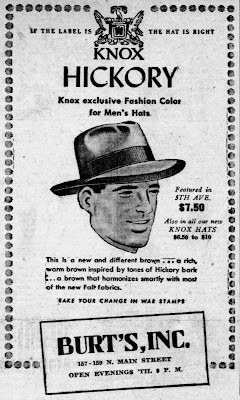
Burt’s Inc. advertisement, Star-Gazette, November 2, 1944

Burt’s Inc. started selling Knox hats in the later 1920s and continued selling them through the store’s final closing in 1963. Jerome’s at 350 North Main Street took over sales of Knox hats after Burt’s closing and continued selling them through 1979.

Mrs. G.W. Cornish and The Cornish Shop

Ladies’ Knox hat sold by Mr. G.W. Cornish, c. 1910
Label inside the hat
The Knox company did not only make hats for men. They also produced women’s hats. In 1906, Mrs. Gene W. Cornish began her millinery business at 111 West Market Street, offering a fine line of trimmed and untrimmed hats. She traveled regularly to New York City to purchase new merchandise - including Knox hats - and to visit family.

Advertisement for Mrs. G.W. Cornish, Star-Gazette, September 28, 1906

The change in the business name to the Cornish Shop first appears in the local newspaper in 1914. That year, the store also relocated to 108 North Main Street. It continued to be the purveyor of Knox hats, offering the latest seasonal styles for fashionable women.

The Cornish Shop advertisement, Star-Gazette, October 13, 1919

Fourteen years later, in 1928, the Cornish Shop moved into one of the storefronts in the Mark Twain Hotel where it continued to carry Knox hats. It’s interesting to note that in the 1930s, S.F. Iszards, the Mark Twain Hotel’s neighbor just down North Main Street, also sold Knox hats.

The Knox “Midshipman” sold by The Cornish Shop, 1920s
Labels inside the “Midshipman”

The Cornish shop remained at the Mark Twain Hotel until 1936. It moved to a couple other locations downtown over the next few years and was located at 107 W. Church Street in 1942 when its proprietor passed away after an extended illness. Gene Cornish’s passing marked the end of the Cornish Shop but one of her long-time employees, Blanch K. Holland, took over the store, renamed it the Holland Hat Shop, and continued selling Knox hats there through the middle of the 1940s.