Showing posts with label Chemung County History. Show all posts

Monday, April 6, 2026

Strike! The Secret History of Elmira's 1840s Bowling Saloons

By Milo Miller, CCHS Volunteer


Lucy Rossi Cesari, 1950s, CCHS Collection

Because bowling surged in popularity during the twentieth-century, many in today’s Elmira would be surprised to learn that the sport first became popular downtown in the 1840s. In those days, bowling was not played in lanes with automated pinsetters. Instead, it was more likely for city goers to play the game in establishments known as bowling saloons. Bowling saloons typically had an upstairs that contained a standard saloon along with bowling alleys in the basement. In the alleys, working-class men would meet, bowl, drink, gamble, and socialize. Due to these activities, those who gathered at the bowling saloons developed unsavory reputations, influencing the public perception of the sport.


Before the 1830s, when New York City’s Knickerbocker Hotel began to house indoor lanes, bowling was an exclusively outdoor sport in the United States. Often, establishments had side lots where they hosted lawn bowling on bowling greens. With the rise of bowling saloons, this changed rapidly, and indoor alleys sprang up across the country during the 1840s. By 1850, New York City alone had over 400 indoor alleys, all of which had sprung up within a 15-year span. This rise in popularity catalyzed changes to bowling that have carried over to today’s game. On bowling greens, early Americans usually played nine-pin bowling rather than the now-popular ten-pin game. During the 1840s boom of indoor bowling, several cities and states outlawed nine-pin bowling in an attempt to curb the drinking and gambling that became associated with the sport.  Many alleys quickly switched to ten-pin bowling to circumvent these laws. Even though lawmakers caught on to this change quickly, banning all forms of bowling, this switch resulted in the ten-pin game becoming the more popular option in the United States.

In Elmira, early bowling matched the objectionable reputation that plagued bowling alleys nationwide.

Stone Bowling Ball, CCHS Collection

Though the location and inception date of the first bowling alley in Elmira are unknown, the first mention of the game in Elmira’s newspapers occurred in The Elmira Gazette on January 2nd, 1841. In the story, a writer for the Elmira Gazette lists a number of places he thought that young men ought not go, explaining that when he saw the “young entering the gin palaces, or the rum shops, or the illuminated billiard rooms, or the dark bowling alleys...I could wish some spirit would put the thought into their minds- ‘Never go there.’”


This reputation prevailed for years- in one extreme instance, quoting a Baptist pastor, Elder Knapp, an 1846 article from the Elmira Gazette claimed “the devil was rolling ten pins, and the little devils [set] them up; and that the devil rolled three balls, the first of Infidelity, the second Universalism, and the third ball of Damnation.” By 1850, it seems there were several bowling saloons in Elmira. On Main Street, in the Globe Hotel, R.P. Kinyon and E.A. Darling operated one bowling saloon until the hotel burned down in 1850. On Lake Street, Thomas B. Borden operated an alley in Knickerbocker Hall, and Miles Cook operated the Old Soldier’s Bowling Saloon, which appeared to be quite popular.

Unfortunately, bowling at the Old Soldier’s may have claimed a child’s life in Elmira. An 1854 story in The Elmira Gazette reported that a boy named Thomas Doolin was hit in the stomach by a ball. Though he was still alive, the newspaper was not optimistic about his recovery. There likely were other Elmira bowling saloons that went unreported. In a unique case, after a Maine ban on alcohol an 1855 article in the Elmira Advertiser speaks of an underground alley on Water Street that flew a white banner, “though not [one] of truce,” exclaiming “Maine Law Drinks Below.” The days of the bowling saloon were relatively short, losing popularity quickly after the 1850s. In Elmira, they leave few traces, existing only in old newspapers and business directories.

Elmira Bowling Alley, 1900-1932, CCHS Collection


Monday, March 23, 2026

Sweet Home Big Flats: The Story of DeMet’s Turtles and Their New York Connection


by Karen Meade, CCHS Volunteer

If you're ever passing through Chemung Valley on 1-86 or walking on the Sperr Memorial Park trail and catch a faint, chocolatey sweetness in the air, you'll know where it's coming from. Big Flats candy lovers have a small piece of American confectionery history, the place where a century-old Chicago dream found a new home in upstate New York.

CCHS Collection
There’s a good chance you’ve bitten into a DeMet’s Turtle at some point in your life, that perfect little cluster of crunchy pecans, gooey caramel, and silky chocolate,and never once wondered where it came from. If you live in the Southern Tier of New York, the answer might be closer than you think.

1929, Chicago Historical Society

The story of DeMet’s Turtles begins not in New York, but in Chicago, Illinois, where candy maker George DeMet opened a shop on Madison Street in 1898. It was a classic American confectionery dream: a candy store and soda fountain where George crafted sweets by hand and built a loyal neighborhood following. By 1916, he had struck upon something truly special. It was a cluster of pecans draped in caramel and dipped in chocolate. The shape, with pecan “legs” poking out from the chocolate shell, reminded someone of a little turtle crawling across a marble board. The name stuck, and an American candy icon was born.

The Turtles brand passed through several hands over the decades, eventually landing with Nestlé in 1988, before being acquired in 2007 by Brynwood Partners, a private equity firm that resurrected the dormant DeMet’s Candy Company name and set about building something new.

When the newly reconstituted DeMet’s Candy Company began searching for a U.S. manufacturing home, they cast a wide net across the northeastern states, looking at New York, New Jersey, Pennsylvania, Connecticut, and Massachusetts. What they found in Big Flats, a small community in Chemung County just outside Elmira, checked every box.

DeMet’s selected a 17-acre parcel in the Airport Corporate Park to construct their 100,000-square-foot facility.  The location offered excellent transportation access, a strong regional labor pool, and critically, was part of New York State’s Empire Zone incentive program. This gave DeMet’s the competitive edge it needed to choose the Southern Tier over other states. To date, the project has created 250 new jobs for the region. This has been a meaningful boost for a community that, like many in upstate New York, had weathered its share of economic headwinds.

 While the iconic original Turtles clusters are primarily produced at DeMet’s facility in Scarborough, Ontario, the Big Flats plant soon became a hub for the company’s broader confectionery portfolio, including Flipz chocolate-covered pretzels and other snack products that DeMet’s brought under its umbrella after Brynwood Partners consolidated several candy brands.


CCHS Collection

It’s worth pausing to appreciate just how enduring the Turtles formula really is. It consists of only three ingredients: crunchy pecans, creamy caramel, and a chocolate shell. This formula has kept candy lovers coming back for more than 100 years.  Just a simple, honest combination that George DeMet figured out more than a century ago on a marble board in Chicago.

 Today, DeMet’s is owned by Yıldız Holding, the Turkish conglomerate that also owns Godiva, and the brand sells tens of millions of units annually. But the soul of the product remains the same — and part of that soul, for the better part of two decades now, has been rooted in the quiet, hardworking community of Big Flats, New York, a local sweet spot


Monday, November 24, 2025

Fun Facts

 by Susan Zehnder, Education Director

“I didn’t know that!” For the last few years, The Chemung County Historical Society has printed bookmarks with photos and biographical information about more than 20 different community leaders. Our mission, “to deepen the understanding of and appreciation for our community’s place in state and national history,” inspires us to continue to add more to our collection whenever we can, and we welcome any suggestions. Some of the people and their stories are quite well-known, while others may be more of a surprise.

Newcomers don’t always recognize the man with wild white hair smoking a cigar on the city’s Welcome to Elmira sign on Church Street. Nor do many younger people have any idea who the other people are. Our bookmarks help to share some of their stories. Hardly comprehensive, they act as small reminders of what people in our community have accomplished.

The bookmarks highlight local athletes, scholars, scientists, civic leaders, authors, inventors, politicians, lawyers, astronauts, and engineers from Chemung County. We pass them out at events and share local history.


This summer a ceremony was held to recognize renaming the former Madison Avenue Bridge over the Chemung River. Now known as the Allen-Berry Bridge, it honors two local Civil Rights leaders who did so much for the community: A’Don Allen and Bessie Berry. 

A'Don Allen (1916 - 1994)

Allen grew up in Elmira. He served with the Army Corps of Engineers in WWII and earned a bronze star on Okinawa. Upon his return, he became active in politics and was known as a prominent civic and community leader. In 1966, he became Elmira's first Black man appointed to the Civil Service Commission. Over the next thirty years, Allen held various government positions including that of deputy mayor for the City of Elmira.

Bessie Berry (1932 - 2008)

As president of the local NAACP, Berry supported “Black Dollar Days” to encourage people of color to use Susan B. Anthony dollar coins and $2 bills when making purchases to highlight the Black community’s economic impact. Berry became the first African American elected to the Elmira School Board and successfully pushed the district to recognize Martin Luther King Jr. day as a holiday.

(Hear an interview with Bessie Berry followed by a community discussion, by checking out https://www.youtube.com/watch?v=eGPjCQ32UHs )

In no way do we claim these bookmarks tell a complete story of any local leader. But we pass them out in hopes that they may spark curiosity to learn more about local history. To learn about the lives, contributions, and accomplishments people have made to our community.

The next time you pass over the Allen-Berry Bridge, we hope you think of some of the work these two did. Neither Allen nor Berry is pictured on the Church Street welcome sign, but they are part of our community’s story and certainly could be.

Monday, July 24, 2023

Paved Streets

 by Susan Zehnder, Education Director

Street grader in Chemung County

Driving during the summer can often be frustrating. Sometimes it feels like every road you come across is in the process of being built, or badly needs to be repaired. To add to the frustration, drivers navigating construction zones, summer weather, and road conditions often have a short supply of patience. It’s as if the smell of asphalt goes along with hot air and hot tempers.

In its purest form, asphalt is the hardened form of petroleum. Currently, the United States leads in petroleum production, and it was in our region that one of the world's first petroleum deposits, located in what is now western Pennsylvania, was used by the Seneca. As far back as the 15th century, the indigenous group was known to use the sticky substance for healing lotions and in ceremonial fires.

Road construction in Chemung County
Using asphalt for paving road surfaces starts to show up in the late 19th century. At first, Elmira’s busier streets were covered with either vitrified (a heating process to harden) bricks over sand or Medina stone, a material discovered during construction of the Erie Canal. For a while, these surfaces stood up to ever increasing traffic. But when the area’s population passed 30,000 people, it became clear that the city’s roads needed more attention. Local officials turned to newer technologies.

Engineers had been using petroleum in liquid form as a road cover for gravel-covered streets. They found it helpful in keeping the road surface intact and reducing the dust kicked up by traffic. Then Edward Joseph de Smedt, a Belgian immigrant, chemist, and professor at Columbia University, came up with another idea for using petroleum. Using the material in hardened form, he developed what he called asphalt concrete.

De Smedt’s process mixed crude petroleum with construction materials, like sand and gravel, then dried the mixture into sheets that were laid down on a gravel road. The sheets were applied in layers, with each layer compacted to create a flexible and stronger surface. Through trial and error, de Smedt was convinced that the new layered pavement was successful. In July 1870, the first asphalt road was paved in Newark, NJ. Much to the chagrin of another man, de Smedt went on to be called the inventor of asphalt paving.

General Averell
That other man was General William W. Averell from Bath, NY. During his Civil War service, Averell had come across naturally dried petroleum or asphalt in the Carolinas. Seeing its potential, he formed the Grahamite Asphalt Pavement Company, and set himself up as its president. In 1870, while observing de Smedt’s approach, Averell saw problems. He went on to experiment on his own and in 1878, Averell filed a patent, “Improvement in Asphaltic Pavement” staking his claim to fame.

Amzi Barber: The King of Asphalt
Other investors and entrepreneurs swarmed to get in on the new financial opportunities. An American businessman, Amzi L. Barber, decided the best way to make money in the asphalt business was to control the source of petroleum. He set about buying mineral rights. Barber, later known as the Asphalt King, already held financial interests in real estate and the Locomobile Company of America, one of the first American automobile manufacturers. Barber believed that both of these benefited from having paved streets. Barber bought some of de Smedt’s patents and went into business with his brother-in-law, Buffalo industrialist John J. Albright, establishing the Barber Asphalt Company.

Barber Asphalt was competitive and bid for work all around the country. In 1895, Elmira leaders decided to pave the first roads in asphalt and awarded the contract to Barber over a local firm, Costello & Neagle. West Church Street, west of Main was paved that summer. The Barber Asphalt Company beat Costello & Neagle at least one more time in 1897, underbidding them by only .01 cent per square yard.

By the turn of the century, the Barber Asphalt Company had laid more than 12 million square yards of asphalt pavement in 70 American cities to the amount of $35 million, well over a billion dollars today. Most of Barber’s business ventures seem to have been successful, but they were not without controversy. Numerous reports of international bribes, faulty patent use, and coercion led to lawsuits against the company, including one filed by General Averell, who challenged Barber’s use of patents. Averell won and was awarded nearly $400,000, about $11 million in today’s money. Despite this vindication, Averell was never able to change the narrative of who invented pavement.

Star-Gazette March 6, 1896

Another unsuccessful Barber venture was his attempt to establish The Asphalt Trust by consolidating companies and creating a monopoly. It was ultimately denied by the federal courts and the trust collapsed. Even so, Barber’s wealth seemed to endure. When he died in 1909 of pneumonia at the age of 66, he left his second wife, Julie Louise Langdon, first cousin to Olivia Langdon of Elmira, and five children an inheritance said to be worth millions. However in the spring of 1913, the New York Times reported that six years before he died, he had sold off many of his interests to his brother-in-law for a guaranteed annual income of $12,000.

Today the majority of American roads are paved with asphalt. It continues to be one of the least costly methods to use even though it means that summer also seems like road repair season. 


Thursday, March 23, 2023

Poles Dancing

 by Monica Groth, Curator

Polish Dolls
Courtesy of Jackie Droleski

In 1983, the Chemung Valley History Museum's Bank Gallery was filled with dancers costumed in bright boots, flower crowns, and intricately embroidered vests.

The Tatra Dancers at CVHM, 1983

That day, the Tatra Dancers, a Polish folk dancing group, performed at the Museum before an excited audience. 

The Tatra Dancers at CVHM, 1983

The Tatra Dancers had been established as a club just seven years earlier with the encouragement of two local Polish cultural organizations: the White Eagle Society and the Polish Arts Club. These organizations were on a mission to revive interest in and appreciation for Polish art and culture among second and third generation Polish-Americans who were losing knowledge of their heritage. 

Polish immigration to Chemung County peaked in the late 19th century. Many immigrants had settled in the coal mining districts of northern Pennsylvania in the decades prior to 1900, but came to Chemung County when jobs in industrializing Elmira and Elmira Heights offered better economic opportunities. Organizations were immediately created to keep Polish culture alive. The earliest Polish organizations were founded through St. Casimir's Church, established in 1890 as the center of the Polish Catholic community. The St. Casimir's Society was founded in 1895, and the White Eagle's Society (which still thrives today and is part of the Polish National Alliance) was established in 1907. The societies generated income for members' sick/death benefits and hosted events within the community. Through the decades, Polish music and language were promoted at St. Casimir's church services and Polish-language classes were taught at St. Casimir's parochial school, run by the Polish-speaking Sisters of St. Joseph. 

St. Casimir's Church, c. 1890.
Image Courtesy of Jackie Droleski. 

St. Casimir's Church, 2002.
A large brick structure was built to replace
the original wood-frame church in 1912.
 The Church stands at 1000 Davis St., Elmira today.  

Over time, however, as Polish-Americans increasingly assimilated into multicultural America, the use of Polish language in church, school, and clubs decreased, nearly disappearing by the early 1950s. 

Minutes of Council 104 of the Polish National Alliance taken in Elmira, NY 1954-1955.
The book is open to the entry where records switch from Polish to English. 

In the early 1970's, the community experienced a cultural Renaissance, as parishioners of St. Casimir's reinitiated Polish music and language in Masses. A new Polish Choir was assembled and the Polish Arts Club was formed in 1973. The Club hosted language and crafts classes as well as lecture and film series on Polish culture. 

As part of this Renaissance, the Tatra Dancers were established in 1976. The name Tatra comes from the name of the Western Carpathian mountain region of Poland where many folk dances originated. 

The Tatra Dancers
Image from Elmira's Poles by Ray Winieski

The group learned and performed traditional Polish folk dances and were dedicated to authenticity. Group instructor George Bacmanski supplied the group with traditional costumes directly from Poland. In 1979, his daughter Rose Bacmanski studied at Poland's Koscuiszko Foundation, and in 1980, the group traveled to Poland to perform in the Rzeszow Folk Festival. 

Embroidered woolen vest made in Poland and
believed to have been worn by a Tatra dancer
Loaned courtesy of Marge Cowulich

There are many different styles of Polish folk dance, each deriving from the distinct culture of the region in which it originated. However, the so-called "national" dances spread throughout the country from their original regions and were danced by all classes. 

The five national dances of Poland include:

The Krakowiak: a fast paced exhibition dance featuring several couples following a lead pair. It hails from the Krakow region of Poland.
The Kujawiak: a slow, smooth dance from the Mazovian plains region of Kujawy. The dance is usually paired with the faster Oberek. 
The Oberek: a dance from the Mazowsze villages of Central Poland. Like many styles, the Oberek originated amongst peasants and spread to the nobility. It's name comes from the Polish word "to spin" or rotate and it is known for its jumps and spins. 
The Mazur: another dance from the Mazovian plains, the mazur has a popular if irregular rhythm and much foot-stomping and heel-clicking.
The Polonez: the aristocratic waltz-like "walking" dance is a slow promenading ballroom dance 

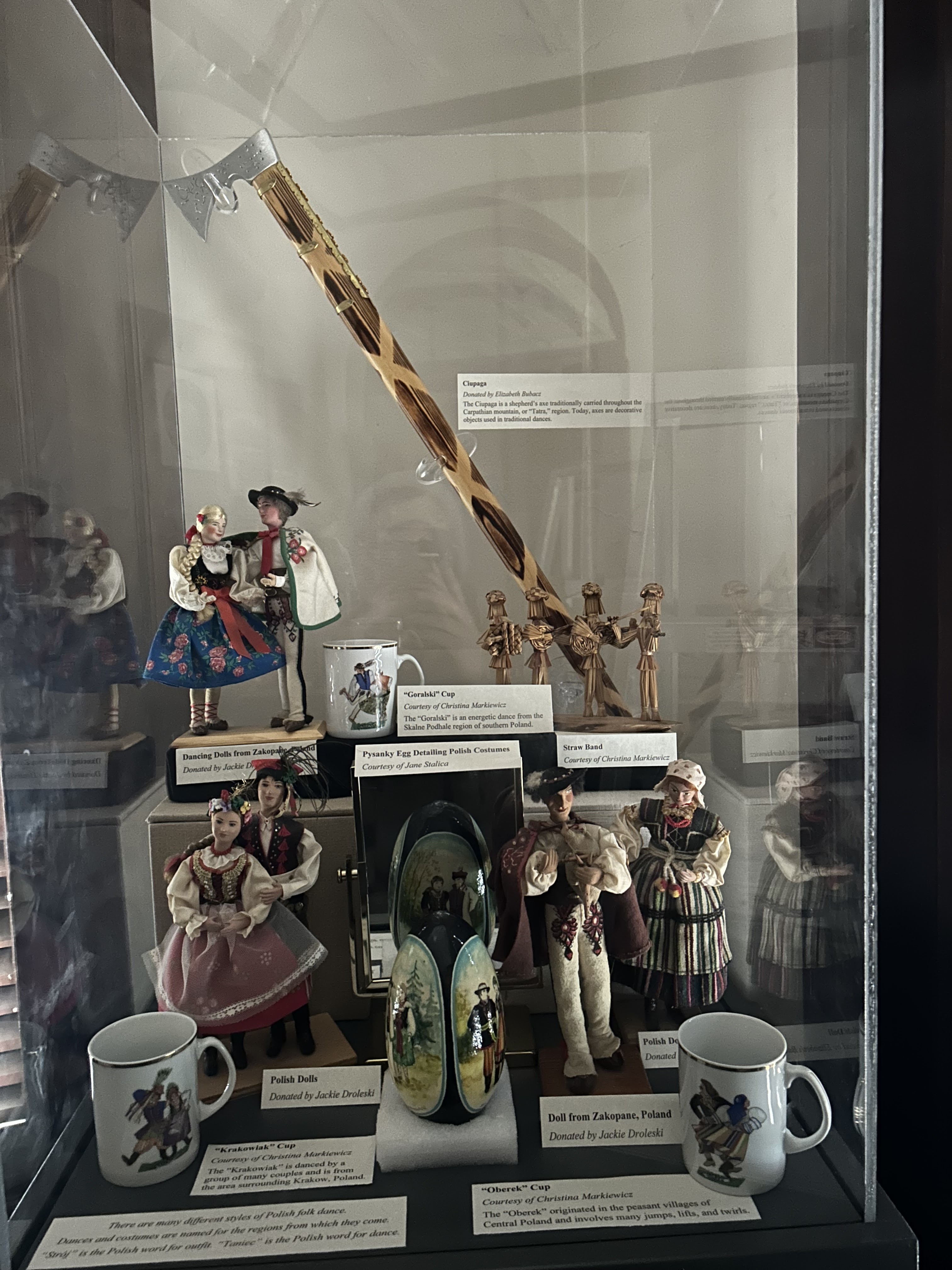
Popular regional dances from the Tatra region of Poland include the Goralski and the Zbojnicki, both known as highland dances. Both dances showcase the acrobatic talents of dancers and can use the ciupaga, or shepherd's axe, though the axe is more popular in the Zbojnicki, an all-male dance modeled after the exploits of the "zbojnik", or mythical robber, of the region.

Watch Polish dances being performed on this YouTube Playlist: https://www.youtube.com/playlist?list=PLR18vxeMSzPSBEsjhKAOkzbBmYM29axyn
 
Cup featuring the Kujawiak 
Courtesy of Christina Markiewicz
Cup featuring the Mazur
Courtesy of Christina Markiewicz
Cup featuring the Polonez
Courtesy of Christina Markiewicz

Today, the exhibit Polonia in Chemung County is on display just off the gallery where the Tatra dancers performed fifty years ago. The exhibit showcases many items having to do with Polish dancing. Christina Markiewicz kindly loaned the Museum a series of porcelain cups displaying multiple dance styles and Bettyann Bubacz donated a ciupaga (dancing axe) to the Museum. Come check it out!

Polish Dancing Case in the exhibit Polonia in Chemung County
 On Display Now at the Chemung Valley History Museum
Objects loaned to the Museum courtesy of Bettyann Bubacz,
Jackie Droleski, Christina Markiewicz, and Jane Stalica 


Monday, June 20, 2022

Half a Century of Computing Technology

 By Monica Groth, Curator

The coming exhibit, When Waters Recede: 50 Years Since the Flood of 1972, will remind visitors how much communications and computing technology has progressed in the past fifty years. When Hurricane Agnes struck Chemung County in 1972, the first commercially available handheld cellphone was still a decade away, and families waited months to hear from loved ones whose telephone lines were down. That year, the new PDP-8F “minicomputer” (which actually weighed 57 lbs.) could process information at a rate of only 0.667 megahertz – 5000 times slower than the computer I’m writing on today.

Technological advancements since then have certainly made monitoring and warning systems more effective, equipping people with accurate tools needed to predict danger and readily communicate emergency plans. Fifteen years after the flood, a system of electronic river level gauges and rain gauges fed data directly to the county’s Emergency Operation Centers through telephone lines and radio transmitters. The data was read by computers, which also received figures from surrounding counties and the National Weather Service. In 1987,
Civil Defense coordinator Gary Angus told the Star Gazette that the communication and computer equipment made it “easier for us to detect and forecast how storms will affect the county”. Flood Warning Service Operations Director Gregory Clark was pleased to announce data was the result of “real-time reporting. Meaning the information is current when called in,” adding that you can “never have enough information”.

Or can you? The computers of 1987 were still hundreds of times slower than they are today, with only a small fraction of the memory of a modern processor. The importance of real-time reporting and enough information storage was widely recognized and over time computer scientists engineered machines with the ability to store and analyze more information faster and more efficiently.

Computers bridging the years from 1972 to 2013 have been generously donated to our collection for the upcoming exhibit. Take a peek at what will be on display. Consider the computers’ specifications to compare their memory (measured as RAM, or short-term data storage in megabytes) and speed (measured as clock-speed, or number of processor cycles/second in megahertz).

PDP-8F  1972 
(This unit, which includes a punch card system and monitor is 5.5 ft tall, 22 in wide, and 30 in. deep)

                                           Memory: 0.000512 MB   

                                             Speed: 0.667 MHz 

Timex 1000  1982

                                      Memory: 0.002 MB (0.0036 MB maximum)

                                          Speed: 3.25 MHz


Compaq LTE Lite/25  1992

                                                   Memory: 2 MB (18 MB maximum)

                                                       Speed: 25 MHz


Compaq C140  1997

                                               Memory: 4 MB (6 MB maximum)

                                                   Speed: 40 MHz


HP Pavilion N3210  2000

                                               Memory: 32 MB (256 MB maximum)

                                                   Speed: 475 MHz


HP Chromebook 14-q010dx  2013

                                                   Memory: 2000 MB

                                                      Speed: 1400 MHz

Monday, January 3, 2022

Posting Blogs

 by Susan Zehnder, Education Director


What do faces of the depression, a shortage of dictionaries, and Arctic explorer Ross Marvin have in common? If you read our blogs, you can easily answer that question because each showed up in one of our blog posts this year.

Most of CCHS's blogs are written on a rotating basis by our archivist, curator and education director and have published weekly since February 6, 2012. Adding the 48 new blog posts from 2021 brings our grand offering to 514 blogs containing different stories of Chemung County history. The collection has been viewed close to 500,000 times. Send us a suggestion if you have a topic we haven't covered and we always appreciate your comments. Here are the top five viewed blogs of 2021, in order of popularity, see if you remember any of these:

1.     February 8th  Elmira’s First Black Fire Fighter A blog profiling the life and accomplishments of Thomas J. Reid, Jr.  In addition to being the first Black Fire Fighter in Elmira, Reid was also known for his inventions.


2.     February 15th The Neighborhood House and E.O. P. shared the history behind this 143 year old organization and its place in our community.


3.     January 4th Capturing the Local Faces of the Great Depression A little known connection between a Chemung County family and Farm Security Administration photographers documenting rural conditions.


4.     A follow up blog published January 25th The Maki Family of Rumsey Hill, revealed more of the story of one of those families photographed.


5.     March 8th Elmira HistoryForge: Discovering Local Stories written by our HistoryForge coordinator Andrea Renshaw, outlined the launch of this exciting project and how to get involved in documenting local history.

It’s not easy to predict which blogs will be the most popular, and we're often surprised. We choose topics because we’ve uncovered something new, or we want to share what's going on at the museum. Sometimes it may take longer for a blog to be discovered.  Years after being published, relatives of Elmiran Edward Brooks came across a blog written about his life. They traveled to Elmira to visit the museum and share his story with their children. It was a moving experience for them and for us. 

Here are blogs from last year which we think deserve another look:

1.     July 12th L. Libbie Adams and her Youthful Enterprise A blog connecting our Printing exhibit and the story of a young girl printer from the late 19th century who battled odds and made a living from writing, editing, and publishing her work.


2.     June 18th Revisiting Juneteenth, was a revised blog outlining the holiday’s origins and meanings.


3.     July 26th Jury Duty look at role of Jury duty in the United States, and how it has been practiced in the county.


4.     Viewing the Civil War, published last May 31st shared the topics and brief background of our three spring speakers and their contributions.


5.     November 8th’s Veterans Day shared some of the important work being done connecting veterans and local history organized by a local elementary school teacher.

     Of all the blogs we've published since 2012, the one which has been viewed the most was written in 2015 by our former Curator Erin Doane. The Holding Point and POWs published in January of that year shared the history of the WWII military camp located in Horseheads, NY.


 Erin was instrumental in putting together Hidden Lives of Chemung County, a book CCHS published this year. On sale at the museum or online, the book contains a collection of lesser known stories of  some amazing people in Chemung’s history.


Sharing our community’s history through blogs, is something we will continue in 2022. We’re happy when our viewers share too, just be sure to give us credit for our work when you do.