Showing posts with label Elmira. Show all posts

Monday, July 13, 2026

The Bicentennial Bridge

by Erin Doane, Senior Curator

If someone asked you where the Bicentennial Bridge in Elmira is, could you tell them? Until a short time ago, I couldn’t have. My recent research into how we celebrated the 200th birthday of the United States 50 years ago led me to this information. On July 17, 1976, the new bridge spanning the Chemung River at Main Street was dedicated. While it was not officially part of the County’s festivities for the momentous year, the bridge was dubbed the Bicentennial Bridge.

The first Main Street bridge was chartered in 1853. The original bridge was replaced in 1873 after suffering from flood and fire damage in the 1860s. Just under 50 years later, in 1921, it was replaced once again. By the early 1960s, the bridge was again showing signs of age. The sidewalks were repaired in 1963 as they were crumbling in several spots and dangerous holes had developed. Deterioration continued into 1968 when major repairs were recommended by a private engineering firm. Some repairs were made and a 5-ton limit on vehicles was put into place.

Main Street bridge, mid-20th century

The Flood of 1972 further damaged the 51-year-old bridge. The Army Corps of Engineers discovered weaknesses in the southern span of the bridge at that time and repairs were made to shore it up. The bridge reopened but was limited to two lanes of traffic.

View under the Main Street Bridge following the 1972 flood

Despite the repairs, in December 1974, city officials closed the Main Street Bridge as it was deemed unsafe for public use.  The piers on the south end of the bridge appeared in good condition but an inspection crew found serious damage under the floor of the bridge. The concrete had crumbled away allowing the steel supports to rust.

Early the next year, plans were in place to construct an entirely new bridge. Phase one of the project was the demolition of the existing bridge. On October 14, 1975, Dawn Webb, wife of the Elmira building superintendent, got to press the button that blew up the first of four spans of the bridge. Unfortunately, no announcement had been made that the demolition was going to take place, and the city police received over 30 concerned phone calls. No warning had been given to local residents because officials were worried that people would gather to see the demolition and possibly get injured. That was a reasonable concern. Even without official notice, people came out onto nearby rooftops to watch. Some reported bits of rubble falling near them from the explosion. Fortunately, no one was hurt.

Concept drawing of the new Main Street bridge, May 8, 1975
City officials promised that the new bridge would be open by Thanksgiving 1976. Through tremendous efforts put forth by contractors and workers at all stages of construction, the bridge opened four months early on July 17, 1976. The entire $3.5 million project was completed within 19 months from initial planning and design through the completion of construction. The new bridge was ceremoniously dubbed the Bicentennial Bridge and Mayor John M. Kennedy Jr. called it an “avenue of unity joining the citizens of Elmira.”

The Bicentennial Bridge right after its opening on, July 17, 1976
The first people over the bridge represented modes of transportation from the city’s past. Teenagers Cindy Dixon of Elmira and Pamela Collins of Wellsburg crossed the bridge from the Southside to the Northside astride Pamela’s horse Lady Shamrock. Daniel J. Bednarek of Elmira and his brother Brian crossed from the Northside to the Southside inside a 1940 Nash.

The Nash and Lady Shamrock passing each other on the Bicentennial Bridge, July 17, 1976
The opening of the Bicentennial Bridge was a momentous event in a celebratory year. Local businesses used the bridge in their advertisements as a location that people readily recognized. Central Radio, for example, was “just over the Bicentennial Bridge.” But the name didn’t stick. After 1980, the “Bicentennial Bridge” no longer appeared in the local newspaper. Everyone seemed to have gone back to simply calling it the Main Street bridge. 50 years later, it’s not surprising if you’re not familiar with Elmira’s Bicentennial Bridge.


Monday, April 6, 2026

Strike! The Secret History of Elmira's 1840s Bowling Saloons

By Milo Miller, CCHS Volunteer


Lucy Rossi Cesari, 1950s, CCHS Collection

Because bowling surged in popularity during the twentieth-century, many in today’s Elmira would be surprised to learn that the sport first became popular downtown in the 1840s. In those days, bowling was not played in lanes with automated pinsetters. Instead, it was more likely for city goers to play the game in establishments known as bowling saloons. Bowling saloons typically had an upstairs that contained a standard saloon along with bowling alleys in the basement. In the alleys, working-class men would meet, bowl, drink, gamble, and socialize. Due to these activities, those who gathered at the bowling saloons developed unsavory reputations, influencing the public perception of the sport.


Before the 1830s, when New York City’s Knickerbocker Hotel began to house indoor lanes, bowling was an exclusively outdoor sport in the United States. Often, establishments had side lots where they hosted lawn bowling on bowling greens. With the rise of bowling saloons, this changed rapidly, and indoor alleys sprang up across the country during the 1840s. By 1850, New York City alone had over 400 indoor alleys, all of which had sprung up within a 15-year span. This rise in popularity catalyzed changes to bowling that have carried over to today’s game. On bowling greens, early Americans usually played nine-pin bowling rather than the now-popular ten-pin game. During the 1840s boom of indoor bowling, several cities and states outlawed nine-pin bowling in an attempt to curb the drinking and gambling that became associated with the sport.  Many alleys quickly switched to ten-pin bowling to circumvent these laws. Even though lawmakers caught on to this change quickly, banning all forms of bowling, this switch resulted in the ten-pin game becoming the more popular option in the United States.

In Elmira, early bowling matched the objectionable reputation that plagued bowling alleys nationwide.

Stone Bowling Ball, CCHS Collection

Though the location and inception date of the first bowling alley in Elmira are unknown, the first mention of the game in Elmira’s newspapers occurred in The Elmira Gazette on January 2nd, 1841. In the story, a writer for the Elmira Gazette lists a number of places he thought that young men ought not go, explaining that when he saw the “young entering the gin palaces, or the rum shops, or the illuminated billiard rooms, or the dark bowling alleys...I could wish some spirit would put the thought into their minds- ‘Never go there.’”


This reputation prevailed for years- in one extreme instance, quoting a Baptist pastor, Elder Knapp, an 1846 article from the Elmira Gazette claimed “the devil was rolling ten pins, and the little devils [set] them up; and that the devil rolled three balls, the first of Infidelity, the second Universalism, and the third ball of Damnation.” By 1850, it seems there were several bowling saloons in Elmira. On Main Street, in the Globe Hotel, R.P. Kinyon and E.A. Darling operated one bowling saloon until the hotel burned down in 1850. On Lake Street, Thomas B. Borden operated an alley in Knickerbocker Hall, and Miles Cook operated the Old Soldier’s Bowling Saloon, which appeared to be quite popular.

Unfortunately, bowling at the Old Soldier’s may have claimed a child’s life in Elmira. An 1854 story in The Elmira Gazette reported that a boy named Thomas Doolin was hit in the stomach by a ball. Though he was still alive, the newspaper was not optimistic about his recovery. There likely were other Elmira bowling saloons that went unreported. In a unique case, after a Maine ban on alcohol an 1855 article in the Elmira Advertiser speaks of an underground alley on Water Street that flew a white banner, “though not [one] of truce,” exclaiming “Maine Law Drinks Below.” The days of the bowling saloon were relatively short, losing popularity quickly after the 1850s. In Elmira, they leave few traces, existing only in old newspapers and business directories.

Elmira Bowling Alley, 1900-1932, CCHS Collection


Monday, February 23, 2026

Purity Above All

 by Susan Zehnder, Education Director

This is a story of a business whose success literally ran dry. In early 1900, downtown Elmira was abuzz. There were over 35,000 people living in the city and 54,000 in the county.

Water Street under water
While a year earlier, the city’s commercial area had flooded, the spring now saw the area recovering and prosperous. Business opportunities were growing. One business looking to expand into the area was Salzman & Siegelman, a wholesale wine and liquor store based out of Brooklyn, New York. Their Brooklyn store had been so successful that they’d been able to add stores in Albany, Amsterdam, Syracuse, and Troy. Now, in the spring of 1900, they were opening a sixth shop at 108 East Water Street in downtown Elmira.

The turn of the 20th century saw a rise in the trend of drinking at home. It was a change from the past, when liquor and wine were mainly purchased and consumed in bars and saloons, often dark and smoky places. Leading up to the store’s May 5th opening day, Salzman & Siegelman had been getting the store ready and advertising for weeks aiming to attract modern men and women interested in purchasing alcohol to drink at home. 

The Elmira store would be well stocked with the largest selection of wine and liquor in the area. It would carry the very best products and gladly refund customers if anything was found wanting. Because they’d learned from experience, they hired saleswomen to attract more women customers. Women, they found, were the primary customers when it came to purchasing liquor this way. Finally,  for an open and family-friendly atmosphere, the store’s walls and large shelves were painted white and well lit. Another draw was that for weeks ahead of its May opening, Salzman & Siegelman had been advertising that they would be giving every purchaser a souvenir card for a free quart bottle of Red Cross Port.


The man behind this business was thirty-year-old Morris Salzman. Salzman was born in Austria in 1870, and arrived in New York City at sixteen years old. He lived in the city’s Lower East Side, among other Jewish immigrants. He went to work in the growing liquor business, both making and selling whiskey. He adopted the motto Purity Above All and included it on everything he sold to promote the quality of his product. It must have worked, since his business boomed. By his early twenties, he had accumulated considerable wealth and expertise. He married Rose, another Austrian-American Jew, and the couple had three children. Around this time, he also went into business with Meyer Siegelman, forming the company Salzman & Siegelman.

The Salzman Family

Unfortunately, the new store’s May 5th opening day in Elmira had a few hiccups. After weeks of whipped-up anticipation, several hundred customers lined the sidewalk hoping to gain admittance and receive their free port. By evening, the crowd had grown so large and impatient, the clerks were forced to limit customers in the shop to only 50 at a time. Four policemen were called in to restore order. By 10 pm, over 1,200 bottles of Red Cross Port had been given out, which still left hundreds more customers empty-handed. The store promised to honor their promise to any patrons who missed out.


Eventually things were resolved, and the store attempted other promotions and attractions. One that caught the attention of the newspaper was a window display of an eternally pouring bottle of Empire rye whiskey. It seemed to defy nature and intrigue passersby. Other promotions Salzman offered were shot glasses, whiskey jars, and bottles, complete with his purity motto.

Less than four years after their Elmira store opened, Salzman & Siegelman’s business partnership fractured. While the reasons are unknown, the two men filed injunctions against each other. Each ended up starting competing liquor stores, but not in Elmira. Here, the store became Salzman & Co. Its last business listing in the Elmira City Directories was 1919, the year before Prohibition started.

In 1920, Morris Salzman joined the Greenpoint National Bank briefly before leaving and starting his own company, Colonial Discount Company out of Brooklyn. It offered loans for automobiles, another growing field. Salzman died in Brooklyn at 61 years of age in 1930. The obituary described him as a philanthropist and banker, with no mention of his whiskey making-- not a surprise since the country was still under prohibition and dry.


Today, you can still find bottles and liquor jugs with the Salzman name and the purity motto on them. It’s interesting to note that unlike many other whiskey makers, Salzman was never cited by state or national authorities for adulterating his liquor or wines.


Monday, August 26, 2024

At the Corners of Church and Main Streets

by Erin Doane, Senior Curator

Map of the City of Elmira from actual surveys by G.M. Hopkins, C.E., 1865

Jervis Langdon was an entrepreneur, an abolitionist, a philanthropist, and the father-in-law of Samuel Clemens (aka Mark Twain). In 1863, he bought property from Anson E. Ely at the northwest corner of Church and Main Streets in Elmira. Jervis’s family lived there for over 75 years and the home became known as the Langdon Mansion. We currently have the exhibit “Grand, Domestic and Truly Comfy” on display here at the museum through May 2025 which showcases the mansion and its furnishings.

Residence of Anson C. Ely. Photograph, early 1860s,
courtesy of the Mark Twain House & Museum

Jervis had major renovations made to his new home soon after he purchased it. The original was in the Greek Revival style. It was cube shaped with wood siding and a square cupula on top. Had had the structure enlarged and transformed into a three-story Italianate brownstone with several wings that telescoped from the back. Throughout the years, the Langdon family made more changes to the home, including adding a porte-cochere and expanding the veranda in the 1890s.

The Langdon Mansion around 1900

So, what did Jervis Langdon see when he looked out from his home across Church and Main Streets in 1865? To the east, across Main Street, sat Trinity Episcopal Church which was founded in 1833. The church itself was built between 1855 and 1858. It was constructed entirely of brick, including its steeple, which is unusual. In fact, it is one of only 11 churches in the world with a brick steeple.

Trinity Episcopal Church, 1860s
South of Trinity Church, across Water Street, was the First Baptist Church. The church we see on that corner today is a massive brick building, but when Jervis first took up residence in the neighborhood, it was a much more modest wooden structure with a square steeple. It was originally built in 1830 and expanded in 1847. After a devastating fire, the new, larger brick church was built in 1892.

First Baptist Church, 1870s
First Baptist Church, 1890s

In the 1860s, there was still a burial ground next to the First Baptist Church. By the 1850s, they were running out of space for burials next to the church so Woodlawn Cemetery was created in 1858. Church sextant John W. Jones began moving graves from the First Baptist burial ground to Woodlawn Cemetery immediately after it opened but the task was not finished until 1877.

First Baptist burial ground, c. 1860

There were also strips of park land on either side of Main Street south of Church Street. It was probably nice for Jervis to have a park right across the street. His own property could be described as park-like, as well, with hundreds of trees and shrubs, flower beds, gravel paths, decorative urns, and fountains on the property. His wife, Olivia, personally oversaw the development and maintenance of the landscaped grounds.

View of the Langdons’ gardens, c. 1875

South of the Langdon Mansion, across Church Street and west of the park, was the Park Church. In 1846, 41 abolitionists broke from the First Presbyterian Church over the issue of slavery and formed the Independent Congregational Church of Elmira. Jervis and Oliva were among the founding members of the new church. The congregation built a white wooden church in 1851. Rev. Thomas K. Beecher arrived in 1854 and served as pastor until his death in 1900. By the 1870s, the congregation had grown so large that a new church was constructed - the large brick structure we see there today.

The Park Church and inset portrait of Rev. Thomas K. Beecher in 1854

The Park Church, 1905

Jervis Langdon passed away in 1870 and would not have seen most of the changes that made the intersection of Church and Main Streets what we see today, like the two large brick churches that dominate the area. The Langdon Mansion itself was torn down in 1939. We can, however, still enjoy of some of Jervis’s original view including the cool green space of Wisner Park and the red brick of Trinity Church’s steeple.

Sunday, April 30, 2023

Reached their Quota: The Short History of Elmira's Quota Club

by Susan Zehnder, Education Director

Elmira businesswomen were galvanized, back in the spring of 1919, by the news that a woman in Buffalo had founded the International Quota Club—an organization similar to the various men’s business clubs, but solely for women. In hopes of starting an Elmira chapter, a group of local women advertised in the Star-Gazette for potential members. The ad ran in May, and by June, more than 75 women had applied for a Quota Club charter. In August, however, before the charter paperwork had even arrived, the group abruptly disbanded. The Quota Club of 1919 never took hold in Elmira.

Quota International Logo

Clubs have been around a long time, and the first ones were formed primarily around sports or social causes. Two of the earliest examples include the Schuylkill Fishing club in Delaware, which can be traced back to 1732, and the Sheffield football club in England, formed in 1857. Business clubs didn’t show up until the early 20th century, and offered professionals the chance to network and do good deeds.

Three of the earliest business clubs - Rotary, Optimist, and Kiwanis - began near the turn of the century and are still going strong. The oldest of these is the Rotary Club, which was formed in Chicago in 1905. The name comes from the fact that the group rotated official meetings among the members’ different business locations. In 1912, with the addition of clubs in Canada and Europe, the name was changed to the International Rotary Club. Early rules prohibited women from being members, and each chapter allowed only one representative member per job classification. They did not have official restrictions on race, though many early clubs excluded Black members until 1980. The restriction on job classifications was eliminated and women were allowed to join in 1989. Elmira’s International Rotary chapter was started in 1916.

The Optimist Club was formed in 1911 in Buffalo. As the name suggests, members sought to take a positive approach when addressing societal problems. It wasn’t until 1989 that the Optimists accepted women as members. Today there are over 3,000 Optimist clubs with more than 80,000 members. Elmira’s chapter was founded in 1988.

Perhaps most directly influential on the Quota Club was the Kiwanis organization, founded in Detroit in 1915. First known as the Supreme Lodge Benevolent Order Brothers, they soon changed their name to Kiwanis. Early members thought the word was a Native American word that meant to trade or build. It actually is a misunderstanding of an Ojibwa phrase meaning “to fool around.” The organization became Kiwanis International in 1916 when chapters from Canada joined.

Like the two other professional service organizations, Kiwanis was slow to offer membership to Blacks and women. Blacks were officially invited to become members in 1980, and women were invited in 1987. In Elmira, the Kiwanis chapter started in 1974.

These three business clubs became immediately popular and offered businessmen a chance to network, hang out, and work together. Not to be left behind, women wanted their own club. In 1919, Buffalo businesswoman Wanda Frey Joiner established the Quota Club.

Wanda Fry Joiner

Born in Russia, Wanda Frey immigrated to Buffalo with her family as a child. At 28 years old, she married Robert Parks Joiner, who owned a company in the paint and glass industry. He died three years later, leaving her to run his business. She was a guest attending a Kiwanis Christmas party when she was inspired to form a similar professional club exclusively for women.

Women’s rights were in the news. One year earlier, women in New York State had earned the right to vote, and now the United States was poised to give all women that right, having passed the 19th amendment. (However, it would take the adoption of the Voting Rights bill decades later to address voting barriers for Black women.)

News of the newly formed Quota Club spread quickly. As the Star-Gazette pointed out, “Combining social, business and civic activities in the manner of these clubs is a quite modern idea.”

The Elmira group elected a board of directors and waited for their chapter to be officially recognized. They elected officers and held planning luncheons. To celebrate their upcoming formation, they scheduled their first “annual” event for July. They had originally planned to meet at Sullivan’s Monument, but changed locations when a heavy rainstorm came through the area. They went instead to Brand Park, where 60 members participated in pie-eating contests, footraces, and skilled sports competitions like baseball throwing and unnamed “stunts.” Apparently, some of the footraces created a ruckus; according to the newspaper, a few of the heftier racers insisted on entering footraces for slim or lightweight women, though everyone seemed to enjoy themselves. Events finished with an excursion to Rorick’s Glen to attend an opera that evening.

Less than one month later, the Star-Gazette reported that one of the local organizers had said the “reputation and character of the national organizer of the club has been assailed,” and the local group refused to accept official recognition. They would be returning all paperwork when it arrived.

Whatever specific disagreements the Elmira group had aren’t clear, but the seeds were sown for discontent and soon the group broke apart. Some women moved away, while others reorganized into the Elmira Business Women’s Club. In December 1919, this group joined Zonta International and formed a chapter in Elmira. Zonta International was a businesswomen’s club formed in Buffalo, and the Elmira chapter was one of its first five chapters. It is the only Zonta chapter that owns its own house, and it is still going strong today, though I don’t know if they have any footraces scheduled.

Elmira's Zonta House
Author's note: Corning Painted Post had a Quota chapter for years though Quota International disbanded operations in 2020 due to dwindling membership. 


Sunday, December 18, 2022

Holiday Memories

 by Susan Zehnder, Education Director

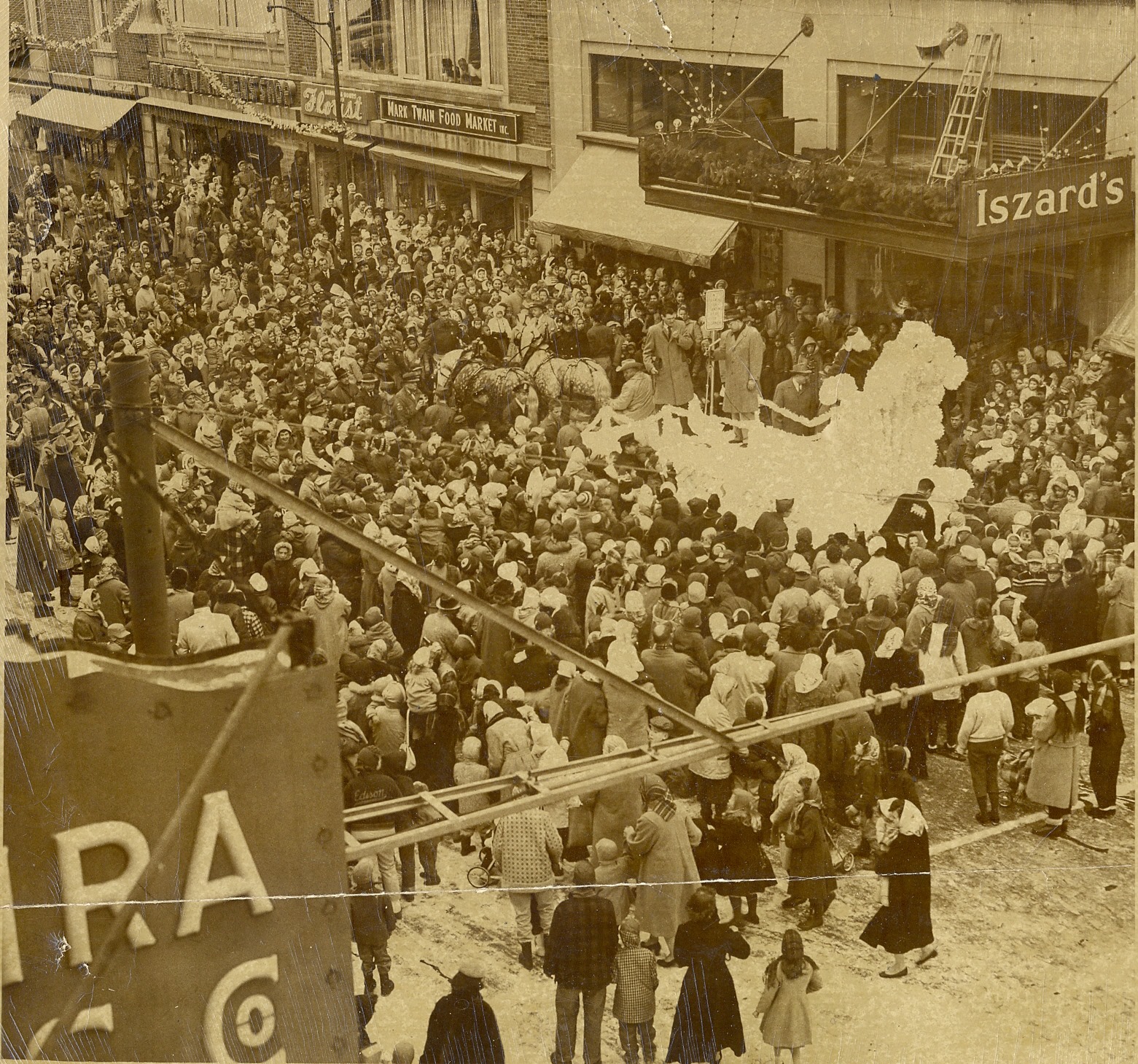
In 2020, when the whole world seemed to pause, the annual Elmira Downtown Holiday parade was canceled. Without a parade, CCHS shared 170 images from our collection for a virtual walk down memory lane. You can still see that album on our Facebook page. Eighteen of the images are from a Corning parade, and two are missing dates because we couldn’t confirm when the pictures were taken. Of the 150 remaining images, we thought you might enjoy seeing the top 5 ‘liked’ photos. In order of popularity, here they are.

1958 (64)1958


This image got the most attention. Since we posted photographs in chronological order, it was also the oldest confirmed photo in the album. It was taken in 1958, and shows a crowd of people surrounding a horse drawn sleigh in front of Iszard’s Department store. Best guess is it was the end of that year’s parade. On the sleigh, Santa is joined by two official-looking men wearing winter coats. Most of the crowd are wearing coats and hats and many women are wearing scarves on their heads. One observer commented he remembered watching Santa get off the train and climb down for the parade. Others remembered shopping on crowded streets. While a few remembered specific food they ate at Iszard’s. Cream cheese and olive sandwiches anyone?


Second in popularity was this crowd scene from 1966. Here the image includes mostly children intently watching something just out of the picture frame. A few children are waving. One observer recognized himself in the crowd. It must have been warmer that year, because fewer people are wearing hats and there are no winter boots in sight.


The third photograph was also taken in 1966. You can see a group of Southside High School baton twirlers high-stepping down the street followed closely by a marching band. Onlookers line the side of the street, and a partial view of the viaduct span can be seen. One observer recognized her mother performing with a baton.


The fourth photograph was also from 1966. It shows two men dressed in Batman and Robin costumes astride motorcycles. They both look off to the side at something out of the photograph’s frame, and have their feet on the ground, indicating they are paused. A crowd of children and adults watch. While no one left any comments on this image, it clearly sparked nostalgia.


The fifth most popular photograph was taken in 1969. The image shows two young women carrying a banner for Southside’s High School Band which follows behind. Behind the banner are two processional flags. Both sides of the street are lined with onlookers. Commenters on this image recognized themselves or other band members.

Winter holidays often inspire us to look back at the past, whether fifty years ago, twenty-five years ago or the year about to pass. We hope you enjoy seeing these again. Whatever traditions you celebrate, we hope you share them with friends and family, and maybe a cream cheese and olive sandwich on the side.