Showing posts with label prohibition. Show all posts

Monday, February 23, 2026

Purity Above All

 by Susan Zehnder, Education Director

This is a story of a business whose success literally ran dry. In early 1900, downtown Elmira was abuzz. There were over 35,000 people living in the city and 54,000 in the county.

Water Street under water
While a year earlier, the city’s commercial area had flooded, the spring now saw the area recovering and prosperous. Business opportunities were growing. One business looking to expand into the area was Salzman & Siegelman, a wholesale wine and liquor store based out of Brooklyn, New York. Their Brooklyn store had been so successful that they’d been able to add stores in Albany, Amsterdam, Syracuse, and Troy. Now, in the spring of 1900, they were opening a sixth shop at 108 East Water Street in downtown Elmira.

The turn of the 20th century saw a rise in the trend of drinking at home. It was a change from the past, when liquor and wine were mainly purchased and consumed in bars and saloons, often dark and smoky places. Leading up to the store’s May 5th opening day, Salzman & Siegelman had been getting the store ready and advertising for weeks aiming to attract modern men and women interested in purchasing alcohol to drink at home. 

The Elmira store would be well stocked with the largest selection of wine and liquor in the area. It would carry the very best products and gladly refund customers if anything was found wanting. Because they’d learned from experience, they hired saleswomen to attract more women customers. Women, they found, were the primary customers when it came to purchasing liquor this way. Finally,  for an open and family-friendly atmosphere, the store’s walls and large shelves were painted white and well lit. Another draw was that for weeks ahead of its May opening, Salzman & Siegelman had been advertising that they would be giving every purchaser a souvenir card for a free quart bottle of Red Cross Port.


The man behind this business was thirty-year-old Morris Salzman. Salzman was born in Austria in 1870, and arrived in New York City at sixteen years old. He lived in the city’s Lower East Side, among other Jewish immigrants. He went to work in the growing liquor business, both making and selling whiskey. He adopted the motto Purity Above All and included it on everything he sold to promote the quality of his product. It must have worked, since his business boomed. By his early twenties, he had accumulated considerable wealth and expertise. He married Rose, another Austrian-American Jew, and the couple had three children. Around this time, he also went into business with Meyer Siegelman, forming the company Salzman & Siegelman.

The Salzman Family

Unfortunately, the new store’s May 5th opening day in Elmira had a few hiccups. After weeks of whipped-up anticipation, several hundred customers lined the sidewalk hoping to gain admittance and receive their free port. By evening, the crowd had grown so large and impatient, the clerks were forced to limit customers in the shop to only 50 at a time. Four policemen were called in to restore order. By 10 pm, over 1,200 bottles of Red Cross Port had been given out, which still left hundreds more customers empty-handed. The store promised to honor their promise to any patrons who missed out.


Eventually things were resolved, and the store attempted other promotions and attractions. One that caught the attention of the newspaper was a window display of an eternally pouring bottle of Empire rye whiskey. It seemed to defy nature and intrigue passersby. Other promotions Salzman offered were shot glasses, whiskey jars, and bottles, complete with his purity motto.

Less than four years after their Elmira store opened, Salzman & Siegelman’s business partnership fractured. While the reasons are unknown, the two men filed injunctions against each other. Each ended up starting competing liquor stores, but not in Elmira. Here, the store became Salzman & Co. Its last business listing in the Elmira City Directories was 1919, the year before Prohibition started.

In 1920, Morris Salzman joined the Greenpoint National Bank briefly before leaving and starting his own company, Colonial Discount Company out of Brooklyn. It offered loans for automobiles, another growing field. Salzman died in Brooklyn at 61 years of age in 1930. The obituary described him as a philanthropist and banker, with no mention of his whiskey making-- not a surprise since the country was still under prohibition and dry.


Today, you can still find bottles and liquor jugs with the Salzman name and the purity motto on them. It’s interesting to note that unlike many other whiskey makers, Salzman was never cited by state or national authorities for adulterating his liquor or wines.


Monday, December 8, 2025

Chop Suey and Deportation

by Erin Doane, Senior Curator 

A long-time resident and owner of a local Chinese restaurant is detained by immigration officials. He is a well-known and respected member of the community, but he originally entered the United States illegally. After all legal avenues have been exhausted, he is deported. While this story could be one lifted from today’s headlines, it is actually from 1931. This is the story of Lee Hee, who opened the Peking Restaurant at 106 East Water Street in Elmira in 1926.

East Water Street, Elmira, c. 1932

When I first noticed the Peking Chop Suey sign in a historic photo of East Water Street, I had no idea where my research would lead me. I started by looking into when Chinese restaurants first appeared in the area and ended up with stories of immigration and prohibition raids.

An article in the Star-Gazette in 1899 declared that “Chinese restaurants are querious [sic] places” but by the early 1900s there were several of them in Elmira. That coincides with the “Chop Suey Fad” that appears to have swept the nation around 1902. The origins of chop suey are uncertain. The dish of meat and eggs cooked with vegetables in a thick sauce served with rice is thought to have been developed by Chinese Americans in the late 1800s, but some believe it actually did come from China. Either way, by the early 20th century, it was a well-known dish in Elmira. 

There were already half a dozen Chinese restaurants specializing in chop suey when Lee Hee filed his paperwork with the county clerk in 1926 to operate the Peking Restaurant. Lee had been working as chef at Spaghetti Land, an Italian/Chinese restaurant on the second floor of the Lyceum Theater on Lake Street. His new restaurant was located on East Water Street across from the Regent Theater on the second floor above T.J. Connelley’s grocery store. It offered Chinese, American, and Italian food, including chop suey, from 11 a.m. to 2 a.m. every day. The special businessmen’s lunch was just 40 cents. Over the years, the restaurant and Lee built a reputation for high class, quality food.

Elmira Star-Gazette, February 25, 1926

In 1928, the Peking Restaurant was the target of a raid by federal prohibition agents. They found eighteen bottles of high-powered beer on the premises and arrested Lee. He was released on $1,000 bail and seemingly continued on with his business. The next time he appeared in the local newspaper was in June 1930 when there was a catastrophic collapse of a temporary sidewalk at the Gorton Coy construction site. Two people, including a small girl, were killed in the incident. Lee was on the sidewalk when it collapsed but only sustained a slight injury to his right leg. 

On January 29, 1931, the Peking Restaurant was raided again, this time by the U.S. Immigration Department. It was one of dozens of Chinese businesses – mostly restaurants and laundries – targeted by immigration officials. Lee Hee was among several men who were not able to provide papers showing they were in the U.S. legally. Lee had been a seaman on a Chinese merchantman who had jumped ship in Seattle and entered the country without official documentation. From there he made his way to Elmira in the early 1920s. Lee seemed fairly nonchalant about the arrest telling the reporter that he was planning to return to China anyway and he didn’t mind letting the government deport him and pay the transportation costs. He had been in Elmira for about ten years at that time and had saved thousands of dollars working as an “unusually skillful chef and cook.” 

Lee was released on $3,000 bond and continued working as a chef and restaurateur while his deportation case made its way through the courts. In December 1931, Federal Judge John R. Knight of Buffalo, affirmed the earlier decision of U.S. Commissioner William W. Gregg ordering Lee’s deportation. His last appeal to the U.S. Circuit Court of Appeals was rejected and on August 25, 1932 he was taken into custody again. Finally, on September 6, 1932, nearly two years after his initial arrest, Lee was sent back to China. A year later, several residents of Elmira received Christmas greeting from Lee from his new home in Hong Kong.

Lee Hee (left) pictured with fellow deportee Chu Sun, Elmira Star-Gazette, September 9, 1932

Days before Lee Hee was deported, an advertisement in the Star-Gazette announced that the Peking Chop Suey Chinese Restaurant at 106 East Water Street was under new management. The new proprietor, Lee Tui How, had previously operated laundries on West Water Street and Baldwin Street. Whether from lack of experience running a restaurant or because of a prohibition raid in February 1933, the restaurant had closed for good by 1934.


Monday, April 5, 2021

Beer Returns to Chemung County

by Erin Doane, Curator

It was 88 years ago this week that people in Elmira and surrounding towns tasted beer again after years of Prohibition. Nationally, Prohibition began on January 17, 1920 but Elmira had gone dry 15 months earlier on October 1, 1918. Between then and April 7, 1933, not a single drop of alcohol passed the lips of anyone in the county.

A group of men eating, drinking, and being merry in 1886

Okay, that’s not true at all. Throughout the entirety of Prohibition, illegal beer and hard liquor had been available (clickhere to read about the Briggs Brewery operation) and some low-alcohol beverages were legal to sell and consume (click here to learn about “near beer” and cereal beverages). For law-abiding beer lovers, however, the years had been quite dry. So, many people were excited when President Franklin Roosevelt signed the Cullen-Harrison Act on March 22, 1933 which legalized beer with an alcohol content of 3.2 percent. Previously under the Volstead Act, all beverages with an alcohol content of over 0.5 percent were illegal. On April 7, 1933, 3.2 percent beer became legal to sell and consume in 19 states, including New York, that did not have state prohibition laws that would supersede the federal legislation.

Map of states (marked in black) where 3.2 percent beer became legal on April 7, 1933, Star-Gazette, March 16, 1933

As soon as the act was signed, breweries jumped into action to get beer legally to their customers. They had two weeks to ramp up production before thirsty men and women could again partake of their beverages. Distributors, wholesalers, and retailers also began scrambling to get the precious brew. For those in Chemung County, the new beer was coming from the American Brewing Company of Rochester, West End Brewing Company of Utica, and from several other breweries in New York or New Jersey. The Nectar Brewery on Tuttle Avenue in Elmira (previously Mander’s Brewery before Prohibition) did not restart its operation until later in April. Briggs Brewery, by the way, did not ever switch to producing the lower-alcohol beer, preferring to continue illegally producing the full-strength stuff. 

The rush between President Roosevelt signing the Cullen-Harrison Act into law and its implementation just 15 days later was not just a challenge for breweries and beer distributors. The new federal law went into effect so quickly that state governments and local municipalities did not have time to make their own regulations. Elmira Police Chief Elvin D. Weaver said that local police had no jurisdiction over the sale of beer until a state law was put into effect as there were no city ordinances governing beer traffic. All that was needed to become a legal beer seller was a retail license, which the federal government was reportedly giving out indiscriminately to anyone who paid the $20 licensing fee. Beer would soon be available at bars, hotels, restaurants, pool halls, grocers, gas stations, and even soft drink stands in parks. 

The intersection of Water and Main Street in Elmira, early 1930s
Some local businesses took polls of their patrons to see if they were interested in buying beer. One unnamed restaurant reported to the Star-Gazette that the vote was 10 to 1 in favor of the sale of beer there. The Mark Twain Hotel manager announced that beer would be offered for sale in the coffee shop and with room services. Other businesses decided to wait and see how the rollout went. There was still considerable opposition to the consumption of alcoholic beverages in Elmira and throughout the entire nation. Frank E. Gannett took a stand against any sort of beer advertisements in his newspapers. Clinton N. Howard of Rochester, one of country’s most militant dry leaders, who had spoken on several occasions in Elmira, sent a message to President Roosevelt that read in part, “with the single exception of the crucifixion of the Son of God by the politicians of Jerusalem, legalization of beer is the crowning infamy of the ages.”

Despite uncertainty and opposition, at the stroke of midnight on Friday, April 7, 1933 barrels and bottles of 3.2 beer were loaded into waiting trucks at the breweries and government seals were broken on railroad cars that had already arrived at distribution hubs. The first shipment arrived in Elmira at 8:00 a.m. with more quickly following. Wholesalers purchased the beer at $2 to $2.50 per case (around $40 to $50 today) then turned around and sold it for 20 cents ($4) a bottle or 10 cents ($2) a glass for draft beer. The demand, however, greatly outpaced the supply and by noon many were left disappointed as they moved from one watering hole to the next searching for the highly-desired beverage. Several restaurants had promised beer with lunch but were not able to deliver. By Saturday morning, the supplies had been replenished and plenty of 3.2 beer was available for the rest of the weekend.

“First Shipment of Legal Beer Arrives This Morning,” Star-Gazette, April 7, 1933
It is estimated that within the first 24 hours, 1.5 million barrels of beer were sold in New York State. Despite not having passed laws yet regulating the new beer trade, Governor Lehman had signed a dollar-a-barrel beer tax in time to collect some substantial revenue for the state. New York City alone made $200,000 in fees from issuing retail permits. Nationally, the stock market rose in the hopes that legal manufacturing and distribution of beer would stimulate business in general.

Locally, the grand rollout of 3.2 beer seemed to have gone smoothly, despite shortages. Elmira police encountered no unusual disturbances that first weekend and reported that it was, in fact, unusually peaceful downtown. By Monday, April 10, “wet hysteria” had died down. In his ‘Round Town column in the Star-Gazette, Matthew Darrin Richardson summed it up by writing, “Beer ought to pretty well recover from its hysteria this week and settle down to regular traffic…By this time Elmirans should have satisfied their curiosity, if not their thirst entirely.”


Monday, August 3, 2020

Tales of Woe at 1893 Grand Central Ave.

by Erin Doane, Curator  

The house that once stood at 1893 Grand Central Avenue had served as a hotel, boarding house, tavern, inn, restaurant, and private home throughout its history. It was also a place of misfortune for many who lived, drank, dined, and slept there. Police raids, illnesses, car crashes, battles with city hall, and butcher knife fights befell those who passed through its doors. Perhaps 1893 is an unlucky number.

It is important to note that sometime in the last quarter of the 20th century, houses on many streets were renumbered to comply with the 911 emergency system. The property I’m writing about was physically located on Grand Central Avenue near what is now Eldridge Park Road.

Elmira Star-Gazette, January 18, 1895

In the 1890s, John Thetgee was the proprietor of a hotel at number 1893 Grand Central Avenue. He would regularly hold dances that were attended by some shady characters, including workers from the nearby glass factory and women who didn’t have the best reputations. It was apparently fairly typical for the glass workers to get into arguments about who would be taking said women home at the end of the night.

On January 18, 1895 one such quarrel turned violent. Three young man escaped in a sleigh with several glass blowers in hot pursuit. The two parties met again near the D.L.&W. Railroad tracks where the glass workers attacked the other men with butcher knives. The three young men in the sleigh suffered a number of wounds, but were able to get away with their lives. Two glass workers were arrested for the incident. They pled guilty to charges of intoxication and paid $10 fines, but claimed they knew nothing about the knife assault.

In the 1910s Henry G. Foster became owner of 1893 Grand Central and operated a hotel and saloon there. He was accused of violating the liquor tax law on August 16, 1914. At his trial in October, he was found guilty and was surprised at the stiff sentence that was imposed on him – a $200 fine and three months in county jail. He pleaded with the judge saying he had a wife and children to care for, but the judge replied that he should have considered them before breaking the law.

In 1915, Henry Foster’s wife Myrtle was issue a liquor license for the establishment, so it seems she was now in charge. Her luck at 1893 Grand Central wasn’t much better than his, however. 1918 was a rough year in particular. Myrtle’s father Charles Evans died in the house on July 14. In October, the Spanish flu swept through the family. Henry was gravely ill, as were their two daughters, Bernice and Helen. 20-year-old Bernice was taken to the Arnot Ogden Hospital with influenza and pneumonia on October 10 and died just days later.

Star-Gazette, October 19, 1918

By the 1920s, Myrtle was having a tough time running their boarding house and tavern. The property was listed several years in the newspaper for unpaid taxes. Perhaps that’s why she turned a blind eye, or even encouraged, certain goings on at the Foster Hotel. On April 15, 1926, the establishment was raided by federal agents and state police. Six guests were arrested along with Myrtle, who was charged with violating prohibition laws and conducting a house of ill repute. Two of those arrested, Margaret King and Clarence Huntley, were found together in one of the bedrooms. While they were both married, they were not married to each other. They pled guilty to statutory offenses, paid $25 fines, and Margaret agreed to testify against Myrtle.

Star-Gazette, May 27, 1926

Two days before her trial, Myrtle was riding in an automobile with her husband and daughter at 2 o’clock in the morning when the vehicle was hit by another car. Talk about unlucky. She suffered cuts from flying glass, but was not injured badly enough to have her trial postponed. Even though Margaret King, the star witness for the prosecution, had disappeared and thus could not testify, the jury only took ten minutes to decide Myrtle was guilty as charged. Unfortunately, I wasn’t able to find what her sentence was.

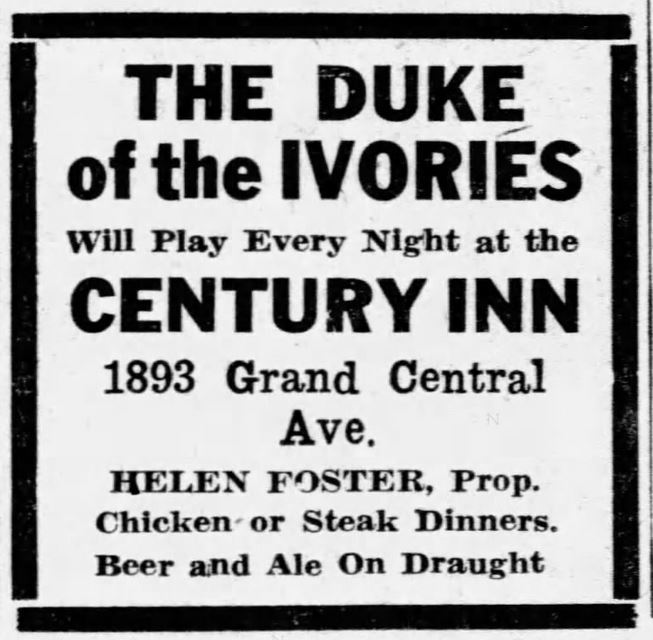
The hotel stayed open for several more years under the Foster proprietorship and its character seemed unchanged. Henry Foster was charged with violating prohibition law in May 1928 and again that November. On August 1932, the location’s bad luck reared its head again when the Fosters’ barn, workshop, and garage containing three automobiles and a large quantity of tools were destroyed by fire. By 1933 their daughter Helen M. Foster had taken over operations. That year, she was granted a license to sell beer and wine at the newly rebranded Century Inn.

Star-Gazette, May 12, 1934

In the late 1930s, the Fortuna family took ownership of 1893 Grand Central Avenue and ran it as the Fortuna Inn. The bad luck that clung to the place seemed to be mostly held at bay until 1961. That was when Thatcher Glass decided to expand their operations. In order to do so, they needed an easement to a portion of Grand Central Avenue that was held by Katherine Fortuna. After not being able to get their way when dealing directly with her, Thatcher representatives went to the City Planning Commission and had them secure the easement despite Katherine’s objections. Thatcher did construct a new entrance to the property and the Fortuna Inn continued to operate as a restaurant and tavern until the early 1990s.

Misfortune struck one last time on June 10, 2015. The former hotel, boarding house, tavern, and inn had sat abandoned for years when fire broke out. It was heavily damaged and eventually torn down, thus ending its years of woe.