Showing posts with label Business. Show all posts

Monday, June 1, 2026

When Lovell’s Drug Store Ran Out of Ice Cream

by Erin Doane, Senior Curator

Postcard of a watercolor painting of Lovell’s Snack Bar by Talitha Botsford

“Sorry! No More Ice Cream This Month!” read the advertisement in the Star-Gazette. It was November 15, 1944 and Lovell’s Drug Store has sold its quota of ice cream for the month. World War II was raging, cream and sugar were being rationed, and a milk shortage was looming. Yet, people still wanted their ice cream and local sellers were allowed a certain amount each month.

Star-Gazette, November 15, 1944

Lovell’s Drug Store at 1131 Lake Street had been in business for over 40 years by the time the U.S. entered World War II. It was started by Charles Lovell in 1900. Charles was born in Elmira in 1872. He attended School No. 4 (now Diven School) then went to the Elmira Free Academy. In 1891, he began his apprenticeship at E.A. Jones Drug Store. With the hands-on experience and correspondence courses, he passed the examination of the state board of pharmacy in 1897 and became a licensed pharmacist.

Charles Lovell and his wife Stella, c. 1900

He went to work at Hooker & Dorr’s Drug Store at the corner of Main and 3rd Streets in 1898. That same year, he was elected as a member of the New York Pharmaceutical Association.

Hooker & Dorr’s Drug Store, 1890s
Two years later, when an opportunity to purchase Frederick A. West’s drug store at 1134 Lake Street came up, Charles took it. In 1905, he moved the store across the road to 1131 Lake Street. Along with selling pharmaceuticals and health-related items, Charles added a soda fountain which offered ice cream and other treats. In later years, there was also a wide selection of candy and comic books that were enjoyed by students at near-by Diven School. 
Lovell’s Drug Store, 1908

Interior of Lovell’s Drug Store, Charles standing at left, 1910

Clayton Lovell took over the business from his father in 1939, though Charles remained working as pharmacist at the store until about a year before his death in 1953. It was Clayton who had to deal with the ice cream shortages in the 1940s.  

Ice cream had become an important part of the United States’ armed forces starting in World War I. On Navy hospital ships, ice cream was considered a nutritious, healthful food for sick and injured sailors and soldiers. By World War II, ice cream was officially designated by the War Production Board as a “wartime essential” alongside medical supplies and ammunition. Battleships and aircraft carriers were equipped with ice cream making machinery. Not only was ice cream considered important for health as a good source of vitamins, proteins, and minerals, it was also good for morale.

Members of the Women’s Ambulance and Defense Corps enjoying ice cream, 1944
Two of the main ingredients of ice cream, sugar and cream, were rationed on the home front to make sure the military had enough. In January 1944, it was reported that four-fifths of New York State’s milk and ice cream stocks had been taken to supply the troops. That year, there was concern that there would be a nationwide milk shortage as dairy farmers suffered from feed scarcity and lack of manpower and equipment for their operations. Fortunately, they were able to overcome these difficulties and by May 1944 more ice cream was promised for civilians. The War Food Administration approved the manufacture of about 30 million more gallons of ice cream for consumers at home.

Lovell’s advertisement, Star-Gazette, June 27, 1945

That boost really helped the local supply. In both February and March of 1944, Lovell’s Drug Store had run out of its quota of ice cream before the end of the month. They didn’t run short again until November 1944. The demand for ice cream at Lovell’s exceeded demand again in 1945 when sugar allotments were cut for manufacturers of sweets. In every month from the beginning of the year through August, except for May, Lovell’s ran out of ice cream. In February, they had already gone through their quote by the 12th. The supply picked up right after the war ended in September 1945 and Lovell’s never advertised being out of ice cream again.

Back before the war, in 1939, Harry Pack started working at Lovell’s as a part-time carhop for the soda fountain. He was 16 years old at the time. In 1957, he bought the store from the Lovell family and kept the name, running it as Lovell’s Gay Nineties Original Soda Fountain. Harry’s grandson Theodore “Ted” Pack, Jr. took over operations in 1993 and ran it for two more years before having to close for good in 1995. The building was torn down in 2012, but many people have fond memories of the store, its ice cream treats, and the generations of families who served them.

Lovell’s advertisement, Star-Gazette, August 13, 1966


Monday, March 28, 2022

Clothes Make the Man (or Woman)

 by Susan Zehnder, Education Director

Two years ago COVID-19 arrived, and since then we’ve all learned to live with a variety of changes. One of those changes that continues to evolve is how we present ourselves at work. With more meetings happening remotely, some office workers are opting for a more casual look on the job but keep “zoom shirts” or jackets handy to appear more presentable online.

In the past, people in the medical field, transportation, and business professions were expected to wear specific types of clothing to reflect their position, indicate their responsibilities and communicate their status and class. Think of them as work uniforms.

Our current exhibit All in a Day’s Work: Dressed for Success shares examples of how, over the years, different Chemung County professionals have dressed for work.

Three uniforms on display in our exhibit reflect some ongoing changes in our societal expectations for work attire.

A woman’s nursing uniform, like other uniforms in the medical profession, is designed to inspire patients’ confidence and trust. Being attended by someone wearing a dirty uniform is almost hard to imagine, and the importance of wearing a uniform in nursing can be traced back to Florence Nightingale. When Nightingale established the world’s first secular nursing school in 1860, she dressed her nurses in gray uniforms. The outfits helped identify nurses who had training, and the gray didn’t show the color or blood when wet. The uniform was also meant to neutralize the wearer’s appearance and deter unwelcome advances from patients under their care, who were commonly young male soldiers far from home.

At the beginning of the 20th century, nurses shifted to wearing white. There were strict protocols and expectations for them to keep their uniforms starched and pristine. Wearing white was “proof” that nurses were clean, sanitary, and offered scientific care. Mid-century nurses wore starched white dresses, white caps, white nylons and white shoes, similar to the example on display from St. Joseph’s Hospital. Often nurses were required to care for their own uniforms which meant time-consuming work to remove from bodily fluids.

When women’s fashion became less restrictive, the style of nursing uniforms followed along. By the 1970s and 80s, nurses began to wear scrubs, and today scrubs are the primary outfit of choice for the profession which includes more male nurses. Scrubs allow the wearer more freedom to move, often come with pockets to carry tools, and can be worn by any gender. Scrubs come in a variety of bright colors and patterns which allows nurses to personalize their look, if their affiliated institution permits it.

Uniforms have also been part of transportation work. Each style of dress indicated what position workers held and informed the public what to expect. Early train and trolley conductors, airline pilots, and bus drivers wore matching uniforms that had a distinct military style. This inspired confidence in their skills and abilities, and helped to make them look competent. The Lackawanna Railroad conductor's uniform from 1954 is a good example of that style. It comes with fancy brass buttons that include the Lackawanna R.R. logo to indicate the wearer was someone of note. Today transportation uniforms vary. Airline pilots still wear military influenced uniforms, often with brimmed hats and epaulets on the shoulder. Bus drivers are more casual and if they wear hats, tend to favor ball cap styles.

Unofficial uniforms have been worn by office workers providing business services since the beginning. In the 1930s, American writer Upton Sinclair called professionals who receive salaries “white collar workers,” referring to the white shirts and business suits many workers wore. The term stuck and is still used today. “Business casual,” or business attire was expected in many professions as a way to command respect from peers and customers, as well as show respect to those they worked with. Male workers who dressed this way communicated an unwritten message of who was in charge, and what position someone aspired to.

For women entering the workforce during the last century, fashion trends shifted from ultra-feminine to more traditionally masculine. Early on, it was unthinkable for women in offices to show up without wearing stockings, heels, skirts or dresses. Women began to wear suits similar to their male colleagues, adding shoulder pads to convey power and authority. The office worker’s outfit we have on display is a man’s suit from 1930, when white-collar workers were expected to wear suits, hats, and dress shoes to the office every day.

Today, advice for anyone interviewing for a job is often to dress for the job level above the one they’re applying for. What we choose to wear is a kind of language. We represent the organizations we work for as well as representing ourselves, and our clothes can say something about us.

Whether or not the more casual styles adopted during the pandemic stay with us, we’ll just have to see.


Monday, March 15, 2021

The Fabulous Derby Sisters

by Erin Doane, Curator

left to right: Cora, unidentified, Annie, and Eva Derby, 1895

Sisters Cora, Eva, and Annie Derby were avid cyclists, entrepreneurs, and life-long residents of Elmira. They all had strong independent streaks which were likely fostered by their parents. Their father Alden was a veteran of the Civil War and worked for over thirty years as a carpenter at the T. Briggs Brewing Company. Their mother Sarah was a longtime editor of the Young Women’s Banner magazine and was involved in efforts to improve the lives of young working women in the city.

At about 5 feet tall each, the Derby sisters were not to be underestimated. Cora was the oldest, born in 1871; Eva was the middle sister, born in 1873; and Annie was the youngest, born in 1876. All three attended School #2 then went on to EFA. As young women, the three were known to go off on long-distance bicycle rides to places like Rochester and Buffalo. They would ride until they were tired, rest overnight, then get on their bicycles again to finish the trip. They would then return to Elmira by train.

Annie in front of the American Girl Statue in Eldridge Park, 1899

Cora and Eva continued their educations by going to business school. Cora attended Elmira Business College while Eva was a student at Warner’s Business School. Eva was also a fan of informal education. In 1892, she kept a notebook entitled “Learn Something New Everyday.” Her new daily knowledge ranged from discovering “that ice cream isn’t quite as good in winter as summer” on January 20 to finding out “that Judd would rather hug me than any other girl he knows” on June 18. 

In the 1890’s, Cora and Eva worked as clerks at Fitch & Billings’ bookstore at 112 Baldwin Street. (The aforementioned Judd also worked there doing odd jobs.) When Hosmer Billings retired in 1914, the sisters purchased the business and renamed it the Derby Book Shop. Annie invested in the store as a silent partner and Eva did most of the bookkeeping. They sold books, stationery, writing implements, bridge sets, holiday cards, and gifts for over thirty years until 1946 when the Langdon building which housed the store was sold. Rather than reestablish the businesses at a different location, they decided to retire from the book business.

Inside the Derby Book Shop, 1910s

Each of the sisters had rich lives beyond work. Cora had a very active social life as a young woman. Her name appeared often in the newspaper when she visited friends and family throughout the northeast. In 1905, she reportedly caught the bride’s bouquet at the wedding of Grace M. Wilcox and Charles S. Colby. The superstition of her being the next to marry did not come to pass. In fact, none of the three sisters ever got married. Cora was an active member Zonta and represented the local club at the national convention in St. Paul Minnesota in 1928. She also served in the American Red Cross during World War II. She passed away in 1959.

While Annie was a silent partner in the bookstore, she made a name for herself as a talented milliner in Elmira. She worked for several years at the Cornish Millinery Shop at 180 North Main Street. She was also an active supporter of the Elmira Association for the Blind. She passed away at the Arnot-Ogden Hospital on May 5, 1947 after an extended illness.

Eva and Cora at Rorick’s Glen with their father Alden and their uncle Warren Newell, 1898

Middle sister Eva was the longest lived of the Derby sisters. She was a resident of the Elcor Nursing Home in Horseheads when she passed away on October 3, 1973 at the age of 100. Eva was a nature enthusiast who loved birds and flowers in particular. She was a member of the Audubon Society and the Elmira Garden Club. She taught Sunday school at the Park Church and at Lake Street Presbyterian Church. Upon her death, she left a fairly substantial estate that included bequests to several local organizations including the Elmira Zonta Club, the American Cancer Society, the Elmira Association for the Blind, and the Order of the Eastern Star.

The three sisters share a single headstone with their mother in Woodlawn Cemetery.

Cora, Annie, and Eva, October 3, 1909
 

Monday, August 3, 2020

Tales of Woe at 1893 Grand Central Ave.

by Erin Doane, Curator  

The house that once stood at 1893 Grand Central Avenue had served as a hotel, boarding house, tavern, inn, restaurant, and private home throughout its history. It was also a place of misfortune for many who lived, drank, dined, and slept there. Police raids, illnesses, car crashes, battles with city hall, and butcher knife fights befell those who passed through its doors. Perhaps 1893 is an unlucky number.

It is important to note that sometime in the last quarter of the 20th century, houses on many streets were renumbered to comply with the 911 emergency system. The property I’m writing about was physically located on Grand Central Avenue near what is now Eldridge Park Road.

Elmira Star-Gazette, January 18, 1895

In the 1890s, John Thetgee was the proprietor of a hotel at number 1893 Grand Central Avenue. He would regularly hold dances that were attended by some shady characters, including workers from the nearby glass factory and women who didn’t have the best reputations. It was apparently fairly typical for the glass workers to get into arguments about who would be taking said women home at the end of the night.

On January 18, 1895 one such quarrel turned violent. Three young man escaped in a sleigh with several glass blowers in hot pursuit. The two parties met again near the D.L.&W. Railroad tracks where the glass workers attacked the other men with butcher knives. The three young men in the sleigh suffered a number of wounds, but were able to get away with their lives. Two glass workers were arrested for the incident. They pled guilty to charges of intoxication and paid $10 fines, but claimed they knew nothing about the knife assault.

In the 1910s Henry G. Foster became owner of 1893 Grand Central and operated a hotel and saloon there. He was accused of violating the liquor tax law on August 16, 1914. At his trial in October, he was found guilty and was surprised at the stiff sentence that was imposed on him – a $200 fine and three months in county jail. He pleaded with the judge saying he had a wife and children to care for, but the judge replied that he should have considered them before breaking the law.

In 1915, Henry Foster’s wife Myrtle was issue a liquor license for the establishment, so it seems she was now in charge. Her luck at 1893 Grand Central wasn’t much better than his, however. 1918 was a rough year in particular. Myrtle’s father Charles Evans died in the house on July 14. In October, the Spanish flu swept through the family. Henry was gravely ill, as were their two daughters, Bernice and Helen. 20-year-old Bernice was taken to the Arnot Ogden Hospital with influenza and pneumonia on October 10 and died just days later.

Star-Gazette, October 19, 1918

By the 1920s, Myrtle was having a tough time running their boarding house and tavern. The property was listed several years in the newspaper for unpaid taxes. Perhaps that’s why she turned a blind eye, or even encouraged, certain goings on at the Foster Hotel. On April 15, 1926, the establishment was raided by federal agents and state police. Six guests were arrested along with Myrtle, who was charged with violating prohibition laws and conducting a house of ill repute. Two of those arrested, Margaret King and Clarence Huntley, were found together in one of the bedrooms. While they were both married, they were not married to each other. They pled guilty to statutory offenses, paid $25 fines, and Margaret agreed to testify against Myrtle.

Star-Gazette, May 27, 1926

Two days before her trial, Myrtle was riding in an automobile with her husband and daughter at 2 o’clock in the morning when the vehicle was hit by another car. Talk about unlucky. She suffered cuts from flying glass, but was not injured badly enough to have her trial postponed. Even though Margaret King, the star witness for the prosecution, had disappeared and thus could not testify, the jury only took ten minutes to decide Myrtle was guilty as charged. Unfortunately, I wasn’t able to find what her sentence was.

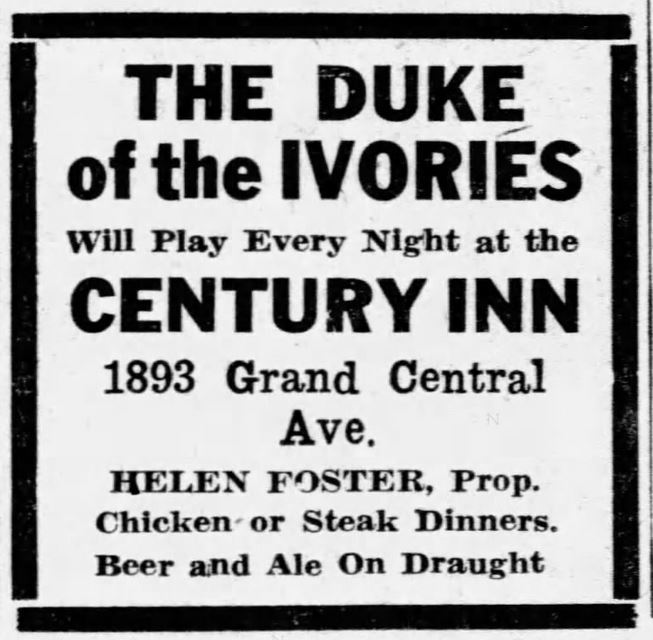
The hotel stayed open for several more years under the Foster proprietorship and its character seemed unchanged. Henry Foster was charged with violating prohibition law in May 1928 and again that November. On August 1932, the location’s bad luck reared its head again when the Fosters’ barn, workshop, and garage containing three automobiles and a large quantity of tools were destroyed by fire. By 1933 their daughter Helen M. Foster had taken over operations. That year, she was granted a license to sell beer and wine at the newly rebranded Century Inn.

Star-Gazette, May 12, 1934

In the late 1930s, the Fortuna family took ownership of 1893 Grand Central Avenue and ran it as the Fortuna Inn. The bad luck that clung to the place seemed to be mostly held at bay until 1961. That was when Thatcher Glass decided to expand their operations. In order to do so, they needed an easement to a portion of Grand Central Avenue that was held by Katherine Fortuna. After not being able to get their way when dealing directly with her, Thatcher representatives went to the City Planning Commission and had them secure the easement despite Katherine’s objections. Thatcher did construct a new entrance to the property and the Fortuna Inn continued to operate as a restaurant and tavern until the early 1990s.

Misfortune struck one last time on June 10, 2015. The former hotel, boarding house, tavern, and inn had sat abandoned for years when fire broke out. It was heavily damaged and eventually torn down, thus ending its years of woe.


Monday, September 5, 2016

The Elmira Vocational School

By Kelli Huggins, Education Coordinator

Since my turn to write our weekly blog post has fallen on Labor Day, I thought that this would be a perfect opportunity for me to share some images of the Elmira Vocational School, which are part of one of my favorite photograph collections at the museum. The Elmira Vocational School was public school in the Elmira district. It opened in 1913 to teach boys mechanical, industrial, and construction trades. The school opened in an abandoned building owned by the city at 717-721 Lake Street.  The building needed significant remodeling to make it a working school, but that challenge itself provided an important opportunity for the school. In fact, the students did most of the remodeling as part of their course work. This involved building classrooms and workrooms, doing plumbing and electrical work, and metal work and carpentry.

Above: Students working on concrete forms for new school building annex
Below: Framing done by students on the school building

Students’ time in school was divided equally between traditional book work and their vocational training. The school taught intermediate and high school boys. Intermediate students (those who had completed 6th grade) took a two year course before they had the opportunity to move on to the high school program.
Above and below: students in various workshops and classrooms at the school, learning carpentry, plumbing, metalwork, and drafting.
                           

 The Elmira Vocational School was operating at a time of new emphasis on formalized vocational training.  A few years ahead of its time, the school was already in operation for four years before the 1917 Smith-Hughes Act, or the National Vocational Education Act, gave federal funds to states to support job training in business and industry, agriculture, and home economics.
Getting a lesson about electricity
Learning how to use the lathe.
Ultimately, the school’s success led to it being merged with Southside High School in the mid-1920s. Its methods and faculty served as the foundation for the new vocational program at the high school.  

Monday, April 18, 2016

Farrington Stoneware

by Erin Doane, curator

Stoneware was widely popular in the United States in the 19th century. The pottery was fired at extremely high heat, making it very durable and suitable for daily use. Many companies that made stoneware stamped their names on the pieces they made. Just recently, CCHS received a collection of stoneware stamped “E.W. Farrington.” The company produced drain tiles and fire bricks as well as stoneware pottery. The pottery bore the marks “J. Farrington & Co. / Elmira, N.Y.,” “E.W. Farrington,” and “E.W. Farrington & Co. / Elmira, N.Y.”
E.W. Farrington stamp on a piece of stoneware
James B. Farrington came to Elmira around 1862 from Havana, New York (now Montour Falls). Two years later, his wife and children joined him here. In 1868, he and Orin C. Walter took over a local pottery manufacturing business. Albert O. Whittemore had built the stoneware factory in 1865 at 900 East Church Street. Whittemore also operated a similar plant in Havana. The Elmira factory was next to the Chemung Canal so clay and other supplies could be brought in by water and finished products could be shipped out the same way.

Large crock made by E.W. Farrington
In 1876, Orin Walter left the business and was replaced by a man named Everard. At that point the business changed its name to Farrington and Everard. After Everard died in 1881, James Farrington brought his son E. Ward into the business and the company name became J.B. Farrington and Company.

Advertisement from the 1885 Elmira city directory
Upon the death of his father in July 1887, E. Ward Farrington took over the company and operated it himself under the name E.W. Farrington & Co. On February 16, 1894, a note in the Elmira Daily Gazette and Free Press announced that “the pottery of Ward Farrington on East Church Street has been shut down, owing to the oversupply of earthen wares on hand and no market. Seven employes (sic) are thrown out of employment.” In 1913, a fire destroyed the storehouse located in the rear of the old pottery works. E. Ward Farrington remained listed in the Elmira city directories as a seller of stoneware until 1916. Perhaps the business no longer manufactured pottery but still sold it. In 1917, E.W. Farrington was listed as selling only wood and coal.

Three E.W. Farrington stoneware jugs
While the factory was in operation, the crocks, jugs, and pitchers produced by Farrington were sold to various businesses and individuals. Different sizes of jugs were used by wholesale and retail wine and liquor sellers here in Elmira including J.J. O’Connor, John M. Connelly, Fred Ferris, and C.E. Vinton. The number on the side of many of the jugs indicates how many gallons of liquid it could hold.


E.W. Farrington stoneware jugs used by
local businesses in three different sizes
Stoneware butter crocks made by Farrington were also used by creameries such as the Atwater Brothers.

Atwater Bros. butter crock made by E.W. Farrington
One interesting thing about the Farrington pottery factory was that none of its owners were potters. They were all businessmen who relied on their hired craftsmen to do the actual work. This may not be at all unusual for businesses today but it marks Farrington as one of the few potteries in New York State that was owned for its entire history by men who were untrained as potters.

Stoneware spittoon made by E.W. Farrington
The recent donation of eleven pieces of Farrington stoneware is a great addition to CCHS’s collections. The museum now has examples of the many different shapes and sizes of jugs, crocks, and other pieces that were made by the company and used by other local businesses.


E.W. Farrington jug used by the
Family Liquor Store of Elmira