Showing posts with label Chemung County Historical Society. Show all posts

Monday, January 26, 2026

A Unique Opportunity for Change


by Bruce Whitmarsh, Executive Director

CCHS Executive Director, Bruce Whitmarsh
Throughout 2025 the Chemung County Historical Society Board of Trustees worked on updating their own internal operations. The result is a new committee structure that in 2026 the Board will be working on to bring into full use. The goal is to make better and more efficient use of the talents that are present on the Board. In much the same manner, the CCHS staff holds annual staff retreats where we spend a full day away from our desks, even traveling offsite, just to discuss and plan for our upcoming year. This includes thinking about what exhibits to produce, what programming to offer and what changes we may wish to see as a staff. This discussion then guides our day-to-day work for the remainder of the year.

In December of 2025 I learned that I had been awarded the Leadership Advancement Award from the Community Foundation of Elmira-Corning and the Finger Lakes to allow me the chance to take an extended sabbatical from my position as Director. The Board of Trustees, staff and I are currently planning for me to be away July, August and September of this year. Given the planning work mentioned above, this may seem like the opposite of what is needed but just bear with me for a moment.

The use of sabbaticals as part of a non-profit executive compensation package is still a relatively new, but growing, idea. The opportunity for me to take a sabbatical actually comes from the Community Foundation granting a sabbatical to their president, Randi Hewitt, a few years ago. Upon her return, she and the Community Foundation as a whole, found that they had both benefitted with Randi refreshed and reset while the organization had developed new operational capabilities and resilience during her extended break. The success of this experiment led to the establishment of the Leadership Advancement Award that is now permitting me to step away later this year.

Prior to applying, I reached out to my colleague Elaine Smith, Executive Director at Tanglewood Nature Center and Museum. Elaine had been awarded one of the first Leadership Advancement Awards two years ago. As I was considering whether to apply myself or not, she shared her positive experience with her own sabbatical. The chance to step away from the day-to-day of her organization and take the time to pursue some of her interests gave her the chance to refresh and refocus. The proof for this is the Tree top Canopy that Tanglewood will begin construction on in 2026. This has been a multi-year fundraising effort, with more work to come, but her time off allowed Elaine the necessary break to come back with more determination and energy to now bring this project to a successful conclusion.

In the same manner, I am looking forward to getting away myself. I will do some traveling and plan to attend a woodworking class, supported by the grant. I will also spend some time in my own workshop, trying to complete some half-finished projects as well. I am confident that during my time away the Board and staff will be able to manage the everyday operations of the CCHS and that I will be ready to take on the big projects we have started talking about for 2027. This is all a bit theoretical at the moment, but I will be sure to follow up here with all of you at the end of this year to let you know how things turned out.


Monday, February 12, 2024

100 Years of History

By Erin Doane, Senior Curator

On November 7, 1923, the Elmira chapter of the Sons of the American Revolution held a meeting. At that meeting, the organization’s president Dr. Arthur W. Booth proposed the creation of a historical society to preserve historic objects, documents, and stories. The first official meeting of the Chemung County Historical Society took place two weeks later with 75 people in attendance.

The Historical Society’s first home was in two rooms on the upper floor of the Steele Memorial Library on the corner of Lake and Church Streets (now the Chemung County Chamber of Commerce). The rooms quickly filled with donations from the community. Members of the society presented talks about local history and created displays of historic objects in the library for the public to enjoy.

Chemung County Historian Clark Wilcox stands in one of the
Historical Society’s rooms in the Steele Memorial Library, 1947
The Historical Society received its charter from New York State in 1947. Shortly after, they began searching for a stand-alone building to house the collections and provide more space for displays. In 1953, the Historical Society moved into 425 East Market Street and Frances Brayton was appointed as its first professional curator.

The Chemung County Historical Center on Market Street, 1950s
It was around this time that Historical Society also began searching for the mammoth tusk that had been found by Judge Caleb Baker along the Chemung River in 1778. (Read all about that tusk and the Historical Society’s search for it here) While they were not able to find the original, they were able to get a similar mammoth tusk from the American Museum of Natural History in New York City.

Mammoth tusk on display at the Historical Society, 1950s
 The Historical Society relocated again in 1965 to 304 William Street.

The Chemung County Historical Center on William Street, 1976

The mammoth tusk and all the other historic objects, documents, and photographs that had been donated over the previous 40+ years were moved into their new home. Many of the objects were used in new exhibits focused on topics we still explore in the museum today - life here in the 1800s, the Civil War, local organizations and schools, and, of course, Mark Twain. Materials that didn’t go on display went into storage. Unfortunately, one of the main storage spaces in the building was the basement, which proved disastrous during the 1972 Flood. (click here to read how the Historical Society reacted to the flooding)

The mammoth tusk on display on William Street, 1976

The Chemung County Historical Society moved one more time to its current location at 415 E. Water Street. The building was originally home to the Chemung Canal Bank starting in 1833. After the bank moved into new headquarters, the building housed law offices and apartments. It underwent major renovations in the late 1970s and opened to the public as the Chemung County Historical Society in 1982. In 1986, the Historical Society received accreditation from the American Alliance of Museums (AAM). It was reaccredited most recently in 2021. Less than 5% of museum in the United States are accredited by the AAM. In 1992, further renovations to the building took place. An addition that includes the Howell Gallery, the Frances Brayton Education Room, and the Barn Gallery, as well as a new entranceway, was added to the main building.

415 E. Water Street, late 1970s
The Chemung County Historical Society currently operates the Chemung Valley History Museum and the Booth Research Library. Our mission is to deepen our understanding of history and to provide an appreciation of our community’s place in state and national history. We’ve done this over the last 100 years by collecting, preserving, interpreting, and presenting the history of our community and we plan to continue this mission for the next 100 years.

And, yes, the mammoth tusk is still on display.

The mammoth tusk at E. Water Street, 2014


Monday, November 27, 2023

Participation

by Susan Zehnder, Education Director


At 5 am on November 7, 2023, our executive director arrived at work to unlock the museum’s doors. It was New York State’s General Election Day, and the Chemung County Historical Society welcomed voters from county districts 09-05/11-04, and 11-05. Poll workers arrived, set up, and were open for voters at 6 am. Polls closed at 9 pm. Before the end of the day, more than 200 people walked through the doors and our archivist stayed until 10 pm to lock up.

Many voters had never been in our building before. After voting, they took advantage of the museum’s free admission for the day to explore. Others took a quick look around, vowing to come back to see more. We even had a few tell us they wanted to donate items to our collection.

It was the first time CCHS was a polling site. In the United States, the majority of polling places are located in public schools. This makes sense because they are situated throughout the community. Most school buildings have good accessibility features, and are designed with large rooms, like gymnasiums or cafeterias, which can accommodate polling equipment and poll workers. Schools also have sufficient parking to handle the flow of traffic.

Unfortunately, what makes less sense, is the disruption Election Day can bring to schools and student routines. Concerns about safety make it more problematic.

We thought we could help and in the fall of 2022, we contacted the Chemung County Board of Elections. We have ample parking, a good-sized education room, and our museum is all on one level. Local Election Board officials visited then sent an independent inspector to evaluate voter accessibility. There were a few things that needed to be addressed, but overall, the officials agreed CCHS would be a good site and we were granted the right to host an election in the spring.

The New York State Board of Elections is responsible for defining all New York State election laws and rules for each of the state’s 62 counties. The Board mandates what the national, state, county, city, and town elections look like on the local level tasking local administration to the Chemung County Board of Elections. Local boards also provide election supplies to villages, fire districts, and school districts that conduct their own elections. They register eligible citizens to vote, and they perform various public education services including providing information to candidates seeking elective office. Local boards also accept and rule on voter petitions.


The Chemung County Board of Elections consists of two Election Commissioners. The commissioners are elected by county committees of their same political party and must be approved by the county legislature. Each are supported by two Deputy Commissioners and office staff.


According to the Chemung County Board of Elections, as of May 2023, the county has 55,480 registered voters. The unofficial results from November 7th, indicate that only 9,063 voters or 16% of eligible voters cast their vote. The election results aren’t official until after the required recount on November 22nd since races in Districts 1, 2, and 4 remained too close to call.


Voting, or having a voice in their government, is a key part of democracy. The United States is founded on the idea of freedom, and our nation’s history contains the struggle of different groups of Americans fighting to secure their vote. Voting reflects how engaged the public is.

According to the Brennan Center for Justice, a nonpartisan policy and law institute inspired on the work of United States Supreme Court Justice William J. Brennan, Jr., more states, about 19, have recently passed legislation making it harder to vote. Some of these laws require people to present IDs, or they take away the vote from anyone previously convicted of a felony. Others severely restrict early and absentee voting, and remove voters’ names from lists if they haven’t recently voted. Since 2020, only 17 US states have passed legislation making it easier to vote. Is voting important? In reference to the 16% of Chemung County voters who voted on November 7th, Chemung County’s Democratic Committee Chair Jamal Malik recently said, “The future of the city council is in the hands of a very few people. I think it was like 17% of the eligible voters came out and voted. So, every vote counts, and it's important that people get engaged, civically get engaged, not just be registered to vote, but actually go out and vote and that's the message that needs to be crystal clear to everyone.”

We hope that county voter engagement grows. Since the Chemung County Historical Society collects history through artifacts and documents of the County, we have items from elections more than 100 years old. We’ve been sharing some of these online in our weekly posts. This past fall, we were also pleased to be selected by the Smithsonian Institution’s Museums on Main Street program to be one of twelve sites to host a traveling exhibit called Voices and Votes. We won’t be getting the exhibition until fall of 2025, but have started planning for an accompanying display and programs to highlight voting in Chemung County. We’ll be sharing more details about this exciting project in the future.

Granted, 5 am was a pretty early start to the day, but well worth it to participate in local democracy. 

To see more about voting in Chemung County's past, check out our online exhibit Vote! Chemung County  

 Voting machine used from 1962 - 1982, CCHS Collection

Monday, July 10, 2023

Behind the Scenes

 By Monica Groth, Curator


This year, the Chemung County Historical Society celebrates its 100th anniversary. To kick off our commemorative year, we’ve opened the exhibit It’s About Time: Celebrating 100 Years of the Chemung County Historical Society.

This exhibit is truly special – it gives you, the viewer, a behind the scenes look into the sort of work the Historical Society does. What is it we’re up to all day? What’s the point of having us around? It also features some great objects, specifically a 1923 American LaFrance Brockway Torpedo Fire Engine, and photos and documents discovered in our institutional archives and displayed for the first time.

The gallery being prepared for installation

The exhibit endeavors to answer questions people might have about the purpose of a historical society:

How do we add new items to the collection?

·        Well, donated items are assigned special numbers, known as accession numbers, when they are accepted into our collection. In the exhibit, you can see examples of how we write that number on different materials – fabric, paper, earrings made of human hair…

How do we take care of the collection?

·        Keeping stuff in good shape for over a hundred years is no mean feat. In this section of the exhibit, we’ll explain how materials break down as they age. Temperature and humidity must be kept in check in all storage areas and galleries to prevent chemical reactions or mold growth from occurring. Check out the equipment we use to monitor the climate in our collections. Look through a microscope at an example of mold that can damage historic items. Check out the magnified verdigris forming on a 150-year-old mechanical pencil, and watch as light causes a modern newspaper to fade over time.

This case highlights how different materials, including wood, metal, glass, and cotton age.

A magnified view of the common mold of the genus Aspergillus seen through a microscope lens. Molds can cause great damage to museum collections if relative humidity (average moisture in the air) is not kept between 30-55%

How do we design exhibits?

·        It’s been a unique experience for me, the curator, to install an exhibit about exhibits. Exhibitions are planned months in advance and require the help of many collaborators. There are always engineering projects that I encounter when installing an exhibition. For example, the image below showcases a stained-glass window lit from behind by an array of lights constructed specifically for this display (many thanks to volunteer Kevin Wechtaluk for assisting me with its creation)!

These three objects simplify the exhibit process from research to completion

How do we recover from disaster?

·        Following the flood of 1972, nearly 60% of the Society’s library was damaged (or outright lost). Volunteers painstakingly worked to rescue items, freezing a lot of archival documents to slow their deterioration. Many items in our collection still bear signs of flood damage. Interestingly, a lot of our donation records were destroyed in the flood. When going through the institutional archives in researching this exhibit, we found far fewer records before that fateful year. On display, you can check out a severely waterlogged and muddy visitor register kept at the Museum (then located at 304 Williams St.) at the time of the flood.


 How do we help researchers?

·        As a society, we want to make our county’s history accessible to anyone interested in learning about it. Our Booth Library, named for our founder Arthur Booth (whose 1928 wool suit is also on display in the gallery), is open to researchers interested in looking through the maps, letters, books, and documents which comprise an archive of over 100,000 items.

Archivist Rachel Dworkin by the Library's shelf of Elmira City Directories

 How do we teach local history?

·        Since the society opened its first public museum in 1954, students have been welcomed into the Museum. Many county residents will recall their elementary school trips inside our doors to this day. Be sure to see our Educator Susan Zehnder’s June 12th blog featuring our most recent visitors. Beyond school programs, we’ve hosted excursions to historic sites around the country (including up the Mississippi River), created escape rooms, and organized antique shows. Of course, our ever-popular GhostWalk remains a favorite October event. This year, we’ve invited you all to our Birthday Party on August 26, 2023!

 How else do we share stories?

·        How do we reach out to people who can’t visit the Museum? Well…this blog is one example of our growing reach! Since our first Journal was published in 1955, we’ve created a lot of literature from which people can learn. The internet allows us to reach a worldwide audience today and we hope you continue to keep up with us here on our blog and across our social medias!

 Whose history do we tell?

·        As a society which preserves our county’s history, it’s important to ensure we are including the stories of all. For example, our Black Oral History Project highlights black voices in Chemung County, our new gallery guide pamphlet series leads visitors through the museum by focusing on different perspectives, and our Heritage Exhibit Series focuses on the history of a different immigrant community every 6 months.


We also include Native American perspectives; this pair of beaded moccasins on display was made by the Seneca


Monday, June 12, 2023

Young Historians at the Museum

 by Susan Zehnder, Education Director

As a child on a field trip to a history museum, I remember being awestruck as I walked around a dugout canoe. It looked so different from any pictures I’d seen in books. It seemed larger than canoes floating in a nearby lake, and the texture of axe marks almost looked like a pattern with a secret message. I wondered who made it, why they made it, and where they might have traveled with it. It was a mystery and I wanted to learn more. The Historical Society seeks to ignite that same kind of awe and curiosity in Elmira’s children today.

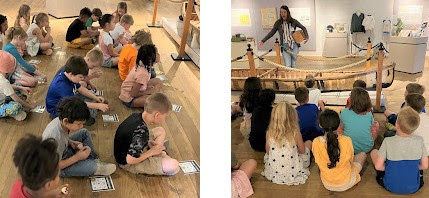
As this year’s public-school calendar nears the finishing line, the Historical Society has recently hosted close to 400 Elmira City School District (ECSD) second graders and their teachers. Each 90-minute visit to the museum means that our small staff of five, including the Executive Director, Archivist, Curator, and Office Manager drop everything and join me to help out.  We want students to feel welcome, that they belong here at the museum, and we want them to see themselves connecting to local history. Knowing that for many students it will be their first time visiting a museum, we give them the tools to understand what museums are and what a history museum holds.

We’ve designed these end-of-year visits to reinforce their school lessons and connect to the six topics we cover when we visit their classrooms. Visiting each class multiple times helps to build trust in the students and teachers who work so hard. The six visits culminate at the end of their second grade with a field trip to the museum. This program connecting students to a deeper understanding of history and a sense of place was piloted in 2015, starting with just one school in the district. Today the program includes 120 in-class visits with 60 classrooms in four schools. When the second graders finally visit the Chemung Valley History Museum, they see for themselves the actual size of artifacts they’ve only seen pictures of in the classroom. They also see the enormous number of items on display in the galleries, part of a collection that is constantly growing in size and variety. The range of items almost guarantees that each student will see something that interests them. Overall, it can make a powerful impression on them, and their excitement often inspires us to look at history and the items that we hold in new ways.  

Often hosting 60 students at a time, we rotate them through three stations. To make sure they move around the museum, students go on a scavenger hunt in the Bank gallery looking for artifacts and documents that span the Devonian age to the Space age.

Scavenger hunt
Next, after seeing the building’s original bank vaults, they play bingo by solving simple math problems.  

Bank Bingo

A
nd lastly, students capture something they’ve seen in the galleries by creating drawings which they take home.

Riverside 2nd graders with their artwork

Ninety minutes pass quickly, and we encourage them to come back and teach others about what they’ve learned. For the museum staff, comments like ‘this is the best day ever,’ ‘I’m definitely coming back,’ and ‘I didn’t know the mammoth tusk was so big’ can be the best reward ever.

Young Historians with drawings of Bike, Tusk, and Radio

Throughout the year, we host other school groups visiting for programs on natural disasters, the Underground Railroad, notable Elmirans, and writing like Mark Twain. But this ECSD program is unique for its multiple visits and topics. Statistics show that if children visit museums while young, they are more likely to feel welcomed and more likely to visit museums, any museum, as adults. The Chemung County Historical Society is marking its 100th year of operations*, and while the museum collections we hold are from the past, sharing artifacts and documents from history, they are really here for future generations.  We invite you all to visit the museum this summer and bring a young historian along.

And maybe discover a little awe for yourself.

*On August 26, 2023, from 1 pm to 5 pm we are hosting a birthday party featuring the Excelsior Cornet Brass Band, history talks, open galleries, and cake. Free admission for all.


Monday, January 3, 2022

Posting Blogs

 by Susan Zehnder, Education Director


What do faces of the depression, a shortage of dictionaries, and Arctic explorer Ross Marvin have in common? If you read our blogs, you can easily answer that question because each showed up in one of our blog posts this year.

Most of CCHS's blogs are written on a rotating basis by our archivist, curator and education director and have published weekly since February 6, 2012. Adding the 48 new blog posts from 2021 brings our grand offering to 514 blogs containing different stories of Chemung County history. The collection has been viewed close to 500,000 times. Send us a suggestion if you have a topic we haven't covered and we always appreciate your comments. Here are the top five viewed blogs of 2021, in order of popularity, see if you remember any of these:

1.     February 8th  Elmira’s First Black Fire Fighter A blog profiling the life and accomplishments of Thomas J. Reid, Jr.  In addition to being the first Black Fire Fighter in Elmira, Reid was also known for his inventions.


2.     February 15th The Neighborhood House and E.O. P. shared the history behind this 143 year old organization and its place in our community.


3.     January 4th Capturing the Local Faces of the Great Depression A little known connection between a Chemung County family and Farm Security Administration photographers documenting rural conditions.


4.     A follow up blog published January 25th The Maki Family of Rumsey Hill, revealed more of the story of one of those families photographed.


5.     March 8th Elmira HistoryForge: Discovering Local Stories written by our HistoryForge coordinator Andrea Renshaw, outlined the launch of this exciting project and how to get involved in documenting local history.

It’s not easy to predict which blogs will be the most popular, and we're often surprised. We choose topics because we’ve uncovered something new, or we want to share what's going on at the museum. Sometimes it may take longer for a blog to be discovered.  Years after being published, relatives of Elmiran Edward Brooks came across a blog written about his life. They traveled to Elmira to visit the museum and share his story with their children. It was a moving experience for them and for us. 

Here are blogs from last year which we think deserve another look:

1.     July 12th L. Libbie Adams and her Youthful Enterprise A blog connecting our Printing exhibit and the story of a young girl printer from the late 19th century who battled odds and made a living from writing, editing, and publishing her work.


2.     June 18th Revisiting Juneteenth, was a revised blog outlining the holiday’s origins and meanings.


3.     July 26th Jury Duty look at role of Jury duty in the United States, and how it has been practiced in the county.


4.     Viewing the Civil War, published last May 31st shared the topics and brief background of our three spring speakers and their contributions.


5.     November 8th’s Veterans Day shared some of the important work being done connecting veterans and local history organized by a local elementary school teacher.

     Of all the blogs we've published since 2012, the one which has been viewed the most was written in 2015 by our former Curator Erin Doane. The Holding Point and POWs published in January of that year shared the history of the WWII military camp located in Horseheads, NY.


 Erin was instrumental in putting together Hidden Lives of Chemung County, a book CCHS published this year. On sale at the museum or online, the book contains a collection of lesser known stories of  some amazing people in Chemung’s history.


Sharing our community’s history through blogs, is something we will continue in 2022. We’re happy when our viewers share too, just be sure to give us credit for our work when you do.

Monday, October 4, 2021

It Takes a Village

 by Susan Zehnder, Education Director

CCHS has a small but mighty staff. Getting all the things we do done can often mean that we need help. We are grateful for our volunteers who help us out in so many different ways, and they are our ‘village.’ Volunteers have represented CCHS at different events, set up systems to make our work smoother, created inventories to keep track of journals, prepared activity bags for students, took tickets, greeted people at museum functions, scanned photos, and completed information documenting our collections. One volunteer even tested out our Ghost Walk path to make sure that this year it will be wheelchair friendly. When we pivoted to more online work, we found volunteers who worked remotely transcribing recordings from our collection, and others who videotaped and posted dramatic readings of past historical figures. By no means is this a comprehensive list but here are some of our volunteers along with a few of the things they’ve been working on. They also answered what cool discovery they’ve come across while volunteering.

Karen puts in about 10 hours a week at the Historical Society, helping out on all sorts of projects. Lately, she's put her previous background in lab work to use taking precise notes and entering information to reconcile the museum's stored collections. One of the cool discoveries she's come across was the original 1870 marriage certificate of Samuel and Olivia Clemens. Another surprise she came across was a beautiful array of intricate bone, stone, and ivory Inuit carvings. Karen started volunteering in 2019 greeting visitors at the front desk and for the past two summers she has sat at our information desk at Wisner Park during Thursday market days, spreading the word on the Museum's new exhibits and events. She also pitched in to help with last year's Ghost Walk. We have been lucky that Karen called us to volunteer and share her time and efforts helping us get our work done.

Karen and Susan sitting at Wisner Park

Daniel is another volunteer who contacted us looking to add to his academic and archive skills and experience. He has been putting in about 8 hours over two days a week organizing the Elmira Central Christian Church information. The Historical Society received many of the Church’s boxes of papers and information to organize, put into boxes and folders, and document. When asked what discovery he’s found, Daniel mentioned how working with the collection has let him see an evolution of the organization and arch of their story over time. Daniel’s volunteer efforts are critical in keeping ahead of the archive’s continuously growing collections.

Daniel working with our collection

Bob remembers his history classes fondly while growing up. As a volunteer, he divides his 6-8 hours a week between greeting visitors and organizing our vast journal collection. A collection that started way before digital devices. Bob is a people person always quick with a smile, compliment or a joke. He says he loves to show people around the museum helping them discover new things about the area. Responding to the coolest thing he’s come across, he cites the old bank vaults (and is still searching out lost pennies!) Bob has enjoyed rediscovering some of the history right here in Elmira and Chemung County, and says he believes the Chemung Valley History Museum is a great place to find out more.

Bob greeting visitors at the front desk

Georgia has been volunteering at the Chemung County Historical Society on a steady basis since early 2017, documenting photos from our vast collection. She is also a loyal attendee at our Out to Lunch talks and programs. “I only thought I knew about our history in Chemung County, but once I started working with the photos I realized I didn’t have a clue about how much history there is in this area. I couldn’t pick just one thing that was really cool - I didn’t realize Babe Ruth had played at Dunn Field, that a canoe train that would bring the canoes to a designated area, or that there were two airports in Elmira – one near Caton Ave. and another where Broadway School is located. The list of things that existed in Chemung County that I have found out about is long and it has been a wonderful journey. I look forward to every time I volunteer – just waiting to see what I will discover next.” 


Georgia working on photo documentation

Georgia, like Karen, Daniel, and Bob are just a few of the people who help us get it done, and we thank them and all our volunteers for their contributions to the Chemung County Historical Society. If you're interested in getting involved, or find out more about what we do, send an email to Educator@ChemungValleyMuseum.org

Heather testing the Ghost Walk route


Monday, September 20, 2021

It's a Wrap


by Susan Zehnder, Education Director

This summer we were asked a number of questions that inspired new discoveries, more questions, a couple of laughs, and even a possible ghost story. Who asked these questions? One of the seventy participants who accompanied us on one of our nine Walking Tours this summer. We’ve finished our tours for the season, and met people from out of state, and others whose families have lived here for generations. Either way, everyone now knows a little more about the area’s architectural details, hidden stories, and some frisky gossip.

Here are some highlights, in case you missed them. Our Architectural Tour of Maple Avenue was led by archivist Rachel Dworkin who walked and talked pointing out examples of architectural house styles through the years. If you’re a regular to this blog, you’ll see a more comprehensive explanation of what she shared in the previous two blogs.


Our Historic Tours started at the museum, using the bank building as a time marker. The Chemung Canal Bank was built in 1834, designed by architect Ammon Beardsly. The structure is the oldest commercial building in the city and today houses the Historical Society and History Museum. Over the next hour the tour passed other buildings along Lake Street, heading north to Church Street, west to Baldwin Street, south to Water Street and after passing the distinctive 1971 Chemung Canal Trust Company Bank we looped back to the museum. Along the way we mentioned over 23 different blogs we’ve written with connections to history. It might be true stories about the buildings, streets, or people that lived in the area and the topics we covered were as diverse as 19th century billiards to 20th century smut. We’ve always said we don’t have a blog about the Adult Book Store on Lake…..yet. Perhaps this mention counts?


Our third tour was a fun 1913 Gossip Tour which also lasted an hour. Here our curator Erin Doane walked a similar route to the historic version, but shared stories that were darker, and a bit more titillating. You’ll have to join us next year if you want to hear those. A bonus to her tour, Erin wore a vintage dress for the stroll. She also wore a hat she claimed she bought in the Amazon, or was that on Amazon? Her stories were the rumors and gossip of the day. Who thought Lake Street would have so many murders, hangings, or surprised mistresses over the years.


Our summer Walking Tours have come to a close. We’re busy getting ready for a different kind of walk - our 15th annual Ghost Walk around Woodlawn Cemetery. We’re excited to offer three different options this year over three different days and tickets are going quickly. If a historic cemetery walk at dusk or in the dark interests you, check out the details on our website today.

We enjoyed ourselves leading the walks, and were so pleased to hear others did too. We were also lucky with the weather for 8 of the 9 tours. The last one took place in drenching rain, which was maybe a fitting end to the season.

Monday, August 2, 2021

Part of History

by Susan Zehnder, Education Director

Can you identify this century old artifact from the CCHS collection?


It’s one of the objects I asked nine year old students to think about during this year’s Summer Cohesion Program from the Chemung County Youth Bureau. CCHS has participated in this program for several years, and though it had to go strictly online in summer of 2020, instead of bringing students to the museum, the Summer Cohesion staff were determined to carry on. We were proud to be involved, and we congratulate the program staff on receiving the Program of Merit Award by the Genesee Valley Recreation & Parks Society, and the Program of Merit by the New York State Recreation & Park Society.

Thankfully, this year’s visits resumed in person. However, instead of field trips out in the community, students stayed put and we visited them. To do this, I created a portable museum complete with artifacts, and an activity.

Sitting in a circle, the students put on curator’s gloves and passed around the mystery artifact. Its function isn’t obvious, and I asked them to share what they noticed about it. I wanted them to comment on things like the object's size, texture, weight, and materials - not what they thought it was. This exercise helps them look a little longer and avoid making conclusions or assumptions about an object. In the end, all the students were surprised when I revealed that the object was placed in a fire to absorb heat and used to keep people’s beds warm in the wintertime.

Then I shared another artifact - a diary written in the fall of 1918 by Clara Gilbert, a fourteen-year-old girl from Elmira.


Students talked about what a diary is and why people might keep a journal or diary.

If you follow our blogs, you’ll know in March 2020, when COVID-19 first started to shut down schools and businesses, our archivist shared some of Clara Gilbert’s diary entries in a post titled The First Quarantine. Clara writes about her school being closed, events cancelled, and having to stay home. She shares her excitement about school cancellation, then her boredom at home, then the strangeness of returning to school at last. Students talked about how Clara described much that was familiar to them, while other aspects of the time were very different.

Each student then received their own diary to keep and the students broke up into groups to interview each other. The idea was to come up with questions Clara might ask if she time-traveled to 2021. What would seem familiar to her and what would seem different. Students recorded their questions and answers to each other on small voice recorders which we purchased from a QuickArts grant for this project. (Parents gave us permission ahead of time to save student answers and images.)

Some students were surprised that someone from a century ago went through experiences similar to theirs. When they talked about their own experiences with the pandemic, many talked about how hard it was to wear masks. Some mentioned how much they missed their best friends and teachers when school went online. Others mentioned how their computers kept breaking which made learning online even harder for them. Some talked about how they got to play with their sister, brother or best friend.

My hope is that these students gained an inkling of their own place in history, although that isn’t something a nine-year-old is likely to articulate. I was delighted, though, that one student said she enjoyed the history program because through it she got to know her classmates better.