Showing posts with label Elmira City School District. Show all posts

Monday, December 22, 2025

Unexpected History: Henry Keene's Flag

by Susan Zehnder, Education Director

This fall, I’ve been teaching students about the American flag. Almost 400 Elmira City School District first grade students have colored the United States flag and created a flag that represent themselves, and they are now hanging in our entry way. I encourage you to drop by to see them before we change exhibits in early January.


During my research into our museum's flag collection, I came across a flag that dates to the mid-19th century.


At first glance, it’s not very remarkable. The blue field of 34 stars is haphazardly printed, while the red and white stripes have been sewn together by hand. Any repairs, of which there are a few, are hand-stitched. What caught my attention was the story that goes along with it—the story of a man who experienced major parts of American history, from the Civil War to westward expansion and the building of railroads, before settling in Elmira, where he would be a prominent citizen for over forty years. 


The flag belonged to Henry L. Keene, born in 1847 in Erie, Pennsylvania, the son of Galen D. Keene and Anna B. Tierney. When he was young, his family moved to Buffalo, NY, where Henry attended public school. He was thirteen years old when the Civil War broke out, and at fifteen, he joined the 16th New York Volunteer Calvary. Throughout the war, his unit fought alongside the Army of the Potomac and saw action in more than twenty notable battles, including Gettysburg. They also helped to pursue and kill John Wilkes Booth, President Abraham Lincoln’s assassin. Members of the same regiment later stood guard at the prison where others connected to the president’s assassination were held. It was spring 1865.


In August of that year, Henry, now 18, was discharged from the Army. He returned to Buffalo and took a job with the American Express Company, then in the business of moving freight. In 1873, he married Catherine E. Dorst. When the westward push into the continent began, American Express, along with the Wells Fargo Express Company, put considerable effort into enlarging the country’s railroad system. Henry was sent to Kansas, where he worked on expansion and construction of a rail line between Kansas City and Denver. Some of Henry’s duties involved handling land skirmishes and “Indian fighting.”


During this period, he spent time at Cheyenne, Wyoming, and at Fort Hayes in Columbus, Ohio. It was at Fort Hayes that Henry became acquainted with General George Armstrong Custer and other U.S. military leaders. In 1876, the year Custer died at the Battle of the Little Bighorn (also known as the Battle of the Greasy Grass), Henry returned to Buffalo. In 1877, his and Catherine’s son Frederick was born, the first of their six children.


In 1887, Henry was appointed city agent for the Elmira, Cortland and Northern Railroad (later renamed the Lehigh Valley Railroad) and moved his family to Elmira. They lived at 550 West Washington Avenue.  

When he retired from the railroad, Henry took a job as chief clerk of records at the Reformatory, working under Zebulon R. Brockway, the institution’s influential superintendent. In this capacity, he worked with clerks at the Nappanock and Auburn prisons. His reputation for trustworthiness became widespread and well known. 


Henry was appointed Supreme Court crier for Chemung County, in charge of court business and order. He proudly served in the position until the political administration changed. 


He also maintained ties to the military and other veterans. He worked actively with the Grand Army of the Republic and served as the commander for the Baldwin Post, No. 6.  He was appointed trustee of the Soldiers’ and Sailors’ Home in Bath, NY, and served as president of the home for more than five years. In 1924, he was elected commander of the Department of New York’s annual encampment at Schenectady, an honor he called one of his greatest achievements.


Henry and Catherine had been married for fifty-one years when she died in 1924. Four years later, Henry, now 81, died from surgical complications. His daughter, Edna Keene Goodwin, held his funeral at her home at 262 Lyon Street in Elmira. It was common practice at the time to put the dead on display in the parlor for friends and family to pay their respects. The Rev. Albert Cornwell of The Park Church officiated, and Henry L. Keene was buried next to his wife in Woodlawn Cemetery. The newspaper noted the loss of one of Elmira’s prominent citizens.


The flag in question was donated to the Chemung County Historical Society in 1989 by a relative, H. Frederick Goodwin. While it is somewhat tattered, the story connected to its owner is remarkable.

Monday, November 24, 2025

Fun Facts

 by Susan Zehnder, Education Director

“I didn’t know that!” For the last few years, The Chemung County Historical Society has printed bookmarks with photos and biographical information about more than 20 different community leaders. Our mission, “to deepen the understanding of and appreciation for our community’s place in state and national history,” inspires us to continue to add more to our collection whenever we can, and we welcome any suggestions. Some of the people and their stories are quite well-known, while others may be more of a surprise.

Newcomers don’t always recognize the man with wild white hair smoking a cigar on the city’s Welcome to Elmira sign on Church Street. Nor do many younger people have any idea who the other people are. Our bookmarks help to share some of their stories. Hardly comprehensive, they act as small reminders of what people in our community have accomplished.

The bookmarks highlight local athletes, scholars, scientists, civic leaders, authors, inventors, politicians, lawyers, astronauts, and engineers from Chemung County. We pass them out at events and share local history.


This summer a ceremony was held to recognize renaming the former Madison Avenue Bridge over the Chemung River. Now known as the Allen-Berry Bridge, it honors two local Civil Rights leaders who did so much for the community: A’Don Allen and Bessie Berry. 

A'Don Allen (1916 - 1994)

Allen grew up in Elmira. He served with the Army Corps of Engineers in WWII and earned a bronze star on Okinawa. Upon his return, he became active in politics and was known as a prominent civic and community leader. In 1966, he became Elmira's first Black man appointed to the Civil Service Commission. Over the next thirty years, Allen held various government positions including that of deputy mayor for the City of Elmira.

Bessie Berry (1932 - 2008)

As president of the local NAACP, Berry supported “Black Dollar Days” to encourage people of color to use Susan B. Anthony dollar coins and $2 bills when making purchases to highlight the Black community’s economic impact. Berry became the first African American elected to the Elmira School Board and successfully pushed the district to recognize Martin Luther King Jr. day as a holiday.

(Hear an interview with Bessie Berry followed by a community discussion, by checking out https://www.youtube.com/watch?v=eGPjCQ32UHs )

In no way do we claim these bookmarks tell a complete story of any local leader. But we pass them out in hopes that they may spark curiosity to learn more about local history. To learn about the lives, contributions, and accomplishments people have made to our community.

The next time you pass over the Allen-Berry Bridge, we hope you think of some of the work these two did. Neither Allen nor Berry is pictured on the Church Street welcome sign, but they are part of our community’s story and certainly could be.

Monday, June 12, 2023

Young Historians at the Museum

 by Susan Zehnder, Education Director

As a child on a field trip to a history museum, I remember being awestruck as I walked around a dugout canoe. It looked so different from any pictures I’d seen in books. It seemed larger than canoes floating in a nearby lake, and the texture of axe marks almost looked like a pattern with a secret message. I wondered who made it, why they made it, and where they might have traveled with it. It was a mystery and I wanted to learn more. The Historical Society seeks to ignite that same kind of awe and curiosity in Elmira’s children today.

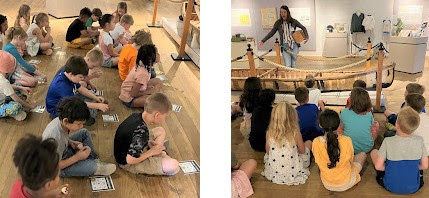
As this year’s public-school calendar nears the finishing line, the Historical Society has recently hosted close to 400 Elmira City School District (ECSD) second graders and their teachers. Each 90-minute visit to the museum means that our small staff of five, including the Executive Director, Archivist, Curator, and Office Manager drop everything and join me to help out.  We want students to feel welcome, that they belong here at the museum, and we want them to see themselves connecting to local history. Knowing that for many students it will be their first time visiting a museum, we give them the tools to understand what museums are and what a history museum holds.

We’ve designed these end-of-year visits to reinforce their school lessons and connect to the six topics we cover when we visit their classrooms. Visiting each class multiple times helps to build trust in the students and teachers who work so hard. The six visits culminate at the end of their second grade with a field trip to the museum. This program connecting students to a deeper understanding of history and a sense of place was piloted in 2015, starting with just one school in the district. Today the program includes 120 in-class visits with 60 classrooms in four schools. When the second graders finally visit the Chemung Valley History Museum, they see for themselves the actual size of artifacts they’ve only seen pictures of in the classroom. They also see the enormous number of items on display in the galleries, part of a collection that is constantly growing in size and variety. The range of items almost guarantees that each student will see something that interests them. Overall, it can make a powerful impression on them, and their excitement often inspires us to look at history and the items that we hold in new ways.  

Often hosting 60 students at a time, we rotate them through three stations. To make sure they move around the museum, students go on a scavenger hunt in the Bank gallery looking for artifacts and documents that span the Devonian age to the Space age.

Scavenger hunt
Next, after seeing the building’s original bank vaults, they play bingo by solving simple math problems.  

Bank Bingo

A
nd lastly, students capture something they’ve seen in the galleries by creating drawings which they take home.

Riverside 2nd graders with their artwork

Ninety minutes pass quickly, and we encourage them to come back and teach others about what they’ve learned. For the museum staff, comments like ‘this is the best day ever,’ ‘I’m definitely coming back,’ and ‘I didn’t know the mammoth tusk was so big’ can be the best reward ever.

Young Historians with drawings of Bike, Tusk, and Radio

Throughout the year, we host other school groups visiting for programs on natural disasters, the Underground Railroad, notable Elmirans, and writing like Mark Twain. But this ECSD program is unique for its multiple visits and topics. Statistics show that if children visit museums while young, they are more likely to feel welcomed and more likely to visit museums, any museum, as adults. The Chemung County Historical Society is marking its 100th year of operations*, and while the museum collections we hold are from the past, sharing artifacts and documents from history, they are really here for future generations.  We invite you all to visit the museum this summer and bring a young historian along.

And maybe discover a little awe for yourself.

*On August 26, 2023, from 1 pm to 5 pm we are hosting a birthday party featuring the Excelsior Cornet Brass Band, history talks, open galleries, and cake. Free admission for all.