Showing posts with label museum education. Show all posts

Monday, June 12, 2023

Young Historians at the Museum

 by Susan Zehnder, Education Director

As a child on a field trip to a history museum, I remember being awestruck as I walked around a dugout canoe. It looked so different from any pictures I’d seen in books. It seemed larger than canoes floating in a nearby lake, and the texture of axe marks almost looked like a pattern with a secret message. I wondered who made it, why they made it, and where they might have traveled with it. It was a mystery and I wanted to learn more. The Historical Society seeks to ignite that same kind of awe and curiosity in Elmira’s children today.

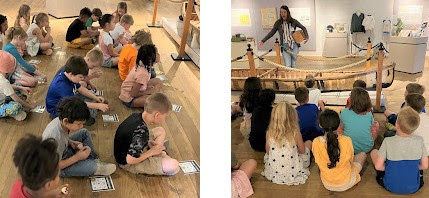
As this year’s public-school calendar nears the finishing line, the Historical Society has recently hosted close to 400 Elmira City School District (ECSD) second graders and their teachers. Each 90-minute visit to the museum means that our small staff of five, including the Executive Director, Archivist, Curator, and Office Manager drop everything and join me to help out.  We want students to feel welcome, that they belong here at the museum, and we want them to see themselves connecting to local history. Knowing that for many students it will be their first time visiting a museum, we give them the tools to understand what museums are and what a history museum holds.

We’ve designed these end-of-year visits to reinforce their school lessons and connect to the six topics we cover when we visit their classrooms. Visiting each class multiple times helps to build trust in the students and teachers who work so hard. The six visits culminate at the end of their second grade with a field trip to the museum. This program connecting students to a deeper understanding of history and a sense of place was piloted in 2015, starting with just one school in the district. Today the program includes 120 in-class visits with 60 classrooms in four schools. When the second graders finally visit the Chemung Valley History Museum, they see for themselves the actual size of artifacts they’ve only seen pictures of in the classroom. They also see the enormous number of items on display in the galleries, part of a collection that is constantly growing in size and variety. The range of items almost guarantees that each student will see something that interests them. Overall, it can make a powerful impression on them, and their excitement often inspires us to look at history and the items that we hold in new ways.  

Often hosting 60 students at a time, we rotate them through three stations. To make sure they move around the museum, students go on a scavenger hunt in the Bank gallery looking for artifacts and documents that span the Devonian age to the Space age.

Scavenger hunt
Next, after seeing the building’s original bank vaults, they play bingo by solving simple math problems.  

Bank Bingo

A
nd lastly, students capture something they’ve seen in the galleries by creating drawings which they take home.

Riverside 2nd graders with their artwork

Ninety minutes pass quickly, and we encourage them to come back and teach others about what they’ve learned. For the museum staff, comments like ‘this is the best day ever,’ ‘I’m definitely coming back,’ and ‘I didn’t know the mammoth tusk was so big’ can be the best reward ever.

Young Historians with drawings of Bike, Tusk, and Radio

Throughout the year, we host other school groups visiting for programs on natural disasters, the Underground Railroad, notable Elmirans, and writing like Mark Twain. But this ECSD program is unique for its multiple visits and topics. Statistics show that if children visit museums while young, they are more likely to feel welcomed and more likely to visit museums, any museum, as adults. The Chemung County Historical Society is marking its 100th year of operations*, and while the museum collections we hold are from the past, sharing artifacts and documents from history, they are really here for future generations.  We invite you all to visit the museum this summer and bring a young historian along.

And maybe discover a little awe for yourself.

*On August 26, 2023, from 1 pm to 5 pm we are hosting a birthday party featuring the Excelsior Cornet Brass Band, history talks, open galleries, and cake. Free admission for all.


Monday, November 8, 2021

Veterans Day

 by Susan Zehnder, Education Director

With Veterans Day coming up, it’s a good time to think about how we can teach children why November 11th is a special day. It’s also a great time to ask yourself how much you really know about how this holiday was created and how it has evolved over the years.

Teacher John Liquori and his first grade class

Elmira City School District elementary teacher John Liquori is taking a new approach this year to teach students about Veterans Day. He is taking advantage of Fassett's physical location in the community by connecting students to nearby organizations. With the help of area veterans and community members, the Vietnam Veterans Memorial War Museum, the John W. Jones Museum, and the Chemung County Historical Society, he arranged a special program for Fassett’s nearly 100 first graders. 

On Monday November 8th, students will spend two hours rotating through 5 different stations to build their understanding of what Veterans Day is all about. They'll meet local veterans, learn about the Vietnam War Memorial Museum, hear about care and treatment of the American flag, see uniform medals from local veterans who served in different military branches, and learn about an important contribution Elmiran John W. Jones made for veterans during the American Civil War.

For others, here’s a quick refresher course on Veterans Day. It began in 1919, when November 11th was known as Armistice Day (an armistice is an agreement by opposing sides to stop fighting). The armistice for World War I took place on the eleventh hour of the eleventh day of the eleventh month, making the date of November 11th historically significant. At first, celebrations commemorating the soldiers were community driven. The day was officially recognized in 1926 by congress and became a national holiday in 1938.

In 1954, President Dwight D. Eisenhower, a veteran himself, decided that November 11th would be the country’s official day to recognize all military veterans’ service and sacrifice. He renamed the day Veterans Day and issued the first Veterans Day Proclamation:

In order to insure proper and widespread observance of this anniversary, all veterans, all veterans' organizations, and the entire citizenry will wish to join hands in the common purpose. Toward this end, I am designating the Administrator of Veterans' Affairs as Chairman of a Veterans Day National Committee, which shall include such other persons as the Chairman may select, and which will coordinate at the national level necessary planning for the observance. I am also requesting the heads of all departments and agencies of the Executive branch of the Government to assist the National Committee in every way possible.

Veterans Day would continue to honor those who fought in WWI, and would now include veterans who served in other wars. It would pay tribute to all American veterans, both living and dead. It would recognize and honor those who served their country with honor during wartime or in peace.

The original idea was for citizens to observe the day with parades, public speeches, and meetings. Businesses were asked to pause for 2 minutes of silence and reflection at 11:00 am. In Chemung County, in anticipation of the first Veterans Day, the Star-Gazette published this quiz:


(See answers below.)

The 10 questions show how closely the new Veterans Day was initially tied with WWI’s Armistice Day.

In 1968, congress shifted the day to the fourth Monday of every October. The intention was to create more three-day weekends for federal employees and to promote travel, cultural activities, recreation, and commerce. What it mainly did was confuse people. Many states didn’t comply with the change and stuck to celebrating on November 11th.

In 1975, President Gerald Ford, who was also a veteran, returned the official recognition date to November 11th to realign it with the original importance of the date.

Today, many organizations around the nation hold Veterans Day observances, and volunteers refresh grave sites of military personnel, adorning them with new flags. In 2021 there are approximately 19 million living US veterans. Gone are the country’s WWI veterans, and dwindling are the numbers for WWII vets still alive, hovering somewhere around 240,000.

The restoration of the observance of Veterans Day to November 11 preserved the historical significance of the date, and turned the lens to the day’s important purpose. Teaching new generations that it is a day to celebrate and honor America's veterans for their patriotism, love of country, and willingness to serve and sacrifice for the common good, carries on that significance.

Thank You Wreath created for Veterans by Liquori's class


November 10, 1954 Star-Gazette