Showing posts with label artifacts. Show all posts

Monday, July 10, 2023

Behind the Scenes

 By Monica Groth, Curator


This year, the Chemung County Historical Society celebrates its 100th anniversary. To kick off our commemorative year, we’ve opened the exhibit It’s About Time: Celebrating 100 Years of the Chemung County Historical Society.

This exhibit is truly special – it gives you, the viewer, a behind the scenes look into the sort of work the Historical Society does. What is it we’re up to all day? What’s the point of having us around? It also features some great objects, specifically a 1923 American LaFrance Brockway Torpedo Fire Engine, and photos and documents discovered in our institutional archives and displayed for the first time.

The gallery being prepared for installation

The exhibit endeavors to answer questions people might have about the purpose of a historical society:

How do we add new items to the collection?

·        Well, donated items are assigned special numbers, known as accession numbers, when they are accepted into our collection. In the exhibit, you can see examples of how we write that number on different materials – fabric, paper, earrings made of human hair…

How do we take care of the collection?

·        Keeping stuff in good shape for over a hundred years is no mean feat. In this section of the exhibit, we’ll explain how materials break down as they age. Temperature and humidity must be kept in check in all storage areas and galleries to prevent chemical reactions or mold growth from occurring. Check out the equipment we use to monitor the climate in our collections. Look through a microscope at an example of mold that can damage historic items. Check out the magnified verdigris forming on a 150-year-old mechanical pencil, and watch as light causes a modern newspaper to fade over time.

This case highlights how different materials, including wood, metal, glass, and cotton age.

A magnified view of the common mold of the genus Aspergillus seen through a microscope lens. Molds can cause great damage to museum collections if relative humidity (average moisture in the air) is not kept between 30-55%

How do we design exhibits?

·        It’s been a unique experience for me, the curator, to install an exhibit about exhibits. Exhibitions are planned months in advance and require the help of many collaborators. There are always engineering projects that I encounter when installing an exhibition. For example, the image below showcases a stained-glass window lit from behind by an array of lights constructed specifically for this display (many thanks to volunteer Kevin Wechtaluk for assisting me with its creation)!

These three objects simplify the exhibit process from research to completion

How do we recover from disaster?

·        Following the flood of 1972, nearly 60% of the Society’s library was damaged (or outright lost). Volunteers painstakingly worked to rescue items, freezing a lot of archival documents to slow their deterioration. Many items in our collection still bear signs of flood damage. Interestingly, a lot of our donation records were destroyed in the flood. When going through the institutional archives in researching this exhibit, we found far fewer records before that fateful year. On display, you can check out a severely waterlogged and muddy visitor register kept at the Museum (then located at 304 Williams St.) at the time of the flood.


 How do we help researchers?

·        As a society, we want to make our county’s history accessible to anyone interested in learning about it. Our Booth Library, named for our founder Arthur Booth (whose 1928 wool suit is also on display in the gallery), is open to researchers interested in looking through the maps, letters, books, and documents which comprise an archive of over 100,000 items.

Archivist Rachel Dworkin by the Library's shelf of Elmira City Directories

 How do we teach local history?

·        Since the society opened its first public museum in 1954, students have been welcomed into the Museum. Many county residents will recall their elementary school trips inside our doors to this day. Be sure to see our Educator Susan Zehnder’s June 12th blog featuring our most recent visitors. Beyond school programs, we’ve hosted excursions to historic sites around the country (including up the Mississippi River), created escape rooms, and organized antique shows. Of course, our ever-popular GhostWalk remains a favorite October event. This year, we’ve invited you all to our Birthday Party on August 26, 2023!

 How else do we share stories?

·        How do we reach out to people who can’t visit the Museum? Well…this blog is one example of our growing reach! Since our first Journal was published in 1955, we’ve created a lot of literature from which people can learn. The internet allows us to reach a worldwide audience today and we hope you continue to keep up with us here on our blog and across our social medias!

 Whose history do we tell?

·        As a society which preserves our county’s history, it’s important to ensure we are including the stories of all. For example, our Black Oral History Project highlights black voices in Chemung County, our new gallery guide pamphlet series leads visitors through the museum by focusing on different perspectives, and our Heritage Exhibit Series focuses on the history of a different immigrant community every 6 months.


We also include Native American perspectives; this pair of beaded moccasins on display was made by the Seneca


Monday, February 6, 2023

Collecting Objects

 by Susan Zehnder, Education Director


Last year, someone accused us of collecting objects just to squirrel them away into drawers. A thought that if true, might explain the overflowing condition of the museum's storage areas. Drawers, closets, and storage rooms around the building are full of artifacts and documents connected to life in Chemung County. The Historical Society doesn't collect items just to accumulate them, we collect them to tell a more complete story of Chemung County’s history. That story is more fluid than many people think.

Items on display and in the archives come mostly from donations. Before being added to the collection, they are reviewed by a committee made up of members of the public, staff, and board members. Staff at the museum are trained to evaluate an item’s potential and the reasons why things are declined vary. Sometimes it’s because we already have an item, or the item has no connection to Chemung County. Other times, items are in poor condition, or we’re not able to care for them properly. Only when the committee feels an item helps tell a more complete story of the area, is it accepted. Our collection is constantly growing, and currently the number of items we hold is well into the hundreds of thousands. 

No matter what anyone thinks, museums are not neutral spaces, and that might be different if humans weren’t involved. It’s also the reason your grandparents' visit to the Chemung Valley History Museum does not look exactly the same as yours today. For instance, the Barbie lunchbox on display in the Bank Gallery often surprises people.

Barbie Lunch box 1984

The museum's mission-- 

To deepen our understanding of history and to provide an appreciation of our community's place in state and national history

requires us to constantly refresh our understanding of what our community looks like in order to tell the stories.

A great example of this can be seen in our new exhibit, “Faces of Chemung County.” At first glance on display in the Howell Gallery, are nine framed portraits from our permanent collection. The portraits capture a likeness of each person and show off the artists’ skills. But, and here’s where art museums and history museums differ, the images are accompanied by artifacts, carefully chosen to tell more of each person’s story.

Faces of Chemung County exhibit

From the paintings and drawings, we learn about the person by noticing what is and isn’t included. Asking questions -- what are they wearing, are there any objects included in the image, what is their posture, how are they wearing their hair, what hand gestures are they making, or even what color of clothes they have on -- gives us information from the artists' point of view. It is a visual story. The artists have left nothing to chance, no choice is random. Yet, the two-dimensional images tell only part of each person's story. The  artifacts nearby add depth to our understanding. Their physical presence reminds us the people were real.  

The reason each artifact was included varies.  Objects  might have belonged to the person, or might be linked to them in some other way. For example, near the portrait of Colonel Liscom, who fought in the Civil War, there's a saddle and blanket. The saddle is from the time period but he didn't own this one. The saddle blanket was one he owned, but came from a slightly later time period. We've included objects that might be tools of their trade, evidence of their social class, bits from hobbies, or might even reference something about them now missing or unrecorded. And by the way, the object that the donor feared we were squirreling away is currently on display in this exhibit.

"Faces of Chemung County" is not about rewriting history, it’s about using what we know in the 21st century to step back and get a deeper understanding of particular people, events, and stories from our past. Here, we have the advantage of stepping into nine different pairs of shoes to better understand who these people were in society, what choices they made, and the pathways they followed. We can see how their lives might seem similar or different from our own.

Better understanding the past helps us make sense of our current events, society, and culture and can guide our future choices.

The Historical Society is continuing to add to our collection and we are currently searching for objects to include in an upcoming exhibit on Polish culture. This is the first of many ethnic groups planned for future exhibits, and we encourage you to think about donating items to help preserve our county’s history for generations to come.

 Museum hours are 10 am - 5 pm Monday through Saturday.


Monday, November 28, 2022

Faces of Chemung County

by Monica Groth, Curator

The display surrounding Julia Stancliff Reynolds,
one of nine individuals featured in our newest exhibit

The Museum’s upcoming exhibit Faces of Chemung County features the portraits of nine distinct individuals. Each face has a unique past and story, and this exhibit invites you to step into the frame. A deeper look into the lives of those depicted reveals that in addition to great differences, our characters also share similarities across time and space. Viewing them side by side helps the visitor compare their contexts and contemplate the lives they lived in relation to each other – human lives filled with the same heartbreak, sacrifice, and perseverance present throughout all of history.

Julia Renolds (left) and Rachel Gleason (right):
notice their difference in dress as well as frame

Julia Reynolds (1836-1916) and Rachel Gleason (1820-1905) both led long lives. As women born in the early nineteenth century, they were subjected to many societal expectations –including the expectation to marry. Julia, born an Eldridge, married twice, experiencing a heartbreaking widowhood followed by a bitter separation from her second husband. She then lived independently abroad and in New York City for the last twenty-five years of her life. Julia was a wealthy woman and readers may remember that her mansion, nicknamed "Fascination" was mentioned in a previous blog of mine.  

Rachel’s husband, Silas, supported her desire to become a physician and encouraged her interest in medicine. Rachel became one of the first women in the United States to receive a medical degree, graduating from Central Medical College in Rochester, NY in 1851. Rachel knew that women not only experienced discrimination in what careers were open to them, but were also deprived of sound medical care. At the time, male doctors dismissed women as hysteric patients and many considered it “indecorous” to discuss female health problems. Rachel therefore specialized in treating women and educating them about their health. She lectured often and promoted her book Talks to my Patients, in which she wrote candidly about women’s health topics. She worked with Silas at Elmira’s Water Cure, established on the city’s East Hill in 1852, and even delivered Samuel Clemens’ (Mark Twain’s) daughters, being Livy Clemens’ personal physician. Both Julia and Rachel lived through Elmira’s Gilded Age, Rachel defying expectations on the city’s East Hill in order to reach success, and Julia fulfilling the responsibilities of a wealthy hostess downtown only to find it very lonely indeed.

Isaac Baldwin (left), Thomas Kane (middle), Colonel Liscum (right)

Beside each other in the exhibit are a young lad and an old gentleman – a 150 year old rocking horse, bedecked in a fine small saddle and bridle, within a few feet of a saddle blanket actually used in combat. Colonel Emerson Liscum (1841-1900), the owner of that saddle, died whilst leading a charge on the walled city of Tien-Tsin, China during the Boxer Rebellion. A career soldier who enlisted in the Union Army at only 19 years old, Emerson married Elmiran May Diven after the Civil War ended. May received a sorrowful letter accompanying the saddle blanket now in the Historical Society’s collection, expressing condolences over the loss of her husband. Known as Old White Whiskers, Liscum’s last words “Keep up the fire” became the motto of the 9th US Infantry he commanded, and a monument and ornate silver bowl were commissioned in his honor. 

Young Isaac Baldwin (1869-1949), likely the proud rider of a rocking horse similar to that one on display, is only nine years old in his portrait. His childhood was comfortable, as his father was a wealthy real-estate mogul, and it is memorialized in the exhibit through toys from the 1870s-1880s. Among Baldwin’s associated objects are a toy cannon and game pieces from a political board game, reminding viewers of the irony of children playing at war and politics when soldiers like Liscum were in the midst of very real conflicts. 

Another veteran in this exhibit enlisted eighty years after Liscum at nearly the same age. Elmiran Pvt. Thomas Kane (1923-1978) was 20 years old when he joined up in WWII. USO artist Freda Reiter captured his likeness in a sketch while he was convalescing in a French military hospital a year later. His portrait, in between the innocent youth and the battle-hardened soldier, gives one a look into the eyes of a young man experiencing the trials of a very different war. Happily, Pvt. Kane survived his wounds and went on to a very successful career in the Postal Service.

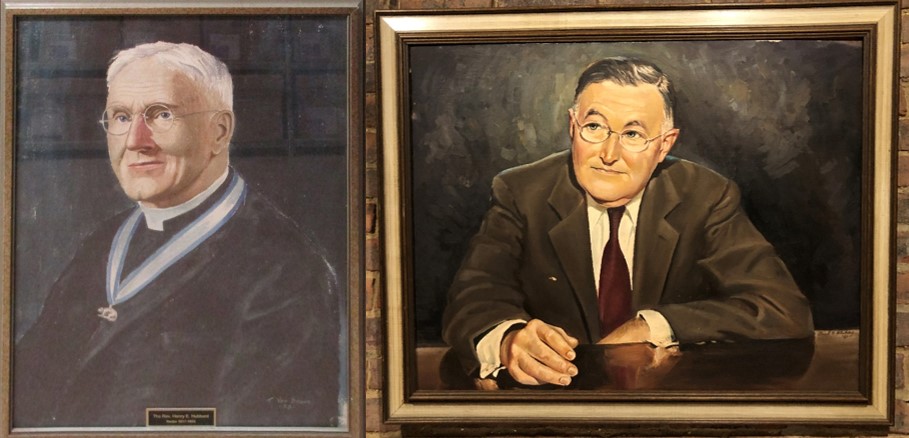
Reverend Henry Hubbard (left); Harry York Iszard (right)

Kane may have known two figures who now make their entrances – Harry York Iszard (1893-1971) and Reverend Hubbard (1873-1957). The portraits of these two men were painted within two years of each other, the Reverend’s in 1953 and Harry’s in 1955. The 50’s were a time of great post-war growth in Chemung County, as citizens across the country recovered from the war. Harry Iszard inherited S.F. Iszard’s Department store upon his father’s death. He opened a new branch in the Arnot Mall and sponsored the annual holiday parade to increase business, a tradition which continues to this day. Hubbard served as rector of Trinity Episcopal Church from 1917-1953, retiring the year this portrait was painted. Archival documents reveal his congregation was very grateful for his leadership during both World Wars, and that he was a champion of programs for young people. Though one served the material needs of the community and the other its spiritual, these two be-speckled gentlemen had a great impact on their community.

Native American Woman tentatively identified as Sha-ko-ka of the Mandan tribe (left);
Black Woman tentatively identified as a member of the Williams and Underwood families (right)

It is equally important to draw attention to those individuals who are not always remembered by history – those who do not come from privileged backgrounds and are marginalized due to gender and race. The identities of two individuals in this exhibit have been lost to history. The first portrait is of a Native American Woman. Her portrait is thought to have been painted by the prolific western artist George Catlin. From 1830-1838 Catlin toured the native tribes of the American West, creating a portrait gallery.  In traveling up the Missouri River around his final years of work, he encountered the Mandan tribe of the Heart River area of North Dakota. There he painted a young woman named “Mint”, or Sha-ko-ka in her native language. This young woman bears some resemblance to the subject of the portrait we are now displaying and may be a rendition of her in different dress. Sha-ko-ka, like many Native Americans in the early 19th century, were wrongly viewed as exotic people part of a romanticized past rather than as individuals with rights. Continued Westward Expansion, of which Colonel Liscum was later a part, pushed Mandan people from their ancestral lands and afflicted many with smallpox and disease. 

Another unidentified portrait in our collection is that of an African American woman, tentatively identified as Elmer Underwood’s mother and a member of the Williams extended family. The Black community in Chemung County faced much discrimination in housing, education, and employment throughout the late 1800s, the approximate date of this portrait. Yet, many political action groups fought against this injustice, including Colored Citizens of Elmira and the Elmira chapter of the NAACP. Five members of the Williams family were founding members of the city’s chapter of the NAACP, created in 1942, and worked to advance the status of the county's Black community. 

History is filled with unrecorded stories and the circumstances and biases which prioritize some lives whilst relegating others to footnotes. Both of these women’s portraits reveal unrecorded lives we must recognize in telling the county’s story and highlight our mission to turn historical omissions into learning experiences.

Faces of Chemung County is currently being installed. Visit the Museum to view the objects which accompany these portraits and see if you can identify more similarities and differences among them.

Monday, December 14, 2020

Souvenirs from a Doomed Voyage

by Erin Doane, Curator

The purpose of the Lady Franklin Bay Expedition from 1881 to 1884 was to establish a polar research station near Lady Franklin Bay on Canada’s Nares Strait north of Greenland. The expedition was funded by the U.S. Congress, managed by the U.S. Army Signal Corps., and led by Lieutenant Adolphus Greely. Twenty-five men began the voyage into the Arctic in 1881, but only seven,* including Greely, survived. Uncooperative weather, poor planning, unsuccessful resupply attempts, interpersonal conflicts, and all around bad luck led to disaster. (You can read about it in more detail here.)

No one in the expedition had strong connections to Chemung County (that I am aware of), so why am I writing about it? Well, the museum has a collection of 19 items that are labeled “Greely Expedition 1881-1884.” Later Arctic explorers collected these souvenirs from the doomed voyage. The items include tobacco tins, a pipe, a lid to a brandy keg, various size ammunition, pieces of rope and chain, and fur mittens purportedly used during the Lady Franklin Bay Expedition and abandoned at Fort Conger in the northeast of Ellesmere Island where Greely had set up his basecamp in 1881.

Selection of items in the collection marked "Greely Expedition 1881-1884"

So, how did these items get to CCHS? One of the pieces, the brandy keg lid, has this description in the database:

Brought back by Ross Marvin while on his 1905-1906 Arctic expedition with Admiral Robert E. Peary. This lid from a brandy keg is from the HMS Alert, a British Navy ship that was part of an 1875-1876 British Arctic Expedition. They reached Ellesmere Island. Then the Greely Expedition in 1881 reached the same spot on Ellesmere Island, but the expedition became infamous because only 6 of 24 members survived.* In 1905-06, Admiral Peary's expedition stopped at the same spot and found the site where Greely had been. Ross Marvin brought back relics from the site.

Wooden keg lid with the words “HMS Alert” and “Brandy” just discernible

Elmiran Ross Marvin was a member of Robert Peary’s 1905-1906 and 1908-1909 Arctic expeditions. (You can read more about him here.) Marvin kept journals during both voyages and wrote about finding the keg lid on September 2, 1905:

…Found the remains of a cache made by English Party, H.M.S. Alert, on northern shore of bay. Contents were used later by sledge trips of the Greely Party. Found one box containing 9 tins of boiled beef, frozen and well preserved. Secured head of an old cask…. 

Ross Marvin’s journal, September 2, 1905

I feel confident that the “head of an old cask” he found among the remains of the HMS Alert’s cache is indeed the wooden keg lid in the collection. While the lid did not originate with the Greely Expedition, it was among the other items found at Fort Conger. Marvin’s journal entry from September 5, 1905 mentions that he “found a souvenir for myself,” but does not go into detail. There is no way of knowing if he was referring to any of the other items we have here at the museum.

The other items in the collection may not have been collected by Ross Marvin at all. A general note on the collection reads:

Professor Donald MacMillan of Peary's expedition found the remnants of Greely's base camp at Fort Conger. The items here were brought back from Peary's expedition by Donald MacMillan.

This note made me wonder. I have done quite a lot of personal research on Ross Marvin, his two expeditions into the Arctic with Peary, and his untimely death there in 1909. I had never read anything indicating that MacMillan ever came to Elmira, let alone donated a collection of objects to the Historical Society. Donald MacMillan (who later became a significant Arctic explorer and researcher in his own right) was on Peary’s 1908-1909 Arctic expedition with Ross Marvin. He certainly would have had the opportunity to collected souvenirs that had been left behind on previous voyages as Marvin had done three years prior. But how did those items end up here?

I found a clue to this mystery when I learned that MacMillan was a longtime friend of James Vinton Stowell. Stowell was an Elmira artist, archaeologist, and explorer. He traveled into the Arctic four times, including once with MacMillan in 1946 to Northern Labrador. In 1967, Stowell donated his extensive collection of Native American and Arctic artifacts to the Chemung County Historical Society.

The Seal Hunters, oil on canvas by James Vinton Stowell, 1958

Since Stowell donated one collection of items to the museum, was it possible that sometime along the way he made another donation of items that had been collected by MacMillan during his voyage with Peary in 1908-1909, then given to Stowell as a gift to a fellow polar explorer and friend? Maybe. Maybe not. There is no proof of such a thing, but it is fun to speculate about how such an interesting collection got here. 


* I have found sources that say six men survived and others that say seven. Naval History Magazine; International Journal of Naval History, and the New England Historical Society all have articles that indicate seven men survived; PBS, the National Museum of American History, Nature Magazine have articles indicating six survived. I’m not sure which is correct. Similarly, some sources report that there were 24 men on the voyage, others 25.

** On September 9, 2026, Roman H. Cain, Ph.D. Student in Arctic & Northern Studies at the University of Alaska reached out to explain why different sources list different numbers of survivors of the expedition. He wrote:

When Greely and the survivors were discovered by Winfield Scott Schley's relief expedition in 1884, the came across seven living members: Adolphus Greely, David Brainard, Maurice Connell, Henry Biederbick, Julius Frederick, Joseph Ellison, and Francis Long. However, Joseph Elison/Ellison died on the ship, the Neptune, as a result of his injuries sustained as a result of the expedition/travel to Camp Clay, leaving only six survivors to return to the United States. 

This is why some sources say six, while other say seven. Some of them count Ellison as a survivor, while others do not. A great resource for this is the 1886 Greely Relief Expedition report written by Schley in the aftermath.

Thank you Roman!