Showing posts with label Exhibit. Show all posts

Monday, November 28, 2022

Faces of Chemung County

by Monica Groth, Curator

The display surrounding Julia Stancliff Reynolds,
one of nine individuals featured in our newest exhibit

The Museum’s upcoming exhibit Faces of Chemung County features the portraits of nine distinct individuals. Each face has a unique past and story, and this exhibit invites you to step into the frame. A deeper look into the lives of those depicted reveals that in addition to great differences, our characters also share similarities across time and space. Viewing them side by side helps the visitor compare their contexts and contemplate the lives they lived in relation to each other – human lives filled with the same heartbreak, sacrifice, and perseverance present throughout all of history.

Julia Renolds (left) and Rachel Gleason (right):
notice their difference in dress as well as frame

Julia Reynolds (1836-1916) and Rachel Gleason (1820-1905) both led long lives. As women born in the early nineteenth century, they were subjected to many societal expectations –including the expectation to marry. Julia, born an Eldridge, married twice, experiencing a heartbreaking widowhood followed by a bitter separation from her second husband. She then lived independently abroad and in New York City for the last twenty-five years of her life. Julia was a wealthy woman and readers may remember that her mansion, nicknamed "Fascination" was mentioned in a previous blog of mine.  

Rachel’s husband, Silas, supported her desire to become a physician and encouraged her interest in medicine. Rachel became one of the first women in the United States to receive a medical degree, graduating from Central Medical College in Rochester, NY in 1851. Rachel knew that women not only experienced discrimination in what careers were open to them, but were also deprived of sound medical care. At the time, male doctors dismissed women as hysteric patients and many considered it “indecorous” to discuss female health problems. Rachel therefore specialized in treating women and educating them about their health. She lectured often and promoted her book Talks to my Patients, in which she wrote candidly about women’s health topics. She worked with Silas at Elmira’s Water Cure, established on the city’s East Hill in 1852, and even delivered Samuel Clemens’ (Mark Twain’s) daughters, being Livy Clemens’ personal physician. Both Julia and Rachel lived through Elmira’s Gilded Age, Rachel defying expectations on the city’s East Hill in order to reach success, and Julia fulfilling the responsibilities of a wealthy hostess downtown only to find it very lonely indeed.

Isaac Baldwin (left), Thomas Kane (middle), Colonel Liscum (right)

Beside each other in the exhibit are a young lad and an old gentleman – a 150 year old rocking horse, bedecked in a fine small saddle and bridle, within a few feet of a saddle blanket actually used in combat. Colonel Emerson Liscum (1841-1900), the owner of that saddle, died whilst leading a charge on the walled city of Tien-Tsin, China during the Boxer Rebellion. A career soldier who enlisted in the Union Army at only 19 years old, Emerson married Elmiran May Diven after the Civil War ended. May received a sorrowful letter accompanying the saddle blanket now in the Historical Society’s collection, expressing condolences over the loss of her husband. Known as Old White Whiskers, Liscum’s last words “Keep up the fire” became the motto of the 9th US Infantry he commanded, and a monument and ornate silver bowl were commissioned in his honor. 

Young Isaac Baldwin (1869-1949), likely the proud rider of a rocking horse similar to that one on display, is only nine years old in his portrait. His childhood was comfortable, as his father was a wealthy real-estate mogul, and it is memorialized in the exhibit through toys from the 1870s-1880s. Among Baldwin’s associated objects are a toy cannon and game pieces from a political board game, reminding viewers of the irony of children playing at war and politics when soldiers like Liscum were in the midst of very real conflicts. 

Another veteran in this exhibit enlisted eighty years after Liscum at nearly the same age. Elmiran Pvt. Thomas Kane (1923-1978) was 20 years old when he joined up in WWII. USO artist Freda Reiter captured his likeness in a sketch while he was convalescing in a French military hospital a year later. His portrait, in between the innocent youth and the battle-hardened soldier, gives one a look into the eyes of a young man experiencing the trials of a very different war. Happily, Pvt. Kane survived his wounds and went on to a very successful career in the Postal Service.
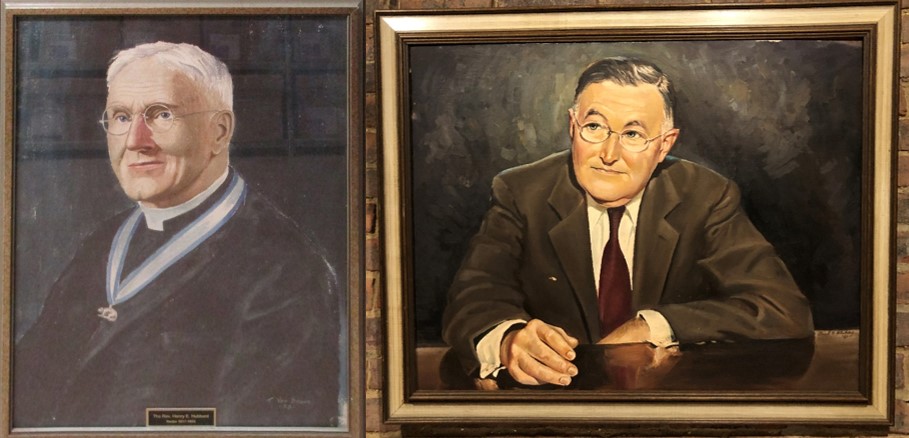
Reverend Henry Hubbard (left); Harry York Iszard (right)

Kane may have known two figures who now make their entrances – Harry York Iszard (1893-1971) and Reverend Hubbard (1873-1957). The portraits of these two men were painted within two years of each other, the Reverend’s in 1953 and Harry’s in 1955. The 50’s were a time of great post-war growth in Chemung County, as citizens across the country recovered from the war. Harry Iszard inherited S.F. Iszard’s Department store upon his father’s death. He opened a new branch in the Arnot Mall and sponsored the annual holiday parade to increase business, a tradition which continues to this day. Hubbard served as rector of Trinity Episcopal Church from 1917-1953, retiring the year this portrait was painted. Archival documents reveal his congregation was very grateful for his leadership during both World Wars, and that he was a champion of programs for young people. Though one served the material needs of the community and the other its spiritual, these two be-speckled gentlemen had a great impact on their community.

Native American Woman tentatively identified as Sha-ko-ka of the Mandan tribe (left);
Black Woman tentatively identified as a member of the Williams and Underwood families (right)

It is equally important to draw attention to those individuals who are not always remembered by history – those who do not come from privileged backgrounds and are marginalized due to gender and race. The identities of two individuals in this exhibit have been lost to history. The first portrait is of a Native American Woman. Her portrait is thought to have been painted by the prolific western artist George Catlin. From 1830-1838 Catlin toured the native tribes of the American West, creating a portrait gallery.  In traveling up the Missouri River around his final years of work, he encountered the Mandan tribe of the Heart River area of North Dakota. There he painted a young woman named “Mint”, or Sha-ko-ka in her native language. This young woman bears some resemblance to the subject of the portrait we are now displaying and may be a rendition of her in different dress. Sha-ko-ka, like many Native Americans in the early 19th century, were wrongly viewed as exotic people part of a romanticized past rather than as individuals with rights. Continued Westward Expansion, of which Colonel Liscum was later a part, pushed Mandan people from their ancestral lands and afflicted many with smallpox and disease. 

Another unidentified portrait in our collection is that of an African American woman, tentatively identified as Elmer Underwood’s mother and a member of the Williams extended family. The Black community in Chemung County faced much discrimination in housing, education, and employment throughout the late 1800s, the approximate date of this portrait. Yet, many political action groups fought against this injustice, including Colored Citizens of Elmira and the Elmira chapter of the NAACP. Five members of the Williams family were founding members of the city’s chapter of the NAACP, created in 1942, and worked to advance the status of the county's Black community. 

History is filled with unrecorded stories and the circumstances and biases which prioritize some lives whilst relegating others to footnotes. Both of these women’s portraits reveal unrecorded lives we must recognize in telling the county’s story and highlight our mission to turn historical omissions into learning experiences.

Faces of Chemung County is currently being installed. Visit the Museum to view the objects which accompany these portraits and see if you can identify more similarities and differences among them.

Monday, January 31, 2022

Forever: Sending a Letter

 by Susan Zehnder, Education Director

Today “forever” costs fifty-eight cents. At least that’s what sending a one-ounce letter within the United States in 2021 costs. In October this year, the US Postal Service announced that first class mail may take them a little longer to deliver and for us to expect some letters and packages to arrive days later than in the past.

At this time of year, letters and packages keep the Post Office pretty busy. To appreciate how some things have changed, we invite you to view our current exhibit Going Postal. This exhibit is a fun look at mail service in Chemung County. 

Of course, mail was delivered in the colonies before the United States was a country, it was just delivered by anyone you might convince or pressure into carrying a message for you. As the colonies grew, Great Britain set up a mail system modeled after their own public mail service, one which had operated since the time of Henry VIII. The word post refers to the English mail service being carried from post to post. Each post had a master who would sort out and remove his area’s mail and return the rest to a post boy who then resumed delivery.

B. Franklin, Painting by J. Duplessis, 1778

In 1753, the Crown appointed Benjamin Franklin to serve as Joint Postmaster General for the colonies. During his tenure he established new mail routes, and erected sandstone mile markers known as Franklin Markers, to indicate distances. The changes Franklin made resulted in a faster and more reliable mail service. He even worked remotely as he spent much of the late 1750s in England. He audited postal statements and made decisions through the mail. Under his leadership, the postal service in the colonies turned a profit for the first time.

It was all fine until Franklin was implicated in leaking important letters sent between the British Crown and the British Governor of Massachusetts. Franklin, opposed to British rule, was dismissed from his post in 1774. Without his lead, the system began to fail.

In 1775, the Second Continental Congress created the United States Post Office. The drafted constitution of the United States, Article I, Section 8, Clause 7 gave Congress the power “To establish Post Offices and post Roads” to promote interstate communication and establish a source of revenue. Franklin was appointed its first Postmaster General. He was quick to rebuild his previous postal system, and it soon outperformed the British version. Franklin served in this position for a little over a year before he was appointed ambassador to France.

The Postal Service Act, signed by President George Washington in 1792 established unification, rules and regulations, and gave the Postmaster General greater powers under the United States Post Office Department. One of these was the ability to create postal routes to ensure that mail delivery would serve existing communities and expand as the new nation grew. It also allowed newspapers to be carried by the postal system at low rates. This helped spread information and improve communication throughout the young nation.

The title Postmaster General comes from the British model. For most of its existence in the United States, the position was part of the presidential cabinet. In 1971, the Post Office Department was reorganized into the United States Postal Service (USPS) by President Nixon. Since then, the Postmaster General is appointed by the Board of Governors and can only be removed by the board. Members are nominated to the board by the US President with the advice and consent of the Senate. The current Board of Governors consists of nine members in addition to the Postmaster General and the Deputy Postmaster General.

The USPS is the only delivery service that reaches every address in the nation, both personal and business. It receives no tax dollars for operating costs relying on postage sales and services to pay for funding. For the past few years, USPS has operated at a loss. Much of the blame for this is misunderstood.

In 2006, the Postal Accountability and Enhancement Act was passed to address USPS financial issues. The act requires the USPS to deliver mail six days a week; prohibits increasing postage faster than the rate of inflation; and prepays benefits for all their employees for at least fifty years. The prepaid benefits is something no other organization does, and many think it is to blame for their growing deficit. The Postal Service Reform Act (2021) was introduced last May with bi-partisan support to undo some of the 2006 changes.


The USPS is the nation’s 2nd largest civilian employer and there are 15 Post Office branches in the county to serve us. Our Going Postal exhibit has uniform patches, photographs, stamps, and more fun facts about Chemung County’s mail service and is on display Monday through Saturday 10 am – 5 pm through the spring. Seeing some of the history behind receiving a personal letter or package makes that first class stamp even more of a bargain.


Monday, December 2, 2019

New Student Exhibit: The African American Experience in Chemung County

by Mr. John Liquori, 5th Grade Teacher, Horseheads Intermediate School

This is our country, as much as it is the country of any other race.... We may be the descendants of Africans, but we are citizens of the United States. This is our home... 
-Silas X. Floyd 

A large part of the 5th grade New York State Social Studies curriculum, which focuses on the history and governments of the Western Hemisphere, is the struggle for equality that happened to many groups of people in the United States throughout its history. This includes the Black struggle for racial equality, from the transatlantic slave trade and the Middle Passage all the way through the Civil Rights Movement and beyond. Black history is American history and the two should not be taught as if one is only a small part of the other. The Black experience in America is the backbone of the history of this entire nation--a nation built by slaves, torn apart by slavery, and suffers from a continuous struggle for human and civil rights that impacts us even today.

March 11, 1968 protest at Elmira City Hall
As a Social Studies teacher, one of my goals is to show students that any historical topic that can be studied in the broad context of American History can also be applied at the local level. For example, while the American Revolution was being fought throughout the entire thirteen colonies, locally, General Sullivan led a campaign through the Southern Tier which included the Battle of Newtown right outside Elmira. When the Civil War was ripping apart our nation in the 1860s, Confederate soldiers were dying in a prison camp called “Hellmira,” located on the banks of the Chemung River. There are always local ripples that affect the history of our entire country. When we begin to understand that the history of a nation is molded by local events and people, we can then truly understand why local history is so important. That is why in our classroom, American History is taught through a microhistory lens to where we live. This makes history relevant and it makes it real.

John Jones and Ernie Davis
 Starting December 5, there will be a new exhibit at the museum detailing the struggles and victories that local Blacks experienced as they fought for racial equality at home in Chemung County. This exhibit was created by a team of forty-four fifth grade students at Horseheads Intermediate School. These students, only nine and ten years old, were able to do the extraordinary task of taking primary and secondary source material and using it to tell the story from the perspective of those who lived and experienced the struggle for racial equality. This is a project the students worked on over a few months and the end product is incredible. In this exhibit, you will learn about the courage of John W. Jones and other abolitionists. You will learn about the humanitarianism of the Neighborhood House as they worked with local youth. You will read about the activism of the NAACP as they fought against injustices and empowered the Black people in this area. You will see beautiful visuals, including original artwork from Alsace Blandford and much more. There is so much that you will take away after visiting this exhibit. The African American Experience in Chemung County will be on display December 5, 2019 through January 11, 2020.

Orpheus Club party, 1942
Please join us on Thursday, December 5th, 5-7PM at the Chemung County Historical Society as we celebrate the 5th grade students and the important historical work they did to tell this history. There will be food and drinks, the opportunity to see and celebrate the new student-created exhibit, and also the chance to view the rest of the museum as well. This event is free and open to the public. We hope to see you there!

Monday, November 9, 2015

People Actually Do That?

by Erin Doane, curator

Someone once asked me what I did as a curator. I gave the short answer that I create exhibits in a history museum. The person looked at me incredulously and said, “I didn’t know people actually did that.” My immediate thought was sarcastic. No, people don’t create exhibits. If you believe in history hard enough, exhibits just appear in museums. My actual reply was that yes, I made exhibits and I really enjoyed doing it.

Just this past Friday, we finished the installation of our newest exhibit Clean, which examines what cleanliness is on physical, social, and spiritual levels and how people work to become clean. I say “we” finished it because this exhibit, like all of them at the museum, was very much a group effort. I head the exhibit team that includes our education coordinator Kelli and archivist Rachel. We work together to create educational, entertaining, interactive exhibits. And I think we do a great job.

Our newest exhibit: Clean
So, how exactly is an exhibit created? The first step is picking a topic. Some exhibits are based on the types of objects that are in the museum’s collection. A couple years ago we did an exhibit on wedding traditions because we have a good collection of wedding-related objects. We also did an exhibit on World War I posters because we have so many wonderful examples in the archives. Other exhibits start with an idea and then we work out what to put on display from there. Clean is a good example of this.  We usually have our exhibit topics selected at least a year from the opening date. (We are always looking for suggestions of what people would like to see so if you have an idea, let us know!)

A view of 'Til Death Do Us Part - a previous exhibit on wedding traditions
Once we pick a topic, we start researching and writing. We split up this task among the three of us on the exhibit team. There are usually around 9 to 12 main text panels exploring different aspects of the topic. Each panel has up to 100 words each. After conducting hours of research, it can be a real challenge to boil all that information down to just 100 words but years of experience have made it a fairly painless process. Once we’ve all done our individual research and writing we get together to review and edit the text. This can be a harrowing process at times but better text is always the end result.

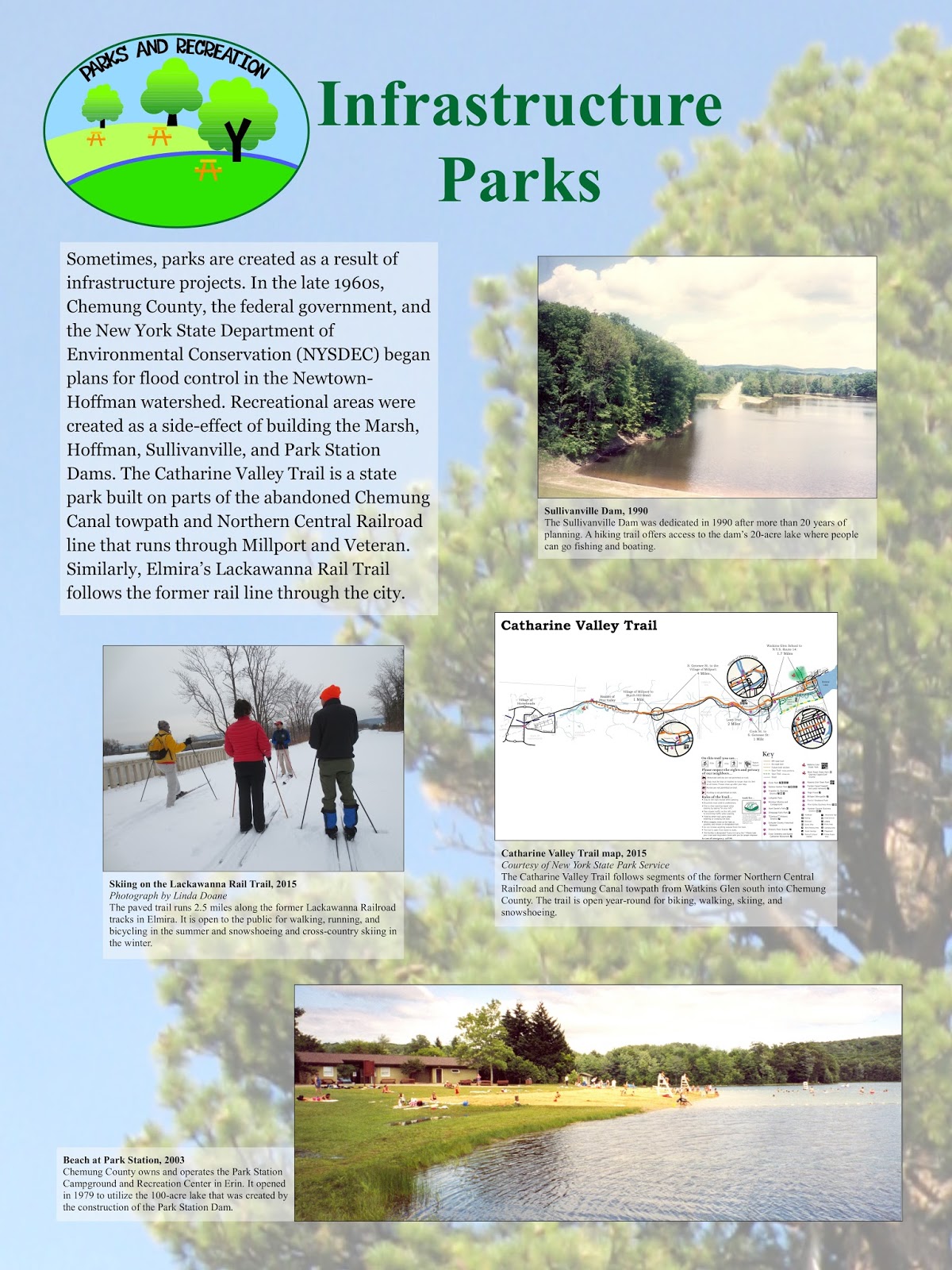
Text panel from Parks and Recreation
Once the main text is written a lot of things start happening all at once. We decide on the general style of the exhibit panels and I work on graphic design. Kelli designs and creates hands-on interactives for the exhibit. Rachel selects photographs and archival documents that will go on display while I select three-dimensional objects. I also work on the floor plan – where all the text panels, display cases, and interactives will go in the gallery. My favorite way to do this is with graph paper. I have scale drawings of all the galleries and little cutouts of display cases and other exhibit furniture. Moving things around on paper is a lot easier than moving them around in real life. I sometimes even dabble in Google SketchUp to get a 3-D view of my layout.

The Howell Gallery in SketchUp
Almost two years ago, we go a large scale printer through a grant from the Community Foundation of Elmira-Corning and the Finger Lakes. I love that printer! We can now produce our own graphics in-house. We can print up to 48” wide on various types of paper including satin photo paper and self-adhesive polypropylene. This has really streamlined the exhibit process. We no longer have to wait on graphics printed by an outside company and if I notice a typo that somehow slipped through our review I can instantly make a reprint. I have actually become quite adept at adhering large graphics onto foam board for display.

An example of a large (32"x60") text panel printed and mounted in-house
After months and months of planning, it’s finally time to install the exhibit. An installation usually takes one very long week to complete. It’s a tiring process to get everything precisely in place and ready for the public but I love doing it (despite the multiple bruises I get along the way). There is something very rewarding about pulling an idea out of the air and making it into a concrete visual experience. Creating exhibits is by far one of my favorite duties as a curator.

Housework-related artifacts in Clean
If anyone is interested in all the other stuff I do on a day-to-day basis as a curator, check out A Curator’s Day on tumblr.

Monday, August 17, 2015

When Needle, Thread, and Fabric Meet

by Erin Doane, curator

Embroidery is described as the handicraft of decorating fabric or other materials with needle and thread or yarn but it is so much more than that. It is a creative expression and a labor of love for many. The art of embroidery has been around for thousands of years as have the most common stitches - chain stitch, buttonhole or blanket stitch, running stitch, satin stitch, and cross stitch. What most likely began as a way to repair or reinforce clothing has truly become an art form. The complexity and beauty of some embroidered pieces is astonishing yet the craft is still accessible to people of all ages and skill levels.

If you want to see a wonderful collection of works of embroidery, visit the museum for When Needle, Thread, and Fabric Meet: Embroidery by the Chemung Valley Chapter of the Embroiderers’ Guild of America. Over 60 pieces of embroidery by ten members of the chapter are on display now through September 30. There will also be a special reception this Thursday, August 20 from 5:00 to 8:00pm where you can meet and speak with some of the embroiderers. This event is free and open to the public.

When Needle, Thread, and Fabric Meet, on display at the 
Chemung Valley History Museum through September 30, 2015
The museum has a fairly large collection of embroidered pieces ranging from samplers and other decorative wall hangings to embroidered clothing and accessories. From as early as the mid-18th century, creating samplers with the alphabet, flowers and other decorative motifs was part of a girl’s education. By the late 19th century, samplers began changing into decorative, pictorial wall hangings like cross-stitch samplers of today.

Sampler on linen from 1833
Needlepoint sampler on canvas, mid-19th century
Cross-stitch sampler made by Talitha Botsford
Doing needlework on perforated paper was very popular in the 1870s. Bookmarks and wall hangings with mottoes and biblical sayings were commonly made out of the paper. It was a relatively inexpensive material and sometimes was made with pre-printed patterns.

Embroidered perforated paper bookmark, late 19th century
Embroidered perforated paper wall hanging, late 19th century
Embroidery on perforated paper, perhaps made for a box lid, mid-late 19th century
Embroidery is not limited to just purely decorative pieces. Throughout history, and even today, many practical items have been embellished with needle and thread. Household items like bedding and doilies are often embroidered by hand and by machine. Embroidery is also widely seen on clothing and accessories.
Crazy quilt with embroidered decorations, 1900
Embroidered doily, early 20th century
Keepsake pillowcase with embroidered signatures of 
members of Elmira Free Academy class of 1910
Silk fan with painted and embroidered design, 1870
Machine-knit stockings with hand-embroidered design, 1890s
Child’s apron with embroidered flowers, c.1880
Blue chiffon dress with beaded embroidery, 1925
Do you like to embroider? Have you never done it before but want to give it a try? You might want to check out the Chemung Valley Chapter of the Embroiderers’ Guild of America (EGA). The group meets every third Wednesday of the month from September through June at 6:30pm at the Steel Memorial Library in Elmira. The mission of the EGA is to stimulate appreciation for and celebrate the heritage of embroidery by advancing the highest standards of excellence in its practice through education, exhibition, preservation, collection, and research.

Monday, June 8, 2015

Make a Teen Movie!

by Linda Norris, museum consultant


Are you a teenager (or know one) who’s interested in video production and/or history?  This summer, CCHS is offering a great weekend opportunity to learn about video production while helping create our new exhibit on 20th century teenagers in Chemung County.

On the weekend of July 18-19, workshop participants will get the chance to produce video interviews about teenage experiences.  You’ll learn what makes a great question, how to set up, shoot and edit a video interview, and ways to share that content online and in exhibits.

I’ll be co-presenting the workshop with Drew Harty.  I grew up in Elmira and graduated from EFA, so I have my own collection of teenage Chemung County stories, just as your parents or grandparents might.   Drew is a videographer who’s worked for all different kinds of organizations and as a filmmaker in residence at the arts magnet high school in Cleveland, making films with students, some of which you can see here on his website.

Together we’ll be working together to create great questions—but here’s a couple to get you started thinking:
  • Where was your favorite place to hang out?
  • What piece of clothing made you feel cool?
  • What music, when you hear it on the radio, instantly brings back school? 
  • Who were your heroes?
Space is limited for the free workshop, so register now by contacting education coordinator Kelli Huggins at (607)734-4167 x205 or educator@chemungvalleymuseum.org.

And yes, that’s me somewhere in a class photo from EFA at the top of the post!