Showing posts with label art. Show all posts

Monday, February 6, 2023

Collecting Objects

 by Susan Zehnder, Education Director


Last year, someone accused us of collecting objects just to squirrel them away into drawers. A thought that if true, might explain the overflowing condition of the museum's storage areas. Drawers, closets, and storage rooms around the building are full of artifacts and documents connected to life in Chemung County. The Historical Society doesn't collect items just to accumulate them, we collect them to tell a more complete story of Chemung County’s history. That story is more fluid than many people think.

Items on display and in the archives come mostly from donations. Before being added to the collection, they are reviewed by a committee made up of members of the public, staff, and board members. Staff at the museum are trained to evaluate an item’s potential and the reasons why things are declined vary. Sometimes it’s because we already have an item, or the item has no connection to Chemung County. Other times, items are in poor condition, or we’re not able to care for them properly. Only when the committee feels an item helps tell a more complete story of the area, is it accepted. Our collection is constantly growing, and currently the number of items we hold is well into the hundreds of thousands. 

No matter what anyone thinks, museums are not neutral spaces, and that might be different if humans weren’t involved. It’s also the reason your grandparents' visit to the Chemung Valley History Museum does not look exactly the same as yours today. For instance, the Barbie lunchbox on display in the Bank Gallery often surprises people.

Barbie Lunch box 1984

The museum's mission-- 

To deepen our understanding of history and to provide an appreciation of our community's place in state and national history

requires us to constantly refresh our understanding of what our community looks like in order to tell the stories.

A great example of this can be seen in our new exhibit, “Faces of Chemung County.” At first glance on display in the Howell Gallery, are nine framed portraits from our permanent collection. The portraits capture a likeness of each person and show off the artists’ skills. But, and here’s where art museums and history museums differ, the images are accompanied by artifacts, carefully chosen to tell more of each person’s story.

Faces of Chemung County exhibit

From the paintings and drawings, we learn about the person by noticing what is and isn’t included. Asking questions -- what are they wearing, are there any objects included in the image, what is their posture, how are they wearing their hair, what hand gestures are they making, or even what color of clothes they have on -- gives us information from the artists' point of view. It is a visual story. The artists have left nothing to chance, no choice is random. Yet, the two-dimensional images tell only part of each person's story. The  artifacts nearby add depth to our understanding. Their physical presence reminds us the people were real.  

The reason each artifact was included varies.  Objects  might have belonged to the person, or might be linked to them in some other way. For example, near the portrait of Colonel Liscom, who fought in the Civil War, there's a saddle and blanket. The saddle is from the time period but he didn't own this one. The saddle blanket was one he owned, but came from a slightly later time period. We've included objects that might be tools of their trade, evidence of their social class, bits from hobbies, or might even reference something about them now missing or unrecorded. And by the way, the object that the donor feared we were squirreling away is currently on display in this exhibit.

"Faces of Chemung County" is not about rewriting history, it’s about using what we know in the 21st century to step back and get a deeper understanding of particular people, events, and stories from our past. Here, we have the advantage of stepping into nine different pairs of shoes to better understand who these people were in society, what choices they made, and the pathways they followed. We can see how their lives might seem similar or different from our own.

Better understanding the past helps us make sense of our current events, society, and culture and can guide our future choices.

The Historical Society is continuing to add to our collection and we are currently searching for objects to include in an upcoming exhibit on Polish culture. This is the first of many ethnic groups planned for future exhibits, and we encourage you to think about donating items to help preserve our county’s history for generations to come.

 Museum hours are 10 am - 5 pm Monday through Saturday.


Monday, November 28, 2022

Faces of Chemung County

by Monica Groth, Curator

The display surrounding Julia Stancliff Reynolds,
one of nine individuals featured in our newest exhibit

The Museum’s upcoming exhibit Faces of Chemung County features the portraits of nine distinct individuals. Each face has a unique past and story, and this exhibit invites you to step into the frame. A deeper look into the lives of those depicted reveals that in addition to great differences, our characters also share similarities across time and space. Viewing them side by side helps the visitor compare their contexts and contemplate the lives they lived in relation to each other – human lives filled with the same heartbreak, sacrifice, and perseverance present throughout all of history.

Julia Renolds (left) and Rachel Gleason (right):
notice their difference in dress as well as frame

Julia Reynolds (1836-1916) and Rachel Gleason (1820-1905) both led long lives. As women born in the early nineteenth century, they were subjected to many societal expectations –including the expectation to marry. Julia, born an Eldridge, married twice, experiencing a heartbreaking widowhood followed by a bitter separation from her second husband. She then lived independently abroad and in New York City for the last twenty-five years of her life. Julia was a wealthy woman and readers may remember that her mansion, nicknamed "Fascination" was mentioned in a previous blog of mine.  

Rachel’s husband, Silas, supported her desire to become a physician and encouraged her interest in medicine. Rachel became one of the first women in the United States to receive a medical degree, graduating from Central Medical College in Rochester, NY in 1851. Rachel knew that women not only experienced discrimination in what careers were open to them, but were also deprived of sound medical care. At the time, male doctors dismissed women as hysteric patients and many considered it “indecorous” to discuss female health problems. Rachel therefore specialized in treating women and educating them about their health. She lectured often and promoted her book Talks to my Patients, in which she wrote candidly about women’s health topics. She worked with Silas at Elmira’s Water Cure, established on the city’s East Hill in 1852, and even delivered Samuel Clemens’ (Mark Twain’s) daughters, being Livy Clemens’ personal physician. Both Julia and Rachel lived through Elmira’s Gilded Age, Rachel defying expectations on the city’s East Hill in order to reach success, and Julia fulfilling the responsibilities of a wealthy hostess downtown only to find it very lonely indeed.

Isaac Baldwin (left), Thomas Kane (middle), Colonel Liscum (right)

Beside each other in the exhibit are a young lad and an old gentleman – a 150 year old rocking horse, bedecked in a fine small saddle and bridle, within a few feet of a saddle blanket actually used in combat. Colonel Emerson Liscum (1841-1900), the owner of that saddle, died whilst leading a charge on the walled city of Tien-Tsin, China during the Boxer Rebellion. A career soldier who enlisted in the Union Army at only 19 years old, Emerson married Elmiran May Diven after the Civil War ended. May received a sorrowful letter accompanying the saddle blanket now in the Historical Society’s collection, expressing condolences over the loss of her husband. Known as Old White Whiskers, Liscum’s last words “Keep up the fire” became the motto of the 9th US Infantry he commanded, and a monument and ornate silver bowl were commissioned in his honor. 

Young Isaac Baldwin (1869-1949), likely the proud rider of a rocking horse similar to that one on display, is only nine years old in his portrait. His childhood was comfortable, as his father was a wealthy real-estate mogul, and it is memorialized in the exhibit through toys from the 1870s-1880s. Among Baldwin’s associated objects are a toy cannon and game pieces from a political board game, reminding viewers of the irony of children playing at war and politics when soldiers like Liscum were in the midst of very real conflicts. 

Another veteran in this exhibit enlisted eighty years after Liscum at nearly the same age. Elmiran Pvt. Thomas Kane (1923-1978) was 20 years old when he joined up in WWII. USO artist Freda Reiter captured his likeness in a sketch while he was convalescing in a French military hospital a year later. His portrait, in between the innocent youth and the battle-hardened soldier, gives one a look into the eyes of a young man experiencing the trials of a very different war. Happily, Pvt. Kane survived his wounds and went on to a very successful career in the Postal Service.

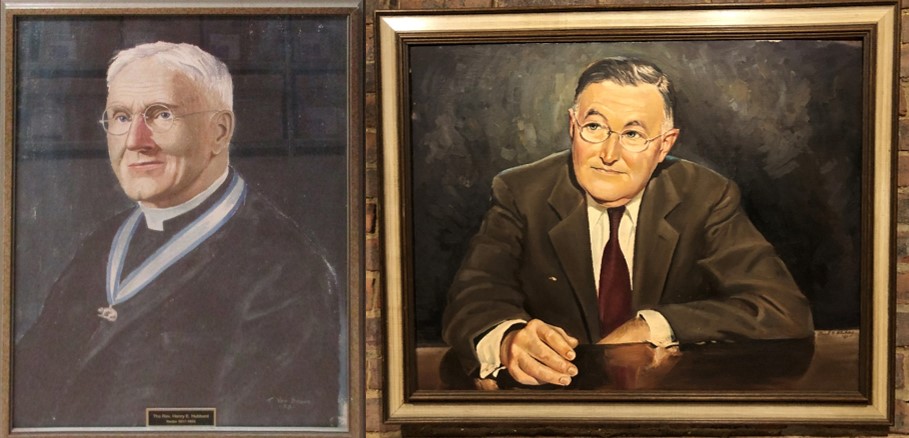
Reverend Henry Hubbard (left); Harry York Iszard (right)

Kane may have known two figures who now make their entrances – Harry York Iszard (1893-1971) and Reverend Hubbard (1873-1957). The portraits of these two men were painted within two years of each other, the Reverend’s in 1953 and Harry’s in 1955. The 50’s were a time of great post-war growth in Chemung County, as citizens across the country recovered from the war. Harry Iszard inherited S.F. Iszard’s Department store upon his father’s death. He opened a new branch in the Arnot Mall and sponsored the annual holiday parade to increase business, a tradition which continues to this day. Hubbard served as rector of Trinity Episcopal Church from 1917-1953, retiring the year this portrait was painted. Archival documents reveal his congregation was very grateful for his leadership during both World Wars, and that he was a champion of programs for young people. Though one served the material needs of the community and the other its spiritual, these two be-speckled gentlemen had a great impact on their community.

Native American Woman tentatively identified as Sha-ko-ka of the Mandan tribe (left);
Black Woman tentatively identified as a member of the Williams and Underwood families (right)

It is equally important to draw attention to those individuals who are not always remembered by history – those who do not come from privileged backgrounds and are marginalized due to gender and race. The identities of two individuals in this exhibit have been lost to history. The first portrait is of a Native American Woman. Her portrait is thought to have been painted by the prolific western artist George Catlin. From 1830-1838 Catlin toured the native tribes of the American West, creating a portrait gallery.  In traveling up the Missouri River around his final years of work, he encountered the Mandan tribe of the Heart River area of North Dakota. There he painted a young woman named “Mint”, or Sha-ko-ka in her native language. This young woman bears some resemblance to the subject of the portrait we are now displaying and may be a rendition of her in different dress. Sha-ko-ka, like many Native Americans in the early 19th century, were wrongly viewed as exotic people part of a romanticized past rather than as individuals with rights. Continued Westward Expansion, of which Colonel Liscum was later a part, pushed Mandan people from their ancestral lands and afflicted many with smallpox and disease. 

Another unidentified portrait in our collection is that of an African American woman, tentatively identified as Elmer Underwood’s mother and a member of the Williams extended family. The Black community in Chemung County faced much discrimination in housing, education, and employment throughout the late 1800s, the approximate date of this portrait. Yet, many political action groups fought against this injustice, including Colored Citizens of Elmira and the Elmira chapter of the NAACP. Five members of the Williams family were founding members of the city’s chapter of the NAACP, created in 1942, and worked to advance the status of the county's Black community. 

History is filled with unrecorded stories and the circumstances and biases which prioritize some lives whilst relegating others to footnotes. Both of these women’s portraits reveal unrecorded lives we must recognize in telling the county’s story and highlight our mission to turn historical omissions into learning experiences.

Faces of Chemung County is currently being installed. Visit the Museum to view the objects which accompany these portraits and see if you can identify more similarities and differences among them.

Monday, September 14, 2020

Three Generations of Local Fame: Robert, James, and Henry Dumars

 by Erin Doane, Curator

There are different levels of fame. Some people are known within their own town or city, but no one knows who they are outside that community. Some people achieve regional fame with their names and deeds appearing in media across a couple of states. Some become national figures; typically, politicians and performers. And then, there are the international superstars who achieved the type of fame that made them household names. Here at CCHS we like to explore all levels of historic notoriety, but we really focus on those who are locally and regionally famous. That is the case with three members of the Dumars family: Captain Robert R.R. Dumars, James “Jimmie” Dumars, and Henry R. Dumars. Each one attained a bit of fame during their lives, but for very different reasons.

Henry Dumars (left) with Professor Joe Gaulteri in a promotional
photo that appeared in the Elmira Star-Gazette, December 22, 1913
when the pair performed in Elmira during a 3-day Christmas break
from their regular vaudeville circuit

My research began with Henry Dumars. Some time ago, I came across an article in the Star-Gazettefrom September 9, 1907 that included information about the young Elmiran. Henry, who was just 18 years old, was part of a vaudeville performance at Rorick’s Glen. He was billed as a lightning sketch artist who created crayon cartoons and caricatures of celebrities and politician before an enthralled audience.

Elmira Star-Gazette, September 9, 1907

Not only was Henry a visual artist, he was also a talented musician who got his start performing violin solos at the First Methodist Church as a young teen. By 1908, he was touring on local and regional vaudeville circuits as a rapid cartoonist and musician. For the next eight years, Henry performed throughout New England and the mid-Atlantic and won praise as both a musician and a cartoonist. The Marion Star of Marion, Ohio called him “the boy wizard of the violin and crayon.”  The Woonsocket Press of Woonsocket, Massachusetts wrote that he “proved himself a master of the violin and established his right to the title of ‘the little Paganini.’” Locally, The Star-Gazette declared his musical act at the Majestic Theater in 1911 “one of the best numbers ever put on the vaudeville stage in Elmira.” It is clear that Henry gained a fair amount of local and regional fame from his musical and artistic performances.

While reading local news articles about Henry Dumars, I noticed that his father and grandfather were also often mentioned. That made me wonder if either of those gentlemen had also achieved some level of fame. Captain Robert R.R. Dumars, Henry’s grandfather, was indeed locally famous as a Civil War soldier and newspaper man. Robert was the editor of the Elmira Press when he volunteered to serve in the Union army in 1862. He helped organize Company C of the 161st New York Volunteers and was later assigned to the Confederate prisoner-of-war camp in Elmira.

Captain Robert R.R. Dumars, early 1860s

After the war, Robert was one of the charter members of Elmira’s Baldwin Post No. 6, Grand Army of the Republic (G.A.R.). Robert went back into the newspaper business as foreman of the Elmira Advertiser’s composing room in 1868, and he later became telegraph editor there. Captain. R.R.R. Dumar’s name was well-known throughout the city because of his military service and his work at the newspaper. 

Captain Dumars’ Civil War sword was donated the CCHS in 1927

James Dumars, Henry’s father and Robert’s son, was also locally famous for his business dealings. After attending EFA, James got into the printing business. He began working in the office of Wheeler and Watts, and then went on to work as a clerk in the Hall Brothers’ bookstore. In 1871, he opened a bookstore in partnership with Arthur S. Fitch and seven years later went out on his own, opening the West End bookstore on West Water Street. James was in the bookselling business for 32 years.

Invoice from Fitch & Dumars, 1876

One would like to think that James’ hard work and dedication to business was enough to secure his local notoriety, but there was another reason that people in Elmira, and perhaps a wider area, knew the name of Jimmie Dumars. In 1864-1865, when young James was known as Jimmie, he would run messages in and out of the Confederate prison camp for his father. The guards were so used to seeing him come and go, he could just yell his name, Dumars, and they’d let him pass. Well, a prisoner named Benni Orcutt bore a striking resemblance to Jimmie. One day when the young messenger didn’t come to the camp, Benni took the opportunity to walk up to the gate, declare “Dumars!” in a loud, clear voice, and was waved on through. The story of the escape never made the papers, that I could find, but I’m sure it was the talk of the town and made Jimmie famous for at least a time.

Guard house at the Confederate prisoner-of-war camp in Elmira, 1864-65