Showing posts with label Collections. Show all posts

Monday, October 2, 2023

Lethal Leaves: Arsenic Greens

 By Monica Groth, Curator 

Green Bonnet, c. 1880
This bonnet may be colored with arsenic green pigments

In 1775, the young chemist Wilhelm Scheele discovered that copper arsenate (a copper and arsenic compound) made a gorgeously vivid green color. By mixing sodium carbonate, arsenious oxide, and copper sulfate, he produced a vibrant pigment. Immediately desired by customers and cheap to make from mining wastes readily available as the Industrial Revolution took off, Scheele’s Green was adopted by many manufacturers. The compound was used to color wallpaper, book covers, playing cards, and candy wrappers. As the 19th century began, other green pigments with slightly different chemical compositions including Schweinfurt Green and Paris Green also appeared. The beautiful green was attractive –and deadly.  

Arsenic is very poisonous to humans. Early in the Victorian period (1837-1900) it gained a reputation as the poison of choice for murderers and the poison to avoid if you wished to commit suicide (it caused that agonizing of a death). But many arsenic victims weren’t poisoned by another person. Instead, they were unsuspecting consumers – victims of fashion.

Perhaps the most famous case of arsenical green pigments involves Paris Green wallpaper. Glue, damp, and mold would react with the wallpaper, which in addition to flaking off arsenic paint, would off-gas hydrogen cyanide into homes. Multiple people, Napoleon Bonaparte likely among them, died from such poisoning, and Charlotte Perkins Gillman’s popular book The Yellow Wallpaper (arsenical greens were often a lime-ish yellow/green color) was likely inspired by these facts.

However, before doing further research on the topic I was unfamiliar with the knowledge that clothing was also colored with arsenical green pigments and gave off substantial clouds of the lethal stuff. In particular, women’s gowns, hats, and leafy headdresses were dangerous to make and wear. Investigating doctors concluded that a ball gown fashioned from 20 yrds of green fabric might contain 900 grains of arsenic, and that in an evening of dancing, 60 grains might slough off as the wearer spun. With 5 grains enough to kill a person, such a woman, deemed a “killing creature” by the British Medical Journal (this was slang for an attractive woman at that time), could take out a dozen people in one night!

Green Silk Bodice, c. 1832
 Possibly colored with Scheele's Green arsenic pigment

It wasn't often that a beauty left 12 dead in her wake because the full lethal dose of 5 grains would rarely reach a person after one encounter. However, prolonged exposure to the chemical was a death sentence. Workers in factories and shops were very susceptible, developing physical and neurological maladies from constant contact with arsenical dust. The death of artificial flower maker Matilda Scheurer was much publicized in London in 1861. Scheurer, who was only 19 yrs old at the time of her death, dusted artificial flowers with arsenical green powder, daily breathing in the toxic dust and often returning home with it on her hands and clothing. One of the things which makes the pigment so perilous is how loosely its bound to its substrate - it was dusted on and could easily dust off. In addition to painful convulsions, tremors, and vomiting, the whites of Matilda’s eyes turned the verdant shade of Scheele's Green before her death. She reportedly told doctors that everything she saw looked green! Fellow flower workers developed scabs and lesions on their hands and faces, and workers in many different industries using arsenic sickened and died in the 19th century.

Orange Blossom Leafy Wreath, c. 1880:
Headdresses like this one often had leaves dusted with arsenic green pigments 

Word certainly spread that arsenic was present in green pigments and that it could kill. But the color remained fashionable through the decade. Artificial flowers or taxidermized birds (preserved with arsenic pesticide soaps) on hats and accessories were particularly in vogue. Today, I handle these items with caution to ensure no arsenic is inhaled or absorbed through the skin. 

By the 1880s, doctors, women’s groups, and reporters were lobbying for alternatives to arsenical greens. The use of the poisonous pigment slowly decreased, but arsenic was seen in a wide range of consumer products well into the 20th century. As you’ll learn if you visit our upcoming exhibition, Your Victorian House is Killing You, there were plenty of other dangers lurking in the 19th century home. 


Monday, February 6, 2023

Collecting Objects

 by Susan Zehnder, Education Director


Last year, someone accused us of collecting objects just to squirrel them away into drawers. A thought that if true, might explain the overflowing condition of the museum's storage areas. Drawers, closets, and storage rooms around the building are full of artifacts and documents connected to life in Chemung County. The Historical Society doesn't collect items just to accumulate them, we collect them to tell a more complete story of Chemung County’s history. That story is more fluid than many people think.

Items on display and in the archives come mostly from donations. Before being added to the collection, they are reviewed by a committee made up of members of the public, staff, and board members. Staff at the museum are trained to evaluate an item’s potential and the reasons why things are declined vary. Sometimes it’s because we already have an item, or the item has no connection to Chemung County. Other times, items are in poor condition, or we’re not able to care for them properly. Only when the committee feels an item helps tell a more complete story of the area, is it accepted. Our collection is constantly growing, and currently the number of items we hold is well into the hundreds of thousands. 

No matter what anyone thinks, museums are not neutral spaces, and that might be different if humans weren’t involved. It’s also the reason your grandparents' visit to the Chemung Valley History Museum does not look exactly the same as yours today. For instance, the Barbie lunchbox on display in the Bank Gallery often surprises people.

Barbie Lunch box 1984

The museum's mission-- 

To deepen our understanding of history and to provide an appreciation of our community's place in state and national history

requires us to constantly refresh our understanding of what our community looks like in order to tell the stories.

A great example of this can be seen in our new exhibit, “Faces of Chemung County.” At first glance on display in the Howell Gallery, are nine framed portraits from our permanent collection. The portraits capture a likeness of each person and show off the artists’ skills. But, and here’s where art museums and history museums differ, the images are accompanied by artifacts, carefully chosen to tell more of each person’s story.

Faces of Chemung County exhibit

From the paintings and drawings, we learn about the person by noticing what is and isn’t included. Asking questions -- what are they wearing, are there any objects included in the image, what is their posture, how are they wearing their hair, what hand gestures are they making, or even what color of clothes they have on -- gives us information from the artists' point of view. It is a visual story. The artists have left nothing to chance, no choice is random. Yet, the two-dimensional images tell only part of each person's story. The  artifacts nearby add depth to our understanding. Their physical presence reminds us the people were real.  

The reason each artifact was included varies.  Objects  might have belonged to the person, or might be linked to them in some other way. For example, near the portrait of Colonel Liscom, who fought in the Civil War, there's a saddle and blanket. The saddle is from the time period but he didn't own this one. The saddle blanket was one he owned, but came from a slightly later time period. We've included objects that might be tools of their trade, evidence of their social class, bits from hobbies, or might even reference something about them now missing or unrecorded. And by the way, the object that the donor feared we were squirreling away is currently on display in this exhibit.

"Faces of Chemung County" is not about rewriting history, it’s about using what we know in the 21st century to step back and get a deeper understanding of particular people, events, and stories from our past. Here, we have the advantage of stepping into nine different pairs of shoes to better understand who these people were in society, what choices they made, and the pathways they followed. We can see how their lives might seem similar or different from our own.

Better understanding the past helps us make sense of our current events, society, and culture and can guide our future choices.

The Historical Society is continuing to add to our collection and we are currently searching for objects to include in an upcoming exhibit on Polish culture. This is the first of many ethnic groups planned for future exhibits, and we encourage you to think about donating items to help preserve our county’s history for generations to come.

 Museum hours are 10 am - 5 pm Monday through Saturday.


Monday, April 25, 2022

Curating Chemung County's Cool Collection

 By Monica Groth, Curator

The job of a Museum Curator is to safely handle, document, and house an institution’s object collection and design exhibits through which those objects can educate and inspire visitors. I am extremely excited to be joining the dedicated staff at the Chemung County Historical Society as I fulfill this role and I write now to introduce myself to you all!

I come to Chemung County from Aurora, New York, a small village in Cayuga County where I spent my summers finding shards of pottery, rusty nails, and fossils in the lake, gorges, and cemetery by my home. Many years ago, while thinking myself a true archaeologist and with treasures in hand, I visited my local Historical Society at a young age to proudly present my finds. This is when I discovered the purpose and promise of Historical Societies and Museums: to preserve the history of our lives and our homes—the everyday and the unique things that make us who we are and our county what it is to us.

One of my main tasks here at the Museum has been processing new donations whilst exploring the Museum collections. In doing this work I’ve discovered that much of the collection was donated by people very like the younger me. A 16-pound Civil War cannonball donated by Thomas Mallow was found by his father, Glenn Mallow Jr., while digging a WWII victory garden on the site of the Prison Camp. An Eagle Bottling Works Bottle, donated by Elaine Harrington, actually dates to the 1880’s and bears a newspaper clipping suggesting it was unearthed by a curious boy in the town of Chemung.

The donors to our Museum have given many fascinating objects that memorialize the lived experiences of themselves, their families, and their homes. Anne Beattie donated the clothes her parents wore on their wedding in 1939. Larry Bowman donated a collection of gifts received from Horsehead’s sister-city, Bato-Machi, Japan by the 1993 delegation. Betty Clauss donated her husband’s 1960-1964 US Air Force Uniform.

All these donations and more help the Historical Society fulfill its mission, and those donated in 2021 will be on display in the “New to the Vault” exhibit this summer!

A peek into the diverse collections: telephones, typewriters, assorted ladies' fan, shoes, and hats!

I love working as a curator because it allows me to get up close with these historical artifacts and the stories surrounding them. Before working here in Chemung County, I studied at the Mystic Seaport Museum, Connecticut and the National Museum of Bermuda. Some of the coolest maritime objects I studied at these Museums include a whaling harpoon-gun, used on the island of Bermuda; a 200-yr-old figurehead, once mounted on the bow of a ship; and a barometer which used shark liver oil to predict the weather!

I am looking forward to the many interesting objects and stories I’ll be showcasing here at the Chemung Valley History Museum. Visitors are always welcome and I’m eager to meet the community whose stories I’m now privileged to know. Keep exploring. And if you are willing to donate, come on down to the History Museum and add to the amazing collection!

This exhibit case, the newest addition to the Mark Twain's Elmira exhibit, features Mark Twain's quill pen, an c.1890 inkwell, and his thoughts on the area in his own words

Monday, October 4, 2021

It Takes a Village

 by Susan Zehnder, Education Director

CCHS has a small but mighty staff. Getting all the things we do done can often mean that we need help. We are grateful for our volunteers who help us out in so many different ways, and they are our ‘village.’ Volunteers have represented CCHS at different events, set up systems to make our work smoother, created inventories to keep track of journals, prepared activity bags for students, took tickets, greeted people at museum functions, scanned photos, and completed information documenting our collections. One volunteer even tested out our Ghost Walk path to make sure that this year it will be wheelchair friendly. When we pivoted to more online work, we found volunteers who worked remotely transcribing recordings from our collection, and others who videotaped and posted dramatic readings of past historical figures. By no means is this a comprehensive list but here are some of our volunteers along with a few of the things they’ve been working on. They also answered what cool discovery they’ve come across while volunteering.

Karen puts in about 10 hours a week at the Historical Society, helping out on all sorts of projects. Lately, she's put her previous background in lab work to use taking precise notes and entering information to reconcile the museum's stored collections. One of the cool discoveries she's come across was the original 1870 marriage certificate of Samuel and Olivia Clemens. Another surprise she came across was a beautiful array of intricate bone, stone, and ivory Inuit carvings. Karen started volunteering in 2019 greeting visitors at the front desk and for the past two summers she has sat at our information desk at Wisner Park during Thursday market days, spreading the word on the Museum's new exhibits and events. She also pitched in to help with last year's Ghost Walk. We have been lucky that Karen called us to volunteer and share her time and efforts helping us get our work done.

Karen and Susan sitting at Wisner Park

Daniel is another volunteer who contacted us looking to add to his academic and archive skills and experience. He has been putting in about 8 hours over two days a week organizing the Elmira Central Christian Church information. The Historical Society received many of the Church’s boxes of papers and information to organize, put into boxes and folders, and document. When asked what discovery he’s found, Daniel mentioned how working with the collection has let him see an evolution of the organization and arch of their story over time. Daniel’s volunteer efforts are critical in keeping ahead of the archive’s continuously growing collections.

Daniel working with our collection

Bob remembers his history classes fondly while growing up. As a volunteer, he divides his 6-8 hours a week between greeting visitors and organizing our vast journal collection. A collection that started way before digital devices. Bob is a people person always quick with a smile, compliment or a joke. He says he loves to show people around the museum helping them discover new things about the area. Responding to the coolest thing he’s come across, he cites the old bank vaults (and is still searching out lost pennies!) Bob has enjoyed rediscovering some of the history right here in Elmira and Chemung County, and says he believes the Chemung Valley History Museum is a great place to find out more.

Bob greeting visitors at the front desk

Georgia has been volunteering at the Chemung County Historical Society on a steady basis since early 2017, documenting photos from our vast collection. She is also a loyal attendee at our Out to Lunch talks and programs. “I only thought I knew about our history in Chemung County, but once I started working with the photos I realized I didn’t have a clue about how much history there is in this area. I couldn’t pick just one thing that was really cool - I didn’t realize Babe Ruth had played at Dunn Field, that a canoe train that would bring the canoes to a designated area, or that there were two airports in Elmira – one near Caton Ave. and another where Broadway School is located. The list of things that existed in Chemung County that I have found out about is long and it has been a wonderful journey. I look forward to every time I volunteer – just waiting to see what I will discover next.” 


Georgia working on photo documentation

Georgia, like Karen, Daniel, and Bob are just a few of the people who help us get it done, and we thank them and all our volunteers for their contributions to the Chemung County Historical Society. If you're interested in getting involved, or find out more about what we do, send an email to Educator@ChemungValleyMuseum.org

Heather testing the Ghost Walk route


Monday, December 29, 2014

A Few of My Favorite Things

 by Erin Doane, curator

As the year is coming to a close, I’ve been thinking back on the new donations CCHS got throughout the year.  We received 130 donations of objects and archival materials.  That means that over the course of the year we added 237 individual objects and hundreds of paper-based items like photographs, scrapbooks, and documents to our collection.  Each items helps us tell the story of Chemung County.  While all of the objects are wonderful, I do have my favorites.

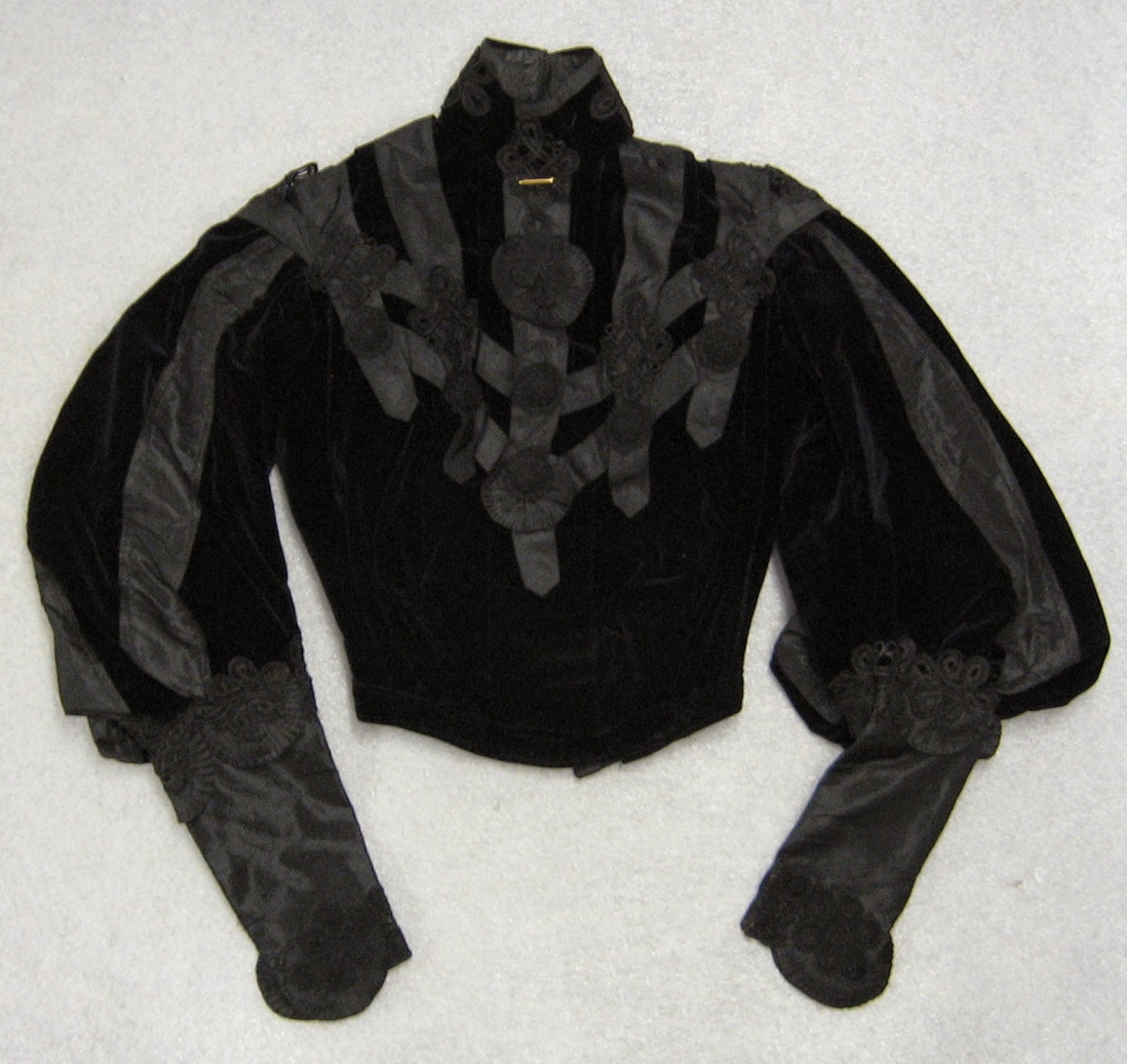
Three Piece Traveling Dress, c. 1900

Traveling dress, c. 1900

Second bodice for traveling dress
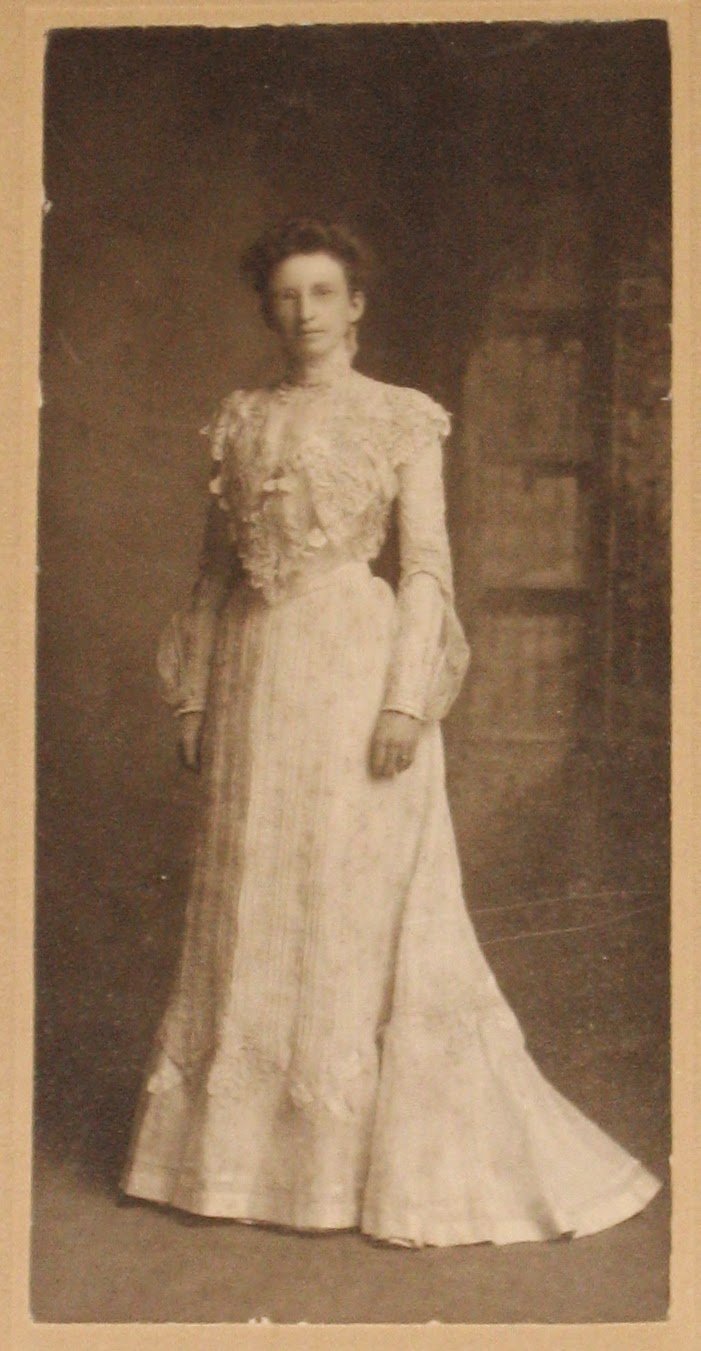
I have always loved historic fashion.  I love the beauty of elaborate dresses and appreciate the skill that went into making them.  I love that clothing was worn by a specific person, often for a specific event.  So much can be learned from a garment and so many stories can be told.  This traveling gown was worn by Helen Innes Mills around 1900.  It is made of black velvet with satin trim and has two different bodices that can be worn with the skirt.  Inside one bodice is a tag that reads The G. E. Weaver Co. Elmira, N.Y.  In addition to this gorgeous dress, we also have a picture of Helen.  It is wonderful when we can actually see the person who wore the historic clothing.
Photograph of Helen Innes Mills
Police Items from Both Ends of the 20th Century

Items from the Gradwell collection
This year we received two donation, quite coincidentally, related to the Elmira Police Department.  One donation was of items from the early 1900s that were owned by Detective Sergeant Charles Gradwell. Sergeant Gradwell and Police Chief John J. Finnell were murdered March 27, 1915 at a boarding house on Baldwin Street, Elmira. CCHS was given items such as his Colt revolver, handcuffs, and night stick, as well as his patrol diaries.

Items from the Holmes collection
We also received a second donation of police items from retired officer David Holmes who served with the Elmira Police Department from 1980 through 2014.  His donation included items such as badges, cartridge slides, a hat, and patch from the late 20th century.  It is very interesting to look at the two collections of items and see how police equipment changed over 100 years.  These two donations, together with other items already in the collection, help tell a more complete history of the Elmira Police Department.
 
Ku Klux Klan Sword

KKK sword with inset detail photo of handle
I am almost hesitant to label this sword as one of my favorite donations because of the hatred and violence that it represents.  I have included it on this list because I feel very strongly that we must make an effort to remember the darkest, most difficult parts of our history.  It is easy to remember just the “good old days” and gloss over what makes us uncomfortable.  Our archivist Rachel Dworkin wrote a great blog post a while ago on the history of the Klan in Chemung County.  It’s definitely worth a read.

Undergarments from the 1950s and 1960s

Assorted “modern” undergarments
Did I mention that I love historic clothing?  Undergarments are a particular favorite of mine.  I was thrilled to receive this donation because CCHS does not have many undergarments from the mid to late 20th century.  Maybe people do not consider things from that period as museum-worthy (how can something they wore be in a history museum when they are still so young?) or perhaps there is some level of embarrassment in donating your underwear for research and possible display.  Either way, I hope that more people choose to donate all types of objects from the 1950s and 1960s and onward so we can strengthen that portion of our collection.

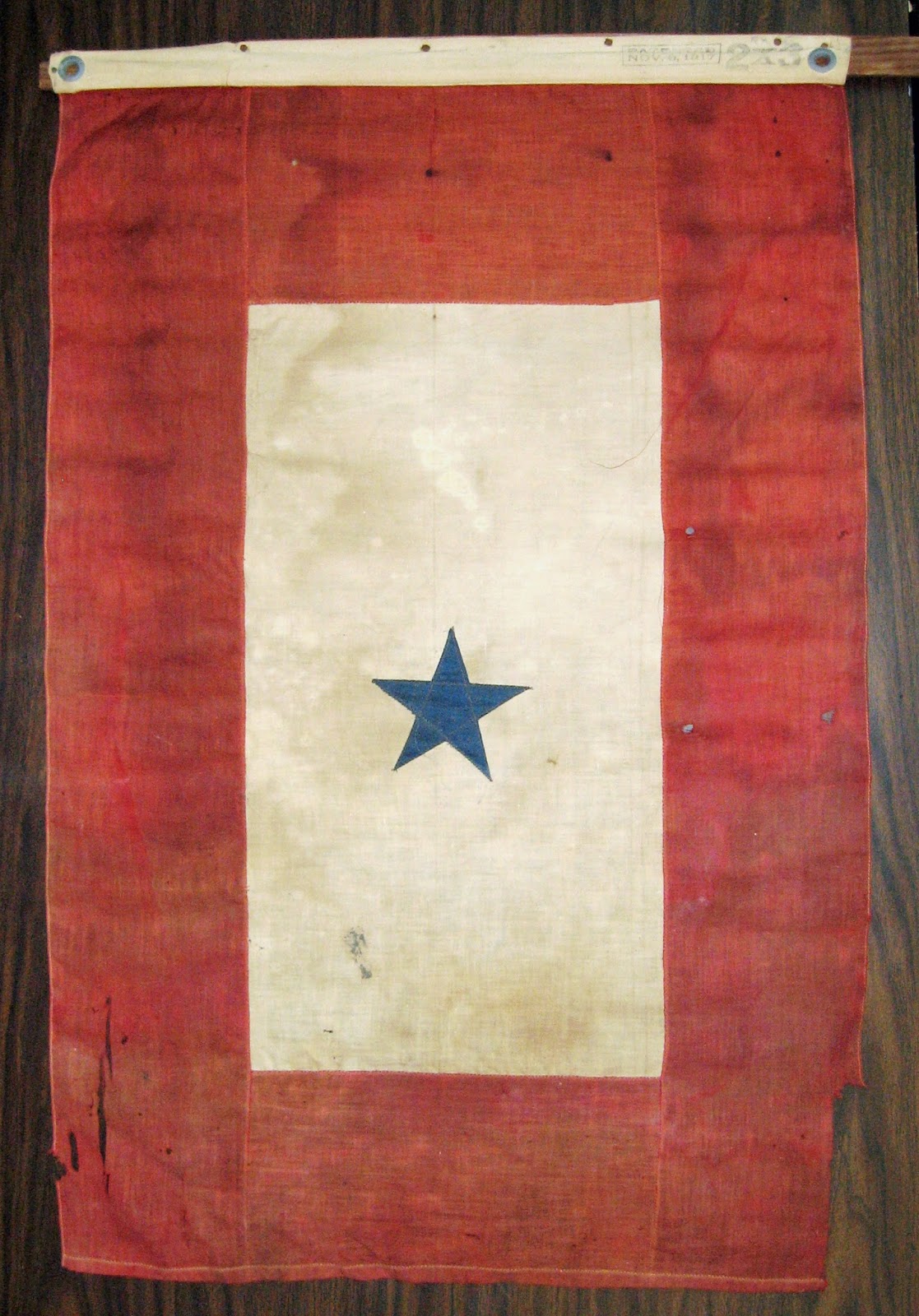
Blue Star Service Banner from WWII

Albert Oberg’s service banner
During WWII, Albert E. Oberg served in the U.S. Navy.  He was aboard the USS Jacob Jones on February 28, 1942 when the ship was hit by two torpedoes from an enemy U-boat.  While 30 survivors were able to abandon the ship before it sank, strong winds and rising seas kept rescuers from quickly reaching the rafts.  Only 11 men survived.  Albert E. Oberg was one of those men.  In 2009, at the age of 91, he finally received a Purple Heart medal for wounds he had suffered that day.  The ceremony took place during the annual Veterans Day service at Wisner Park in Elmira.  This year the CCHS received the Blue Star service banner that hung in his family’s window when he was serving during WWII and thus added his fascinating story to our collective history.