Showing posts with label Behind the Scenes. Show all posts

Monday, October 2, 2023

Lethal Leaves: Arsenic Greens

 By Monica Groth, Curator 

Green Bonnet, c. 1880
This bonnet may be colored with arsenic green pigments

In 1775, the young chemist Wilhelm Scheele discovered that copper arsenate (a copper and arsenic compound) made a gorgeously vivid green color. By mixing sodium carbonate, arsenious oxide, and copper sulfate, he produced a vibrant pigment. Immediately desired by customers and cheap to make from mining wastes readily available as the Industrial Revolution took off, Scheele’s Green was adopted by many manufacturers. The compound was used to color wallpaper, book covers, playing cards, and candy wrappers. As the 19th century began, other green pigments with slightly different chemical compositions including Schweinfurt Green and Paris Green also appeared. The beautiful green was attractive –and deadly.  

Arsenic is very poisonous to humans. Early in the Victorian period (1837-1900) it gained a reputation as the poison of choice for murderers and the poison to avoid if you wished to commit suicide (it caused that agonizing of a death). But many arsenic victims weren’t poisoned by another person. Instead, they were unsuspecting consumers – victims of fashion.

Perhaps the most famous case of arsenical green pigments involves Paris Green wallpaper. Glue, damp, and mold would react with the wallpaper, which in addition to flaking off arsenic paint, would off-gas hydrogen cyanide into homes. Multiple people, Napoleon Bonaparte likely among them, died from such poisoning, and Charlotte Perkins Gillman’s popular book The Yellow Wallpaper (arsenical greens were often a lime-ish yellow/green color) was likely inspired by these facts.

However, before doing further research on the topic I was unfamiliar with the knowledge that clothing was also colored with arsenical green pigments and gave off substantial clouds of the lethal stuff. In particular, women’s gowns, hats, and leafy headdresses were dangerous to make and wear. Investigating doctors concluded that a ball gown fashioned from 20 yrds of green fabric might contain 900 grains of arsenic, and that in an evening of dancing, 60 grains might slough off as the wearer spun. With 5 grains enough to kill a person, such a woman, deemed a “killing creature” by the British Medical Journal (this was slang for an attractive woman at that time), could take out a dozen people in one night!

Green Silk Bodice, c. 1832
 Possibly colored with Scheele's Green arsenic pigment

It wasn't often that a beauty left 12 dead in her wake because the full lethal dose of 5 grains would rarely reach a person after one encounter. However, prolonged exposure to the chemical was a death sentence. Workers in factories and shops were very susceptible, developing physical and neurological maladies from constant contact with arsenical dust. The death of artificial flower maker Matilda Scheurer was much publicized in London in 1861. Scheurer, who was only 19 yrs old at the time of her death, dusted artificial flowers with arsenical green powder, daily breathing in the toxic dust and often returning home with it on her hands and clothing. One of the things which makes the pigment so perilous is how loosely its bound to its substrate - it was dusted on and could easily dust off. In addition to painful convulsions, tremors, and vomiting, the whites of Matilda’s eyes turned the verdant shade of Scheele's Green before her death. She reportedly told doctors that everything she saw looked green! Fellow flower workers developed scabs and lesions on their hands and faces, and workers in many different industries using arsenic sickened and died in the 19th century.

Orange Blossom Leafy Wreath, c. 1880:
Headdresses like this one often had leaves dusted with arsenic green pigments 

Word certainly spread that arsenic was present in green pigments and that it could kill. But the color remained fashionable through the decade. Artificial flowers or taxidermized birds (preserved with arsenic pesticide soaps) on hats and accessories were particularly in vogue. Today, I handle these items with caution to ensure no arsenic is inhaled or absorbed through the skin. 

By the 1880s, doctors, women’s groups, and reporters were lobbying for alternatives to arsenical greens. The use of the poisonous pigment slowly decreased, but arsenic was seen in a wide range of consumer products well into the 20th century. As you’ll learn if you visit our upcoming exhibition, Your Victorian House is Killing You, there were plenty of other dangers lurking in the 19th century home. 


Monday, August 21, 2023

A Woman in Uniform

 By Curator, Monica Groth 

During World War II, some 16 million Americans served in the military, over 350,000 of whom were women. Chemung County is home to a number of remarkable female veterans. An upcoming exhibit features the uniforms of 4 local women who served their country in different ways during WWII, the single deadliest conflict history had yet witnessed. 

U.S. Marine Capt. Marie Snow (1921-2016) was born on a farm in Norfolk, New York. She was living with her sister in Syracuse when the Women’s Reserve of the Marine Corps was established in 1942. The Women’s Reserve placed women in stateside positions within the Marine Corps, freeing men for combat duty. When Marie’s brother-in-law, a veteran of WWI, teased her that she couldn’t make it as a Marine, she enlisted to prove him wrong. 

U.S. Marine Capt. Marie Snow, c. 1945

In 1943, Marie reported for boot camp at Camp Lejeune, North Carolina. She then studied accounting, or store-keeping, at Georgia State College for Women in Milledgeville, Georgia and was promoted to sergeant. 

Marie, known to her friends as “Sergeant Snowy,” was posted to California, where she helped organize supplies and wages for troops shipping off to the Pacific Theatre until the end of the war. She also occasionally appeared as an extra in Hollywood morale films. 

Marie met her first husband Marine Sergeant Raymond Doyle on the train home, when she sought his protection from a drunken airman giving her trouble. Marie attended Syracuse University on the GI Bill before moving with Raymond to Elmira in 1948, where she lived until her death. 

~~~~~~~~~~~~~~~~~~~~~~~~~~~~~~~~~~~~~~~~~~~~~

Army Nurse 1st Lt. Clara Peckham (1917-1996) grew up on Laurel Street in Elmira. She graduated from the Arnot-Ogden Hospital School of Nursing in 1938 and worked at the Veterans Facilities at Bath and Batavia. 

Determined to serve when war broke out, she concealed a heart murmur when enlisting. As the story goes, Clara would shift her position when the stethoscope neared her heart, attempting to disguise its irregular rhythm. It worked and in 1943, she was commissioned as a second lieutenant in the Army Air Force, leaving that summer for training at Mitchel Field in Long Island. When Clara later fainted from over-taxing her heart during her time in Long Island, the doctor who had examined her when she enlisted reportedly asked, “who let you in?” To which she replied, “you did!”

1st Lt. Clara Peckham, c . 1944
Image courtesy of the Star Gazette 

By December of that year, Clara had been assigned to active duty abroad providing medical care to wounded soldiers and civilians. As of February 1944, Clara was one of 19 Elmira nurses serving overseas. She worked in the contagious diseases unit at Kuakini Hospital in Honolulu, Hawaii. Following training which included learning how to shoot a carbine and swim with her boots and helmet on, she was sent to a field hospital near Okinawa, Japan. She served in Japan until the war ended and was discharged in November of 1945. After returning home, Clara worked as a nurse at Arnot-Ogden Medical Center, St. Joseph’s Hospital, and the Chemung County Nursing Facility, retiring in 1982.

~~~~~~~~~~~~~~~~~~~~~~~~~~~~~~~~~~~~~~~~~~~~

Army Cpt. Rita Eisenberg was born in Binghamton, where she taught high school history classes before deciding to make history herself. As a first-generation American in a family with no sons, Rita believed it was her duty to join the Women’s Auxiliary Army Corps (WAAC) in 1942. A year later, the WAAC was made an official part of the US Army and became known as the Women’s Army Corps (WAC). 

Rita was assigned to the Air Force. Following training at Officer Candidate School at Fort Des Moines, she worked suppling the WAC base in Orlando, FL. After further schooling at Fort Leavenworth, she prepared to go overseas as a member of the general staff. However, a friend feared for her safety and used his influence as an army chaplain to have her orders rescinded. Rita was extremely angry about this. She served in Orlando until the war ended and recalls traveling to the Pentagon to finalize supply reports for her area’s bases. 

Following the war, she settled in Elmira, where she and her husband Jess Shapiro were in business on Water Street.

Rita Eisenberg Shapiro at 90, 2006
Image courtesy of the Star Gazette

~~~~~~~~~~~~~~~~~~~~~~~~~~~~~~~~~~~~~~~~~~~~~

Jennie Reid (1919-2006) grew up on Elmira’s Eastside. During WWII, she took her civil service exam so she could work at City Hall, where she got a job operating the elevator. Jennie also joined the Women’s Ambulance Defense Corps (WADC).

The Elmira chapter of the WADC was organized in January of 1942, when 300 women assembled at the Elmira College gymnasium. Women of every race and ethnicity, excluding Japanese, were accepted. 

Jennie Reid, c. 1943

The WADC served many roles in civilian defense and preparedness. They trained in first aid; conducted air-raid and blackout drills; and practiced blackout driving and field maneuvers. Members also studied rifle and pistol use and radio communication. The WADC operated canteens for service men at the Erie and DL&W Railroad stations in Elmira.

Jennie was a member of the AME Zion Church, the Eastern Star, Neighborhood House, and the NAACP. 

Numerous women in the county also served in other areas of civil defense, working as air raid wardens or volunteers. Women helped the war effort on the homefront by selling war bonds, planting victory gardens, and organizing scrap metal drives. Many also worked in factories making war critical technologies, and took on jobs previously held by men then serving overseas.

Stop by and take a closer look at these women's uniforms to appreciate the many ways that women assisted their country during WWII.

Monday, November 28, 2022

Faces of Chemung County

by Monica Groth, Curator

The display surrounding Julia Stancliff Reynolds,
one of nine individuals featured in our newest exhibit

The Museum’s upcoming exhibit Faces of Chemung County features the portraits of nine distinct individuals. Each face has a unique past and story, and this exhibit invites you to step into the frame. A deeper look into the lives of those depicted reveals that in addition to great differences, our characters also share similarities across time and space. Viewing them side by side helps the visitor compare their contexts and contemplate the lives they lived in relation to each other – human lives filled with the same heartbreak, sacrifice, and perseverance present throughout all of history.

Julia Renolds (left) and Rachel Gleason (right):
notice their difference in dress as well as frame

Julia Reynolds (1836-1916) and Rachel Gleason (1820-1905) both led long lives. As women born in the early nineteenth century, they were subjected to many societal expectations –including the expectation to marry. Julia, born an Eldridge, married twice, experiencing a heartbreaking widowhood followed by a bitter separation from her second husband. She then lived independently abroad and in New York City for the last twenty-five years of her life. Julia was a wealthy woman and readers may remember that her mansion, nicknamed "Fascination" was mentioned in a previous blog of mine.  

Rachel’s husband, Silas, supported her desire to become a physician and encouraged her interest in medicine. Rachel became one of the first women in the United States to receive a medical degree, graduating from Central Medical College in Rochester, NY in 1851. Rachel knew that women not only experienced discrimination in what careers were open to them, but were also deprived of sound medical care. At the time, male doctors dismissed women as hysteric patients and many considered it “indecorous” to discuss female health problems. Rachel therefore specialized in treating women and educating them about their health. She lectured often and promoted her book Talks to my Patients, in which she wrote candidly about women’s health topics. She worked with Silas at Elmira’s Water Cure, established on the city’s East Hill in 1852, and even delivered Samuel Clemens’ (Mark Twain’s) daughters, being Livy Clemens’ personal physician. Both Julia and Rachel lived through Elmira’s Gilded Age, Rachel defying expectations on the city’s East Hill in order to reach success, and Julia fulfilling the responsibilities of a wealthy hostess downtown only to find it very lonely indeed.

Isaac Baldwin (left), Thomas Kane (middle), Colonel Liscum (right)

Beside each other in the exhibit are a young lad and an old gentleman – a 150 year old rocking horse, bedecked in a fine small saddle and bridle, within a few feet of a saddle blanket actually used in combat. Colonel Emerson Liscum (1841-1900), the owner of that saddle, died whilst leading a charge on the walled city of Tien-Tsin, China during the Boxer Rebellion. A career soldier who enlisted in the Union Army at only 19 years old, Emerson married Elmiran May Diven after the Civil War ended. May received a sorrowful letter accompanying the saddle blanket now in the Historical Society’s collection, expressing condolences over the loss of her husband. Known as Old White Whiskers, Liscum’s last words “Keep up the fire” became the motto of the 9th US Infantry he commanded, and a monument and ornate silver bowl were commissioned in his honor. 

Young Isaac Baldwin (1869-1949), likely the proud rider of a rocking horse similar to that one on display, is only nine years old in his portrait. His childhood was comfortable, as his father was a wealthy real-estate mogul, and it is memorialized in the exhibit through toys from the 1870s-1880s. Among Baldwin’s associated objects are a toy cannon and game pieces from a political board game, reminding viewers of the irony of children playing at war and politics when soldiers like Liscum were in the midst of very real conflicts. 

Another veteran in this exhibit enlisted eighty years after Liscum at nearly the same age. Elmiran Pvt. Thomas Kane (1923-1978) was 20 years old when he joined up in WWII. USO artist Freda Reiter captured his likeness in a sketch while he was convalescing in a French military hospital a year later. His portrait, in between the innocent youth and the battle-hardened soldier, gives one a look into the eyes of a young man experiencing the trials of a very different war. Happily, Pvt. Kane survived his wounds and went on to a very successful career in the Postal Service.

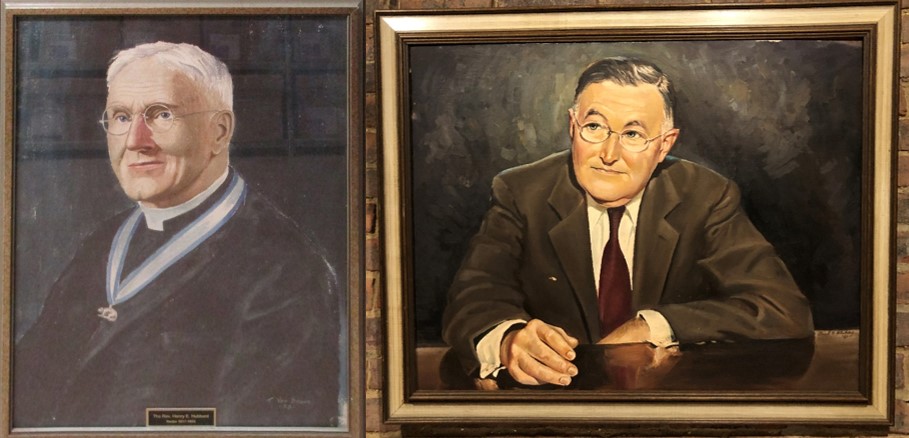
Reverend Henry Hubbard (left); Harry York Iszard (right)

Kane may have known two figures who now make their entrances – Harry York Iszard (1893-1971) and Reverend Hubbard (1873-1957). The portraits of these two men were painted within two years of each other, the Reverend’s in 1953 and Harry’s in 1955. The 50’s were a time of great post-war growth in Chemung County, as citizens across the country recovered from the war. Harry Iszard inherited S.F. Iszard’s Department store upon his father’s death. He opened a new branch in the Arnot Mall and sponsored the annual holiday parade to increase business, a tradition which continues to this day. Hubbard served as rector of Trinity Episcopal Church from 1917-1953, retiring the year this portrait was painted. Archival documents reveal his congregation was very grateful for his leadership during both World Wars, and that he was a champion of programs for young people. Though one served the material needs of the community and the other its spiritual, these two be-speckled gentlemen had a great impact on their community.

Native American Woman tentatively identified as Sha-ko-ka of the Mandan tribe (left);
Black Woman tentatively identified as a member of the Williams and Underwood families (right)

It is equally important to draw attention to those individuals who are not always remembered by history – those who do not come from privileged backgrounds and are marginalized due to gender and race. The identities of two individuals in this exhibit have been lost to history. The first portrait is of a Native American Woman. Her portrait is thought to have been painted by the prolific western artist George Catlin. From 1830-1838 Catlin toured the native tribes of the American West, creating a portrait gallery.  In traveling up the Missouri River around his final years of work, he encountered the Mandan tribe of the Heart River area of North Dakota. There he painted a young woman named “Mint”, or Sha-ko-ka in her native language. This young woman bears some resemblance to the subject of the portrait we are now displaying and may be a rendition of her in different dress. Sha-ko-ka, like many Native Americans in the early 19th century, were wrongly viewed as exotic people part of a romanticized past rather than as individuals with rights. Continued Westward Expansion, of which Colonel Liscum was later a part, pushed Mandan people from their ancestral lands and afflicted many with smallpox and disease. 

Another unidentified portrait in our collection is that of an African American woman, tentatively identified as Elmer Underwood’s mother and a member of the Williams extended family. The Black community in Chemung County faced much discrimination in housing, education, and employment throughout the late 1800s, the approximate date of this portrait. Yet, many political action groups fought against this injustice, including Colored Citizens of Elmira and the Elmira chapter of the NAACP. Five members of the Williams family were founding members of the city’s chapter of the NAACP, created in 1942, and worked to advance the status of the county's Black community. 

History is filled with unrecorded stories and the circumstances and biases which prioritize some lives whilst relegating others to footnotes. Both of these women’s portraits reveal unrecorded lives we must recognize in telling the county’s story and highlight our mission to turn historical omissions into learning experiences.

Faces of Chemung County is currently being installed. Visit the Museum to view the objects which accompany these portraits and see if you can identify more similarities and differences among them.

Monday, April 25, 2022

Curating Chemung County's Cool Collection

 By Monica Groth, Curator

The job of a Museum Curator is to safely handle, document, and house an institution’s object collection and design exhibits through which those objects can educate and inspire visitors. I am extremely excited to be joining the dedicated staff at the Chemung County Historical Society as I fulfill this role and I write now to introduce myself to you all!

I come to Chemung County from Aurora, New York, a small village in Cayuga County where I spent my summers finding shards of pottery, rusty nails, and fossils in the lake, gorges, and cemetery by my home. Many years ago, while thinking myself a true archaeologist and with treasures in hand, I visited my local Historical Society at a young age to proudly present my finds. This is when I discovered the purpose and promise of Historical Societies and Museums: to preserve the history of our lives and our homes—the everyday and the unique things that make us who we are and our county what it is to us.

One of my main tasks here at the Museum has been processing new donations whilst exploring the Museum collections. In doing this work I’ve discovered that much of the collection was donated by people very like the younger me. A 16-pound Civil War cannonball donated by Thomas Mallow was found by his father, Glenn Mallow Jr., while digging a WWII victory garden on the site of the Prison Camp. An Eagle Bottling Works Bottle, donated by Elaine Harrington, actually dates to the 1880’s and bears a newspaper clipping suggesting it was unearthed by a curious boy in the town of Chemung.

The donors to our Museum have given many fascinating objects that memorialize the lived experiences of themselves, their families, and their homes. Anne Beattie donated the clothes her parents wore on their wedding in 1939. Larry Bowman donated a collection of gifts received from Horsehead’s sister-city, Bato-Machi, Japan by the 1993 delegation. Betty Clauss donated her husband’s 1960-1964 US Air Force Uniform.

All these donations and more help the Historical Society fulfill its mission, and those donated in 2021 will be on display in the “New to the Vault” exhibit this summer!

A peek into the diverse collections: telephones, typewriters, assorted ladies' fan, shoes, and hats!

I love working as a curator because it allows me to get up close with these historical artifacts and the stories surrounding them. Before working here in Chemung County, I studied at the Mystic Seaport Museum, Connecticut and the National Museum of Bermuda. Some of the coolest maritime objects I studied at these Museums include a whaling harpoon-gun, used on the island of Bermuda; a 200-yr-old figurehead, once mounted on the bow of a ship; and a barometer which used shark liver oil to predict the weather!

I am looking forward to the many interesting objects and stories I’ll be showcasing here at the Chemung Valley History Museum. Visitors are always welcome and I’m eager to meet the community whose stories I’m now privileged to know. Keep exploring. And if you are willing to donate, come on down to the History Museum and add to the amazing collection!

This exhibit case, the newest addition to the Mark Twain's Elmira exhibit, features Mark Twain's quill pen, an c.1890 inkwell, and his thoughts on the area in his own words