Showing posts with label postal history. Show all posts

Monday, January 31, 2022

Forever: Sending a Letter

 by Susan Zehnder, Education Director

Today “forever” costs fifty-eight cents. At least that’s what sending a one-ounce letter within the United States in 2021 costs. In October this year, the US Postal Service announced that first class mail may take them a little longer to deliver and for us to expect some letters and packages to arrive days later than in the past.

At this time of year, letters and packages keep the Post Office pretty busy. To appreciate how some things have changed, we invite you to view our current exhibit Going Postal. This exhibit is a fun look at mail service in Chemung County. 

Of course, mail was delivered in the colonies before the United States was a country, it was just delivered by anyone you might convince or pressure into carrying a message for you. As the colonies grew, Great Britain set up a mail system modeled after their own public mail service, one which had operated since the time of Henry VIII. The word post refers to the English mail service being carried from post to post. Each post had a master who would sort out and remove his area’s mail and return the rest to a post boy who then resumed delivery.

B. Franklin, Painting by J. Duplessis, 1778

In 1753, the Crown appointed Benjamin Franklin to serve as Joint Postmaster General for the colonies. During his tenure he established new mail routes, and erected sandstone mile markers known as Franklin Markers, to indicate distances. The changes Franklin made resulted in a faster and more reliable mail service. He even worked remotely as he spent much of the late 1750s in England. He audited postal statements and made decisions through the mail. Under his leadership, the postal service in the colonies turned a profit for the first time.

It was all fine until Franklin was implicated in leaking important letters sent between the British Crown and the British Governor of Massachusetts. Franklin, opposed to British rule, was dismissed from his post in 1774. Without his lead, the system began to fail.

In 1775, the Second Continental Congress created the United States Post Office. The drafted constitution of the United States, Article I, Section 8, Clause 7 gave Congress the power “To establish Post Offices and post Roads” to promote interstate communication and establish a source of revenue. Franklin was appointed its first Postmaster General. He was quick to rebuild his previous postal system, and it soon outperformed the British version. Franklin served in this position for a little over a year before he was appointed ambassador to France.

The Postal Service Act, signed by President George Washington in 1792 established unification, rules and regulations, and gave the Postmaster General greater powers under the United States Post Office Department. One of these was the ability to create postal routes to ensure that mail delivery would serve existing communities and expand as the new nation grew. It also allowed newspapers to be carried by the postal system at low rates. This helped spread information and improve communication throughout the young nation.

The title Postmaster General comes from the British model. For most of its existence in the United States, the position was part of the presidential cabinet. In 1971, the Post Office Department was reorganized into the United States Postal Service (USPS) by President Nixon. Since then, the Postmaster General is appointed by the Board of Governors and can only be removed by the board. Members are nominated to the board by the US President with the advice and consent of the Senate. The current Board of Governors consists of nine members in addition to the Postmaster General and the Deputy Postmaster General.

The USPS is the only delivery service that reaches every address in the nation, both personal and business. It receives no tax dollars for operating costs relying on postage sales and services to pay for funding. For the past few years, USPS has operated at a loss. Much of the blame for this is misunderstood.

In 2006, the Postal Accountability and Enhancement Act was passed to address USPS financial issues. The act requires the USPS to deliver mail six days a week; prohibits increasing postage faster than the rate of inflation; and prepays benefits for all their employees for at least fifty years. The prepaid benefits is something no other organization does, and many think it is to blame for their growing deficit. The Postal Service Reform Act (2021) was introduced last May with bi-partisan support to undo some of the 2006 changes.


The USPS is the nation’s 2nd largest civilian employer and there are 15 Post Office branches in the county to serve us. Our Going Postal exhibit has uniform patches, photographs, stamps, and more fun facts about Chemung County’s mail service and is on display Monday through Saturday 10 am – 5 pm through the spring. Seeing some of the history behind receiving a personal letter or package makes that first class stamp even more of a bargain.


Monday, February 25, 2019

Picturing Postcards: the first Instagram?


By Susan Zehnder, Education Director
I found a postcard in my office from 1907 with a message to a Miss Pearl Van Name of Horseheads, NY. It reads, “Will answer your card at last. I had all most forgotten you. Why don’t you Phone? Christina” 

 It’s puzzling to me that Christina wrote to Pearl at all. If both had a telephone, why didn’t Christina phone Pearl herself? Instead, Christina used the reliable postal service to deliver her message.

She sent this card by morning mail, because there's an “AM” appearing below the year in the stamped postmark. Carriers in 1907 delivered mail more than once a day, a convenience that lasted into the 1950s.

A postcard like this required a one-cent stamp. Mailing postcards continued to cost a penny until 1917, when postage doubled. This two-cent price remained the same for the next forty-two years. Today the cost of postage for mailing a first-class postcard is thirty-five cents. 

In the late 1860s, the U.S. government first permitted sending postcards through the mail. Writers were restricted to putting a message on one side, and an address on the other-just as Christina did. This didn't change for almost fifty years until 1907. In fact days after Christina mailed this card, the governing board of the Universal Postal Congress voted to allow a divided side of both government and privately produced postcards. Both message and address could now occupy the same side, and according to the Smithsonian, the era became known as the “Divided Back” or “Golden Age of Postcards” due to the increasing popularity of mailing picture postcards. 

Postal delivery had a direct impact on growing cities like Elmira. Through a program called Rural Free Delivery (RFD) adopted in the 1890s, improvements changed the way small towns and rural areas received their mail. RFD meant instead of traveling to town to pick up mail and packages, small town residents and farm families received mail service at home. RFD also helped regulate shipping costs by assuring delivery from reliable carriers. An early supporter of RFD was U.S. Postmaster General John Wanamaker, an American merchant from Pennsylvania and owner of one of the nation’s first big department stores. Not surprisingly, the success of RFD had negative effects on small town merchants who now struggled to compete with national stores that offered a wider assortment of goods. 

RFD increased access and reliability and had a positive effect on local employment. New opportunities flourished, and the number of letter carriers grew. A 1913 photograph of rural carriers shows a convention of workers from the area.
Rural Letter Carriers Convention, Penn Yan, 1913
At the turn of the twentieth century, few shipping restrictions existed. In 1914, in the state of Utah, parents of four-year-old Miss Charlotte May Pierstorff shipped her off to her grandparents for only fifty-three cents, cleverly avoiding the cost of a train ticket. While her parents may have felt this a frugal choice, the postal service did not agree. She wasn't the only child shipped over the years, and as of 1914, the post office prohibited shipping humans. 

Taken around the same time Christina mailed her postcard, this photograph of the Elmira Post office shows a busy mail sorting room.
Mail sorting room, Elmira Post Office, 1903-1910

Christina, like many others, had great faith in the United States Postal Service, and mailed her postcard and message to Pearl instead of using the telephone.

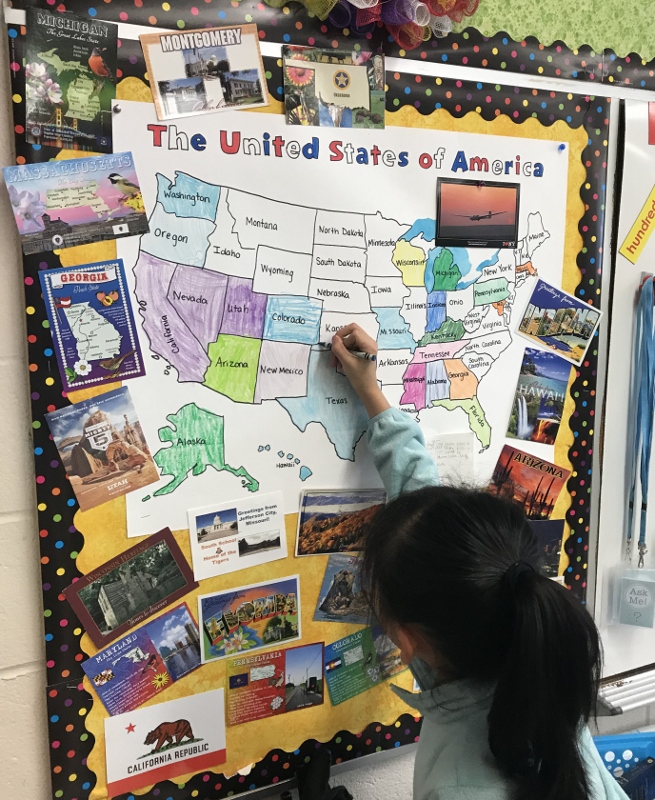
People still send postcards. Today, the United States Postal Service operates over 30,000 post offices in the nation, and delivers billions of pieces of mail every year. One hundred years after Christina sent her card to Horseheads, students from Mrs. Dauphinet's fourth grade class at Gardner Road Elementary, part of the Horseheads Central School District, participated in a postcard project seeking postcards from every state in the nation and Washington, DC. Supported by the school's Parent Teacher Organization and the Chemung County Chamber of Commerce, it’s a great example of a project that just couldn’t be “phoned in.”
Gardner Road 4th grader tracking postcards. (photo supplied by Horseheads Central School District)

Monday, December 11, 2017

You've Got Mail!

By Rachel Dworkin, Archivist

Notice anything funny about this envelope? 

Letter for William Beers, 1862

Let me give you a clue: there’s no street address (and no zip code, but that’s another story). How then, you might ask, was the letter supposed to be delivered? It wasn’t.

When the first Elmira post office opened in January 1801, there was no home delivery. People from all over Chemung County had to visit the small office located at the foot of Fox street in order to pick up their mail. This was actually a pretty big improvement. The village had been founded in 1790, but, until 1801, residents had to go all the way to the post office in Owego or pay someone to pick up their mail for them. Later, in April of that year, Elijah Buck opened the first post office in the Town of Chemung in his general store to serve the eastern half of the county. 

Since coming in from the hinterlands to check if you had mail could be quite a hassle, the Elmira post office notified recipients by posting an ad in the weekly paper. Even with the notices, letters could sit for weeks before it was picked up. By the 1830s, the volume of mail coming into Elmira was so great that the post master could no longer afford to post notices in the paper. By this point, each of the rural towns had their own post office which was good, considering the only way to know if you had a letter was to go and find out. 

List of letters, The Investigator, December 1, 1821
 This lead to long lines at the post office and, in a roundabout way, the first instance of free home delivery. The story goes that in the winter of 1862, Cleveland postal employee Joseph William Briggs was so moved by the sight of women lining up in the cold rain, desperate for word from their husbands and sons fighting in the Civil War that he began delivering mail to their homes for free. Later that same year, Postmaster General Montgomery Blair composed a report to the president wherein he recommended free urban home delivery by salaried carriers as a way improve user convenience. In 1863, Congress acted to authorize home delivery in cities where income from local postage was more than sufficient to pay all expenses of the service. Thus, the inclusion of home addresses on envelopes was born!

 By 1864, 65 cities had free home delivery. By 1880, that number was up to 104, and, by 1900, 796. Elmira began free home delivery in 1873 or 1874. There were initially four carriers for the entire city: John King, John Y. Carpenter, Uriah Warner, and Judson Cornell. All were Civil War veterans. John Carpenter was missing an arm. The volume of mail proved too much for just four men to handle and two additional carriers, William P. Roosa and John R. Brockway, were added in March 1874.  
Letter for William Beers with street address, 1879

Special thanks to Alan Parsons whose research request inspired this post.