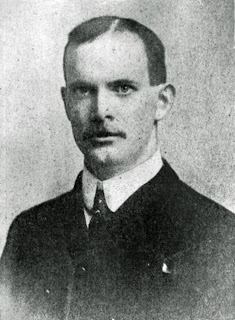
by Erin Doane, Curator
When I was researching my last post here about theMcCann Boulder, I came across
an article in the Star-Gazette from
1922 presenting the monument as part of a series of articles entitled
“Interesting Historical Points Around City Told In Pictures.” From February 14
through March 2, the newspaper highlighted 13 different points – seven historic
buildings and six monuments. The buildings featured were the first post office,
the home of Thomas Maxwell, Elmira’s first academy, the Young Americans’ Hose
House, the Civil War prison camp morgue, the Park Hotel, and John Hendy’s
cabin. Unfortunately, those buildings no longer exist, but all six monuments
can still be seen today.
American
Girl Statue
Star-Gazette,
February 14, 1922, Article
Text:
The
above statue is American Girl, a famous trotting horse which held many records
during Elmira’s early days some fifty years ago. This memorial was erected in
Eldridge Park, facing the site of the track where she captured so many
triumphs.
American
Girl was owned by William Lovell of New Yor. [sic] The beautiful animal was
foaled in 1862 and had 150 heats to her credit. Her record time is 2:16 ½. All
her races were in 2:30 or less.
American Girl dropped dead in a free-for-all race staged October 2,
1875, when thousands of racing fans from throughout the East journeyed to see
this fastest of all horses race.
American
Girl stood in Eldridge park until October 7, 1980, when vandals used a vehicle
to pull the statue off its pedestal and broke it into 147 pieces. In 2016,
after being skillfully repaired and restored by Tom Beatty, the statue was
finally returned to the park. It now stands in its own custom building on the
northeast side of the lake next to the miniature golf course.
 |
| American Girl in Eldridge Park, July 16, 2021 |
Civil War Prison Camp
Marker
Star-Gazette,
February 15, 1922, Article
Text:
Here is all that remains of the once
famous United States Confederate prison camp in 1861 in operation during the
Civil War. The marker is a few feet east of Hoffman street. The camp extended
west about one half mile from the marker, which is noted by arrow in the above
picture. The marker is on the river side of Water street near Hoffman Creek It
was erected by the Baldwin Post, No. 6, G.A.R., in 1900. Doubtless there are
many patriotic Elmirans who did not know that the marker exists.
You can read about the history of the prison camp
by clicking here. The stone marker is still in the same place
just east of Hoffman Street. There are hedges growing around the monument but
they have been trimmed so that it is visible. Just a block south of Water
Street on Winsor Avenue, the Friends of the Elmira Civil War Prison Camp have
reconstructed some of the site and welcome visitors on Saturdays throughout the
summer. You can find more information on their website: www.elmiraprisoncamp.com.
 |
| Civil War prison camp marker, July 16, 2021 |
 |
| Close-up of the marker, July 16, 2021 |
Ross
Marvin Memorial
Star-Gazette,
February 16, 1922, Article Text:
Elmira has the distinction of being
represented in the discovery of the North Pole by Admiral Robert E. Peary. The
above memorial to Ross Gilmore Marvin is located at the intersection of Lake
and Union place. It was erected by Elmirans in memory of Mr. Marvin who was
born on January 28, 1880. He was lost in the Arctic ocean on April 10, 1909,
while a member of the Peary Expedition, which discovered the North Pole. Mr.
Marvin was a student, teacher and explorer. Mr. Marvin was the son of Mary
Marvin, 700 Riverside avenue.
To read
more about Ross Marvin, and learn details about his possible murder, click here. Marvin’s memorial is no longer at the
intersection of Lake Street and Union Place, though that location was
designated as Ross Marvin Park by the Elmira Lions Club in 1957. The monument
was moved several times over the years and today rests at the southeast corner
of Church and Lake Streets.
 |
| Intersection of Lake Street and Union Place, July 16, 2021 |
 |
| Marker in Ross Marvin Park, Lake Street and Union Place, July 16, 2021 |
 |
| Ross Marvin Monument at the corner of Church and Lake Streets, July 16, 2021 |
Samuel L. Clemens’ Headstone
Star-Gazette,
February 20, 1922, Article Text:
This simple
headstone marks the spot in Woodlawn cemetery where rest the remains of Samuel
L. Clemens (Mark Twain), famous American humorist and author, who made is home
in the city during his younger days. Mrs. Clemens was one of Elmira’s fairest
daughters, Olivia Langdon Clemens. Ostentation had no place in the life of Mr.
Clemens, except as a target for many a pinioned shaft of keenest wit – and in
death a simple stone bears the name that needs no costly mausoleum to add to
its luster.
The Clemens
and Langdon families’ gravesite in Woodlawn remained rather modest until 1937
when Sam and Livy’s daughter Clara Clemens Gabrilowitsch had a large stele with
bronze portraits of her father and her husband installed. Woodlawn Cemetery has
made it easy to visit Samuel Clemens’ final resting place. Enter the cemetery through
the Walnut Street gate and follow the signs to Mark Twain.
 |
| Samuel Clemens’ headstone, Woodlawn Cemetery,
July 16, 2021 |
 |
| Clemens/Langdon family plot in Woodlawn
Cemetery, July 16, 2021 |
Shohola Monument
Star-Gazette,
February 27, 1922, Article Text:
The above
monument was erected by the United States Government to mark the last resting
place of 49 unknown Confederate soldiers, who were killed in a railroad
accident near Shohola, Pa., and later moved here.
The monument
stands in the northeast extremity of Woodlawn cemetery near the private
cemetery of a large number of Confederate soldiers and entrance may be gained
through the upper Davis street gate. The names of the unknown Confederate
soldiers are engraved on a tablet. Their graves are unmarked.
The Shohola
monument no longer marks the northeast extremity of the Woodlawn National
Cemetery. Since its dedication, hundreds of U.S. military veterans have been
laid to rest to its north. You can click here to learn more about the National
Cemetery. To visit the monument today, enter Woodlawn National
Cemetery through its Davis Street gate then walk south.
 |
| Shohola Monument, Woodlawn National Cemetery, July
16, 2021 |
McCann
Monument
Star-Gazette,
March 1, 1922, Article Text:
The huge rock near the Davis street side
of Woodlawn cemetery marks the final resting place of George and Crete McCann,
early settlers of Elmira. The boulder was hauled from the east side of the
canal over a specially built bridge. Several teams of oxen were used to draw it
to its present position. Mr. McCann was the uncle of Supreme Court Justice
George McCann. He was an active Elmiran and in the city’s early history Mr.
McCann’s name appears prominently.
To read more about George and Crete McCann, and
their monument, click here. While visiting Samuel Clemens and family in Woodlawn Cemetery, it is very easy
to find the McCann monument just down the hill.
 |
| McCann monument, Woodlawn Cemetery, July 16, 2021 |
If you would like to read the full series of
articles from 1922, including those about the historic buildings, click here.