Showing posts with label Exploration. Show all posts

Friday, October 15, 2021

Ross Marvin Revisited

by Erin Doane, Curator

Ross Marvin’s story is one of tragedy and mystery. Perhaps that’s why I go back to it again and again in my research, writing, and exhibits. Back in 2013, I wrote a brief blog post about him that you can read by clicking here. After eight years, it seems like it’s time to revisit Ross Marvin’s story.

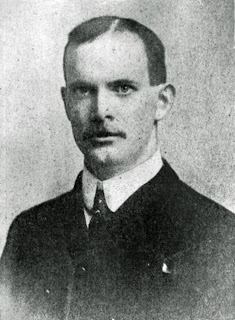
Ross Gilmore Marvin
Ross Marvin was born on January 28, 1880, the youngest of six. He graduated from EFA in 1899, and surprised everyone by earning a scholarship to Cornell University. In 1901, he transferred to the New York Nautical School where he learned nautical astronomy. After graduating from there a year later, he returned to Cornell. In 1905, he graduated with a degree in civil engineering. Before finishing school, Marvin had heard about the Arctic voyage that Robert Peary was planning for 1905-1906. He made it his goal to be part of that expedition. It is said that on graduation day, he received the letter from Peary inviting him to join his team.

Peary’s 1905-1906 attempt to reach the North Pole was not a success but he tried again two years later. Marvin served as chief scientist and Peary’s first assistant on that 1908-1909 voyage. His responsibilities included taking meteorological readings, solar observations, and depth soundings.

According to the caption of this image from an article written by Peary that appeared in the August 1910 issue of The Geographical Journal, that pile of furs is Ross Marvin taking observations at 86 degrees 38 minutes north on March 25, 1909.
Peary purportedly reached the North Pole on April 6, 1909, but Ross Marvin did not survive the journey. His two Inuit companions, Kudlooktoo and Harrigan, reported that on April 10 he broke through the ice while trying to cross a lead and died. It was weeks before Peary and the rest of his men learned of Marvin’s death and it wasn’t until September, some five months after his death, that his family back in Elmira heard the news.

The story of Ross Marvin may have ended there with the local hero’s tragic death, but 17 years later, his name was back in the news. In 1926, Kudlooktoo confessed to killing him. He claimed Marvin went crazy and tried to abandon Harrigan on the ice. Knowing that Harrigan would die if he was left behind, Kudlooktoo shot Marvin.

Kudlooktoo posing with George Borup and other Inuits, from A Tenderfoot with Peary, by George Borup, 1911
The story came as a great shock to those who knew Marvin. His family denounced the story and Peary declared that he didn’t believe it. Peary’s daughter, Marie, who had been a childhood playmate of Kudlooktoo, believed his false confession was induced by religious hysteria and was an attempt to please the white man by having a sin to confess. By that point, 17 years after the fact, there was no way of proving what had truly happened. The Arctic was a sort of no-man’s land at that time with no laws or governance, so Kudlooktoo was never tried for murder. 

Despite the dark turn of Marvin’s story, his life and accomplishments have been memorialized in many ways over the years. Peary erected a stone cairn with a wooden cross at Cape Sheridan overlooking the Central Polar Sea in his honor.

Marvin Memorial, Cape Sheridan, Left from The North Pole, By Robert E. Peary, 1910
Right from Susan Kaplan/Genevieve LaMoine, Peary-MacMillan Arctic Museum at Bowdoin College, 2011
In 1910, a large stone with a brass plaque was set on the corner of Lake Street and Union Place in Elmira as a memorial. It has been moved a couple of times since then and now rests at the corner of Lake and Church Streets by the Chamber of Commerce.

Ross Marvin Monument at the corner of Church and Lake Streets
In the late 1920s, a memorial tablet to Marvin was placed in the Sage Chapel at Cornell University.

Dedication of Ross Marvin plaque at Cornell University, c. 1926, Sunday Telegram, April 5, 1931
In 1943, Marvin’s niece Gertrude Colegrove Tum, christened the SS Ross G. Marvin, a liberty ship that was used for cargo transports during World War II. You can read all about that by clicking here.

In 1948, Marvin and all the other men who had served on Peary’s 1908-1909 Expedition were awarded medals by the U.S. government. I have heard that the reason it took so long – nearly 40 years – to be officially recognized for their efforts in reaching the pole was because there were some in congress who did not want to honor Matt Henson, who was an African American, along with the rest. 

Peary Polar Expedition medal awarded posthumously to Ross Marvin, 1948
The Marvin Islands, a group of islands in extreme northern Canada were named after him. In 1957, the Elmira Lions Club dedicated Ross Marvin Park on the triangle of land between Lake Street and Union Place. In 1967, the State University Maritime College, from which Marvin graduated in 1902, named a wing of their new Science and Engineering building Ross G. Marvin Hall. And finally, in Woodlawn Cemetery, in the Marvin family plot, is a stone dedicated to him. The inscription on the stone reads:

 In Memory of
Ross G. Marvin
Jan. 28, 1880 – April 10, 1909

 Scientist with the Peary Arctic Expedition
Which discovered the North Pole
Drowned in the Arctic Ocean Lat 84 degrees North

 Peacefully he sleeps in his watery grave.
Tho no marble shaft marks his last resting place
it is watched o’er by towering sentinels of snow and ice.
The stars too keep silent vigil while the north winds
sing a requiem for a brave soul gone to meet his maker.

Ross Marvin marker in Woodlawn Cemetery, 2018
If you have made it all the way to the end of this post, thank you! I hope you enjoyed this and other stories I have told during my 10+ years as curator at CCHS. This is my very last blog post here. I will be leaving the museum at the end of October. It’s been a great joy learning about the county’s history and being able to share it with all of you!


Monday, October 22, 2018

Seven Years in the Amazon

by Erin Doane, Curator

On November 18, 1894, Fritz Up De Graff of Elmira sailed from New York City on the SS Advance bound for Ecuador. The young man had recently graduated from Union College in Schenectady, New York with an engineering degree. While a student, he met Domingo Cordovez, the son of a wealthy Ecuadoran. The pair became fast friends and spoke about going into business together to bring much-needed modern improvements to the City of Quito. Fritz had always had an adventurous spirit – he was an original member of Rufus Stanley’s Rambling Club – so, with $100 in his pocket, Fritz left his home in search of adventure and profit in South America.

Fritz Up de Graff, 1923
For two years, Fritz lived as a guest and then employee of Domingo’s father. The Cordovez family occupied a position of importance in Ecuador. They owned eight hundred square miles of forest in which they operated large cattle and horse ranches and multiple plantations. Fritz described those years as one long series of commercial disappointments. He got involved with one get-rich-quick proposition after another with the family. They were going to start a furniture factory, clear 50 acres of forest and plant coffee, build roads, bring electric lights to Quito, build a tannery, bore for oil, distill whiskey, and a whole host of other business ventures. Fritz didn’t lose any of his own money in these schemes (most of the $100 he left home with was spent on his trip south), but he did not make any money either.

In January 1897, after a falling-out with the Cordovez family regarding their treatment of workers, Fritz decided he was ready to move on. Instead of shipping back to the United States, he chose to do some exploring. He sent a letter home to his mother and sisters telling them that he and ten natives were striking out for the Napo River, one of the western tributaries of the Amazon River. They would take a dugout canoe some 3,000 miles through some of the wildest parts of South America. He expected they would arrive in Para, Brazil by March or April where he could take a steamer back to New York City.

The Star-Gazette in July 1897 called Fritz’s expedition into the Amazon “the most exciting and novel trip ever attempted by any Elmiran” and declared that “never was a similar trip with more hazardous undertakings attempted by any white man of his age.” These glowing words came in the same article that described how his family had not heard from him in nearly eight months and how they had been writing letters to the US consul in Para with the fears that he was dead. 
Elmira Star-Gazette, July 26, 1897
In some ways, it is surprising that Fritz actually survived his ordeals. The saying, “if it wasn’t for bad luck, he’d have no luck at all,” certainly applied.  His native guides abandoned him within days of heading into the jungle. Fortunately, he did not find himself entirely alone. He met up with another American named Jack Rouse and they traveled together for four years. The pair suffered terribly through that time. They were attacked by vampire bats and mosquitoes, had their canoe destroyed by a panicked tapir, lost their belongings to unscrupulous outpost managers, nearly starved to death on several occasions, were repeatedly abandoned by their hired help, and suffered various severe fevers and illnesses.

On the positive side of their adventures, they profited from the rubber trade, ate new, exotic things like monkeys and anteaters, killed at least one man without consequences, and rescued a young native woman who had been captured by a rival tribe (though she seemed to help them almost more than they helped her). The pair also successfully lived with several tribes of the Jivaro people, or Shuar as they call themselves, who were known for their practice of shrinking human heads.

Fritz and Jack parted ways in April 1900 after many adventures. Jack was ready to leave South America but Fritz was not yet prepared to return home. He got involved in a couple more money-making schemes – one in the rubber trade and one involving cattle and cedar. Finally, he had had enough travel and boarded a steamship back to the United State. On November 18, 1901, he arrived back in New York City; exactly seven years to the day that he had left.

In 1921, after years of telling his stories to family, friends, and other enthralled audiences, Fritz wrote Head Hunters of the Amazon. The book was first published in November 1922 by Duffield & Co. in the United Kingdom and then in February 1923 in the United States. Eventually it was translated into 13 languages. The book, with a forward written by Kermit Roosevelt, was wildly popular with readers and critics. A reviewer at the New York Times wrote: “The dominant note of Mr. Updegraff’s volume, and at the same time its potent charm, is its personal, straightforward manner of presentation.… His is the easy intimate style of a fluent narrator; his is the art of transforming his thoughts into written words with a sure freedom from hesitancy or affectation.” It is still available in print from several online booksellers and is truly an enthralling read.

Head Hunters of the Amazon by Fritz Up de Graff, 1923
After his time in the Amazon, Fritz continued to travel. He met his wife, Eleanor Grosvenor, on one of his many cross-country trips as an electrical and construction engineer. They married in 1904 and had three sons. They lived in many different place around the world including the U.S., England, Canada, Spain, and Cuba. They were living in Mexico in 1910 when revolution led by democratic reformer Francisco I. Madero broke out against dictatorship of Porfirio Diaz. On December 24, 1927, Fritz died of injuries he had sustained in an automobile accident in Baton Rouge, Louisiana.