Showing posts with label Museum. Show all posts

Monday, February 12, 2024

100 Years of History

By Erin Doane, Senior Curator

On November 7, 1923, the Elmira chapter of the Sons of the American Revolution held a meeting. At that meeting, the organization’s president Dr. Arthur W. Booth proposed the creation of a historical society to preserve historic objects, documents, and stories. The first official meeting of the Chemung County Historical Society took place two weeks later with 75 people in attendance.

The Historical Society’s first home was in two rooms on the upper floor of the Steele Memorial Library on the corner of Lake and Church Streets (now the Chemung County Chamber of Commerce). The rooms quickly filled with donations from the community. Members of the society presented talks about local history and created displays of historic objects in the library for the public to enjoy.

Chemung County Historian Clark Wilcox stands in one of the
Historical Society’s rooms in the Steele Memorial Library, 1947
The Historical Society received its charter from New York State in 1947. Shortly after, they began searching for a stand-alone building to house the collections and provide more space for displays. In 1953, the Historical Society moved into 425 East Market Street and Frances Brayton was appointed as its first professional curator.

The Chemung County Historical Center on Market Street, 1950s
It was around this time that Historical Society also began searching for the mammoth tusk that had been found by Judge Caleb Baker along the Chemung River in 1778. (Read all about that tusk and the Historical Society’s search for it here) While they were not able to find the original, they were able to get a similar mammoth tusk from the American Museum of Natural History in New York City.

Mammoth tusk on display at the Historical Society, 1950s
 The Historical Society relocated again in 1965 to 304 William Street.

The Chemung County Historical Center on William Street, 1976

The mammoth tusk and all the other historic objects, documents, and photographs that had been donated over the previous 40+ years were moved into their new home. Many of the objects were used in new exhibits focused on topics we still explore in the museum today - life here in the 1800s, the Civil War, local organizations and schools, and, of course, Mark Twain. Materials that didn’t go on display went into storage. Unfortunately, one of the main storage spaces in the building was the basement, which proved disastrous during the 1972 Flood. (click here to read how the Historical Society reacted to the flooding)

The mammoth tusk on display on William Street, 1976

The Chemung County Historical Society moved one more time to its current location at 415 E. Water Street. The building was originally home to the Chemung Canal Bank starting in 1833. After the bank moved into new headquarters, the building housed law offices and apartments. It underwent major renovations in the late 1970s and opened to the public as the Chemung County Historical Society in 1982. In 1986, the Historical Society received accreditation from the American Alliance of Museums (AAM). It was reaccredited most recently in 2021. Less than 5% of museum in the United States are accredited by the AAM. In 1992, further renovations to the building took place. An addition that includes the Howell Gallery, the Frances Brayton Education Room, and the Barn Gallery, as well as a new entranceway, was added to the main building.

415 E. Water Street, late 1970s
The Chemung County Historical Society currently operates the Chemung Valley History Museum and the Booth Research Library. Our mission is to deepen our understanding of history and to provide an appreciation of our community’s place in state and national history. We’ve done this over the last 100 years by collecting, preserving, interpreting, and presenting the history of our community and we plan to continue this mission for the next 100 years.

And, yes, the mammoth tusk is still on display.

The mammoth tusk at E. Water Street, 2014


Monday, August 30, 2021

Our Mammoth Tusk

by Erin Doane, Curator

Visitors love the mammoth tusk we have on display here at the Chemung County Historical Society. Multiple people have told me it’s the one thing they remember from a visit to the museum when they were kids. But how did it get here?

Mammoth tusk on display at CCHS, August 2021

Both mammoths and mastodons roamed the prehistoric Chemung Valley. Mastodons lived all around the world. They first appeared in the early Miocene (23 million to 2.6 million years ago) and continued to live in various evolutionary forms through the Pleistocene (2.6 million to 11,700 years ago). Mammoths lived on every continent except for South America and Australia. Fossil remains found in North America date from the Pleistocene and the very early Holocene (11,700 years ago to the present). Both mammoths and mastodons share an ancient ancestor with modern elephants. While mammoths were about the same size of elephants, mastodons were shorter and more heavily built.

Mammoth (left) and mastodon (right) from Wikimedia Commons

Throughout the years, mammoth and mastodon tusks, teeth, and other remains have been found through our area. In 1933, a mammoth tooth was found in Elmira; in 1940, a mastodon skeleton including tusks was found in Big Flats; and in 1999, two mastodons and parts of a mammoth were found in Millport. Early Native Americans in the valley were said to have found a tusk near the river bank and named it “Chemung” which has been translated as “place of the big horn.”

In 1778, Judge Caleb Baker and two other men discovered a tusk sticking out of the water of the Chemung River near the narrows west of Chemung Village. In order the preserve the artifact and keep it from splitting, Judge Baker took it to a local blacksmith to have it banded in iron. Unfortunately, when the judge returned to pick up the tusk, he found that the blacksmith had sold it to a peddler who had taken it off to New England.

In the 1950s, when members of the Chemung County Historical Society were in the process of creating their first independent museum (they had been tenants of the Steele Library before that), they decided they wanted to include a mammoth tusk in their new displays. The Historical Society board made attempts to track down Judge Baker’s tusk but came up empty-handed after contacting the American Museum of Philadelphia, the Stockbridge Massachusetts Library Association, the Springfield Museum of Natural History, Williams College, the Smithsonian Institution, the New York State Museum, the Canadian Department of Resources and Development in Ottawa, and the British Museum (in hope that when the British lost control of North American territories the tusk might have been removed to London).

Since finding Judge Baker’s original tusk proved impossible, the board turned to having a model made for display. They contacted the American Museum of Natural History in New York City to inquire if they could create such a model. In response, the folks at the Natural History Museum offered an actual mammoth tusk from their collection that had been found in Alaska. All the Historical Society board had to do was pay for the tusk’s preservation treatment, which totaled $9 ($3 an hour for three hours’ labor), and the tusk was theirs. The board readily agreed and a member of the Natural History Museum and his wife loaded the tusk into their station wagon and drove it up to Elmira.

In my imagination, our mammoth tusk was brought to Elmira
in something like this 1950 Willys station wagon.

The mammoth tusk went on display in the Chemung County Historical Society’s new museum on William Street and then came over here to 415 East Water Street in the 1980s when CCHS moved into the old Chemung Canal Bank building. Today, you can still come and visit the ~11,000-year-old artifact prominently display in our Bank Gallery.


Monday, October 21, 2019

Ghost Stories


by Susan Zehnder, Education Director

For the past thirteen years, the Chemung County Historical Society  has joined forces with the talented Elmira Little Theatre and Friends of Woodlawn Cemetery to present an historic Ghost Walk along the paths of Woodlawn Cemetery. Unlike the artifacts and documents we have at the museum, at Woodlawn Cemetery, we’re sharing stories of people who lived their lives in the area. The stories range from heartwarming to hilarious and deserve not to be forgotten. 


October is a natural time of year to honor those who have passed on. Summer feels like it's coming to an end. Falling leaves and colder temperatures suggest winter is on its way. Plans however for our annual historic Ghost Walk actually start back in the summer. In July we start to research, write, and revise original scripts based on the lives of potential characters. We visit the cemetery to find the perfect combination of characters and walk various potential routes. Ghosts are selected on variables like a mix of genders, ages and professions. We balance the mood of the stories we share. And, we pay attention to grave site locations. Ghosts must be close enough to get to on a reasonable walking tour, and far enough apart that when each actor tells his or her story, it won’t disturb the others.

Final scripts are passed on to Elmira Little Theatre members who audition, cast and bring the ghost stories to life. As we get closer to the walk date, Friends of Woodlawn Cemetery provide people to carefully guide each visiting group along the paths to meet the ghosts. Other people are involved including those who keep the lanterns lit, drive the buses, welcome visitors, count bus riders, help with gathering tickets, run the trivia contest and jump in to fill in where needed to keep things going. 

Many people who are part of this event have their own stories to tell. Quite a few volunteers have been doing this for years, including those who have participated as long as the event has been going on. Among them are a brother and sister who stepped in and became guides to honor their father when he wasn't able to do it anymore. Another guide drove from Ithaca to participate after falling in love with the event that her sister volunteers for, and this year a guide was surprised to hear a ghost story involving an act of kindness her own grandfather did. All the people who are part of this event are so important to its success and we can't thank them enough.

Lanterns being checked and ready

In thirteen years, the historic Ghost Walk has changed. In the beginning, there were three ghosts and four tours that took place during one evening. Now the event lasts two nights, and involves four or more ghosts with eight tours each evening. It brings 400 visitors to the museum and to the cemetery, and with only five full-time staff, it takes a heroic effort, and many volunteers to pull this off. This year we were rewarded by selling out all 400 tickets in just two weeks. Our event at the graveyard is to share some stories of those who are buried there, and we are thrilled that history can still be so exciting and popular. We also encourage anyone who missed getting tickets this year to watch for notices next September.

Woodlawn Cemetery

The historic Ghost Walk for this year is over, and the 2019 ghosts have been revealed. These scripts are now posted on our CCHS website.

This year, also look for an additional event coming up. Concerned that our ghost walk isn’t accessible to all visitors, especially those unable to walk the ¾ mile trek at night, on October 30th we are hosting another event called Ghostly Readings. At the museum on that Wednesday from 1:30 pm-2:30 pm, staff members will read this year’s ghost scripts and share images of the people we’ve profiled. We will also feature a mystery celebrity reader. Tickets for this event are $5 and include admission to the museum, cider and donuts. We encourage you to call to make reservations, and hope to see you here or in a year when we do this all again!


Call us at 607-734-4167 for reservations or email educator@chemungvalleymuseum.org

Monday, October 7, 2019

Who works at a museum?

by Malachi Doane, museum helper

All buildings have a certain amount of internal infrastructure. Electrical, Plumbing, and Air Conditioning are all present in our homes businesses and at the museum as well. Normally my day to day work is as a project coordinator based at the museum and working on tourism projects. I look for and promote interesting but lesser well known sites in our area. Some days however I get to help with other needs around the museum such as exhibitions and electrical projects.

Keeping it all going falls to many hands and everyone at a small museum has to wear a few hats.  When it’s lighting in the cases the exhibits staff, typically under the direction of the curatorial department, become electricians.


Like many, our museum has lighting in the exhibit cases and small low voltage puck type lights were installed around the year 2000. This type of light fixture had halogen light bulbs in them when they first came out, it was before the revolution in LED technology we all enjoy today. As such they ran hot and bright, and emitted ultraviolet light even at low voltage. At our museum a clever system was installed to manage the light/UV/heat output of the little bulbs back when they were installed. Over the last twenty years though, the little lights and the crafty controllers did start to wear out.


Skip ahead to 2019 and the miniaturization of electronics along with advances in LED technology meant we could replace the old halogen bulbs directly, keeping the old fixtures with a bulb that made no UV light, used a fraction of the electricity and none of the heat in the cases.

A little digging for some new transformers as well to replace the old units which had nearly made 20 years in operation, and it was time to get out the ladder and bring our case lighting ahead into the twenty first century!


It’s good to remember that it takes all sorts of people to make a museum work. Our staff all come from various backgrounds, not always in history museums, some not from museums at all. As students we all faced the question, “when am I ever going to need to know this?” Electrical training for me began in high school volunteering backstage in theatrical productions as well as tinkering with ham radios in my spare time.  Internships and summer jobs between semesters called on those resources and helped me build new ones.  Today I was an electrician and an exhibits technician, tomorrow I’ll go back to managing social media and researching in the archives because keeping a museum working takes all sorts of skills.

Monday, August 20, 2018

Time for a Change

By Kelli Huggins, Education Coordinator

I have a big, bittersweet announcement to make: I have accepted a new job as a Visitor Experience Coordinator at the Catskill Interpretive Center in Mount Tremper, NY and I will be leaving my position at CCHS on August 31. This is an exciting opportunity for me professionally and personally, but I would be lying if I said I didn’t have any sadness about leaving. Please accept this rambling farewell letter to all of you--our readers, friends, and visitors--as my final CCHS blog post.
My new stomping grounds
I have been at CCHS for over 5 years now and moved to Elmira having never been here before. I know this region has its struggles and people tend to dismiss it, but as a newcomer, I found incredible opportunity. As a historian, I marvel every day at how rich this county’s history is (and will continue to be far into the future). As an educator, I’ve had the fortune to work with thousands of local children and have seen how smart, empathetic, and interested in history they can be. Please embrace these positives.
Just look at these smart 2nd graders learning about gold panning in their westward expansion unit!
I’m grateful to everyone out there who read one of my blog posts, attended a program at CCHS, or bought my book. As you may have noticed, I’m not a historian who is interested in the “big” popular stories. Sure, they’re fine and all, but I like the weird stuff, the small tales that normally get lost when we look at the past. My favorite kind of history is infused with humor. I’m particularly proud of Curiosities of Elmira and would be remiss if I didn’t take one more opportunity to shamelessly promote it.

I’ve worked hard to bring our local history to you in new and novel ways, with our History They Didn’t Teach You in School series being my favorite of our successes (don’t forget to sign up for Joy! in December). Thanks to everyone who attended these programs, let us be totally silly, and threw things at Bruce (you’ll understand what that means if you’ve been to the programs…). You always made it fun for me to lead those tours. I also can't leave this blog post without mentioning my alter-ego Mark the Mammoth. I hope you follow him on Twitter. Having built his account from nothing to mini-celebrity, he is strangely one of the parts of this job I will have the most trouble letting go of.

Is it weird that Mark is one of the things I'll miss most about this job?
I won’t go on and wax poetic here for much longer. As you know, my coworkers, Bruce, Erin, Christine, and Rachel are fantastic and smart. I’ve been lucky to have a chance to spend the last 5 years learning from them. They’ll be stuck picking up the slack while they wait to hire my replacement, so please be extra nice to them in this transition period as they add even more work to their busy schedules. And please be as nice to the new educator as you all were to me. If you find yourself in the Catskills, please feel free to say hi!

Monday, April 20, 2015

CCHS at the Museum Association of New York Conference

by Kelli Huggins, Education Coordinator

Last Sunday-Tuesday (April 12-14), most of the CCHS staff attended the annual Museum Association of New York (MANY) conference, held in Corning this year.  In those three days, we were featured on three separate panels, received two awards, attended other sessions, and went to special breakfasts, lunches, dinners, and networking receptions.  We also were able to catch-up with old friends in the field, while meeting new colleagues.  All told, it was a great time!  Here's a quick recap of what we learned and did.

This year, CCHS was selected to receive two Awards of Merit, given by MANY to acknowledge "outstanding programs and individuals who have made the state's museum community richer and more relevant. They reward the innovative efforts of staff and volunteers and they provide encouragement for the development of new and remarkable projects."  First, we received the Award of Merit for Innovations in Interpretation for our new History They Didn't Teach You in School series. 


 I also received the Rising Star Award of Merit for my work at CCHS creating new programming and reaching out to new communities.


 The CCHS staff also presented on three panels.  Director Bruce and Curator Erin organized a panel called "Rethinking Outreach by Moving Outside of the Museum."  The panel also featured Pam Davis-Webb, Principal of Diven Elementary, and Louise Richardson, Communications and Marketing Manager at the Chemung County Humane Society and SPCA.  The panel discussed the efforts that our staff has made to work with non-traditional community partners.  The audience at the panel was very interested in the discussion, with some attendees saying they wanted to try to use these ideas at their own museums.
The "Rethinking Outreach" Team: (from left to right) Louise Richardson, Pam Davis-Webb, Bruce Whitmarsh, and Erin Doane
I organized another panel, called "Making Your Mark in Our Digital World: Museums and Creative Social Media Use."  The panel also featured Yvette Sterbenk, Senior Manager of Communications, Corning Museum of Glass; Bridget Sharry, Community Relations Manager, Tanglewood Nature Center and Museum; and Rachel Bournique, Student, Siena College.  We discussed best practices and management techniques for social media and also how to use different platforms creatively.  I brought Mark the Mammoth our museum mascot to discuss how we've used Mark to tap into an international museum community on Twitter (find Mark's Twitter account here: https://twitter.com/MarktheMammoth).  We got a great response to the panel: it was standing room only and I got lots of feedback from sites that want to create their own museum mascots.  Mark the Mammoth also live-Tweeted the entire conference using the official conference hashtag #MANY2015.
Thanks to our friend Bridget Sharry at Tanglewood Nature Center for live Tweeting this shot of me and Mark the Mammoth at our panel.  
Curator Erin also participated on a panel about deaccessioning.  This is a tricky issue for many museums and Erin's first-hand experience was helpful for museum professionals dealing with deaccessioning items in their collections.
This conference also allowed our staff and museum professionals from around the state to explore the beautiful Corning Museum of Glass (CMOG) and Rockwell Museum, our gracious hosts. 
CMOG hosted a fun opening reception complete with a live glass-blowing demonstration in their new auditorium.
At the end of the three day conference, we all had many new ideas that we want to use at CCHS.  We attended great panels on everything from design tips, to Common Core standards, to promoting regional tourism.  We hope to use these ideas to create even more innovative, creative, and meaningful experience for our visitors and members.  The staff is already making plans for next year's conference in Lake Placid.

On top of that, make sure you congratulate Director Bruce the next time you see him: he was recently elected to the board of MANY!

Monday, October 20, 2014

On Being Creative in a Changing Museum World

By Kelli Huggins, Education Coordinator

I think we're at the beginning of a museum renaissance.  Museums, both small and large, are being flooded with incredibly creative, well-trained professionals who are continuously challenging the status quo.  Part of this shift is tied directly to the economic crash of 2009 and the ensuing "Great Recession."  Funding is tight and museums have to work with less than in the past.  We're facing greater competition for the money that is still out there.  In order to get ahead, you need to stand out.  In the past few years, I have seen many innovative programs and exhibits come out of the museum world that prove that history is not dusty old stuff and the boring names and dates you learned in high school.  History is awesome stories, new collaborations, and it's fun.

CCHS is a small museum with limited resources, but I know that we have the tools necessary to be an innovative leader in this renaissance.  I'm grateful to have colleagues who have the training, the smarts, and the delightfully offbeat sensibilities that are helping us start some really cutting-edge initiatives for a museum of our size.  I'm going to use this blog post to explain (and brag a little about) some of our new plans to better serve our community and make our mark in the museum world.

Dogapalooza and Catstravaganza
Our collaboration with the Chemung County Humane Society and SPCA is something I really pushed for from the beginning.  I volunteer there and specialize in animal history, so I saw a natural connection between our two organizations (plus they've been in our community since 1891!).  When I posed the idea of doing an event together, fortunately everyone was onboard with trying out this non-traditional idea.  We started with Catstravaganza, a celebration of cat history and contemporary cat issues, in February 2014.  We held it at the museum and had almost 200 people come to the museum in 3 hours.  Those are huge numbers for us.  We also featured artwork by 1,500 local students. 

Enjoying the students' cat-themed art at Catstravaganza.  Come see the dog art at Dogapalooza.
Capitalizing on this success, we're hosting Dogapalooza on November 8, 2014 from 12-3pm.  This will be similar to Catstravaganza, but obviously focusing on canines this time.  We'll have crafts that will teach visitors about local historically famous dogs (like my favorite, Colonel), there will be a police K-9 demonstration, videos, adoptable dogs, artwork by over 2,000 students, and more.
The folks at the SPCA are wonderful and have been great to work with.  So far, we've also put two exhibits in their lobby that you can see when you stop in to visit the dogs and cats. 
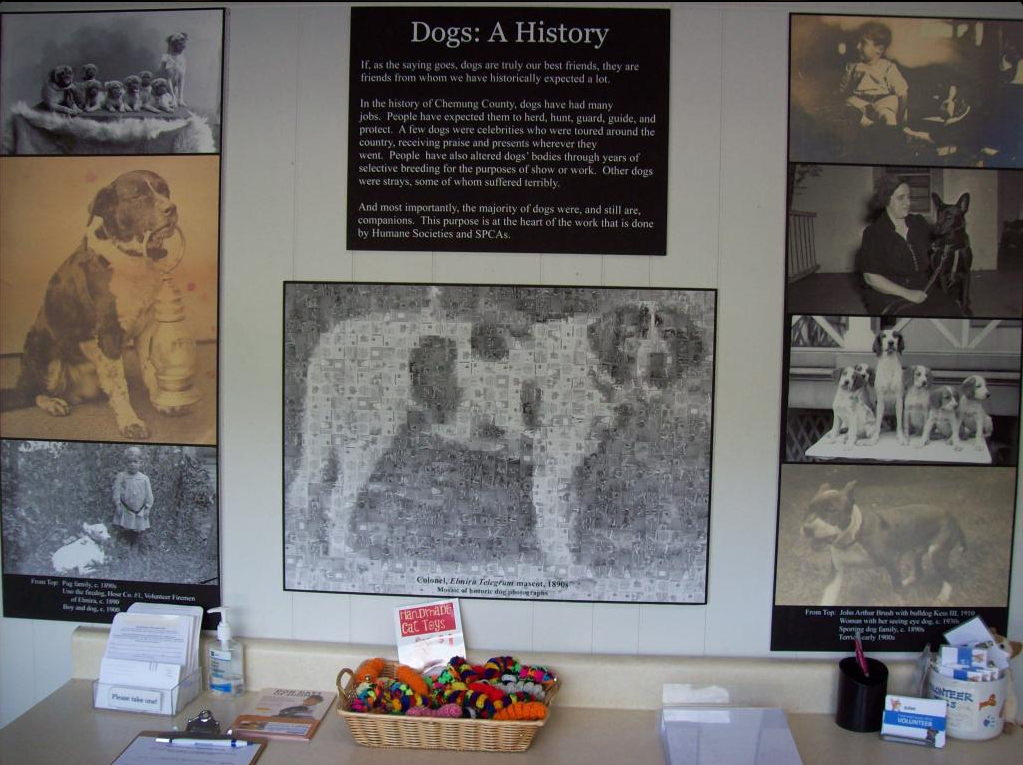
Dog history exhibit on display at the Chemung County Humane Society and SPCA
 
History They Didn't Teach You In School
We're starting a new program series, playfully called, "The History They Didn't Teach You in School."  The first installment is "Scandal!" on December 12, 2014 from 5:30-7.  These will be guided tours of the museum where we'll tell visitors all of the fun stories we don't normally get to tell in exhibits.  Like our Ghost Walk, we want our visitors have so much fun learning about history that they don't even realize that it's educational.

Medical Exhibit Interactives
In November, our new exhibit, "To Do No Harm: Medicine in Chemung County," will open.  The exhibit itself will be great because we have many fascinating, sometimes gruesome, medical artifacts that we'll be able to show-off.  However, what I'm personally most excited about is our interactive component.  At the start of the exhibit, you will be able to choose 1 of 9 stories that will guide you through the exhibit.  These are all accounts of a fictional historical resident of Chemung County who faces a medical problem.  Like those great choose-your-own adventure books, your story will guide you through the exhibit as you decide which doctor you will see, what medicines to take, and more.  We're making a push to do more programming and exhibit work that will give visitors an immersive historical experience.
Uh oh, it's the 1800s and you broke a bone! What do you do? Follow our interactive stories in our medical exhibit to find out!

Mark The Mammoth
You may have seen our adorable new Museum Ambassador, Mark the Mammoth, on our social media accounts or in person at the museum.  Mark represents our first foray into Twitter (you can follow him @MarkTheMammoth) and also a fun, informal way to connect with the public.  We put Mark in costumes (we just had staff contest to design a Halloween costume for Mark- congratulations to the winner, Erin) and have him make friends in the community.  Through Twitter, we have been able to join an international community of museums.  Mark routinely talks to other museums and museum mascots (there are surprisingly a lot of them on Twitter) about Chemung County.  Many of these people will never visit the museum, but Mark's Twitter account is a way to share our collections with these folks, anyway.  Mark has chatted about rain boots with a teddy bear mascot for an Estonian toy museum and about exhibit design with a giant extinct Irish deer from a UK museum.  We also participate in the weekly #MewseumMonday, where museums share images of their feline-themed collections. While these encounters may seem small, they are not only telling people about what we're doing, but they are also providing us with an endless source of ideas for programs and exhibits.  Rule #1 for museum creativity: when you see something good that someone else is doing, steal it for yourself!  

Mark pretends to be in Hawaii.  This costume comes courtesy of Mark's summer fashion designer, 9 year-old Ada.
This is just a sampling of the new ideas we're trying.  Now this doesn't mean that our traditional offerings, like lectures or exhibit openings, are disappearing.  These have long been the backbone of museum programming, and for good reason.  However, we are having fun trying to diversify our programs.  Innovation keeps the museum from becoming stale.  We're also always looking for suggestions from you.  What would you like to see offered at the museum?  How can we better serve you?  Be creative!