Showing posts with label Chemung County. Show all posts

Monday, May 29, 2023

The First Four Decades of Milling in Chemung County

by Monica Groth, Curator 

Arnot Mill on Newtown Creek, painted by Mabel Shoemaker, 1973

Living alongside creeks, rivers, and waterways has its many advantages. A river is not only a source of food and a means of transportation. Its power can also be harnessed to perform work for millers.

Almost as soon as the area which was to become Chemung County was settled by Revolutionary War veterans in the late 18th century, it became home to a number of sawmills – that is, mills which process lumber into wood for building homes. As past curator Frances Brayton writes, “even before a church or courthouse is built, the mill, by a rushing stream is set up and in operation.”

The first sawmill in the area was built on Seeley Creek by Abraham Miller in 1798. If his surname is any indication, Abraham might have descended from a family of English millers. He served in the Continental Army during the Revolutionary War and was captured by the Haudenosaunee. Escaping around Seneca Lake on his captors’ route to Canada, Miller settled in New York. Historian Ausburn Towner names Miller “one of the most active, foremost and enterprising of the earliest settlers of the valley”.

Many equally enterprising settlers followed Miller’s example. In 1800, the first sawmills were built in Ashland and Van Etten. In 1805, Nathan Teall erected two mills, one in Horseheads and another in Millport. In the early years of the 19th century, sawmills sprang up throughout the townships, as the plentiful lumber of the surrounding hills was harvested to supply the needs of the growing population.

Thirty years after Abraham Miller built the first sawmill, there were no less than 19 mills in Southport on Seeley Creek alone.

That year, Big Flats boasted 5 sawmills,

Catlin: 18

Chemung: 21

Elmira: 13

Erin: 4

Veteran: 36

This was before the Chemung Canal opened in 1833. Once completed, the canal greatly increased the efficiency with which lumber could be transported and greatly expanded the markets which it could reach. Trade increased and more mills were constructed to capitalize on this economic opportunity.

Lumber outside Rodbourn Sawmill in Erin, NY. Sawmills continued to thrive into the 20th century.

By 1836, when author Solomon Southwick published the pamphlet “Views of Elmira”, the area’s mills had modernized and were extremely productive. Southwick writes that the 6 mill complexes closest to Elmira produced nearly 20,000 feet of lumber daily.

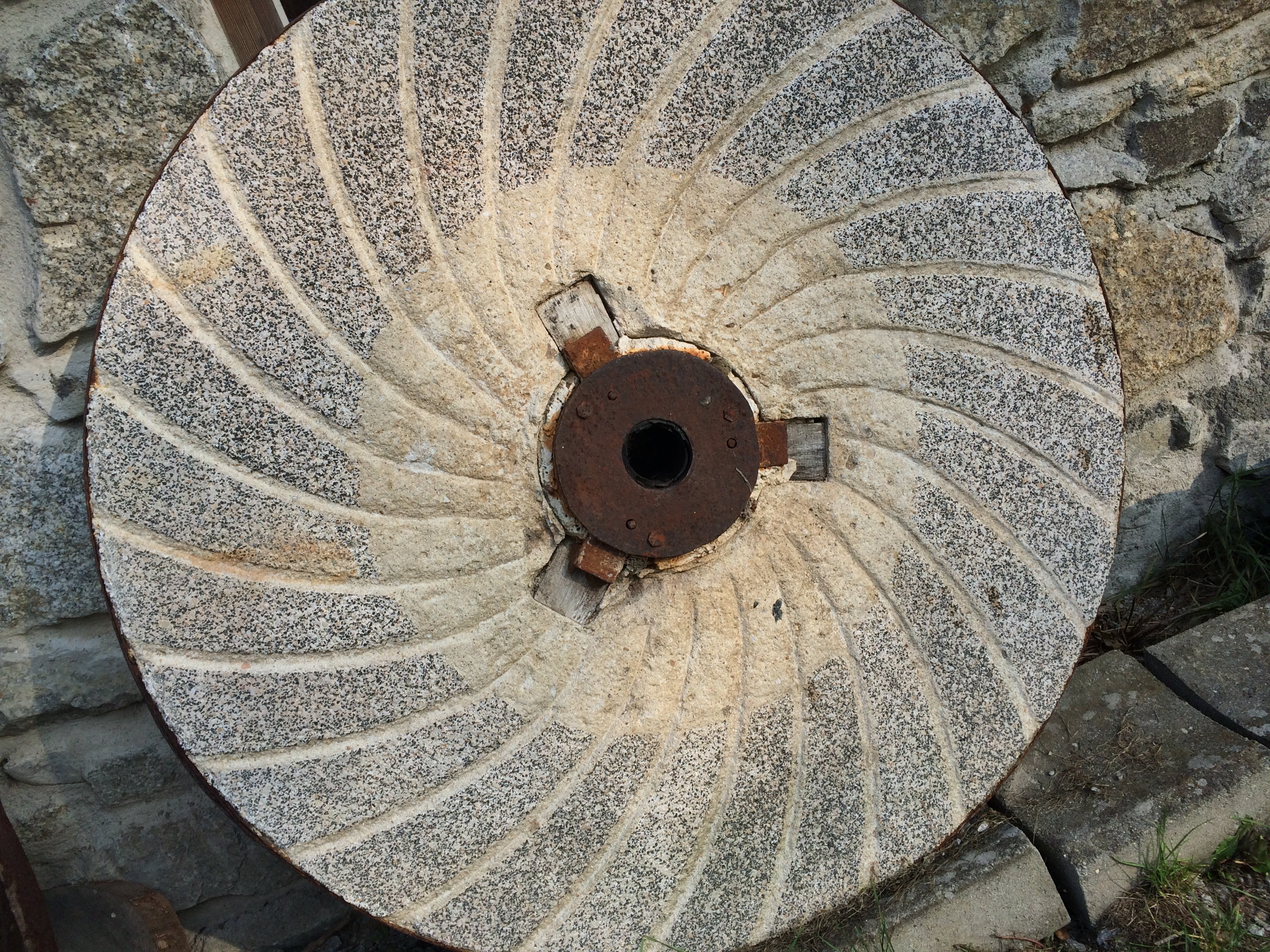
You’ll notice I wrote of mill complexes – meaning buildings harnessing water power to perform a variety of different tasks. Sawmills used that energy the operate saws to cut wood. Grist mills used that energy to grind grain between heavy millstones. Some millers did both tasks, while other specialized in one mill type.

A mill pick like this one in our collection is used to "dress" or re-carve
the furrows on mill grinding stones
A millstone - most grist mills will contain two stones arranged horizontally atop one another. One, the bedstone, remains stationary while the other, the runner stone, rotates on top of it. Grain its poured through the center whole and moves outwards through the channels as it is ground into fine flour, which emerges at its edge.

Grist mills appeared in our county sometime after our earliest sawmills and were extremely important to the area’s first families. Though a matter of some historic debate, the first grist mill is believed to have been built by Daniel Carpenter on Newtown Creek around 1800. Prior to its construction, families would transport their grain south to a mill on Tioga Point to be ground into flour. Towner writes that grain was transported on horseback or more often, by boat, and it was “a tedious process in bringing it home up river”. “When the mill was built at the mouth of Newtown Creek,” Towner writes, “it was an enterprise of more necessity… than the completion of the Chemung Canal.”

Soon after Carpenter’s Mill was built, another early grist mill was opened by the Webb family in Southport (in the vicinity of the district which now bears its name).

Scale model of Webbs Mill, originally on Seeley Creek in Southport.
Webbs Mill was among the first grist mills in Chemung County

By Southwick’s observation, in 1836, the aforementioned mills nearest the city of Elmira were grinding approximately 800 bushels of grain a day.

However, there were still far fewer grist mills in the area than sawmills, and grist mills, performing a great percentage of their work to serve the local community rather than more distant markets, remained very important to Chemung County residents. When a fire destroyed the grist mill Sullivan's Mill (also known as the Tuttle or Arnot Mill) in 1836, The Elmira Gazette wrote that the loss of the mill and over 650 bushels of wheat would be “severely felt by the community, as there are few such establishments in the neighborhood.” The mill was immediately rebuilt the following season.

Monday, December 28, 2020

Your Favorite Things

by Susan Zehnder, Education Director

Whitman Mission on the Oregon Trail

What does the Oregon Trail, a member of the inaugural Girls Professional Baseball League, and souvenirs from a doomed arctic expedition have in common? Each was a Chemung County Historical Society Blog post in 2020.

Since February 2012, we’ve published a new blog almost every week. This year despite various disruptions, we continued and were able to add 53 new blog posts. This brings our blogs-to-date total to 468: that’s four hundred sixty eight different topics!

For the last nine years, these blogs have been written by a staff member or invited guest, with all topics connecting to Chemung County’s history. They may be stories of people, or events, information on artifacts and documents, or explore a story behind another story. Despite posting weekly, we still can't predict which topics will resonate with our readers.

Taking stock of 2020 - and in case you missed any - here are this year’s five most popular blog posts in descending order. See if you find any thread of commonality.

1. On May 11th we published Chemung County's First Fatal Automobile Accident a blog which tells the story of the Voorhees family from Elmira whose 1914 summer afternoon drive resulted in tragic death and loss.

2. Back in January 17th Lost in the Mail profiled a mishap that occurred one snowy day in Wellsburg, March 195, and mail that was never delivered.

3. On March 23rd, shortly after the 2020 pandemic ground things to a halt, the blog titled The First Quarantine shared how the county shutdown for 19 days in response to the 1918 pandemic.

4. Less than a month later on April 17th, another blog titled Typhoid and Thatcher GlassManufacturing Company highlighted local contributions to public health. (Note we have an upcoming exhibit highlighting the Thatcher Glass Manufacturing Company going up in early 2021.)

5. On August 24th a blog shared the story of The Wellsburg Fire of 1912, a devastating fire that wiped out much of the town of Wellsburg in one single afternoon.

Up to this point, statistics show the blogs with the fewest visitors are some of our most recent. We never take blogs down, so it’s likely they’ll pick up additional viewers in 2021. In case you’re curious, the blogs with the fewest views to date are:

1. December 7th’s A Fall Tradition goes Virtual publicized our necessary switch from our usual in-person fund raiser event to one that was virtual.

2. December 14th’s blog Souvenirs from a Doomed Voyage shared objects in our collection from Ross Marvin, a local arctic explorer and The Greely expedition, an expedition that took place in 1881-1884.

3. Esther B. Steele: A Woman of Her Word, on November 30th profiled a well-known philanthropist who still makes an impact on the county today.

4. Our November 9th blog The Bachelor Governor highlighted the life of the 29th governor of New York State and the political connections he had.

5. Win with Wilkie, the blog published on November 2nd just before the presidential election was a little bit of lost history about a 1940 presidential campaign visit to Elmira.

Our continually growing collection of CCHS blogs is a great resource we encourage everyone to share, just be sure to give us credit if you do.

Researching facts and information on objects, people and events from the county gives us an opportunity to look at things in new ways. It also comes in handy. We used a series of blogs ourselves this past summer to create a unique walking tour of Elmira’s Heritage District that wove together over fifteen relevant blogs.

For fun, see our quiz posted on our Facebook page to see what facts from this year that you remember, the reader with the most correct answers will win a complimentary year's membership.

Monday, October 21, 2019

Ghost Stories


by Susan Zehnder, Education Director

For the past thirteen years, the Chemung County Historical Society  has joined forces with the talented Elmira Little Theatre and Friends of Woodlawn Cemetery to present an historic Ghost Walk along the paths of Woodlawn Cemetery. Unlike the artifacts and documents we have at the museum, at Woodlawn Cemetery, we’re sharing stories of people who lived their lives in the area. The stories range from heartwarming to hilarious and deserve not to be forgotten. 


October is a natural time of year to honor those who have passed on. Summer feels like it's coming to an end. Falling leaves and colder temperatures suggest winter is on its way. Plans however for our annual historic Ghost Walk actually start back in the summer. In July we start to research, write, and revise original scripts based on the lives of potential characters. We visit the cemetery to find the perfect combination of characters and walk various potential routes. Ghosts are selected on variables like a mix of genders, ages and professions. We balance the mood of the stories we share. And, we pay attention to grave site locations. Ghosts must be close enough to get to on a reasonable walking tour, and far enough apart that when each actor tells his or her story, it won’t disturb the others.

Final scripts are passed on to Elmira Little Theatre members who audition, cast and bring the ghost stories to life. As we get closer to the walk date, Friends of Woodlawn Cemetery provide people to carefully guide each visiting group along the paths to meet the ghosts. Other people are involved including those who keep the lanterns lit, drive the buses, welcome visitors, count bus riders, help with gathering tickets, run the trivia contest and jump in to fill in where needed to keep things going. 

Many people who are part of this event have their own stories to tell. Quite a few volunteers have been doing this for years, including those who have participated as long as the event has been going on. Among them are a brother and sister who stepped in and became guides to honor their father when he wasn't able to do it anymore. Another guide drove from Ithaca to participate after falling in love with the event that her sister volunteers for, and this year a guide was surprised to hear a ghost story involving an act of kindness her own grandfather did. All the people who are part of this event are so important to its success and we can't thank them enough.

Lanterns being checked and ready

In thirteen years, the historic Ghost Walk has changed. In the beginning, there were three ghosts and four tours that took place during one evening. Now the event lasts two nights, and involves four or more ghosts with eight tours each evening. It brings 400 visitors to the museum and to the cemetery, and with only five full-time staff, it takes a heroic effort, and many volunteers to pull this off. This year we were rewarded by selling out all 400 tickets in just two weeks. Our event at the graveyard is to share some stories of those who are buried there, and we are thrilled that history can still be so exciting and popular. We also encourage anyone who missed getting tickets this year to watch for notices next September.

Woodlawn Cemetery

The historic Ghost Walk for this year is over, and the 2019 ghosts have been revealed. These scripts are now posted on our CCHS website.

This year, also look for an additional event coming up. Concerned that our ghost walk isn’t accessible to all visitors, especially those unable to walk the ¾ mile trek at night, on October 30th we are hosting another event called Ghostly Readings. At the museum on that Wednesday from 1:30 pm-2:30 pm, staff members will read this year’s ghost scripts and share images of the people we’ve profiled. We will also feature a mystery celebrity reader. Tickets for this event are $5 and include admission to the museum, cider and donuts. We encourage you to call to make reservations, and hope to see you here or in a year when we do this all again!


Call us at 607-734-4167 for reservations or email educator@chemungvalleymuseum.org

Monday, July 22, 2019

That Time the Town of Baldwin Almost Dissolved

by Erin Doane, Curator

As I was researching the Town of Baldwin for its upcoming exhibit (on display August 1, 2019-January 31, 2020), the town historian showed me an article written in 1959 about how the town almost dissolved in 1923. In the early 1920s, the town began paving many of the roads within its limits to make them more suitable for increasing automobile traffic. I can see the logic that improved roads might bring more people and businesses into the town, but the municipality was already unstable financially. The budget was unbalanced, there were no reserve funds, and the taxes were high. Adding the cost of paving on top of the general cost of maintaining 63 miles of roads and numerous bridges pushed Baldwin deeper into debt. There were no major industries, stores, utilities, or even a railroad line in the town, so the tax burden fell heavily onto farmers.

Aerial view of the village of North Chemung in the Town of Baldwin, c. 1950s
The first mention of the possible dissolution of Baldwin was in a Star-Gazette article on May 14, 1923. In order to help relieve the town residents of their high taxes, the Chemung County Board of Supervisors discussed the idea of combining the towns of Elmira, Ashland, Chemung, and Baldwin as one unit. By the end of the meeting, nothing had been decided.

One week later, on May 22, another article in the Star-Gazette reported that a petition was presented to the county Board of Supervisors. The petition read as follows:
The undersigned, residents and freeholders of the Town of Baldwin, your county, respectfully petition that your Board take such action as will bring about the annexation of the said Town of Baldwin to the Town of Chemung, in your county, or that the said Town of Baldwin be so partitioned that a part thereof may be set off to each of the Towns of Erin, Van Etten and Chemung in your county, and that your board will take such action as will accomplish this result.
The article then listed 100+ names of Baldwin residents who supported the petition.

Star-Gazette headline, May 22, 1923
These two new propositions – either combining Baldwin and Chemung into one town, or dividing the land of Baldwin up among the three towns of Erin, Van Etten, and Chemung – were left in the hands of the supervisors of the towns of Baldwin, Erin, Chemung, and Elmira. They were to research options and report back to the board of Supervisors at their next meeting.

An editorial appearing in the newspaper on the same day explained how the petition was unlikely to succeed. “Changing long established town boundaries or discontinuing towns entirely and incorporating them with other towns is an extremely hard thing to do,” it stated. Beyond the legal and logistical issues of such a drastic change, Baldwin had the highest taxes in the county (higher even than the city of Elmira). No other town would willingly take on that burden. As a result, the petition quietly died in committee.

This effort by the Town of Baldwin was not for nothing, however. By presenting such a sweeping demand before the Board of Supervisors, the town pushed the county into honestly considering the tax problems it was facing. For years, Elmira had been helping Baldwin cover its tax shortfalls as no other solutions had been implemented. After the petition for dissolution was presented, the board approved a county-wide tax levy that provided $2,000 (around $30,000 today) to Baldwin to help ease its residents’ suffering. 

Map of Chemung County, 1989