by Monica Groth, Curator
 |
| Arnot Mill on Newtown Creek, painted by Mabel Shoemaker, 1973 |
Living alongside creeks, rivers, and waterways has its
many advantages. A river is not only a source of food and a means of
transportation. Its power can also be harnessed to perform work for millers.
Almost as soon as the area which was to become Chemung
County was settled by Revolutionary War veterans in the late 18th
century, it became home to a number of sawmills – that is, mills which process
lumber into wood for building homes. As past curator Frances Brayton writes,
“even before a church or courthouse is built, the mill, by a rushing stream is
set up and in operation.”
The first sawmill in the area was built on Seeley
Creek by Abraham Miller in 1798. If his surname is any indication, Abraham
might have descended from a family of English millers. He served in the
Continental Army during the Revolutionary War and was captured by the
Haudenosaunee. Escaping around Seneca Lake on his captors’ route to Canada,
Miller settled in New York. Historian Ausburn Towner names Miller “one of the most
active, foremost and enterprising of the earliest settlers of the valley”.
Many equally enterprising settlers followed Miller’s
example. In 1800, the first sawmills were built in Ashland and Van Etten. In
1805, Nathan Teall erected two mills, one in Horseheads and another in Millport.
In the early years of the 19th century, sawmills sprang up
throughout the townships, as the plentiful lumber of the surrounding hills was
harvested to supply the needs of the growing population.
Thirty years after Abraham Miller built the first
sawmill, there were no less than 19 mills in Southport on Seeley Creek alone.
That year, Big Flats boasted 5 sawmills,
Catlin: 18
Chemung: 21
Elmira: 13
Erin: 4
Veteran: 36
This was before the Chemung Canal opened in 1833. Once
completed, the canal greatly increased the efficiency with which lumber could
be transported and greatly expanded the markets which it could reach. Trade
increased and more mills were constructed to capitalize on this economic
opportunity.
 |
| Lumber outside Rodbourn Sawmill in Erin, NY. Sawmills continued to thrive into the 20th century. |
By 1836, when author Solomon Southwick published the
pamphlet “Views of Elmira”, the area’s mills had modernized and were extremely
productive. Southwick writes that the 6 mill complexes closest to Elmira
produced nearly 20,000 feet of lumber daily.
You’ll notice I wrote of mill complexes – meaning
buildings harnessing water power to perform a variety of different tasks.
Sawmills used that energy the operate saws to cut wood. Grist mills used that
energy to grind grain between heavy millstones. Some millers did both tasks, while other specialized in one mill type.
 |
| A mill pick like this one in our collection is used to "dress" or re-carve the furrows on mill grinding stones |
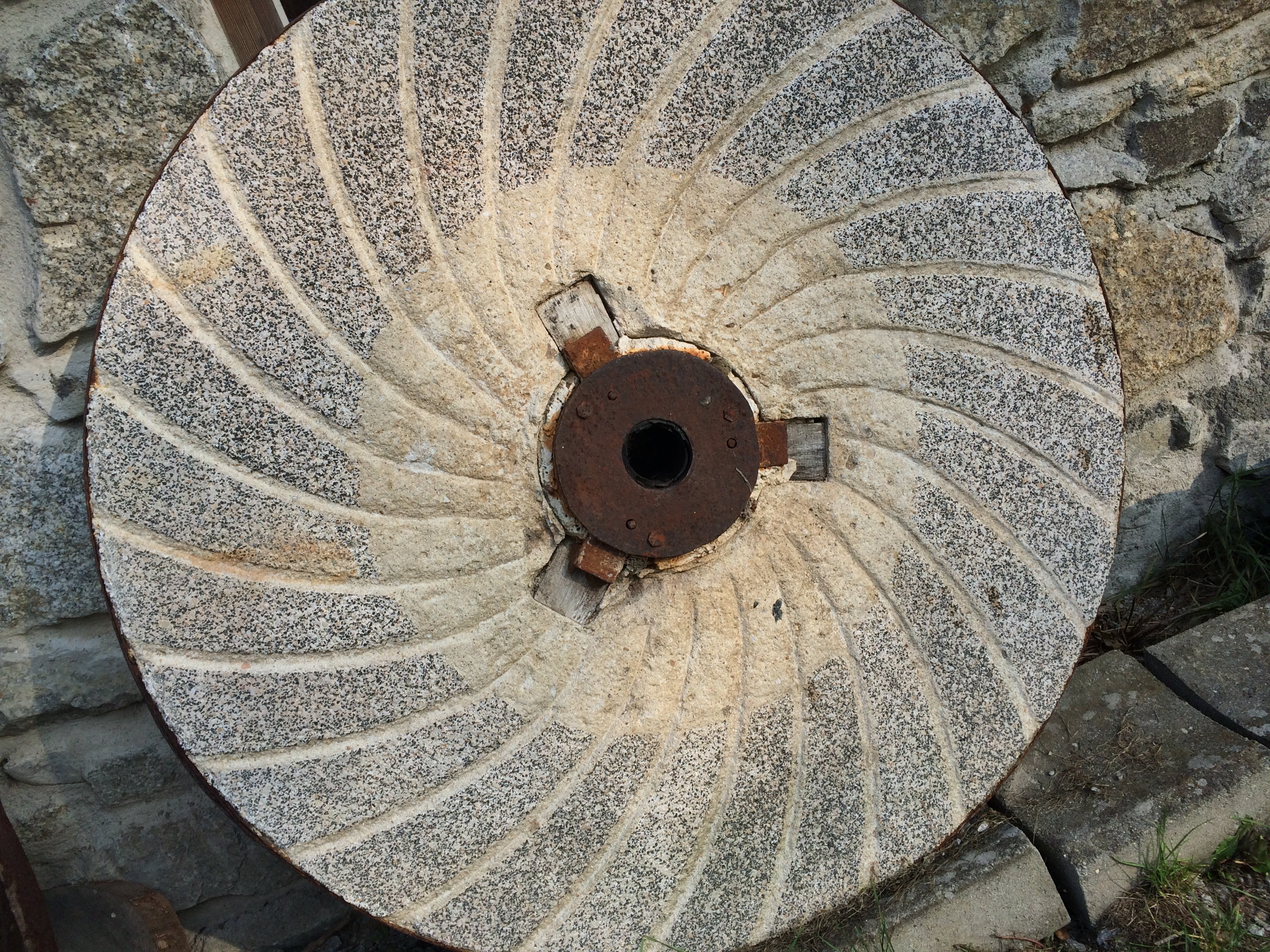 |
| A millstone - most grist mills will contain two stones arranged horizontally atop one another. One, the bedstone, remains stationary while the other, the runner stone, rotates on top of it. Grain its poured through the center whole and moves outwards through the channels as it is ground into fine flour, which emerges at its edge. |
Grist mills appeared in our county sometime after our
earliest sawmills and were extremely important to the area’s first families.
Though a matter of some historic debate, the first grist mill is believed to
have been built by Daniel Carpenter on Newtown Creek around 1800. Prior to its
construction, families would transport their grain south to a mill on Tioga
Point to be ground into flour. Towner writes that grain was transported on
horseback or more often, by boat, and it was “a tedious process in bringing it
home up river”. “When the mill was built at the mouth of Newtown Creek,” Towner
writes, “it was an enterprise of more necessity… than the completion of the
Chemung Canal.”
Soon after Carpenter’s Mill was built, another early grist
mill was opened by the Webb family in Southport (in the vicinity of the district
which now bears its name).
.jpg) |
| Scale model of Webbs Mill, originally on Seeley Creek in Southport. Webbs Mill was among the first grist mills in Chemung County |
By Southwick’s observation, in 1836, the
aforementioned mills nearest the city of Elmira were grinding approximately 800
bushels of grain a day.
However, there were still far fewer grist mills in the
area than sawmills, and grist mills, performing a great percentage of their
work to serve the local community rather than more distant markets, remained
very important to Chemung County residents. When a fire destroyed the grist mill Sullivan's Mill (also known as the Tuttle or Arnot Mill) in 1836, The Elmira Gazette wrote that the loss of the mill and over 650
bushels of wheat would be “severely felt by the community, as there are few
such establishments in the neighborhood.” The mill was immediately rebuilt the
following season.


