Monday, May 8, 2017

Fickle Fashion: The Bustle

by Erin Doane, Curator

Many fashion trends are loved by some and loathed by others. I’ve always been a big fan of the bustle; especially the outrageously large ones of the 1880s. The bustle, a pad or framework worn under a dress to support the back drapery of the skirt, became very popular in the early 1870s. It came back into fashion about ten years later and was at its most exaggerated around 1885. At that time, the perfect bustle was so prominent and substantial that a tea tray could be comfortably balanced upon it.

Fashion plate showing bustled dresses, mid-1880s, from Wikipedia Commons
 Until I began digging more into the social history of the bustle rather than just the fashion history, I did not realize how hated the garment was. It was the source of aggravation and embarrassment. Trolley conductors rejoiced when it began going out of style in the late 1880s. Fashion writers in the late 1890s and early 1900s, called the bustle “unsightly” and declared it unbecoming, ungraceful, and uncomfortable.

Portrait of an unidentified couple, 1880s
An incident dubbed “one of the most distressing of the year” took place in Elmira in 1888. The Elmira Telegram reported on a local lady living in the first ward who had a terrible experience with her bustle. The unnamed woman was the wife of a well-to-do gentleman. She was not obliged to do her own housework but she chose to because she was such a good homemaker. One day, she was in a hurry to run an errand and decided it was not worth getting all dressed up. She was already wearing a good calico wrapper so she put on her sacque coat and tied on her bustle underneath it to give it “the proper swing.” She returned home after a successful trip, took off the sacque, and went about her day’s work. When the milkman arrived at her door she greeted him then remained on her front stoop to enjoy a passing parade of young minstrels. She enjoyed the music but she wondered why many in the crowd look at her with so much interest. Upon going back inside, she caught sight of herself in the hall mirror. She was still wearing her bustle on the outside of her wrapper! “The lady will not be comforted,” the Telegram reported. “It is said that in her dreams she sees bustles of all sorts, shades and sizes floating around in space, and after each one is a crowd of grinning boys.”


Advertisement for Langtry bustles, for sale in Elmira at
Dey Brothers, Durland & Pratt, and B. Erlich & Son, 1888
TheElmira Telegram reported that conductors in Philadelphia were glad to see the bustle go as the trend began to fade in the late 1880s. Part of a conductor’s job was to efficiently fill the seats, making sure as many passengers as possible could ride. In the morning, that was a relatively easy task. Women who were up and on the trolley before 9:00am generally had work to do and were not wearing bustles. By mid-day, however, middle and upper class women came out to shop dressed in the latest, greatest fashions. One conductor observed that “some of the appendages [bustles] are so large that when eight or ten women are standing up not even a thin man can get a chance at a strap.”


Bustles in CCHS's collection, 1880s, left to right: padded bustle; bustle made
of three coiled metal springs with cotton cover; metal mesh bustle
One man who was not entirely pleased with the sudden decline of the bustle was a furniture maker who developed a new design for a sewing chair. An article in the Telegram in 1888 reported that the unnamed craftsman created a chair that extended out in the back to accommodate the bustle. He patented the design and built a stock of the chairs to display for sale just as the bustle went out of fashion. I searched for the ill-timed patent but, since the newspaper did not give the man’s name or any other specific information, I had no luck in finding it.

Cage crinoline/bustle combination, 1883
The bustle abruptly disappeared from fashion around 1890. An article in the Elmira Daily Gazette and Free Press on July 18, 1891 asked “What has become of the bustle?” The writer explained that “in their palmy days there were millions of the unsightly things worn by women in every station of life” but now the garment can no longer be found for sale. A Gazette article a year and a half later stated that “thousands of women protested that they would perish beside their bustles before giving them up but now the bustle is as extinct as the dodo or the plesiosaurus.”

Group portrait of ladies wearing dresses with bustles, 1880s
Rumors of the bustle’s return to fashion appeared throughout the 1890s and the early 1900s. The garment’s reappearance was not seen as a good thing. The Dress Gossip column in a 1906 issue of the Elmira Telegram addressed the newest round of rumors. “It does not seem credible that sensible women, women with an eye to her own personal appearance and grace of movement, would for one moment contemplate with any degree of patience an attempt to bring into vogue the unbecoming fashion of a past generation.” Nevertheless, the writer declared it was “just as well to prepare for the worst,” i.e. the return of the bustle to mainstream fashion, despite the opinion that “it always was an ungraceful, uncomfortable fashion, this bustle business, and partook considerably of the character of an absurdity.” Those who disliked the bustle so much were likely relieved that it never did return as a major fashion trend.


Monday, May 1, 2017

Thomas Carpenter's War Trauma: The Plight of Disabled Veterans of WWI

By Kelli Huggins, Education Coordinator

Corporal Thomas Beecher Carpenter enlisted in the Army in 1912 and served until 1919. A member of the 103rd engineers, he received shrapnel wounds, was gassed, and suffered from shell shock while serving in France during World War I. Upon returning, Carpenter still felt the physical and mental effects of his time in the trenches. By 1927, 34-year-old Carpenter had been hospitalized at least 27 times since leaving the Army. Carpenter suffered from debilitating seizures or fits that often required him to be hospitalized and confined to a strait jacket.


Carpenter was like many World War I veterans who returned from the war facing both physical trauma and what we now know as PTSD. For a while after the war, Carpenter had received disability benefits from the United States Veterans’ Bureau for bronchitis. Those payments stopped in 1923, however, and Carpenter was unable to prove that his other more serious ailments were the direct result of his service. Carpenter was unable to find employment and grew desperate.

Local Congressman Gale H. Stalker and the Elmira chapter of Disabled American Veterans took up his case in 1927 and successfully petitioned the US Veterans' Bureau for Carpenter to receive $4,000 in back compensation and approximately $70 a month in the future. At the end of the ordeal, Carpenter told Stalker that he remained hopeful that he would be able to be rehabilitated and to find employment.
DAV forget-me-not from the CCHS collection
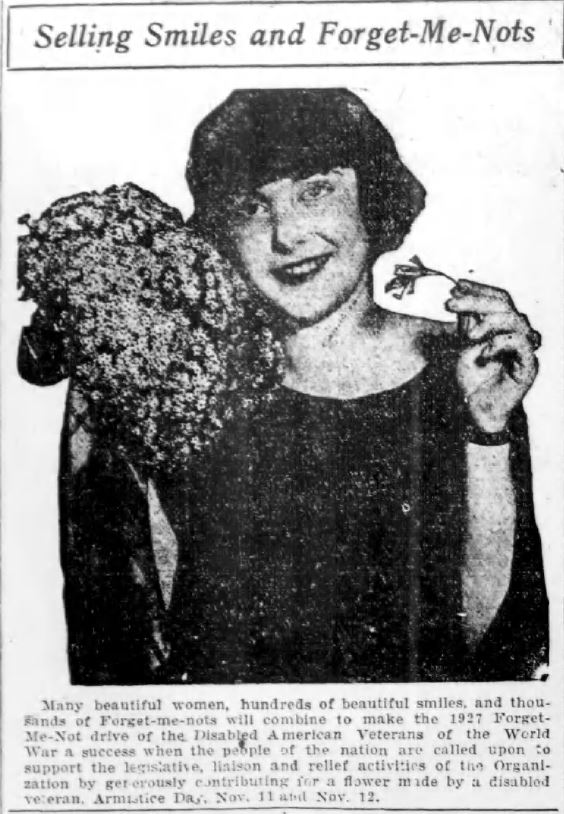
Carpenter and his fellow injured servicemen were assisted by local chapters of Disabled American Veterans of the World War. The DAV was founded in 1920 to help returning veterans who, like Carpenter, were receiving little or no assistance from the government. The Elmira Chapter, No. 13 of DAV held meetings and fundraisers and advocated for local people like Carpenter. The annual forget-me-not sale was the most popular fundraiser for DAV. Similar to the American Legion’s poppy sales, the forget-me-not sales were a way to get the community involved and were a symbolic reminder of the mission of the DAV.
From an article about forget-me-not sales in 1927