Showing posts with label Contest. Show all posts

Sunday, May 3, 2020

Posters Spread the Word

by Susan Zehnder, Education Director


The Chemung County Historical Society is sponsoring a COVID19 Awareness Poster Contest for area students. Posters are due online by June 1st and more details can be found on our Facebook page or this link at Poster Contest.

Our contest is open to all Chemung County students enrolled in public, private or homeschooled classes ranging from Kindergarten through 12th grade. We’ve lined up a committee of local celebrities to judge the entries, and the posters they select will be put together as part of a CCHS online exhibit everyone can see. The overall winning poster will be professionally printed and distributed to schools and public buildings for display, and to remind us of good health practices. Our project is supported by a grant from the Arts Council and we thank them. Please share this contest information with any students you know.

Why Posters? Throughout history, posters have been an effective and eye-catching way for people to get their messages out. Early posters in America can be traced back to the late 18th century and were mainly used for advertising. Most were lithographic prints created with a printing technique that uses a flat treated surface, often a stone. To make a print, the surface is treated to attract or repel ink in order to create the desired image. The word Lithography is derived from two ancient Greek words - stone or lithos and writing or graphy. This process was a big improvement over earlier printing practices, however it remained slow and labor-intensive because each image color required a new surface. By the end of the 19th century printers had improved the process and could now create a rainbow of colors by only using three printing surfaces. Large-format printing became easier, cheaper, and more reliable.

Artists quickly adopted the process to create memorable posters. Design became more important and artists like Henri de Toulouse Lautrec used lithography to create distinctive posters we still recognize today.


His poster of dancer Jane Avril plays up her dramatic flair using that great swooping hat and ribbon snaking down her dress.

Posters were often bold, colorful and used image as much as text to get their message across. Not only used in advertising, they were often used to influence public opinion. As life moved faster and the 20th century world headed towards war, posters advertised or promoted specific issues like this example from our collection. 


Dressed in an American flag, this farmer spreads victory across the land. While some posters promoted greater public knowledge and were based on facts, others were biased sharing very narrow viewpoints. These functioned as propaganda attempting to push false information or ideas. Either way, posters were an effective way using both image and text to spread messages to as many people as possible.

Poster contests don't span the same history. Locally, they show up in the Star-Gazette mid-20th century. In 1949 the Montour Falls School advertised a contest for 5th through 8th grade students to create posters on the Bill of Rights. Other contests and topics over the years were sponsored by the Civil Defense auxiliary guild, Family Doctors Preventative Health, Muscular Dystrophy, Red Cross preparedness, an anniversary of women's voting, fire safety, and racial equity.  

Posters can be serious, clever, funny, subtle or bold. Humor has made its inevitable dent in the COVID19 situation, with posters from the so-named ‘Coronavirus Tourism Bureau’ a clever hack by talented California graphic designer Jennifer Baer. She's made staying at home look exotic.


The world as we knew it before COVID19 has changed. The lives of our students have been changed forever. We want to see what Chemung County students have to say, we believe their voices are important for us to hear.

Encourage any students you know to participate and spread the word!
(For another blog on posters, see our blog Selling the War )

Monday, January 25, 2016

Soap Sculpture in Elmira: How You Can Be a Part of Its History!

By Kelli Huggins, Education Coordinator

The Chemung County Historical Society is hosting a soap carving contest to celebrate our new exhibit, Clean. It’s free and open to all ages and you can find out how to participate here: http://www.chemungvalleymuseum.org/soap-contest

But, why soap carving, you might be thinking?  It’s a pretty obscure art form to us now, but in the 1920s and 1930s it was wildly popular here and across the country.  It really took off when Proctor and Gamble promoted national soap carving contests in an attempt to sell more of their product, Ivory soap.  Soap carving was touted as an activity that was accessible for people of all ages and abilities.  It was supposed to provide a wholesome outlet for children’s energy and also serve as a low-cost medium for amateur adult artists.
If our amateur artist staff at the museum can do it, so can you.
Beginning in the mid-1920s, the Arnot Art Museum periodically displayed soap sculptures, and the popularity of such exhibits led people to call for local contests.  In 1926, the Elmira Community Service provided 100 free instructional booklets to children interested in learning soap carving.  In 1945, the Arnot Art Museum displayed sculptures created by 7th and 8th grade students at Elmira’s George Washington School.  The entries were then to be entered in the National Soap Sculpture Contest in New York City.  
William Lavris and Marjorie Kolb inspect entries in the 1945 Arnot Art Museum display.
Even local businesses got in on the craze: this advertisement from The Junior Shop in 1929 tells of a soap display and contest hosted at boys’ clothing store.

So now, I encourage you to help us revive this once popular art form.  You don’t need to have any artistic background or special ability.  It can be done with a basic kitchen butter knife or you can come to the museum and use our special carving tools during our open carving workshop hours (see here for those times: http://www.chemungvalleymuseum.org/soap-contest).  Your work will be on display at the museum and you could even win a prize.  And it’s free.  Give it a try and you might just uncover a secret talent you never knew you had!


Monday, January 4, 2016

Which Baby is Best?: Baby Contests in Chemung County

By Kelli Huggins, Education Coordinator

I admittedly, and ashamedly so, have spent some time watching TV shows like “Toddlers and Tiaras” in utter horror.  I don’t get the point of putting makeup on your infant so a panel of judges in a sad hotel ballroom can give them a trophy.  But my personal feelings on the subject aside, baby shows aren’t a new idea.  Certainly, modern kiddie pageants operate in the realm of extremes (Fake teeth? Really?!?), but baby contests date back more than a century, and for periods, were very popular locally.

See #16? Babies like winning contests! From 1907.
Baby shows started in England in the 1880s and soon became popular on our side of the Atlantic.  The earliest mentions of baby contests I have found in Chemung County are from the mid-1890s.  These earliest shows were primarily held at the County fair.  As the newspaper reported, “The baby show is usually a howling success.”
Handbill from the 1896 Chemung County Fair that highlights the baby show.
By the 1900s and 1910s, the contests started to evolve, but many still were in place to find the cutest or most popular baby.  A 1905 baby contest at Bethel A.M.E. Church ended when judges “found all so pretty” that it was unfair to choose a winner, so they instead awarded them all prizes.  Local babies placed in larger regional or national competitions, too.  In 1913, Elmiran Jacob Levine won a baby contest in Scranton, PA, defeating 800 other babies.  That same year, Phyllis Jane Dixon won one of the largest national contests at Asbury Park, NJ, earning a gold medal and $15 in gold.  She won “not for beauty alone, but for physical and mental perfection.”  Other types of contests began to emerge: in the 1910s, the Gerity’s Pharmacy awarded prizes to the first baby born in Elmira each New Year.     
Gerity's 1915 winner
In the 1920s and 1930s, the shows morphed into “Better Baby” contests.  Building on some of the less destructive ideas of the eugenics movement, Better Baby shows were developed to identify and award healthy babies and to educate mothers about best child-rearing practices.  Still, the winners were almost exclusively from white, middle-to-upper class families, so the ideals of the eugenics movement were definitely adhered to.  These contests were judged by doctors who gave each child a physical examination. 

Dr. Dale examines a baby at a Chemung County contest in 1924.
The competition was fierce and a lot of maternal pride was on the line.  As Elmira Telegram opined in 1923, “The man who can act as a judge at a baby show and escape without a scratch is a born diplomat.”

Winners of a 1925 Chemung County Better Baby Contest (the crying girl on the left probably wouldn't have won if she cried like that in judging).
In 1929, one-year-old Edgar Allen Terwilliger defeated 200 other babies to win the Chemung County Better Baby Contest.  The show's real purpose was said to be educational. 40 of the 200 babies were deemed “defective,” which was a warning to their families to “keep closer watch of their health.”  In 1925, 10-month-old Ruth Barber won 3rd place in the national Nestle’s Food Healthy Baby Show.  She won her picture and story in the “Pictoral Review,” a sterling silver loving cup, and $25 cash.
Nurses hold winning babies of a contest at St. Joseph's Hospital in 1937.
By the late 1930s through the 1950s, many of the contests again turned back towards popularity- or beauty-based judging. In 1939, the Big Flats Baptist Ladies Aid Society held a contest to “determine the most popular baby.”  Other local organizations held similar contests.  
Advertisement for entrants for the 1938 Daughters of America Baby Show (note the prizes for cutest and most popular babies).
Baby photo contest, 1945.
In 1954, the Big Flats American Legion Auxiliary hosted a snapshot photograph baby contest at Community Days.  Photos were posted on a bulletin board at Minier’s Grocery Store and judging was done by a penny vote.  The winners got to ride on a special parade float.

A rebellious 1938 local winner.
The baby show craze started to fade away after the 1950s, but clearly didn’t disappear entirely.  Early baby shows certainly had some positives, including putting a spotlight on infant health and wellness.  The wit and wisdom section of the Star Gazette suggested one other positive in 1928:
“Your baby may not win

In the Baby Show,
If you enter him. But he’ll meet
Some nice babies.”


Monday, July 20, 2015

How Did a Lake Disappear?

by Erin Doane, Curator

On the morning of April 7, 1990, the Chemung County Sheriff’s Department received an odd telephone call. They were told that the lake behind the Sullivanville Dam had disappeared. They thought it was an April fool’s joke until they saw that the 26-acre lake was, indeed, dry. This strange occurrence brought up a whole host of questions. How was the lake drained? Who emptied it? Why did they do it? And, most importantly, would the lake be refilled by May 26 when the $4.7 million dam project was scheduled to be dedicated?

Panorama of Sullivanville Dam, July 15, 2015
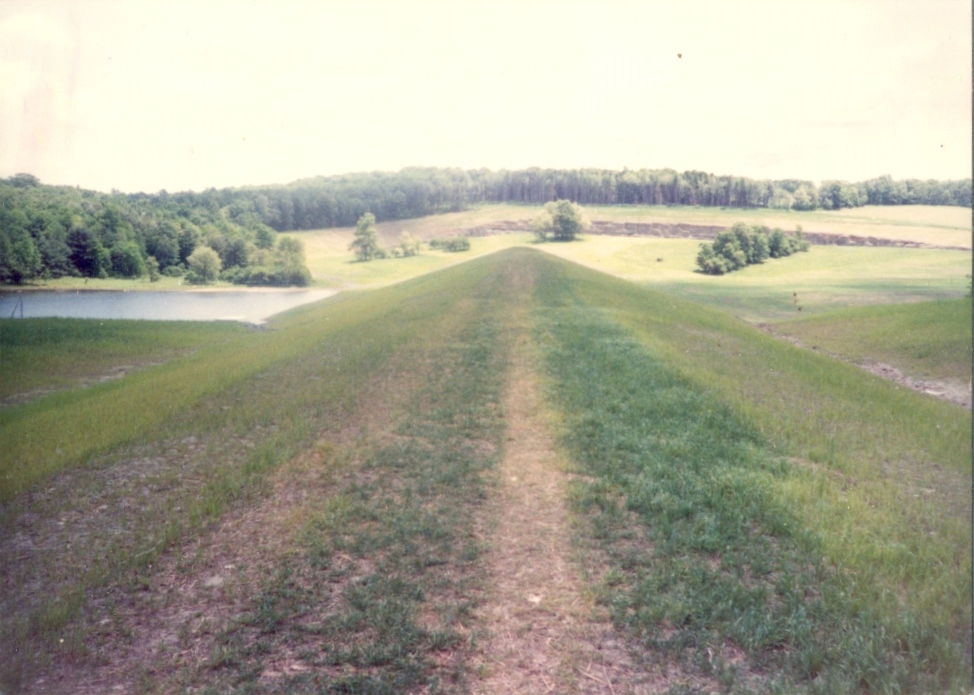
 The Sullivanville Dam was a highly debated project that suffered many delays before its eventual construction. In the late 1960s, Chemung County, the federal government, and the New York State Department of Environmental Conservation (NYSDEC) began plans for flood control in the Newtown-Hoffman Creek Watershed. The project included the Marsh Dam east of Breesport, the Park Station Dam in Erin, the Hoffman Dam on Elmira’s north side, and the Sullivanville Dam in Horseheads. The Sullivanville Dam is the largest in the Newtown-Hoffman network. The earthen dam is 70 feet high, 450-feet wide, and 2,400-feet long with a 26-acre surface area. It reduced the risk of flooding in Horseheads and the east side of Elmira by an estimated 80 percent and provided protection to 530 people, 151 homes, and 73 commercial, industrial and public buildings when it was completed in 1988. But it was almost never built.


In 1979 the U.S. Soil Conservation Service declared that no more flood control projects in the Newtown-Hoffman Creek Watershed program should be built because the cost of the projects, including the Sullivanville Dam, could not be justified by flood control benefits. While it was estimated that the Sullivanville Dam would significantly reduce flooding in Elmira and Horseheads, the $4.5 million cost would only result in an estimated benefit of $3.3 million.


There was also local opposition to the Sullivanville Dam. When the project moved forward again in 1984 local legislators argued that it was not cost-effective. For the project, Chemung County had to acquire a total of 230 acres of private land made up of 32 properties in the towns of Horseheads and Veteran including eight family homes. Several homeowner did not want to give up their homes and land, delaying the project further. Even as the bulldozers were starting to move earth in 1988, protesters were seeking a federal court injunction to stop construction. The project also forced a portion of Route 13 to be rerouted.

On May 31, 1988, after nearly 25 years of arguments and delays, a contingent of local, state, and federal officials ceremoniously dug the first shovelfuls of dirt. The U.S. Soil Conservation Service designed the dam and paid the Cold Spring Construction Co. of Akron, New York $4.73 million to construct it. Less than two years later, the dam was finished. Its official dedication was held on May 26, 1990 and, yes, the lake had refilled with water by then. Natural runoff and snow in the watershed refilled the lake in less than a week.

Sullivanvilled Dam when it was completed, 1990
It took at least two strong people to break into the valve mechanism on top of the dam to drain the lake. They used a hacksaw to cut the lock on the manhole and a pry bar to lift the lid and access the valves. Fortunately, whoever perpetrated this prank/crime did not damage the valves. Once opened, the valves released a slow but steady stream of water from the lake. It is thought that the valves may have been opened on Thursday night or Friday morning and that the water level dropped so slowly that no one noticed until Saturday morning.

Manhole on the top of the dam
I never found a report of who emptied the lake or even if anyone had been caught. For some time before the Dam’s dedication there had been requests for the sheriff to increase patrols of the area. Neighbors had complained of cars drag racing on the closed stretch of Route 13 and people holding wild parties. Perhaps it was thoughtless vandals who opened the dam’s valves. Perhaps it was done as a continued protest against the construction of the dam.

July 15, 2015
Today, you can fish and hike at the Sullivanville Dam. It is one of 73 parks within Chemung County. This summer CCHS is celebrating public green spaces, like the Sullivanville Dam, with the exhibit Parks and Recreation and the Parks and Recreation Contest. By offering prizes like wristbands and backpacks, we hope to encourage people to visit all parts of the county and enjoy some of the wide variety of parks this area has to offer. Click here for more information about the contest.