Showing posts with label Police Department. Show all posts

Monday, July 20, 2020

How Racism Kills

By Rachel Dworkin, archivist


Shortly after the death of George Floyd at the hands of Minneapolis police, a young researcher asked me if anyone in Elmira had ever died because they were Black. The only answer I could give her was, well, it’s complicated. It’s complicated for a couple of reasons. Firstly, no one has ever died because they’re Black. They’ve died because the people and systems around them were racist. Secondly, it’s complicated because racism in Elmira has never taken the form of lynch mobs yelling racial slurs. No, our local brand of racism is far more subtle, but no less dangerous.

Take, for example, the case of Bessie Berry. In 1981, she became the first Black woman to work as a Corrections Councilor at the Elmira Correctional Facility. Despite being fully qualified for the position with bachelors and masters degrees, over 10 years’ experience as a probation worker, and high test scores on the civil service exam, she was given the run around throughout the hiring process. In 1986, she was placed in charge of a state-mandated program designed to provide work and retraining opportunities to inmates. For the next year, she struggled to implement the program with no support and lots of pushback from her coworkers and superiors. They finally agreed to sign off on her plans after a class-action lawsuit alleging racial discrimination in work placement was filed by a group of inmates. By then, Berry was so stressed out from all of this that she had a heart attack and was forced to retire. You can hear all about it in her own words in an oral history interview she gave in 1989.


Studies have shown that dealing with everyday racism can have profoundly negative effects on the health of African Americans, leaving them more prone to stress-related ailments such as high blood pressure, heart disease, diabetes, and other such issues. Research also shows that racism can actually cause premature aging, as well as psychological illnesses like depression, anxiety, and even post-traumatic stress disorder. What’s more, Blacks often have a harder time receiving proper health care. Not only are Blacks 1.5 times more likely than whites to be uninsured, they are less likely to receive quality medical care when they do go to a doctor. As late as 2012, a study revealed that 40% of American medical students believed the myth that Black people have thicker skins than whites. Black patients are 22% less likely than whites to receive pain medication after surgery and are 5 times more likely to die in childbirth. The health effects of everyday racism are deadly.

Dr.George Murphy and nurse with patient, 1936

Encounters with police can be dangerous too. In September 2000, a boyfriend-girlfriend fight at a teen dance devolved into a melee between police and about 200 teens. The police broke up the fight using pepper spray, physical force and attack dogs. Following the incident, eight families filed complaints against the department with the Chemung County Commission on Human Relations alleging excessive use of force, especially as directed towards Black members of the crowd. The police launched their own, internal investigation and the FBI was also called in to review for civil rights violations. While the Elmira Police Department concluded that their officers did nothing wrong, the Commission on Human Relations eventually concluded that the police “overreacted” and used excessive force which escalated the incident from an argument between four teenagers into a brawl. They made a series of recommendations regarding police training and public outreach.

Studies show that across the nation police disproportionally stop, arrest, and use excessive force against Blacks. A 2000 study found that, while Blacks made just 12.5% of Elmira’s population, they represented 41% of police stops. In the last decade, approximately 1,000 people were killed by police nationwide each year. In 2017, the Elmira Police Department killed two men, both of them white. Nationally, the majority of individuals killed by police are also white, but, when their overall percentage of the population is taken into account, Black men are estimated to be between 2.5 and 3.5 times more likely to be shot by police than whites. Implicit bias, or our unconscious assumptions about race or other characteristics, play a large role in accounting for the disparity. American society teaches us through film, television, and the stories we choose to tell that Black people are inherently more dangerous, often leading police to be more aggressive with Black suspects. The second of the two men killed in 2017 was suffering from mental illness, which Americans also have strong implicit biases against. People with mental illnesses are 16 times more likely to be killed by police than other civilians. One of the main arguments of the movement to defund the police is that unarmed social workers would be less likely to kill people while performing wellness checks.

Image courtesy of The Society Pages

I wish I lived in a world where I didn’t have to explain to a ten-year-old the ways that racism has killed her neighbors. I hope with knowledge and some societal self-reflection, we can stop it from killing more.

Monday, May 21, 2018

Oddities and Crime: The Scrapbook of Chief of Police Levi Little

By Kelli Huggins, Education Coordinator

I feel a bizarre kinship to Levi D. Little that is based solely on the contents of his scrapbook. In fact, I consider Little’s scrapbook to be one of my favorite items in our entire collection. It’s not so much that the contents are remarkable—it consists of newspaper clippings which are mostly available to read elsewhere. Instead, what I love about the scrapbook is that I feel like it gives a unique insight into his personality, and as it turns out, we like a lot of the same things.
Levi D. Little
Levi Little was born in the Town of Baldwin on May 20, 1850. As a young man, he quickly moved up the ranks of local law enforcement; he was elected constable in 1873 and, in 1874, moved to Elmira, where he became as deputy sheriff. Three years later, he was elected sheriff on the Republican ticket. Less than four years later, he became the Elmira Chief of Police on April 11, 1883, a position he held until his resignation from the force in 1895. Claiming he was tired of the job, politics, and criticism, he worked the rest of his life as a detective for the Northern Central Railroad.

The scrapbook in our collection is from 1889 to 1890. Little mostly saved clippings of local police and crime news. That makes sense, of course. I used his scrapbook in my research for the “Great Female Crime Spree” chapter in my book Curiosities of Elmira because it includes clippings on the criminal dealings of forger Ella White, alleged murder Mary Eilenberger, and sex trafficker Mary Fairman (check out the book to find out more about these wild women). 

But the crime stories are not the main reason I love the Little scrapbook. Occasionally, Little would clip a news story that had nothing to do with his professional life. He seemed to have an interest in what we might call “oddities,” something Levi Little and I have in common.

An article of national news about a man who was allegedly 150 years old, from the Levi Little scrapbook
He clipped a story about John Lawes, a local man who found unwanted fame for weight gain caused by a uncontrollable medical condition. Lawes’ is a deeply sympathetic story (which I also tell in Curiosities of Elmira) and it is unclear if Little knew Lawes personally or was just following his story.

John Lawes, from the Levi Little scrapbook
Little also saved stories that had to do with the happenings of some of the local clubs and organizations with which he was involved, giving us a better sense of how he was a member of the community outside of his official duties.

News of the Elks Lodge, from the Levi Little scrapbook
I appreciate all of these things, but tucked away on a page toward the back of the scrapbook is the clipping I gravitate towards most:

Railroad Jack in 1890, from the Levi Little scrapbook
This article and etching show the famous Railroad Jack, a train-riding mutt from Albany, NY, who is the subject of my next book (check out www.findingrailroadjack.com for more information!)

From my research, I knew Jack was a frequent guest of Elmira and was popular here, but to see him actually show up in a scrapbook (of the Chief of Police, no less!) gives me a better understanding of just how much local people liked the dog. This has become an important piece of evidence in my book project to prove the reaches of Jack’s celebrity.


Levi Little died unexpectedly on March 8, 1901 from complications from surgery for appendicitis. He had never married, a fact that earned him some gentle ribbing in an 1888 Elmira Telegram article about local eligible bachelors. What was Levi Little actually like as a person? Like all people, he was certainly a complicated figure, but I can’t help but to like the glimpses of the “real” him see in his scrapbook.
 

Monday, October 10, 2016

Police Collection

By Rachel Dworkin, Archivist

This past Wednesday, the Elmira Police Department agreed to loan us their entire history collection for use in our upcoming exhibit Crime and Punishment. Their only stipulation was that we catalog it for them since they weren’t entirely sure what was in it. I haven’t had too much time to really dig in, but so far the collection seems to have a whole lot of photographs of department personnel and offices; five years’ worth of correspondence from the 1940s; various handbooks and training manuals; badges and obsolete equipment; and miscellaneous stuff. 
Here are, in no particular order, five of the coolest things I’ve discovered so far.

Department daybooks, 1890s-1900s

Police daybook, 1898
The books include a daily account of which officers were on duty for each shift and anything of note they encountered during the course of their patrols. Reading through, this includes fires, burglaries, prostitutes, drunks, unlocked doors, stray animals, and a burst water pipe among other things.

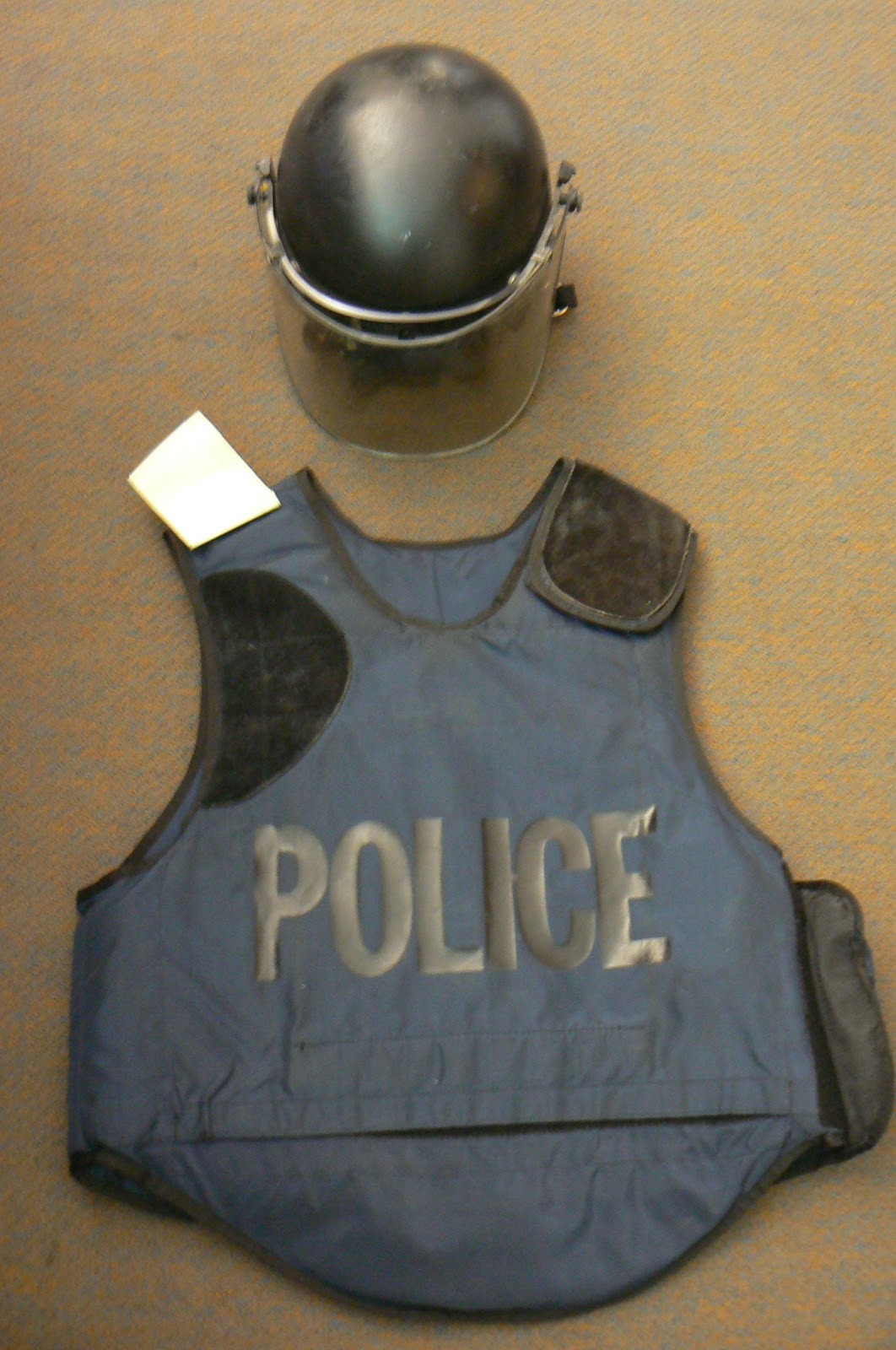
Riot gear, ca. 1980s
The gear includes a helmet with face shield and a bullet-proof vest.  The vest worn by one of the SWAT officers during the Jones Court shoot out on January 8, 1984 where Sergeant John Hawley was killed.

 
SWAT gear

DARE stuff
There’s a box’s worth of material associated with department’s DARE program including photo albums, scrapbooks, press clippings, and informational brochures.  My favorite part though are the literal slide shows still on their slide carousel with the scripts attached. It’s like a flashback to middle school health class.

Evidence from murder cases

I was really surprised to open a box and find photographs of the autopsies of Police Chief John Finnell and Detective Sergeant Charles Gradwell who were both murdered on March 23, 1915 (see "Elmira's Most Wanted" for details).  The pictures are not for the faint of heart, let me tell you. In another box I also found blood samples and bullet fragments from a 1958 murder case. Here’s hoping they don’t need that for a trial any time soon.

I sure hope no one needs this random bag of evidence.  Be glad I didn't post the autopsy photos.  Yeash!

Retired officers’ questionnaires
Last, but certainly not least, is a binder full of questionnaires filled out by retired officers, most of whom served between 1950 and 2005. In it, officers talk about their training and some of their more memorable moments on the job. Some of their stories are hilarious and some are rather harrowing, but all of them are pretty cool.

Tuesday, February 24, 2015

Black Cop, White Cop


by Rachel Dworkin, archivist
            The other day I was working on identifying and cataloging a collection of unlabeled photographs of Elmira Police officers from the 1950s.  It was pretty slow going but there was one man I thought I knew right away: Wilbur Reid.  From 1953 to 1959, Reid was the only black officer in the entire Elmira Police Department.  *** Correction:  According to Reid's son, the man in the photo is actually not Wilbur Reid.  If anyone knows who he actually is, I would be much obliged if you'd let me know***
See the difference?
            In recent months the often troubled relationship between police and communities of color has been in the forefront of our national consciousness.  Problems include racial profiling, excessive use of force and a mutual lack of trust.  There are many steps which need to be taken to begin to deal with these issues, but some feel that having a police force which is more representative of the community it serves might help.  Historically speaking, how has the Elmira Police Department reflected the diversity of our community?

            Over the last 150 years of its existence, the Elmira Police Department has been very white.  The first black police officer was John Washington.  He was appointed to the police in 1876 by Mayor Turner and served for 13 years before retiring in 1889 at the age of 71. Washington was a giant of a man who was frequently called upon to carry home drunks.  At the time of his retirement he received a special commendation from the police commissioners for his service. 
John Washington, ca. 1880
            Washington would be the last African American on the force for over 50 years.  In October of 1947, the civic affairs committee of the Elmira chapter of the National Association for the Advancement of Colored People (NAACP) petitioned the city Council asking for the appointment of blacks to the police and fire departments.  “In other cities Negroes are so employed and it is generally conceded that Negro policemen are very valuable in the city.  Negroes are citizens and in a democratic society should have representation,” the petition read.  The Council agreed and encouraged blacks to apply for the next round of civil service testing, with the understanding that veterans would receive preference.  In 1953, Wilbur Reid passed the test and became Elmira’s first black police officer in the 20th century.

              He left the force in 1959 in favor of a more lucrative job as a medical technician, but the department went on to hire three new black officers during the 1960s: Robert Harriel Jr. (1964-1986), Arthur Keith Sr. (1964-1974) and Joseph Muson (1969-1970).  Following Harriel’s death in 1986, the department was once more completely white.  In 1998, it began a campaign targeted at recruiting blacks, Hispanics and women.  It was also around this time that the department struggled with protests and lawsuits alleging racial discrimination and profiling by police.  Following the incidents, the department conducted a series of community conversations in order to improve communications and allay fears.  In 2006, they hired their first 21st century black officer.  There are currently 2 black officers on the force. 

Elmira police, ca. 1970s