Showing posts with label scientists. Show all posts

Sunday, May 8, 2022

The Bug Lady: Ms. Esther Hart

 By Guest Blogger Melissa Rozengota, a volunteer with Elmira HistoryForge, a project sponsored by the Chemung County Historical Society

Esther Hart

You meet some of the most interesting people transcribing historical census records. I first encountered Miss Esther Hart in the 1910 census during my work as a volunteer with Elmira HistoryForge (https://elmira.historyforge.net/), a project which combines historic maps with census records and photographs to create a unique way to visualize community history.  At first glance, Esther Hart seemed a largely unremarkable individual; she was single, white, female, age 40.  She is listed at 302 E Church Street with her widowed older sister Fannie, niece Frances, nephew Pierson and 80-year-old father, Dr. Ira F Hart at 302 E Church Street. The detail that caught our attention was that she was a clerk in Washington D.C., while living in Elmira.

1910 US Census

Esther was born February 22, 1862 in Elmira, New York to Dr. Ira Hart and Marion E. Cook Hart, early settlers in the Elmira area. Esther attended Elmira College and graduated with a Bachelors of Arts in 1883. She also later attended The Cooper Institute in New York City and completed a 4-year course in wood engraving and art. It was here that she met fellow student, Mrs. Anna Botsford Comstock, the first woman Professor at Cornell University and an acclaimed author, illustrator, and educator of natural studies. The Elmira city directories list Esther as a wood engraver and teacher from 1887 through 1905. By 1906, she attained her job in D.C.
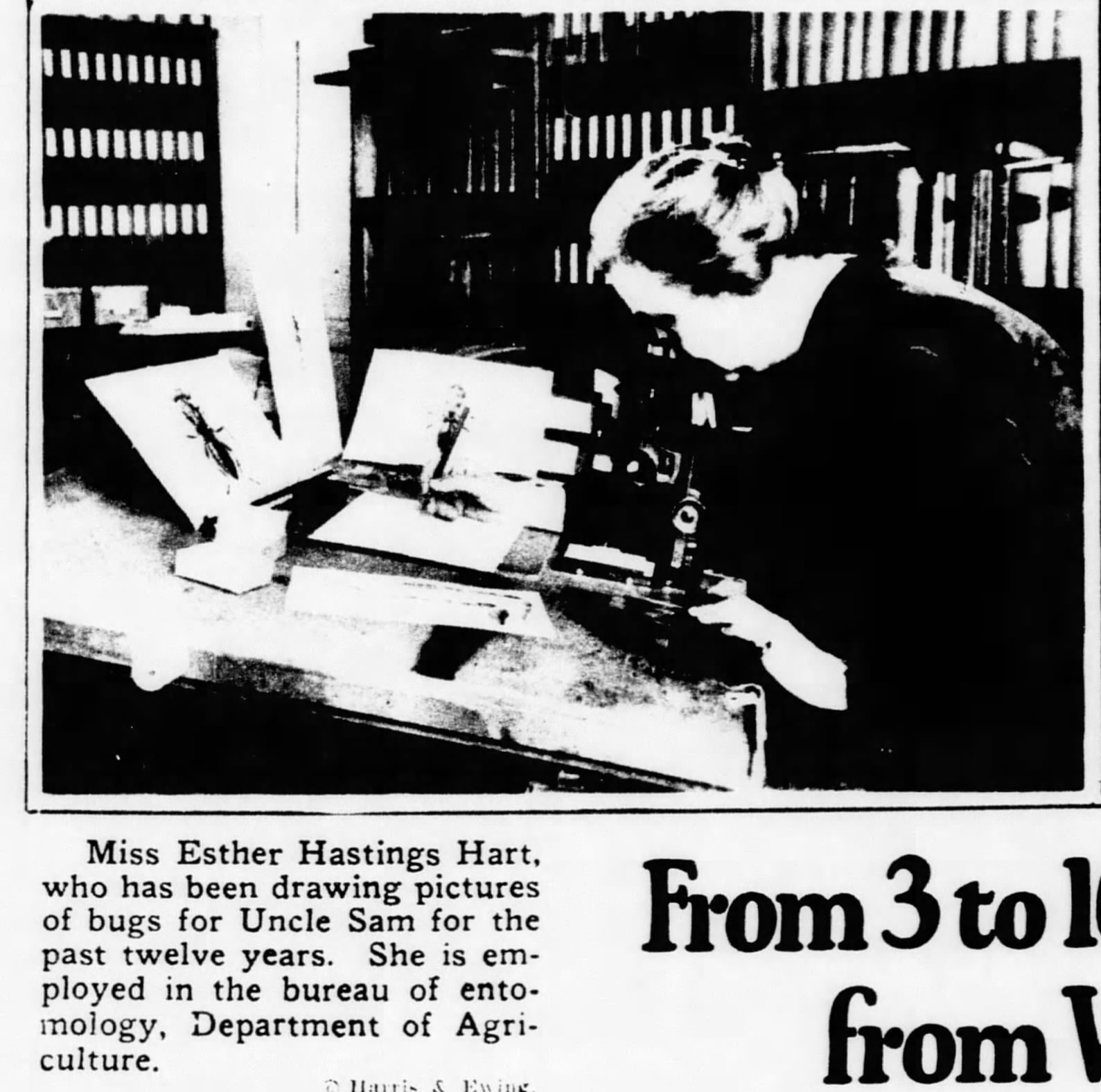
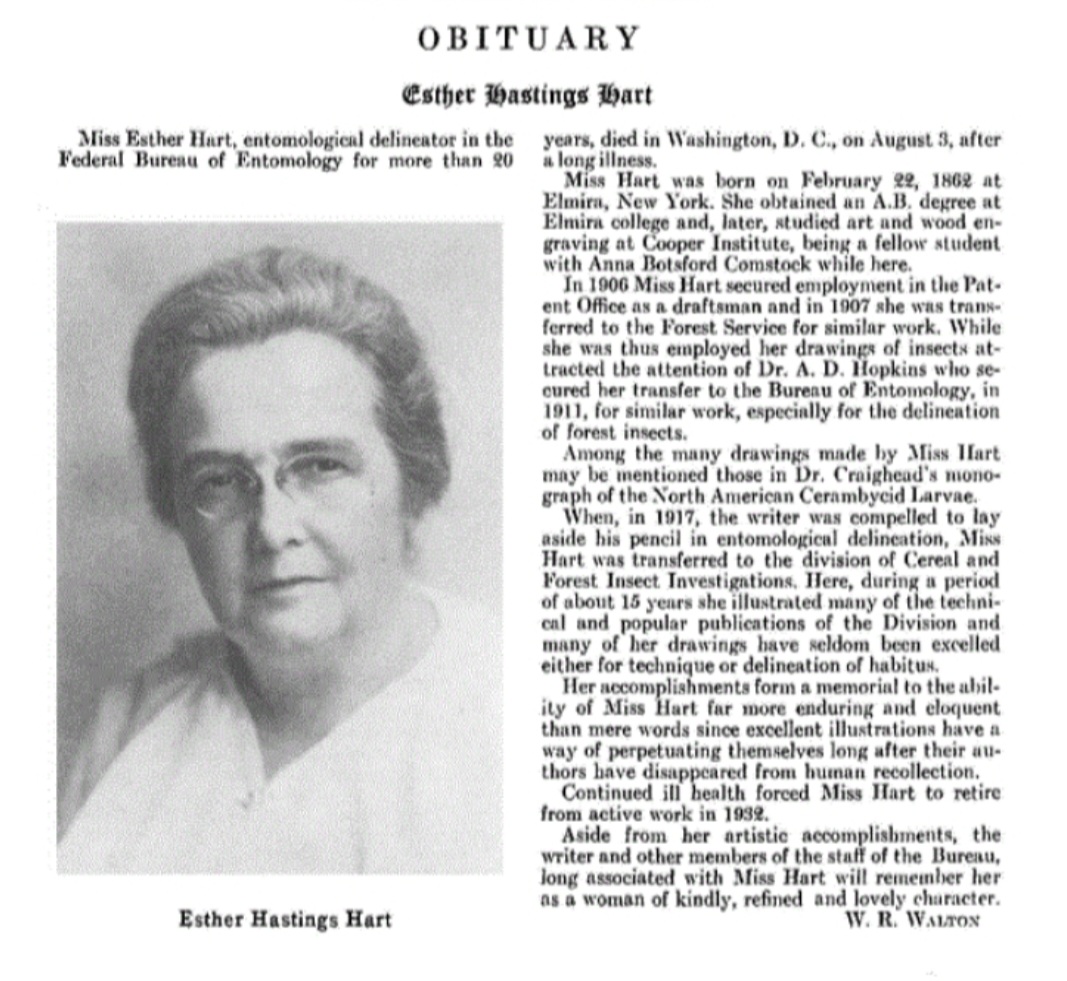
Esther began her work in D.C. in the Patent Office as a draftsman, transferring from there in 1907 to the Forest Service Dept. It is within this department where her drawings caught the attention of Dr. A.D. Hopkins. Impressed with her natural aptitude, Dr. Hopkins secured a transfer reassigning Esther to the Bureau of Entomology for the Delineation of Forest Insects in 1911. In 1917, when Dr Hopkins retired, she transferred to the Division of Cereal & Forest Insect Investigation where, for 15 more years, she illustrated many publications. Some of Esther’s illustrations are still in use to this day and can be found in Dr. Craighead’s Monograph of The North American Cerambycid Larvae and The Southwestern Corn Borer.


Esther’s ambitions were not relegated to her career. She was involved in many activities and groups that brought her into the influential circles of our nation’s capital. In 1906, Esther was a guest of President & Mrs. Roosevelt’s in honor of the Army & Navy in the Blue Room at the White House.


In 1925, Esther was the hostess of a tea given by the American Association of University Women where she displayed her drawings.

When Esther was a charter member of the Elmira College Club in 1932, she met First Lady Mrs. Herbert Hoover for a ceremonial tree planting. The ceremony was in memory of President George Washington and Esther had her photo taken with the First Lady.


Ironically, we at Elmira HistoryForge should never have “met” her transcribing the 1910 Elmira census because she didn’t truly live here. Esther was listed on two 1910 Census. Not only was she listed in the Elmira census, but the Washington D.C. one as well.  

The D.C. Census listed her, inaccurately, as age 41, born in 1869. She was living with Clara S. Davenport, a government stenographer, age 32, born in 1878). I believe Clara was an acquaintance Esther knew from Elmira or maybe from College. The Elmira Census was taken April 21st & 22nd and the D.C. census was taken April 23rd. It is most likely the Elmira census taker didn’t realize that Esther was just a visitor in Elmira.

Esther was respected and esteemed for her work. According to her obituary from August 3, 1940, she was “a woman of kindly, refined, lovely character.” Despite living away for so long, she had strong ties with her family and Elmira and is buried in her family plot in Elmira's Woodlawn Cemetery.

We hope Miss Esther Hart would think the nickname we gave her is endearing and that she’d be delighted that 82 years after she passed away we found her everyday life in the early part of the 19th century so interesting.
As a woman in the early part of the 19th century she had many opportunities in her education and work and left a name for herself.


(To get involved with this cool project, contact our HistoryForge Coordinator at HistoryForge@ChemungValleyMuseum.org for more details!)


Monday, July 29, 2019

To the Moon


by Susan Zehnder, Education Director
Fifty years ago, an invention by a man in Horseheads, New York, helped us see our world in a new way. That summer on the evening of July 20, 1969, astronaut Neil Armstrong took his first steps on the moon’s surface. The world watched as the event was broadcast live using special camera technology developed at Westinghouse Corporation out of Horseheads.
Image of Westinghouse workers from our collection, n.d.

Dr. Gerhard W. Goetze (1930-2007) led the team of scientists as Operations Manager. He had discovered the Secondary Electron Conduction (SEC) effect which captured and amplified individual particles of light, and now his team of scientists adapted the SEC tube to fit NASA’s needs. Under his leadership, they developed the camera technology that allowed NASA to capture images in extreme light and dark conditions and broadcast them back to Earth.

The SEC technology had a variety of applications. It became an important part of night vision sensors, security cameras, and in electron-microscope-based biological tissue studies. It was found critical in work inspecting integrated circuits and helpful in ground-based astronomy work. As for the moon landing, “There would be no other way to get yesterday’s pictures of the moon without this tube” Dr. Goetze was quoted as saying in a Star-Gazette newspaper article published the day after the moon landing.
Gerhard W. Goetze, PhD, (photo source Wikipedia)

Dr. Goetze went on to be awarded a special patent for his work, and the Westinghouse team, along with NASA engineers, won an Emmy for their Apollo broadcasts.

Goetze’s graduate work in atomic physics had first caught the eye of the American government back in the mid-1950s. In 1959, the US Department of the Army sponsored him and he moved from Germany with his young family. He was just twenty-nine years old. His early work at Pittsburgh’s Westinghouse Research and Development laboratories focused on further developing SEC’s application for night vision, a technology supported by the Department of Defense. This went on to be used for police anti-crime measures, and in fighting the war in North Vietnam. By 1964, he had relocated to the Westinghouse Corporation’s Cathode Ray Tube facility in Horseheads and settled his family in Elmira. Under his leadership, the department grew from six members to more than 170 scientists and staff members. Goetze became a US citizen on July 4, 1967 two years before the Apollo moon landing.

In addition to the special patent awarded for the SEC process, Goetz was awarded the Longstreth Medal from the Franklin Institute in Philadelphia. This prestigious award recognized his invention and the impact it played in ultraviolet astronomical observations, as well as his work on night surveillance technology and broadcast television. In 1966, his SEC tube was named one of the 100 most outstanding scientific and technical achievements by Industrial Research Magazine.

It’s estimated that at least one quarter of the earth’s inhabitants watched the lunar landing and Armstrong’s first footsteps as it happened. The moon mission took over ten years and cost close to 25 billion dollars which would be about 100 billion dollars today. It took over 400,000 people working together to create the parts and needed pieces. The camera technology Goetze and his group developed captured color images on the flights to and from the moon, and the black and white images of Neil Armstrong and Buzz Aldrin as they walked on the moon’s surface.

Looking back, the black and white flickering, grainy images don’t seem like very much, but at the time, they surely drew a collective gasp. People and companies were proud to contribute to the space program, and NASA was smart to scatter contracts throughout the nation, awarding companies like Westinghouse with jobs and contracts.

In his free time, Goetz’s passion was gliding, and he spent many weekend hours at the Harris Hill Soaring Club with his family. Another Elmira soaring enthusiast was only 13 years old that summer. Thirty years later, Colonel Eileen Collins went on to be the first female commander of a space shuttle.
 
Colonel Eileen Collins, autographed photo from our collection
But for one warm summer evening in July 1969, the nation and the world watched together and marveled at what humankind had accomplished.
The Moon, taken by Apollo 11 astronauts (source: NASA photo)