Monday, June 17, 2013

Root, Root, Root for the Home Team!

Do you remember the taste of your first ballpark frank? Remember the smell of the oil on your glove and the feel of the bat in your hand? Remember the crack of the ball on the bat and the roar of the crowd? For more than 150 years, people in Chemung County have shared these experiences.

 
Although its origins are a mystery, baseball likely evolved from an older English game called rounders.  There were a number of regional variations but, in 1845, the New York Knickerbockers wrote the rules of the modern game.  By the 1850s, the Knickerbocker rules were used throughout New York, New Jersey and Pennsylvania.  During the Civil War, soldiers from across the Union played ball and created a unified version of the game.  But baseball wasn’t just for players, spectators enjoyed it too.  Elmirans bought their first baseball tickets for a game between the Erastus Ransom Alerts and soldiers from the local garrison in 1866.  Throughout the 1860s and 1870s, Chemung County fans paid to watch semi-pro teams from across the Twin Tiers play in a regional league.

local baseball in the 1860s
To learn more about the history of baseball in Chemung County come see our new exhibit from June 22 through the end of September 2013.

Monday, June 10, 2013

Blacksmithing in Chemung County

by Rachel Dworkin, Archivist

As a craft, the history of blacksmithing dates back to the Iron Age, or about 1200 BCE.  At its most basic, smithing involves using fire and an assortment of tools to forge items from iron or steel.  Over the centuries, smiths have made everything from tools to weapons, horseshoes to art. 

Before the 20th Century, every town and village in America had at least one blacksmith.  In 1861, there were 7 smiths in Elmira; 4 in Big Flats; 3 in Breesport, Post Creek, Millport and Wellsburg; 2 in Horseheads and Van Etten; and 1 in Pine Valley, Seely Creek, Ashland, Chemung and Erin.  These local blacksmiths shod horses, made and repaired farming implements, pots and pans, wagon parts and a wide range of other things necessary for everyday life.       


Industrialization, however, greatly reduced the need for blacksmiths.  Machines could produce metal goods faster and more consistently than any human could.  The products produced by blacksmiths could vary widely from piece to piece, but a machine would make the same thing each time.  Towards the end of the 19th Century, most blacksmiths had moved away from making tools and hardware and were primarily involved in either shoeing horses or doing decorative work.  And then came the car.  In 1900, there were 25 smiths working in Elmira alone.  By 1920 there were 10 and by 1960 there was only one smith in the whole county. 


Nationally, the 1960s were the nadir of the blacksmithing trade.  Throughout the 20th Century, smiths transitioned to automotive repairs or retired and few people were interested in taking up the craft.  In the 1970s the Bicentennial led many to take an interest in traditional crafts from quilting to blacksmithing.  Today blacksmiths can be roughly divided into two groups; farriers (they just shoe horses) and artisans.  The Artisan Blacksmiths’ Association of North America has nearly 4000 members, many of whom make decorative pieces and/or provide demonstrations at museums and living history centers. 


On Saturday, June 15th, from 1pm to 3pm, one of these artisan smiths will be doing a demonstration of his craft right here in the CCHS parking lot.  Nathaniel Francisco, a recent Elmira College grad, has been working as a smith since high school and interned with the blacksmith at the Farmers Museum in Cooperstown.  Some of the products of his work will be available for sale.  Hope to see you there. 

Monday, June 3, 2013

Calling All Local Civil War Collectors

Do you collected items related to the Civil War?  Do you know someone in the area who does?  If you do, CCHS wants to hear from you!

In October 2013, the exhibit Civil War in the Attic will open at the Chemung Valley History Museum.  The exhibit will be the third in our four part series commemorating the Sesquicentennial of the Civil War.  In this new exhibit we want to showcase historical objects borrowed from local history buffs.  We want to show what people collect, why they collect, and why the Civil War is still so talked about 150 years later.

If you have some Civil War related objects you would like loan to the museum or can suggest the name of a collector we should contact, please let us know.  You can email curator Erin Doane at curator@chemungvalleymuseum.org or call her at (607)734-4167 x204.  We can’t wait to see what sorts of Civil War treasures are tucked away in your attic!

Soldiers of 23rd NY Volunteers

Monday, May 27, 2013

Remembering the Meaning of Memorial Day

by Erin Doane, Curator

Since 1971 when the Uniform Monday Holiday Act went into effect, Americans have been celebrating Memorial Day on the last Monday of May.  On that same day, advertisers and marketing campaigns declare that summer has begun. It seems these days that most people view Memorial Day as a day off from work or school, a time for the first barbeque of the season, and a chance to score great deals at the mall not as a solemn day set aside for people to pay tribute to the men and women who have died while serving in the military. 


Originally called Decoration Day, the holiday was created to commemorate the roughly 625,000 Union and Confederate soldiers who died during the Civil War.  The exact origin of the holiday will always be debated but the practice of decorating the graves of fallen soldiers was widely adopted both in the north and south shortly after the war.  On May 5, 1868 General John A. Logan, commander-in-chief of the Grand Army of the Republic (GAR), proclaimed that Decoration Day should be observed annually on the 30th of May all across the nation.  Members of the GAR, the organization of Union Civil War veterans, arranged reunions, parades and visits to cemeteries to commemorate the holiday.


The holiday was first called Memorial Day in 1882 but the name did not surpass Decoration Day until after World War II.  In 1967 Federal law declared it Memorial Day.  By the 20th Century the holiday expanded from its original purpose to honor soldiers killed during the Civil War to include all those who died in the service of the US military. Groups of volunteers around the country place small American flags on soldiers’ graves to commemorate their sacrifice. People also use the day to generally remember loved ones who have gone before them.  My husband has told me that he remembers going to the cemetery with his grandmother on Memorial Day to clean up around the headstones of family members and place fresh flowers on the graves.


Memorial Day commemorates a major part of our shared history that should be preserved.   Hopefully by briefly telling that history here it will help remind people of what the day is really about.
 

Monday, May 20, 2013

Chemung County Melting Pot: South-Asian Heritage Month

by Rachel Dworkin, Archivist

According to my good friend Wikipedia, May is Asian-Pacific Heritage Month, Jewish Heritage Month, National Military Appreciation Month and, randomly enough, National Bike Month.  It is also South Asian Heritage Month.  South Asia generally refers to the countries south of the Himalayans including Afghanistan, Bangladesh, Bhutan, India, Maldives, Nepal, Pakistan and Sri Lanka.  While the peoples of these nations have long and storied histories, their history in the United States and Chemung County has been relatively brief. 

Prior to the 1960s, immigration to the United States from these countries was almost unheard of.   Before 1965, immigration from Asia was restricted through strict racial and national quotas which favored immigrants from Northern and Western Europe.  However, the Hart-Cellar Act of 1965 changed the way the United States handled immigration, doing away with racial-geographic quotas and instead given preferences to those with useful job skills in targeted fields or family members already living here.  By the 1970s, this resulted in an influx of highly skilled and educated immigrants from India and Pakistan.  As of the 2000 census, there were 2,000,000 people from India and 724,000 people from Pakistan living in the United States, plus their American-born children.  According to the 2010 Chemung County census, .78% of our residents are of South Asian descent. 

Attracted here by the hospitals and high-tech industries like Corning Inc., Chemung County’s South Asian immigrants have been settling in.  There are Indian groceries in Big Flats and Horseheads and a Mosque in Big Flats too.  The Southern Tier Indian Cultural Association (http://www.stica.org), a local social and cultural organization, hosts annual events celebrating Indian culture which have become quite a hit in Corning.  Still, their integration into the community hasn’t been easy.  In a recent interview as part of an oral history project, a Horsehead’s student of Pakistani descent expressed her anger at a patient who refused to let her mother treat her because she was wearing a hijab. 

The South Asians in our community might not have been here quite as long as some, but they are an important part of our Chemung County melting pot.  We here at CCHS are looking forward to collecting both their stories and their stuff.

Monday, May 13, 2013

Help Us With Our New Exhibit

by Erin Doane, Curator

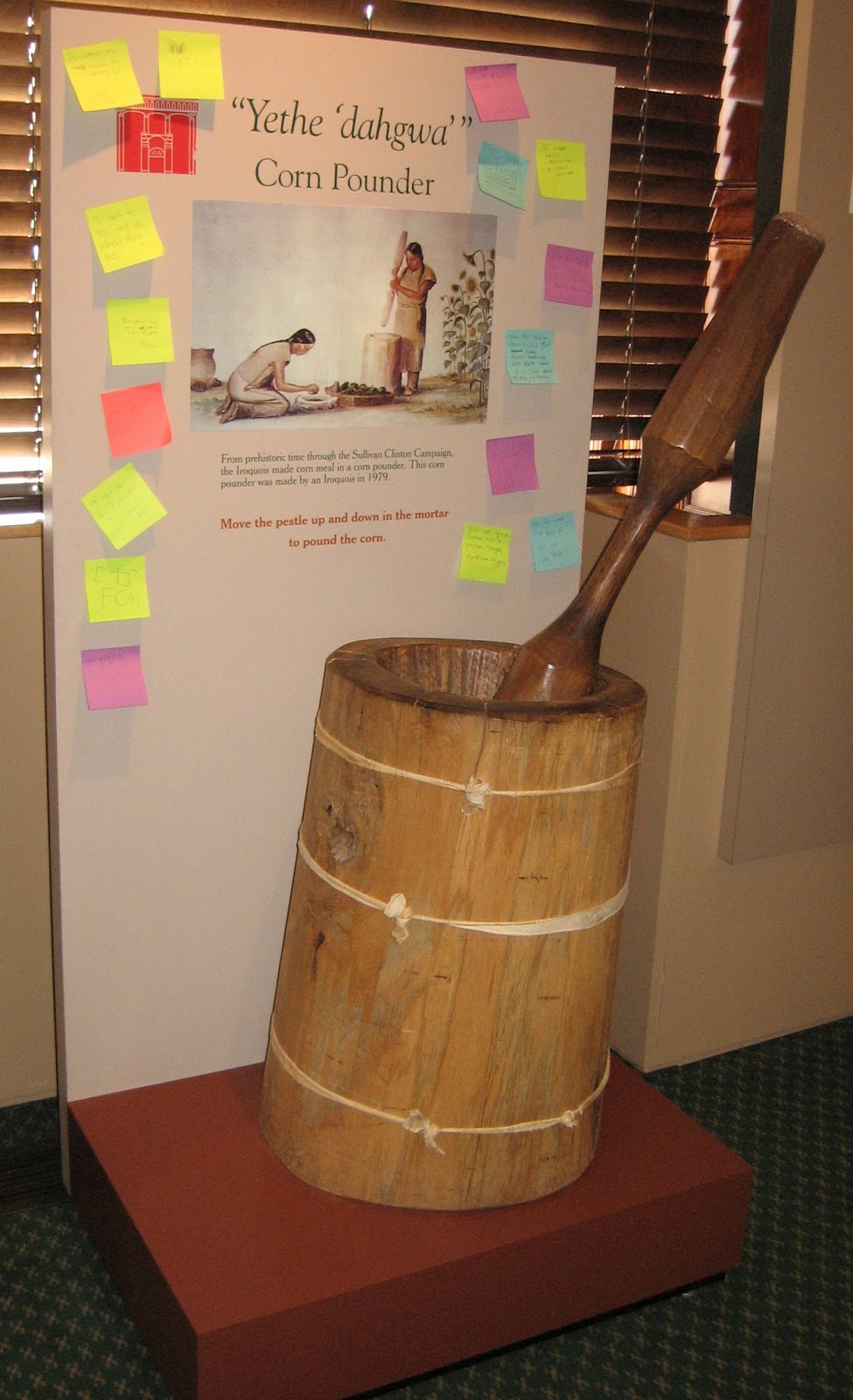
In 1998 the Community Album exhibit opened here in the bank gallery. After nearly 15 years it is time to change it up, to update it with what people really want to see and learn about.  Anyone who has visited the Museum over the last several months may have noticed the brightly colored post-it notes all over the gallery.  They’re hard to miss.  These little notes are playing an important part in revamping the exhibit.  We are asking visitors to take a look at the exhibit with a critical eye.  Tell us what you like and don’t like.  What you’re curious about and what confuses you.  


The response has been great!  Visitors of all ages are making lots of comments – both praise and criticism – that will help us redesign the exhibit.

Here’s some of what we have learned so far.
1. Object and image labels are not always clear.  People don’t know what some things are.

2. People like the hands-on components of the exhibit. 

 3. Some people think that the small bank vault in one part of the gallery is a jail cell.

 
4. Visitors like the section on Mark Twain but want to know how you play pool on a table without pockets.


5. Everyone still thinks the mastodon tusk is pretty cool!

So, what do you think about the exhibit?  Come by for a visit and let us know.  We are continuing the post-it note project through this summer so there is still plenty of time for you to help us make a better exhibit!

Monday, May 6, 2013

The House that Pierce & Bickford Built

by Rachel Dworkin

Over the years, Chemung County has been home to many architects, but our most famous local firm is that of Hiram H. Bickford (1863-1929) and Joseph H. Pierce (1855-1932).  The pair joined forces in 1891 and together they designed a wide range of buildings throughout the Twin Tiers.


Joseph Pierce was the senior partner of the pair, having worked as an architect in Elmira since 1880.  From 1883 to 1890, Pierce worked with Otis Dockstader, primarily designing churches and homes.  One of their more famous local buildings is Elmira’s First Baptist Church, built in 1890.  They dissolved the partnership over a dispute regarding professional ethics in the spring of 1890.  Little is known about Hiram Bickford before he came to work for Pierce & Dockstader, except that he had worked as a draftsman at a number of firms throughout the Northeast.     

The firm worked on a wide range of buildings from residential to religious, commercial to civic.  Their work on public buildings was characterized by a sophisticated and varied treatment of historical styles.  For those of you who are, like me, not architects, that means that they liked to design buildings to have elements that made them look like they were from another time period.  The Elmira City Hall, for example, looks very much like a Renaissance style building which, in turn, rips off a lot of stylistic elements from Greco-Roman designs.  Personally, I just think it’s pretty.  


Pierce & Bickford also designed a number of private residences throughout the area.  Unlike their public buildings which had a clear and consistent “look,” their residential designs tended to cater to the personal style of the original client. 

All told, the pair built several hundred buildings and designed the renovations for many more, including 415 E. Water Street.  If you are interested in seeing examples of their draft work, the Booth Library has blueprints and concept drawings for a number of their buildings including Elmira City Hall, 415 E. Water, the S.F. Iszard’s Building and the home of Mr. R.E. Kinsman among others.  For those interested in a more in-depth look at their lives and their work, we have the book Architects of Standing: Pierce & Bickford, Elmira, N.Y. 1890-1932 available for purchase in our gift shop.