Monday, November 11, 2013

Cold Medicines of Yesteryear: Laxatives, Narcotics, and Deadly Herbs


By Kelli Huggins, Education Coordinator

As an educator, I can tell you we have now entered what may be a teacher’s most dreaded time of the year: cold and flu season.  This is the time when classrooms begin to feel like petri dishes in an infectious disease laboratory as students sneeze and cough and otherwise swap germs back and forth.  In other words, it gets gross.  So in honor of this time of year, I will use this blog post to showcase some of the finest old-school cold remedies.  Here is a selection of late 19th and early 20th century patent and eclectic (herbal-based) medicines and advertisements from our collections.  I bet these concoctions will make you grateful for what we have now.  

Kedeco Laxative Quinine Tablets for Colds

Yes, you read that correctly.  This is laxative cold medicine.  Taking this would seemingly cause more problems than you started out with and you certainly would not want to get coughing too hard after downing one of these.

Dill’s Royal Cough Syrup


Made by the Dill Medicine Company of Norristown, PA in the early 1900s.  After alcohol, the second ingredient listed is chloroform… yes that chloroform.  I suppose that would help you forget about your “coughs and hoarseness.”

Rhinitis Tablets

These pills contain belladonna, camphor, and quinine.  The National Institute of Health considers belladonna to be unsafe and potentially fatal as it blocks nervous system functions.  While camphor is still found in topical medicines, like Vicks, it is now regarded as unsafe to take orally.  You’d be best off with the quinine, but even that can have some nasty side effects.

Tongaline
Not just a cold medicine, “Tongaline” promised to cure all of the following: “Rheumatism, Neuralgia, Grippe, Gout, Nervous Headache, Sciatica, Lumbago, Malaria, Tonsilitis, Heavy colds, Excess of Uric Acid, and whatever the use of the Salicylates is indicated.”  Lofty promises, indeed!  The main ingredient was “liquid Tonga,” which I can find no reference to tell me what that is or what it is from.  Sounds snake-oily to me.  It also contained Cimicifuga racemosa, or Black Cohosh, which is now used for herbal menopause treatments (although its safety and efficacy are debated).

Adamson's Balsam
This is a self-described “pleasant and soothing medicine for coughs due to colds.”  It contained Lobelia, a plant with a long history of use for respiratory ailments that was also known as “puke weed” because of its ability to induce vomiting.  This was produced by Elmira’s own Dr. Kinsman, an eclectic medicine practitioner and member of the Southern Tier Eclectic Medical Society in the 1890s.
 
Glyco-Heroin


This cold medicine contains exactly what its name indicates: heroin.  The glycerin and other additives took away some of the heroin’s bitter taste.  Ah, the good old days when you could leave your doors unlocked and there were still heavy narcotics in over-the-counter medicines.  Actually, drugs like heroin, cocaine, opium, and codeine were incredibly popular active ingredients in many medicines before the FDA and prohibition groups began to think that it might be a bit of a problem in the early 1900s.

Benjamin’s Horehound Drops
After our trip through all of these old medicines that may or may not have been incredibly dangerous, take comfort in the fact that not all of the eclectic medicines were ineffective or deadly.  Take these horehound drops for example.  Horehound is an herb that contains oils believed to soothe sore throats.  Unlike the other medicines listed here, you can still buy horehound drops today.

Monday, November 4, 2013

Vote for Me (No, Really)


by Rachel Dworkin, Archivist

Tomorrow, November 5th, is Election Day and I would like you to vote for me.  That’s right, Rachel Dworkin, your friendly neighborhood archivist is running for the Chemung County Library Board’s 11th District.  If you live in my district, I want you to vote for me.  If you don’t live in my district, I want you to vote for whoever is running.  I want you to vote on the library budget, for sheriff and city court judge, town board and whatever else is on your ballot.  I don’t care who you vote for (as long as it’s me), I just want you to vote. 

For much of America’s history, the majority of its citizens were unable to exercise their right to vote.  At the time of the nation’s founding, not only were women, Blacks and Native Americans specifically forbidden to vote, many states had property requirements which also disenfranchised poor white men as well.  Between 1812 and 1860, most states did away with the property qualifications, but poll taxes remained a popular way of keeping poor people from the polls until it was made illegal in the 24th Amendment of the Constitution in 1964. 

In 1870, all non-white men were technically granted the right to vote by the 15th Amendment to the Constitution, but only kind of.   Many southern states used things like poll taxes and crazy complicated literacy tests to bar African-Americans from voting until the Voting Rights Act of 1965 made them illegal.  Even New York State had a $250 property requirement for African-American voters until 1873.  After a failed attempt to pass an amendment to the state constitution removing the requirement in 1846, wealthy abolitionist Gerrit Smith began distribution 120,000 acres of land in the Adirondacks to Black New Yorkers so they could meet the property requirements.  Twelve men in Chemung County, including John W. Jones and his brother, received land from Smith as part of the scheme.  By the end of the Civil War, Jones, one of the richest African-Americans in upstate New York, almost certainly met the qualifications to vote.

John W. Jones, voter


Garrit Smith, wealthy abolitionist


Although Abigail Adams asked her husband to remember the ladies, it would not be until 1869 when Wyoming granted women the right to vote as a way to entice female settlers to the state.  Other western states and territories followed suit during the 1890s, but the eastern states were slow to do the same.  New York State was home to a whole slew of unsuccessful bids for women’s suffrage before amending the state constitution in 1917 to allow women the vote.   Elmira was a hotbed of suffragist sentiment.  Over the years there were a number of rallies downtown in support of the cause and, in 1915, a poll conducted by the Elmira Advertiser found that 96% of Chemung County women supported getting the vote.  In 1920, all American women gained the right to vote with the 19th Amendment to the Constitution. 

Suffragettes on Water St., 1915

Since 1971, all citizens over the age of 18 have technically have the vote, but even today Americans are still fighting for their rights.  There are currently law suits pending against 10 states because of voting laws which disenfranchise Blacks, Native Americans, Hispanics and the poor.  Pennsylvania, our neighbor to the south, recently enacted a voter id law which the ACLU is challenging on the grounds it hurts the elderly, disabled and poor.  In New York, the homeless and people who have prior felony convictions face significant barriers to registering to vote.  Considering our history, the right to vote is something which no American should take for granted.  So, vote early, vote often and, most importantly, vote for me!

Monday, October 28, 2013

'Til Death Do Us Part

by Erin Doane, Curator

Weddings and funerals are two events that are universally shared by almost every culture on earth.  Our newest exhibit ‘Til Death Do Us Part presents the various wedding and funeral traditions that are practiced in Chemung County.  Join us for the exhibit’s official opening this Saturday, November 2nd from 1:00 to 3:00pm.

‘Til Death Do Us Part on display at 
CCHS through May 2014
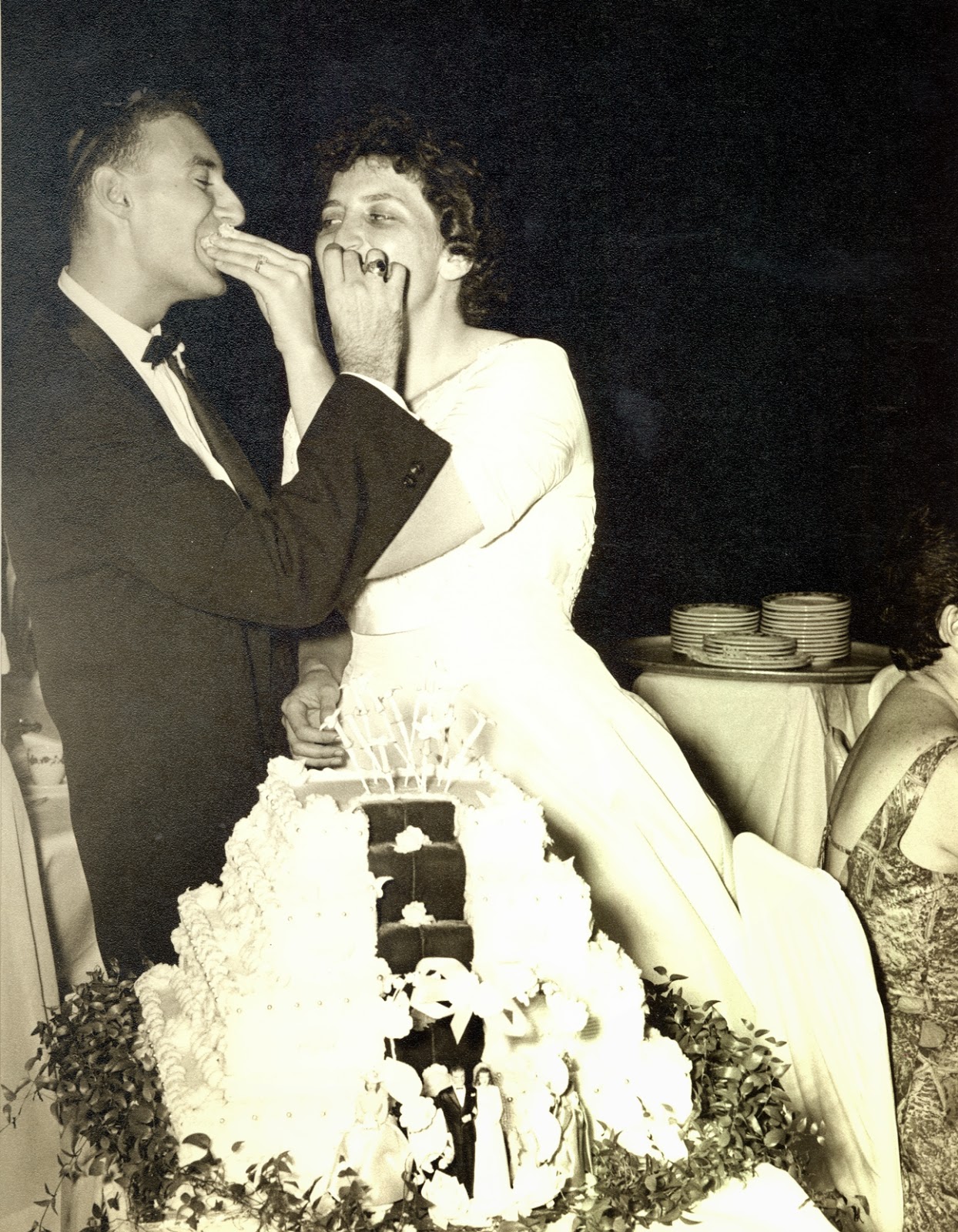
It is surprising how many similarities there are among various wedding and funeral traditions.  Maybe it should not be all that surprising.  When you get right down to it, humans are more alike than they are different.  Food is something that everyone has in common.  Hindu brides and grooms share sweets with each other as part of their wedding, as do Muslims.  Jewish and Christian couples often share the first bites of cake at their wedding receptions.  When a loved one dies, it is traditional for mourners to bring food to the home of the deceased’s family.  Muslims offer help, condolences and food for three days while Jews provide a week’s worth of meals to the grieving family because they are forbidden to cook for seven days.

Myra and Jerry Stemerman sharing cake
 at their wedding in 1959
The number seven appears again and again among the traditions.  From the seven days of Jewish mourning and the seven verses of prayer at a Muslim funeral to the seven steps and vows at a Hindu wedding and the seven blessings at a Jewish wedding, the number holds shared cultural significance.
Bride and groom taking the seven steps
together at a Hindu wedding, 2010
In both the Hindu and the Jewish traditions, a bride and groom stand under a canopy during the wedding ceremony.  There is often an exchange of tokens between the bride and the groom.  A Hindu groom gives his bride a necklace of black beads.  The tradition of wedding rings began with Christians and Jews but has also been adopted by modern brides and grooms of other religious backgrounds.  In nearly every tradition the couple signs a marriage contract before witnesses.  For Muslims the nikah is simply a legal document but the Jewish ketuba and the Quaker wedding certificate are often highly decorated and are put on display in the couple’s home.  
 
Ketuba of Joseph and Mindy Gaieski, 2004
 And finally, among nearly all groups regardless of cultural background or religious belief, the overbearing mother-in-law is a shared cliché.  Come see these similarities and more in person at the exhibit opening this Saturday!