By Kelli Huggins, Education Coordinator
 |
| Horace McDuffee with unidentified cat |
The photograph above, with this older man and his cat in a
humorous scenario, is one of my absolute favorites in our collection. That
said, we didn’t really know anything about it except that it was supposedly of “Horace
McDuffie.” If you’ve read our blog for awhile, you probably realize that I like to take a mysterious photograph and try to find the answers to the questions it raises. So, I decided to put my research skills to the test to find out more about
Horace. This blog post is about Horace, but it is also about the historical
process of putting together shreds of evidence about his life. This post is a
little long, but I think it’s important to talk about how historians know what we know. The work of historians can be
shrouded in mystery, and if you’ve never done historical research yourself (or
even if you have), it can be difficult to know where to start. So here is how I
went about “finding” Horace McDuffee.
I started out with the one piece of evidence I had: the
photograph. Horace is holding a copy of the Elmira
Star-Gazette so that gave me a pretty good indication that he was local. He
doesn’t, however, show up in the Elmira City Directories, which is always one
of the first places I look. The photograph is actually a printed photo
postcard. This gives us a rough idea of the date of the image, placing it most
likely in the 1900s to early 1910s (the date on the newspaper isn’t visible, so
it’s hard to date it exactly).
All well and good, but there were even more clues on the back.
Someone had written a brief inscription, which identified the man as “Horace
McDuffie,” father of Inez McDuffie Baker Schuyler. Cool, now we have two names
to work with. There is also a personal anecdote on the back: “He was such a
dear old man. He carried the mail between the Swartwood Lehigh Valley R.R.
station to the Rodbourn L.V.R.R. ‘depot.’”
Even better, we have a little glimpse into his profession,
where he lived, and his personality. To me, the “dear old man” piece is so
important, because it confirms to me the kindness that I read from him in this
picture. I know that this sentiment is a little ahistorical, but there is such
humor and sweetness to his interaction with the cat in this photograph. You
feel like you understand something about Horace’s personality, which I think is
what draws me to it.
This piece also gave me an indication of why I couldn’t find
him in the Elmira directories- he didn’t live in Elmira. But where was
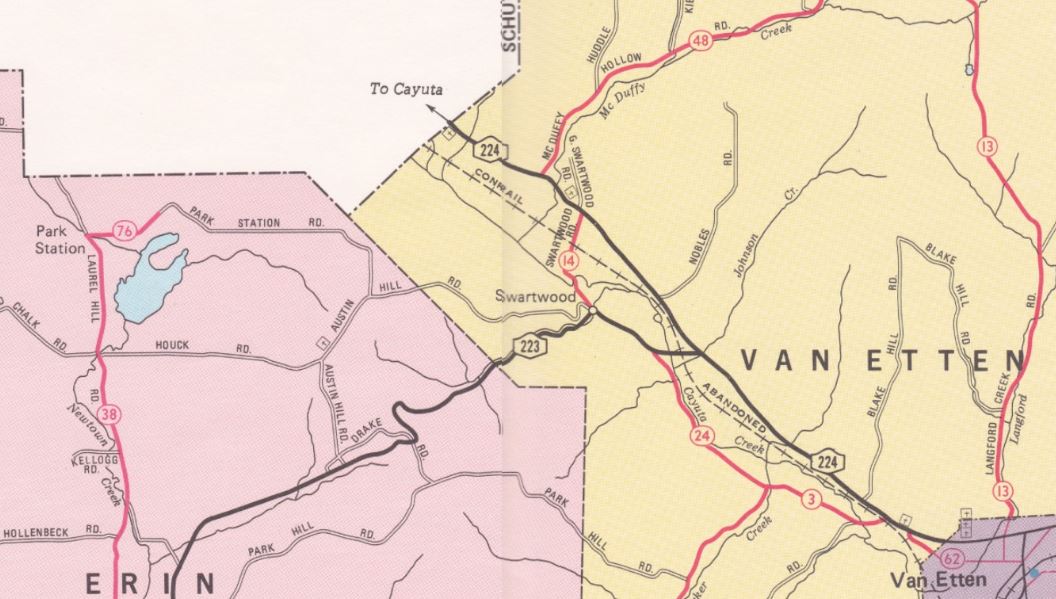
Swartwood? After consulting with my brilliant colleagues and a map, I located
Swartwood. It is an unincorporated area in the Town of Van Etten, near the Erin
border. And lo and behold, you can see the tracks of the old rail line where
Horace delivered mail.
 |
| Map showing Swartwood |
Since I’m the kind of person that won’t stop researching until
I’ve exhausted all reasonable avenues, I wanted to know what else I could find
out about Horace. So I turned to the newspapers. Digitized newspapers, like
those on fultonhistory.com or the New York Historic Newspapers website, are my
go-to sources for much of my historical work. I typed in “Horace McDuffie” and
couldn’t find any results about my guy.
With no results to show with that name in the newspapers
databases, I plugged it into a basic Google search to see what would come up.
There, I found an issue. The inscription on the original photograph had his
name misspelled. I found a Swartwood Horace McDuffee, with an “ee” not an “ie”
in 1878-1880 Elmira directories transcribed on the website of local historian
Joyce Tice. The directories those years included brief sections of residents in
small towns and villages outside of Elmira, including Swartwood. This feature
was just in those couple of directories, and not the ones I had initially
looked at. Plus, without keyword searchability and knowing exactly what town he
lived in to start, looking for Horace was a little like looking for a needle in
a haystack.
The directory entries did more for me than just confirming the
spelling of his name. It gave me his profession: farmer. Had I just stopped at the
original photograph, I wouldn’t have known that and would have assumed he was a
postal employee. Now, it seemed that this work delivering mail was in addition
to his work farming.
With his name correctly spelled now, I went back to the
newspapers and found a couple of hits. “Horace McDuffee” showed up in the
classifieds of the 1920 Elmira
Star-Gazette. He was advertising chickens for sale and his address was
listed as Swartwood.
But that confirmation that he was a farmer was basically it. I
refined my search to include other variations instead of just the search term “Horace
McDuffee” to allow for other ways that it might be written. There I found him
as “Horace M. McDuffee” in his brother Charles’ 1900 obituary.
Now I knew that he had a brother and I knew his middle
initial. Both were helpful pieces of information. I once again returned to a
basic Google search, but this time for “Horace M. McDuffee.” This linked to a
Find A Grave page and a cemetery listing for the Ennis Cemetery in Cayuta,
Schuyler County on Joyce Tice’s website. From these listings, I learned not
only where he was buried, but also his birth and death dates (1840 and 1924),
and the names of his other family members, including his wife, Elsie.
Now that the pieces were all coming together, there was still
one more place to look for Horace McDuffee: the census. You can easily search
for census records on ancestry.com (with a subscription) or sites like
familysearch.org. Tracking Horace in the census from 1860 to 1920 further
confirmed some things I had already discovered and provided a little more
detail, too (it also introduced another misspelling of the family name,
McDuffey). In 1860, for example, 20-year-old
Horace was living at home with his parents Catherine and Daniel, on a farm next
to the farms of other McDuffee relatives. The family also had a “domestic”
worker, 18-year-old, Celista Thorn.
The 1892 State Census showed Horace and his wife living with
their daughter Inez, then 21, and his aged parents. By 1910, however, Horace
was a widower and the household consisted of just him and his daughter, who had
since married and went by the name Inez Baker (interestingly she wasn’t marked
as widowed but her husband also was not listed as living with the family). In
1920, Horace and Inez (then Inez Schuyler, having married and widowed again)
were still living together. Horace died in 1924 at the age of 84.
If you’ve made it to the end of this lengthy blog post, I hope
you’re not disappointed that I wasn’t able to dig up any terribly notable
incidents in the life story of Horace McDuffee. But frankly, I think it’s just
as important to learn about the Horace McDuffees of this world as it is to
learn about the Mark Twains. Looking into the histories of most people in the
past would yield a similar, normal paper trail. For many people, there is even
less information. As a historian, it can be maddening to not find the answers.
All in all, I spent a morning searching for Horace McDuffee and now I better understand
the man in one of my favorite photographs.
No word on the story of the cat, however.