Showing posts with label technology. Show all posts

Monday, September 21, 2026

Time Travel: Hello Girls

 by Susan Zehnder, Education Director

In Mark Twain’s A Connecticut Yankee in King Arthur’s Court (1889), a character travels back in time to the medieval era. Observing the behavior of damsels in those days, he asserts that “the humblest hello-girl along ten thousand miles of wire could teach gentleness, patience, modesty, manners, to the highest duchess in Arthur’s land.” He’s talking about the women who worked as switchboard operators.  

Operators, known as hello-girls, were an important part of the early telephone business. The technology of transmitting the human voice using telephone wires had been patented by Alexander Graham Bell in 1876. Then, to make a phone call, one would lift the receiver which would automatically connect to a switchboard where an operator or hello-girl would answer. The operator would ask which number you wanted and would physically connect the wires. This was called the manual telephone system.


By the end of the 1870s, Chemung County’s first telephone was installed. It was located at Charles Tomlinson’s photography studio on Baldwin Street, and it was soon connected to a similar telephone at the Western Union Telegraph office across the street. The intent was to encourage others to invest in and embrace the new technology.

When Elmira’s first phone book was published in 1880, Tomlinson was not listed. That first book contained 42 subscriber names, their addresses, and phone numbers. Numbers were assigned starting with the number 1. Of the listings, only 4 of these were private residences, including number 29, which belonged to the Langdon mansion, the home of Mark Twain’s in-laws. By the end of that same year Elmira’s phone system had grown to over 100 subscribers. It is not known how many hello-girls were employed.


The job of a hello-girl was a desirable profession open to young women. It offered pay and social status. But on average women stayed in these positions for only three years, so there was a lot of turnover. In larger cities, like New York, businesses attracted applicants by offering amenities like libraries and parlors to lounge in during rest hours, or boat excursions, theater visits, and art museum parties to entertain them. Of course, all of this was under proper supervision. The work they did was critical to the success of the telephone. Sometimes they connected 100 to 225 calls an hour and they were often pushed to handle more.

In response to operator complaints about working conditions, the U.S. Labor Commissioner compiled a report for the Senate in 1910. The report was hundreds of pages long and was not shared with the workers.

The report covered applicants, training, and culture. The majority of hello-girls were unmarried. Of the 6,152 young women who applied to be hello-girls, 2,229 were deemed not eligible because they were too small, too old, unwilling to work on Jewish holidays, not vaccinated, or lacked in personal appearance. That last one is puzzling since the public never saw them, just heard their voices. Hello-girls were required to have a calm manner, be clear-eyed, with a rosy complexion, and have a good appetite. Anyone that met these requirements attended special schools to learn the expected professional protocol. The commissioner found that “the loyalty and esprit de corps among telephone girls is greater than in any other industry in the country.” The report concluded that the hello-girls had nothing to complain about.

As technology changed, the role of the hello-girl changed. Chemung County continued to use the manual telephone system until 1952, when it shifted to the dial system, and all the local hello-girls were let go. Local phone numbers changed to include four digits about this time.

Some things regarding those old telephones do persist. We continue to dial a number when making a call, and we reach someone, which might reflect back to when wires had to be manually connected. Gone are phone booths, phone books and memorizing numbers because they are automatically saved in the phones we carry in our pockets. Today many people making a phone call don’t expect to actually reach a human being, preferring instead to send a text message. Is this a modern telegraph?

Our latest exhibit, Then & Now: How Everyday Objects Have Changed Over Time, includes a variety of telephones from our collection, including one we invite you to dial yourself.  You may not be able to time-travel, but do come see this and other relics from the past.


Sunday, August 7, 2022

Fifty Years

 by Susan Zehnder, Education Director

Two eight-year-olds were recently touring the museum looking at the exhibit When Waters Recede: 50 Years since the Flood of 1972. One was overheard to ask the other, "Were you alive during the flood?” to which the other responded “NOBODY was alive during the flood.” Of course, this was humbling to those of us that were alive fifty years ago.

What is history? History is anything that has happened and history museums like ours house collections to tell the stories. Artifacts in our collections could be from as recent as yesterday, from fifty years ago, or much longer - as in the case of our wooly mammoth tusk.

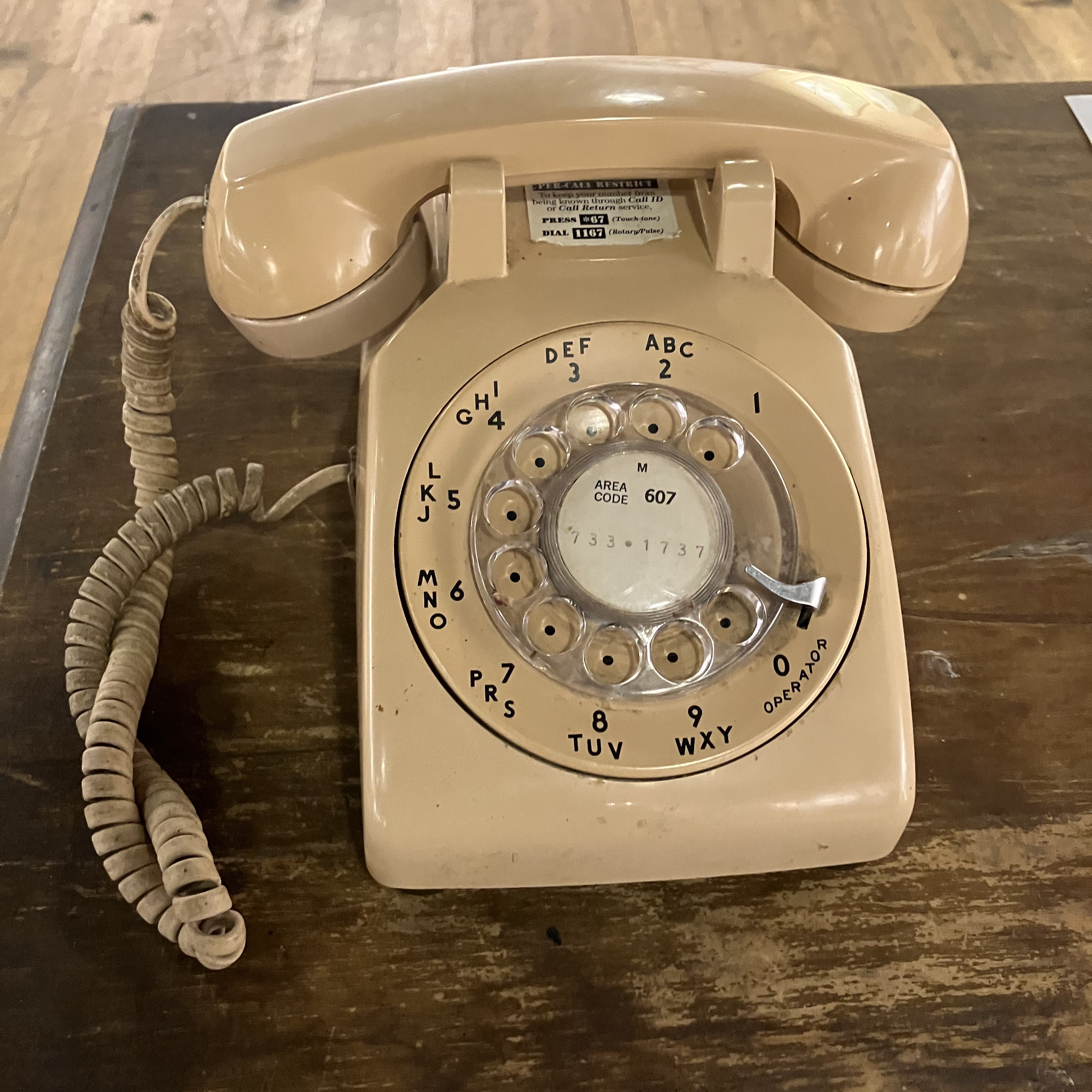
Rotary phone on display to use

The flood fifty years ago was a traumatic event that made huge changes in our area. Less obvious are some of the changes we’ve experienced since then. As part of our exhibit, we’ve put out a rotary phone, adding machine, and manual typewriter so visitors can experience what some technology was like back then.

The visiting elementary students recognized the purpose of the objects, but how to use them was not so clear. Faced with making a phone call, many of our young visitors were full of giggles. They noticed that compared to cell phones, a rotary phone has two parts the handset and the body of the phone to which it’s connected, called the dialer. They noticed it took much longer to dial a number. They noticed it was heavier, and many weren’t sure about where or how to hold the handset. They noticed phones were connected to the wall and they just wouldn’t fit in our pockets.

Adults who remember rotary phones also remember the party lines, and tripping over long cords - cords that were essential to ensure a private conversation. While this phone looked different to the students, they understood it was a phone. 

In 1892, the first patent for rotary phones was filed. In 1919, the American Bell Telephone Company had started national service for what they called user-controlled rotary dial phones. These look closer to what we have on display  commonly found in most households by the 1950s. The 1970s was the decade things transitioned to touch-tone buttons. Anyone remember sounding out tunes on the buttons? By the 1980s, most people had push-button phone dials.

Remington manual typewriter on display to use

The typewriter on display was more recognizable to the students. Its keyboard resembled computer keyboards they are familiar with. However, actually typing on this machine was a different experience for them. Manual typewriters are stiff and the action of the keys take more finger strength to engage. Computer keyboards tend to be much easier to press so it took time for students to get used to pushing the keys hard enough to strike the paper. They had no idea what to do when they typed to the end of the line. Having to manually move the carriage to start a new line was confusing.

Different versions of typewriters can be traced back to the 1700s. In the United States, the first commercial patent for a typewriter was issued in 1868, but different versions of typewriters had already been around for over one hundred years. The oldest typewriter in our collection is the No. 7 Franklin, pictured here, with a patent date of 12/09/1891. And frankly to me, it’s not clear how I should place my hands on the keyboard.

Many of us might recognize what it is, but how to use it is less obvious. This older artifact is not currently on display, but if you haven’t seen our exhibit yet, we invite you to drop by the museum and try your hand at typing, or bring back memories by picking up the phone’s handset and dialing your number. A lot has changed in fifty years.