by Susan Zehnder, Education Director
In Mark Twain’s A Connecticut Yankee in King Arthur’s Court (1889), a character travels back in time to the medieval era. Observing the behavior of damsels in those days, he asserts that “the humblest hello-girl along ten thousand miles of wire could teach gentleness, patience, modesty, manners, to the highest duchess in Arthur’s land.” He’s talking about the women who worked as switchboard operators.
Operators, known as hello-girls, were an important part of the
early telephone business. The technology of transmitting the human voice using
telephone wires had been patented by Alexander Graham Bell in 1876. Then, to
make a phone call, one would lift the receiver which would automatically
connect to a switchboard where an operator or hello-girl would answer. The
operator would ask which number you wanted and would physically connect the
wires. This was called the manual telephone system.

By the end of the 1870s, Chemung County’s first telephone was installed. It was located at Charles Tomlinson’s photography studio on Baldwin Street, and it was soon connected to a similar telephone at the Western Union Telegraph office across the street. The intent was to encourage others to invest in and embrace the new technology.


The job of a hello-girl was a desirable profession open to young women. It offered pay and social status. But on average women stayed in these positions for only three years, so there was a lot of turnover. In larger cities, like New York, businesses attracted applicants by offering amenities like libraries and parlors to lounge in during rest hours, or boat excursions, theater visits, and art museum parties to entertain them. Of course, all of this was under proper supervision. The work they did was critical to the success of the telephone. Sometimes they connected 100 to 225 calls an hour and they were often pushed to handle more.
In response to operator complaints about working conditions, the
U.S. Labor Commissioner compiled a report for the Senate in 1910. The report
was hundreds of pages long and was not shared with the workers.
The report covered applicants, training, and culture. The
majority of hello-girls were unmarried. Of the 6,152 young women who applied to
be hello-girls, 2,229 were deemed not eligible because they were too small, too
old, unwilling to work on Jewish holidays, not vaccinated, or lacked in
personal appearance. That last one is puzzling since the public never saw them,
just heard their voices. Hello-girls were required to have a calm manner, be
clear-eyed, with a rosy complexion, and have a good appetite. Anyone that met
these requirements attended special schools to learn the expected professional protocol.
The commissioner found that “the loyalty and esprit de corps among telephone
girls is greater than in any other industry in the country.” The report
concluded that the hello-girls had nothing to complain about.
As technology changed, the role of the hello-girl changed. Chemung
County continued to use the manual telephone system until 1952, when it shifted
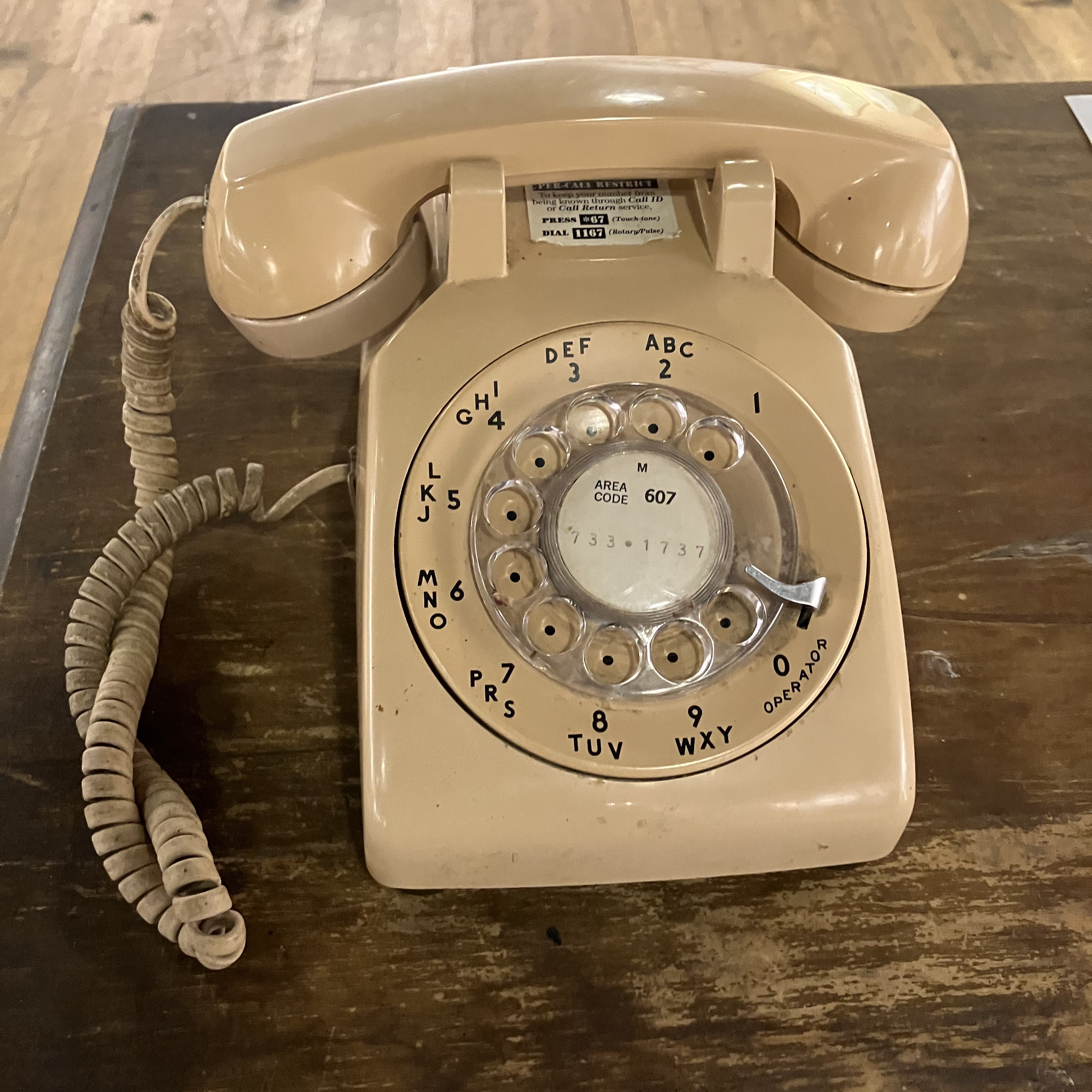
to the dial system, and all the local hello-girls were let go. Local phone numbers
changed to include four digits about this time.
Some things regarding those old telephones do persist. We
continue to dial a number when making
a call, and we reach someone, which might
reflect back to when wires had to be manually connected. Gone are phone booths,
phone books and memorizing numbers because they are automatically saved in the
phones we carry in our pockets. Today many people making a phone call don’t
expect to actually reach a human being, preferring instead to send a text
message. Is this a modern telegraph?
Our latest exhibit, Then & Now: How Everyday Objects Have Changed Over Time, includes a variety of telephones from our collection, including one we invite you to dial yourself. You may not be able to time-travel, but do come see this and other relics from the past.