Showing posts with label Neighborhood House. Show all posts

Monday, November 14, 2022

Mr. Bookmobile: Thompson Ellsworth Williams

by Susan Zehnder, Education Director

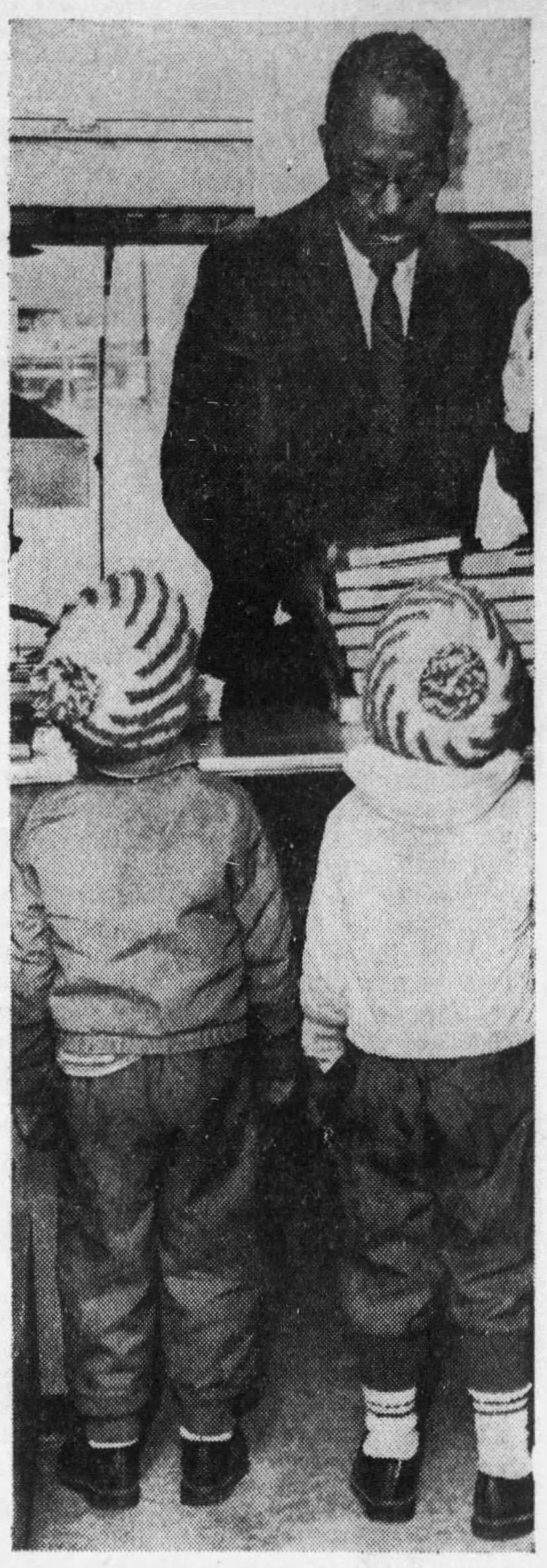
Known affectionately as Mr. Bookmobile for over thirty years, Thompson E. Williams not only drove the county’s first bookmobile, he shared his love of learning with generations of readers.

Thomas E. Williams, Chemung County's first bookmobile clerk and driver

Born in 1918 in Elmira to George and Helen Williams, Thompson came from a family who worked hard. His mother, Helen, raised the couple’s five children, worked at the department store Sheehan Dean & Co., and was active in many clubs and community organizations. His father, George, was a professional boxer who fought throughout the northeast under the name “Cyclone” Williams, competing in the lightweight division. Despite being recognized for his speed in the ring, he attributed to a higher power the fact that he had avoided visible scars or scrapes.

In the 1920s, George gave up boxing to pursue a different path. He threw himself into his studies, working odd jobs to support himself. He studied at Elmira Free Academy, Cook Academy in Montour Falls, and Berkley Divinity School in New Haven, Connecticut. One job he had was running a shoe shine business. It was located under the viaduct near Lake Street, and he often told people that his business had a million-dollar overhead. In 1929, he was ordained and became an AME Zion minister. Over the next few years he was appointed pastor at churches in Corning, Wellsville, and Waverly, NY, Meriden, CT, and Pittsburgh, PA.

Growing up, Thompson Williams was active in the Boy Scouts. He graduated from Elmira Free Academy in 1937, and next to his senior picture, the yearbook lists Howard University, where he intended to study.

EFA, Class of 1937

He didn’t end up going to Howard. After high school, he joined his mother to work at Sheehan Dean & Co. In 1944 he was drafted into the United States Army to fight in World War II.

Thompson trained at Fort Myers gunnery school and graduated in 1945. It was at a time when options were limited for Blacks in the military. Seeking better opportunities, Thompson joined the newly formed Tuskegee Airmen. The airmen were an elite all-Black squadron established in 1941 and the nation’s first Black military aviators. The airmen offered one of the few chances for Black soldiers to excel during harshly segregated times. Thompson did excel and achieved the rank of Corporal. Collectively, the Tuskegee airmen were awarded a Congressional Gold Medal in 2007 in recognition of their efforts during the war and leadership in integrating other branches of the U.S. military.

Honorably discharged, Thompson returned to Elmira. He coached the X-Cel Oilers basketball team from the Neighborhood House

Manager Williams at left
through an unbeaten season, and he worked for the Elmira Foundry Company. He also fell in love with the girl across the street, whose last name was the same as his first - Eva M. Thompson. They married in 1948.

Eva M. Thompson
1950 was a big year for Thompson and Eva Williams. They welcomed their first of seven children, and in December, Thompson was hired to be clerk and driver for Steele Memorial’s brand new $9,000 Bookmobile. He would hold the position he held for the next thirty-one years.

Mr. Bookmobile in action 
Chemung County had qualified for the first bookmobile under the State Aid for Libraries Law passed in June 1950. When it began, the bookmobile carried close to 3,000 books and delivered around 500 weekly. It served 21 rural communities, 65 schools, and 5 village stations.

In 1974, Thompson’s health forced him to scale back and he switched to driving a van for the library. Six years later, he died unexpectedly at 62 years old. It was one week before he had planned to retire.

In 1990, the Historical Society started collecting Black oral histories from people of Chemung County. We are fortunate that Thompson’s wife Eva Williams, was one who shared her story. (link to interview here) In her interview she talks about her husband, mentioning that he encouraged her to return to school to further her own studies, which she did. She talks about how he believed in education and sought out scholarships for his own children to go to college. He also encouraged Eva to vote, telling her that "it makes a difference in your job and in your community."

Thompson and Eva’s oldest child, Holly, who went on to be an educator, school administrator, and minister, remembers her father loved reading and always had a book with him. When asked what kinds of books her father read, Holly remembered that he liked books on early African civilizations and would share what he learned with his family.

Chemung County's first bookmobile, 1950s

Today the bookmobile continues to deliver books around the county. You can find current stops and times at https://ccld.lib.ny.us/bookmobile/

Monday, February 15, 2021

The Neighborhood House and EOP

by Erin Doane, curator 

The Neighborhood House, 1925
In 1878, the Ladies Temperance and Benevolent Union of Elmira started the Industrial School “to help the poor to help themselves.” There, women and girls learned to sew. They then sold what they made to earn an income. The school also hosted weekly meetings with Bible lessons.

Industrial School, c. 1900
The school began in rooms on the corner of Lake and Carroll Streets. By the 1920s, it had grown into a complex that occupied the entire block of East Fifth Street from Dickinson to Baldwin Streets. It had also been officially renamed the Neighborhood House. The organization was strictly non-sectarian and was open to all regardless of race, creed, culture, or national origin. It provided job training and classes for adults and offered athletic and craft activities for children.

Children at the Neighborhood House, 1930s
(photo courtesy of EOP)
During the middle of the 20th century, the Neighborhood House became a center of information, counseling, vocational guidance, and recreation for the community. It sponsored basketball teams and other group sports. The building had two gymnasiums and in the 1950s, the smaller gym was used for dances and roller skating on the weekends.
Roller skating at the Neighborhood House, 1950s
In the 1960s, as the African American community was embroiled in the fight for equal rights, the Neighborhood House took on a more active role in advocating for social justice. A new philosophical approach known as “New Directions” was adopted that focused on striving to eliminate all forms of racism and solving community problems rather than simply providing neighborhood services. In November 1971, the Neighborhood House moved into a newly-built facility at East Fifth and Lake Streets.
Neighborhood House Girl Scout troop, 1950s
(photo courtesy of EOP)
In the 1980s, rising inflation and a weakening economy strained the Neighborhood House’s finances. The organization refocused its attention on two areas: human services and youth services. It provided drug education and drug counseling, computer courses, and sports programs. Despite efforts to rebuild membership numbers, raise funds, and develop new programs to serve the community, the Neighborhood House was forced to close on January 16, 1987. Three years later, in 1990, it reopened as the Ernie Davis Community Center. The center’s work focused on recreational and educational programs for children.
Carole Coleman instructing Natalie Jones in basic
computer techniques at the Neighborhood House,

Star-Gazette, April 21, 1981, photo by Jeff Richards
The Equal Opportunity Program or EOP stared in 1965 with the mission to eliminate poverty. Its early focus was on issues advocacy, including welfare and housing rights. After a few years, it shifted its approach to directly helping underprivileged individuals. It offered daycare and Head Start, alcohol rehabilitation, home weatherization programs, nutrition education, and home heating emergency assistance programs. While it suffered through a financial crunch in the 1980s when community organizations were forced to compete for limited funding, by the mid-1990s EOP had grown to an organization with a budget of $5.6 million that served approximately 10,000 people a year.
Economic Opportunity Program, Inc. of
Chemung and Schuyler Counties, 2019
In 1996, EOP, the Ernie Davis Community Center, and the Eastside Community Center merged under the EOP name. The organization continued operating out of the Lagonegro Building at 318 Madison Avenue until 2002, when the new Ernie Davis Family Center opened on Baldwin Street. Today, the Economic Opportunity Program, Inc. of Chemung and Schuyler Counties continues to operate as a community action organization dedicated to helping the people of the Southern Tier.

Did you want to learn more about what EOP is doing now and see more old photos from the Neighborhood House? Visit https://www.cseop.org/ and https://www.cseop.org/neighborhood-house.