Showing posts with label Roller Skating. Show all posts

Monday, February 15, 2021

The Neighborhood House and EOP

by Erin Doane, curator 

The Neighborhood House, 1925
In 1878, the Ladies Temperance and Benevolent Union of Elmira started the Industrial School “to help the poor to help themselves.” There, women and girls learned to sew. They then sold what they made to earn an income. The school also hosted weekly meetings with Bible lessons.

Industrial School, c. 1900
The school began in rooms on the corner of Lake and Carroll Streets. By the 1920s, it had grown into a complex that occupied the entire block of East Fifth Street from Dickinson to Baldwin Streets. It had also been officially renamed the Neighborhood House. The organization was strictly non-sectarian and was open to all regardless of race, creed, culture, or national origin. It provided job training and classes for adults and offered athletic and craft activities for children.

Children at the Neighborhood House, 1930s
(photo courtesy of EOP)
During the middle of the 20th century, the Neighborhood House became a center of information, counseling, vocational guidance, and recreation for the community. It sponsored basketball teams and other group sports. The building had two gymnasiums and in the 1950s, the smaller gym was used for dances and roller skating on the weekends.
Roller skating at the Neighborhood House, 1950s
In the 1960s, as the African American community was embroiled in the fight for equal rights, the Neighborhood House took on a more active role in advocating for social justice. A new philosophical approach known as “New Directions” was adopted that focused on striving to eliminate all forms of racism and solving community problems rather than simply providing neighborhood services. In November 1971, the Neighborhood House moved into a newly-built facility at East Fifth and Lake Streets.
Neighborhood House Girl Scout troop, 1950s
(photo courtesy of EOP)
In the 1980s, rising inflation and a weakening economy strained the Neighborhood House’s finances. The organization refocused its attention on two areas: human services and youth services. It provided drug education and drug counseling, computer courses, and sports programs. Despite efforts to rebuild membership numbers, raise funds, and develop new programs to serve the community, the Neighborhood House was forced to close on January 16, 1987. Three years later, in 1990, it reopened as the Ernie Davis Community Center. The center’s work focused on recreational and educational programs for children.
Carole Coleman instructing Natalie Jones in basic
computer techniques at the Neighborhood House,

Star-Gazette, April 21, 1981, photo by Jeff Richards
The Equal Opportunity Program or EOP stared in 1965 with the mission to eliminate poverty. Its early focus was on issues advocacy, including welfare and housing rights. After a few years, it shifted its approach to directly helping underprivileged individuals. It offered daycare and Head Start, alcohol rehabilitation, home weatherization programs, nutrition education, and home heating emergency assistance programs. While it suffered through a financial crunch in the 1980s when community organizations were forced to compete for limited funding, by the mid-1990s EOP had grown to an organization with a budget of $5.6 million that served approximately 10,000 people a year.
Economic Opportunity Program, Inc. of
Chemung and Schuyler Counties, 2019
In 1996, EOP, the Ernie Davis Community Center, and the Eastside Community Center merged under the EOP name. The organization continued operating out of the Lagonegro Building at 318 Madison Avenue until 2002, when the new Ernie Davis Family Center opened on Baldwin Street. Today, the Economic Opportunity Program, Inc. of Chemung and Schuyler Counties continues to operate as a community action organization dedicated to helping the people of the Southern Tier.

Did you want to learn more about what EOP is doing now and see more old photos from the Neighborhood House? Visit https://www.cseop.org/ and https://www.cseop.org/neighborhood-house.


Friday, December 19, 2014

The Golden Age of Roller Skating

By Kelli Huggins, Education Coordinator

I do not have fond memories of roller skating.  When I was a kid, it was cool to have your birthday party at Interskate 88 in Oneonta, NY, but I always found such parties rather torturous.  See, I never mastered skating.  You put wheels on my feet and I am totally incapable of mustering anything that even resembles coordination.  When I made it onto the rink, I clung the bar on the wall like my life depended on it (and given my pitiful skating skills, perhaps it did).  All I wanted to do was get to the cake part of the festivities!

But unlike me, many people both now and historically have enjoyed roller skating.  Roller skates first appeared in the 1700s, but didn’t become popular until the late 19th century when the skates could be mass produced and sold cheaply.  
Early roller skates
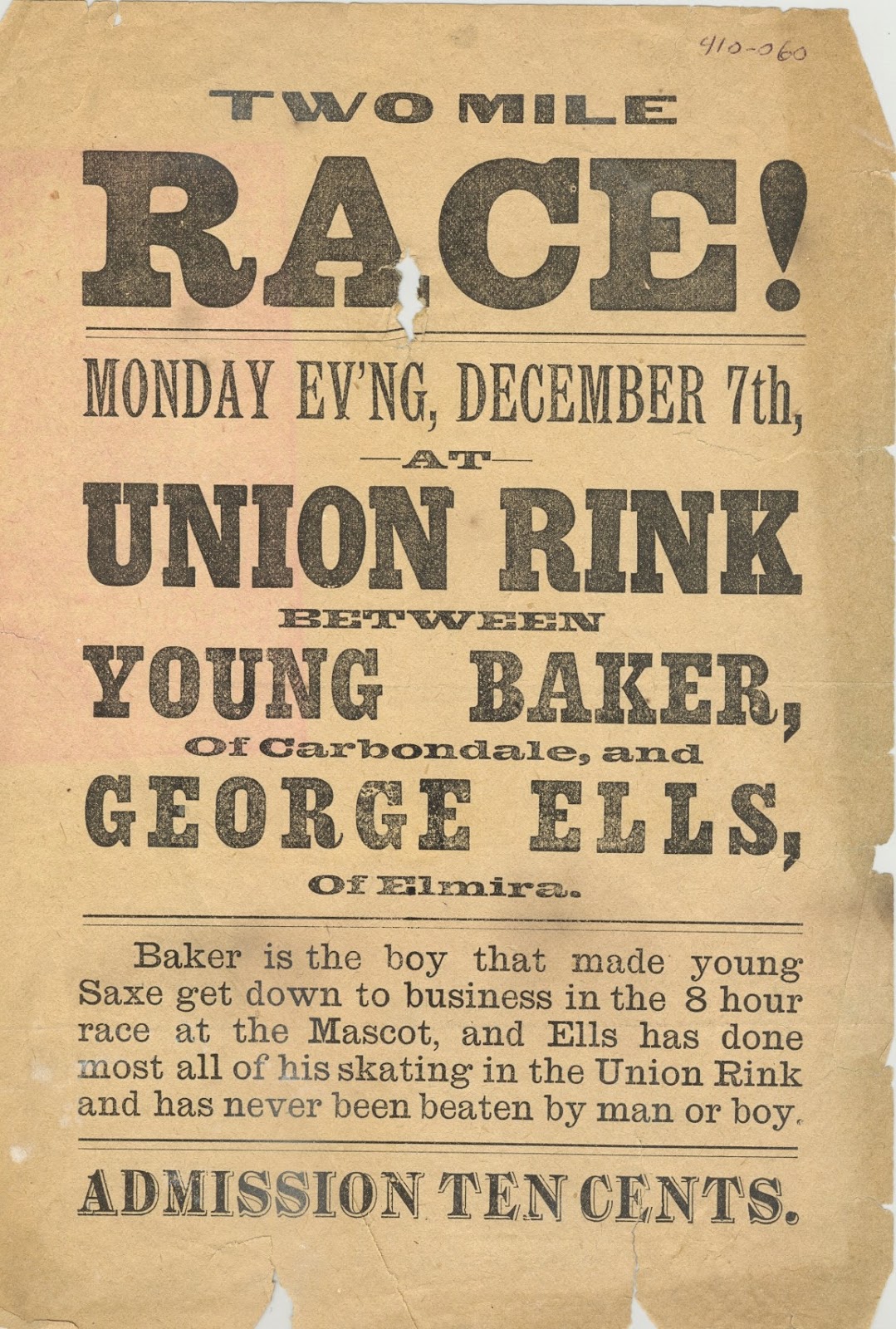
The roller craze swept America and Elmirans latched onto the fad.  Several roller rinks operated within city, including the Mascot, Union, and Star rinks.  The sport and rinks reached the peak of their popularity in the 1880s when there were four rinks open in the city.  3,000 people showed up to the grand opening of a rink in 1884.  The Mascot Rink on Madison Avenue, also constructed in 1884, was described as one of the largest wooden buildings ever built in the city.  Designed by Elmira architects, Pierce and Dockstader, the 85 x 212 foot building featured a 60 x 176 foot skating floor.
Roller skaters outside an Elmira rink, 1885
Roller skating even made its way onto the era's fashion.  This handkerchief features children on skates and likely dates from the late 1800s.
In addition to being able to skate themselves, people who went to local rinks also had the opportunity to see many shows.  Races were a common event at the early rinks.  Some local boys became well-known for their skating prowess as they defeated other young men from around the region.  

The rinks also offered more eclectic fair, like a greased pig race or musical performances.  Trick skaters were also very popular.  In May 1884, 250 braved bad weather to see a performance by the Decker family of New York City, an act that even included skating on stilts!  Some local men, including Joe Powell and Thomas Welsh (brother of the famouscontortionist and juggler William Welsh of DeHollis and Valora), became well-known acrobatic skaters who travelled the country.  Charles Beckwith of 112 Columbia Street was a skating daredevil known for his barrel jumping.  
The skating rinks featured live music, as advertised by the Star Roller Skating Rink
Skating, however, like all fads, quickly began to fall out of fashion.  Around the turn of the 20th century, some of the rinks were converted into theaters and other were out of business.  While many people still enjoyed skating, there was no longer the demand for the sport there was in prior decades.  There were periodic revivals and a new rink opened in 1914.  Skating remained popular with children who raced down the streets on their skates, which created a serious safety issue.  On the city’s west side in 1924, concerned citizens even roped off an entire block to ensure children’s safety while skating, although residents on Elm Street protested the decision.  
Rink ad from 1914: No "undesirables" allowed!
 In the ensuing decades, roller skating has remained a popular hobby in the city, but has never again reached the “golden age” status it held in the late 1800s.