Monday, February 28, 2022

The Little Engine That Couldn’t: Elmira’s Watrous Automobile

 by Susan Zehnder, Education Director
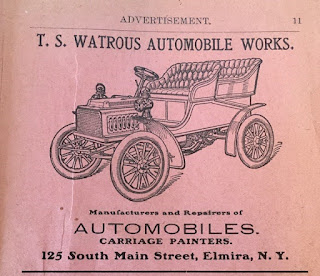

In 1904, Thomas S. Watrous founded the Watrous Automobile Company (WAC) on Main Street, hoping to cash in on the public’s growing desire for automobiles. The new industry was hot. The first American patent for a combustion engine had been filed twenty-five years earlier and now over 3,000 models were on the market. Each car was assembled by hand, making the median price around $1,000. However, the average yearly salary was only $200 - $400. For many the dream of owning their own automobile was still unattainable. Watrous wanted to offer customers more affordable options.

The first car purchased in the county was a Winton Roundabout six years earlier. The buyer was a local doctor William H. Fisher, and the car was manufactured by the Winton Motor Carriage Company, out of Cleveland, Ohio. It was summer when the car finally arrived. The event was announced in the local newspaper and a spontaneous parade was organized to celebrate its arrival. Winton automobiles had a reputation for quality and durability. A few years later, a Winton Roundabout would be driven across the country, successfully completing the nation’s first transcontinental drive. Without connected roads or reliable maps, Dr. H. Nelson of Vermont drove from coast to coast in under 90 days.

Fisher’s Roundabout engine had one cylinder and an advertised speed of 20 mph, which he put to the test.
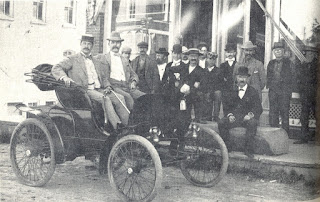
Dr. Fisher and Dr. Carey in Fisher's Winton


Accompanied by Dr. Chauncey Carey, he recorded the county’s first distance drive, visiting Van Etten, Spencer, Owego, and Waverly in one afternoon. In a later attempt to prove his automobile’s prowess, Fisher raced against a horse at the County Fair, only to stall out and be forced to be towed home.

In the spring of 1904, when T.S. Watrous established the Watrous Automobile Company, business headquarters were located at 125 S. Main Street, Elmira, long gone today. His plan was to open a manufacturing plant on 11th Street in Elmira Heights, where WAC would produce two affordable models: the Model B, a Touring Car which would cost $500, and Model C, a Runabout which would cost $400. This was half the cost of other car models at the time. In early 1906 WAC was ready and advertised their vehicles widely. Orders soon rolled in.
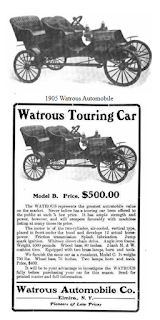

To secure a vehicle, potential customers were asked to send cash deposits of $100 - $200. The company began producing inexpensive car parts, getting ready to assemble, but demand soon outstripped their capacity to deliver. Very quickly they gained an undesirable reputation.  The Third Edition Standard Catalog of American Cars 1805 - 1942, a well-regarded catalog, reports the car was "...a noisy car, and a pretty awful one. Local wags dubbed it the waterless, gearless, powerless, useless Watrous.” 

In March 1906, Hilliard Clutch & Machine Company moved into the building occupied by WAC, and by summer WAC was out of business completely. Watrous’s automotive dream was over. Previously, Watrous had been a carriage painter and earlier notices in the newspapers had him claiming to be the inventor of a “revolutionary” fruit preserving process that would change the industry. When WAC folded, he returned to his earlier profession of carriage painter for a few years, then in 1911, moved to Florida.

In the end, the Watrous Automobile Company assembled just one vehicle. After the company folded, the car was sold to a client in Pittsburgh for the sum of $300 in addition to a previously made deposit. It was reported in the Star-Gazette on September 15, 1909, that according to its owner, this Watrous “worked alright.”

This would be the only automobile ever produced in Elmira. Other automotive companies associated with Elmira, like Willys-Morrow produced their cars elsewhere. In 1908, Henry Ford manufactured his Model T in Michigan and created a new kind of production model. He designed an assembly line and changed industry standards and customer expectations. Manufacturers shifted from producing a small number of handmade cars to producing millions. Ford’s approach brought the price of automobiles down and within reach for more Americans.  


Monday, February 14, 2022

Ernie Davis Day

By Rachel Dworkin, Archivist

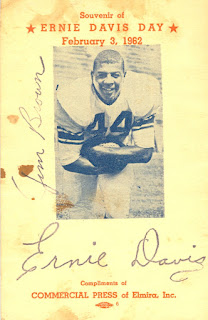
On the evening of February 3, 1962, around 1,400 people packed into the Notre Dame High School’s gym for the banquet in honor of Elmira’s favorite son, Ernie Davis. It was the last stop in what had been an action-packed day. The banquet was attended by such notables as state and local officials; teachers and coaches from EFA and Syracuse University; representatives from the Cleveland Browns and, of course, Davis’s mother. They were all there to pay tribute to his accomplishments and toast his up-coming career as a professional football player.

Although Ernie Davis is Elmira’s hometown hero, he wasn’t actually born here. He was born in New Salem, Pennsylvania and grew up in Uniontown. At the age of 12, he moved to Elmira with his mother and step-father. Here, he excelled at baseball, basketball, and football. While playing for Elmira Free Academy, he earned two All-American honors in basketball and football and was heavily recruited by colleges. He ended up attending Syracuse University where he played football and majored in economics and finance. In 1961, he became the first Black player to be awarded the Heisman Trophy. After graduating, he was recruited by the Cleveland Browns, signing the most lucrative contract of any NFL rookie up until that time. The citizens of Elmira could not have been prouder.


Planning for Ernie Davis Day began in late November 1961, shortly after Davis was awarded the Heisman Trophy. The day overall was going to be sponsored by the Elmira Association of Commerce with assistance from various fraternal groups and corporations. For months, the planning committee worked to schedule events, secure venues, and arrange speakers. They raised funds to buy Davis a new 1962 Thunderbird.

Officially, Ernie Davis Day began at 2pm at the YMCA with a youth meet-and-greet sponsored by Pepsi-Cola. Unofficially, kids began to gather on the sidewalk outside as early as noon. By the time Davis and his friend and fellow football player Jim Brown showed up a little after 1:30pm, there were nearly 400 boys running around. By the time the meet-and-greet officially began, the number had swelled to 700. There were speeches by Ernie Davis, Jim Brown, EFA football coach Bill Wipfler, and others. Each child received a card autographed by Davis and Brown. A few lucky ones actually got to shake their hands.


Next, Ernie headed off to an informal press reception at the Notre Dame High School library along with the ever-present Jim Brown, plus coaches Ben Schwartzwalder of Syracuse University and Arthur Modell of the Cleveland Browns. They schmoozed for an hour or so until Governor Nelson Rockefeller arrived around 5:30pm and the real press conference began.  

Around 6pm, the crowd started gathering for the banquet. Speeches began at 9pm after everyone had eaten their fill and there were a lot of speeches. Governor Nelson talked. President Kennedy talked, or at least wired a toast to be read aloud on his behalf. There were toasts by Ernie’s high school and college friends, his teachers and coaches, the mayor, and the Star-Gazette sports writer who had coined the nickname “Elmira Express.”  All of them wanted to celebrate Davis’s accomplishments and the promising start to his pro football career.


Sadly, his promising career never came to be. In the summer of 1962, Davis was diagnosed with leukemia. Ernie Davis died in a Cleveland hospital on May 18, 1963 at the age of 23. His wake at Elmira’s Neighborhood House on May 21 drew over 10,000 mourners. His funeral featured speeches by many of the same teammates, friends, and coaches who had spoken at his banquet. Even President Kennedy sent a statement to be read aloud. It was, in many ways, a dark reflection of the earlier, happier Ernie Davis Day.

Monday, January 31, 2022

Forever: Sending a Letter

 by Susan Zehnder, Education Director

Today “forever” costs fifty-eight cents. At least that’s what sending a one-ounce letter within the United States in 2021 costs. In October this year, the US Postal Service announced that first class mail may take them a little longer to deliver and for us to expect some letters and packages to arrive days later than in the past.

At this time of year, letters and packages keep the Post Office pretty busy. To appreciate how some things have changed, we invite you to view our current exhibit Going Postal. This exhibit is a fun look at mail service in Chemung County. 

Of course, mail was delivered in the colonies before the United States was a country, it was just delivered by anyone you might convince or pressure into carrying a message for you. As the colonies grew, Great Britain set up a mail system modeled after their own public mail service, one which had operated since the time of Henry VIII. The word post refers to the English mail service being carried from post to post. Each post had a master who would sort out and remove his area’s mail and return the rest to a post boy who then resumed delivery.

B. Franklin, Painting by J. Duplessis, 1778

In 1753, the Crown appointed Benjamin Franklin to serve as Joint Postmaster General for the colonies. During his tenure he established new mail routes, and erected sandstone mile markers known as Franklin Markers, to indicate distances. The changes Franklin made resulted in a faster and more reliable mail service. He even worked remotely as he spent much of the late 1750s in England. He audited postal statements and made decisions through the mail. Under his leadership, the postal service in the colonies turned a profit for the first time.

It was all fine until Franklin was implicated in leaking important letters sent between the British Crown and the British Governor of Massachusetts. Franklin, opposed to British rule, was dismissed from his post in 1774. Without his lead, the system began to fail.

In 1775, the Second Continental Congress created the United States Post Office. The drafted constitution of the United States, Article I, Section 8, Clause 7 gave Congress the power “To establish Post Offices and post Roads” to promote interstate communication and establish a source of revenue. Franklin was appointed its first Postmaster General. He was quick to rebuild his previous postal system, and it soon outperformed the British version. Franklin served in this position for a little over a year before he was appointed ambassador to France.

The Postal Service Act, signed by President George Washington in 1792 established unification, rules and regulations, and gave the Postmaster General greater powers under the United States Post Office Department. One of these was the ability to create postal routes to ensure that mail delivery would serve existing communities and expand as the new nation grew. It also allowed newspapers to be carried by the postal system at low rates. This helped spread information and improve communication throughout the young nation.

The title Postmaster General comes from the British model. For most of its existence in the United States, the position was part of the presidential cabinet. In 1971, the Post Office Department was reorganized into the United States Postal Service (USPS) by President Nixon. Since then, the Postmaster General is appointed by the Board of Governors and can only be removed by the board. Members are nominated to the board by the US President with the advice and consent of the Senate. The current Board of Governors consists of nine members in addition to the Postmaster General and the Deputy Postmaster General.

The USPS is the only delivery service that reaches every address in the nation, both personal and business. It receives no tax dollars for operating costs relying on postage sales and services to pay for funding. For the past few years, USPS has operated at a loss. Much of the blame for this is misunderstood.

In 2006, the Postal Accountability and Enhancement Act was passed to address USPS financial issues. The act requires the USPS to deliver mail six days a week; prohibits increasing postage faster than the rate of inflation; and prepays benefits for all their employees for at least fifty years. The prepaid benefits is something no other organization does, and many think it is to blame for their growing deficit. The Postal Service Reform Act (2021) was introduced last May with bi-partisan support to undo some of the 2006 changes.


The USPS is the nation’s 2nd largest civilian employer and there are 15 Post Office branches in the county to serve us. Our Going Postal exhibit has uniform patches, photographs, stamps, and more fun facts about Chemung County’s mail service and is on display Monday through Saturday 10 am – 5 pm through the spring. Seeing some of the history behind receiving a personal letter or package makes that first class stamp even more of a bargain.


Monday, January 17, 2022

The Terror of the Fugitive Slave Act

By Rachel Dworkin, Archivist

Earlier this month I got the coolest gift for my birthday. And by I, I of course mean the museum, but the donation came on my birthday, so I’m counting it. The gift in question was a letter from Mary and Seymour Fairman of Elmira to Mary’s parents in Fredonia, dated July 8, 1845. In the letter, the Fairmans talked about Elmira’s small, but growing, Black community and the problem of slave catchers.

Mary wrote:

We have for citizens in this place some hundred and fifty or two hundred Negros mostly if not all run-away slaves. They are constantly coming away from the south— Last summer six came here together, two on three weeks ago. Some four or five more came, and yesterday five more from Maryland arrived in search of them. The poor fellows have a good many staunch friends all. And last evening two or three of them went around and told all of them of the arrival of the hunters so they might be on their guard. One of the latest arrived Negros has been in the employ of the first man in the place—not an abolitionist, and when he and his family heard of the arrival of these creatures seeking after the poor negroes that they might drag them back again to slavery, they shed tears. The gentleman has given the negro his rifle to defend himself with—We think the southerners will not be able to take the negroes away if they succeed in finding them.  


Seymour recounted the following:

Those slaveholders are making quite the effort to catch their slaves. Judge Dunn has issued precepts for them and the sheriff is attempting to arrest them. Some three of them were sent by their abolition friends into the country about 6 miles to escape detection but the sheriff heard of them and started in pursuit with five slave holders, but one of the leading abolitionists found out that they discovered the negro retreat and mounting his horse he rode about six miles in 30 minutes to warn them of their danger. He arrived about 20 min before the sheriff. It will be impossible to take them.


With the passage of the Fugitive Slave Act of 1793, slave catchers became an ever-present threat to Blacks throughout the United States. Under the law, slave owners and their agents could snatch any Black person they liked after obtaining a warrant from a judge. Armed with a warrant, slave catchers could search and seize with impunity, even in free states and anyone who harbored a fugitive or tried to interfere with an arrest could be charged and fined $500. The law was wildly unpopular throughout the North and many states passed personal liberty laws designed to nullify or at least blunt the impact. New York, for example, enacted a personal liberty law in 1840 which guaranteed anyone accused of being an escaped slave the right to a jury trial and attorney. Despite various Northern state’s attempts to circumvent the laws, hundreds of Blacks, both free-born and fugitive, were kidnapped and forced into slavery.   

In 1850, the new Fugitive Slave Act made the problem exponentially worse. Slave catchers no longer required a warrant and the right to a trial was explicitly stripped. What’s more, state and federal law enforcement were now required to help slave catchers and could be fined $1,000 for refusing to do so. They also received a bonus for each person captured. The fines for those assisting fugitives was bumped up to $1,000 as well.

The act was hugely unpopular throughout the North. Many fugitives and free-born Blacks fled their homes in the North for the safety of Canada. Riots erupted in Massachusetts, New York, Wisconsin and Pennsylvania as angry mobs attempted to prevent slave catchers from kidnapping their targets. One such riot in Christiana, Pennsylvania turned deadly in September 1851. A slave owner by the name of Edward Gorsuch, aided by his son, nephew and a federal marshal, attempted to take four men. The townsfolk defended them in a pitched battle that ended with Gorsuch dead, his son and nephew wounded, and the marshal fled.  

In 1858, a confrontation with a slave owner here in Elmira nearly ended just as badly. An elderly Black man who had fled slavery to settle in Canandaigua was dying and wished to return to the South to be with his family. He wrote to his former master asking him to come and collect him. The pair stopped in Elmira, staying at the Brainard House on the corner of Water and Baldwin. When the town got word of what was happening, a posse of Black and white abolitionists assembled to rescue the man. Local bookseller Frank Hall, attempted to calm the situation declaring, “If this fugitive wishes to return home to his master, he shall go. If he don’t want to go back there is no power on this earth that shall force him from this place for that purpose.”  

Three Black leaders, Sandy Brant, Jefferson Brown, and John W. Jones, spoke with the man to determine his wishes. They explained to the crowd that the fugitive wanted to go, but the mob would not be deterred. A second group headed to the train station to keep them from boarding the train. In the end, Sheriff William Gregg ended up smuggling the man and his master out of the hotel and spiriting the pair away to Southport so they could board the train safely on the far side of the river. 


Both Fugitive Slave Acts were officially repealed in 1864, but their legacy still casts a long shadow.

Monday, January 3, 2022

Posting Blogs

 by Susan Zehnder, Education Director


What do faces of the depression, a shortage of dictionaries, and Arctic explorer Ross Marvin have in common? If you read our blogs, you can easily answer that question because each showed up in one of our blog posts this year.

Most of CCHS's blogs are written on a rotating basis by our archivist, curator and education director and have published weekly since February 6, 2012. Adding the 48 new blog posts from 2021 brings our grand offering to 514 blogs containing different stories of Chemung County history. The collection has been viewed close to 500,000 times. Send us a suggestion if you have a topic we haven't covered and we always appreciate your comments. Here are the top five viewed blogs of 2021, in order of popularity, see if you remember any of these:

1.     February 8th  Elmira’s First Black Fire Fighter A blog profiling the life and accomplishments of Thomas J. Reid, Jr.  In addition to being the first Black Fire Fighter in Elmira, Reid was also known for his inventions.


2.     February 15th The Neighborhood House and E.O. P. shared the history behind this 143 year old organization and its place in our community.


3.     January 4th Capturing the Local Faces of the Great Depression A little known connection between a Chemung County family and Farm Security Administration photographers documenting rural conditions.


4.     A follow up blog published January 25th The Maki Family of Rumsey Hill, revealed more of the story of one of those families photographed.


5.     March 8th Elmira HistoryForge: Discovering Local Stories written by our HistoryForge coordinator Andrea Renshaw, outlined the launch of this exciting project and how to get involved in documenting local history.

It’s not easy to predict which blogs will be the most popular, and we're often surprised. We choose topics because we’ve uncovered something new, or we want to share what's going on at the museum. Sometimes it may take longer for a blog to be discovered.  Years after being published, relatives of Elmiran Edward Brooks came across a blog written about his life. They traveled to Elmira to visit the museum and share his story with their children. It was a moving experience for them and for us. 

Here are blogs from last year which we think deserve another look:

1.     July 12th L. Libbie Adams and her Youthful Enterprise A blog connecting our Printing exhibit and the story of a young girl printer from the late 19th century who battled odds and made a living from writing, editing, and publishing her work.


2.     June 18th Revisiting Juneteenth, was a revised blog outlining the holiday’s origins and meanings.


3.     July 26th Jury Duty look at role of Jury duty in the United States, and how it has been practiced in the county.


4.     Viewing the Civil War, published last May 31st shared the topics and brief background of our three spring speakers and their contributions.


5.     November 8th’s Veterans Day shared some of the important work being done connecting veterans and local history organized by a local elementary school teacher.

     Of all the blogs we've published since 2012, the one which has been viewed the most was written in 2015 by our former Curator Erin Doane. The Holding Point and POWs published in January of that year shared the history of the WWII military camp located in Horseheads, NY.


 Erin was instrumental in putting together Hidden Lives of Chemung County, a book CCHS published this year. On sale at the museum or online, the book contains a collection of lesser known stories of  some amazing people in Chemung’s history.


Sharing our community’s history through blogs, is something we will continue in 2022. We’re happy when our viewers share too, just be sure to give us credit for our work when you do.

Monday, December 20, 2021

Packaged with Care by the Elmira Red Cross Prisoner of War Committee

By Rachel Dworkin

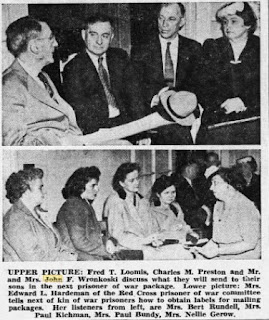
On May 18, 1944, Mr. and Mrs. John Wronkoski were elated to become new members of an exclusive club which met monthly at the German Evangelical Church under the auspices of the America Red Cross. Their son, Lt. Edward Wronkoski, had been shot down over North Africa and been reported missing on March 29th. They were understandably relieved to learn, nearly 2 months later, that he was alive and well in a German prisoner of war camp. The parents and wives of the Red Cross’s POW kin support group welcomed them with open arms.


 During World War II, 100 Chemung County servicemen were held as prisoners of war. The majority were held by German forces, with just a handful held by the Japanese. Lt. Frederick F. Loomis, pilot with a bomber group in stationed in North Africa, was the first Chemung County man to be taken prisoner after being shot down on February 23, 1943. In his first letter home after his capture, received on April 28th, he assured his parents that he was fine and asked them to send candy, books, and model airplane kits to help relieve the boredom. His parents, Fred and Edythe Loomis, became the founding members of the Elmira Red Cross Prisoner of War Committee.

Over the course of the war, the American Red Cross delivered over 27 million food parcels to 1.4 million U.S. and allied POWs held by Germany. They did not send parcels to the Pacific theater as the Japanese refused to take delivery. Around 13,500 volunteers working at packing centers in New York City, Chicago, Philadelphia, and St. Louis assembled 11-pound packages of non-perishable foods like dried fruits, canned meats, condensed milk, hard cheeses, crackers, jam, sugar, chocolate, and cigarettes. They also sent special packages with blankets, clothes, medical supplies, and toiletries. The turn-around from packing to delivery was about three months and the Red Cross tried to time it so that prisoners received a package a week.

Sgt. Henry Pickel of Southport, held captive from August 7, 1944 to January 31, 1945, claimed that the Red Cross packages made all the difference. “If it hadn’t been for the American Red Cross, the food situation would have been extremely serious,” he later told a reporter from the Star-Gazette. The Germans only fed them a slice of bread and a bowl of potato soup once a day, and prisoners relied on the weekly food shipments to stave off mal nutrition. That wasn’t all the Red Cross provided. “They sent us food, clothes, and warm blankets,” Pickel reported. “Until the blankets came, we had been trying to keep warm with small, worn out blankets that didn’t begin to do the job.”

Sgt. Henry Pickel


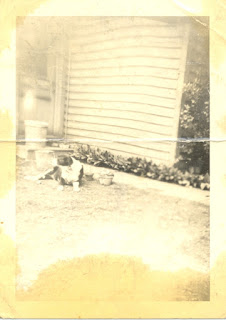
Prisoners’ friends and family could send packages too. In May 1944, the Loomis family sent their captive son four tiny screwdrivers and a pair of tweezers so he could do watch repairs. In another package, they sent him a saxophone. The Frawley family of Elmira sent their son, T-Sgt. John Jr., a package with cigarettes and a photo of the family dog. Despite being forced to march from camp to camp as the Allied armies advanced, John Frawley Jr. managed to hang onto every letter his family sent, along with the increasingly worn picture of Tippy the dog. Loomis, on the other hand, was forced to leave his belongings behind.


Photo John Frawley had of his dog

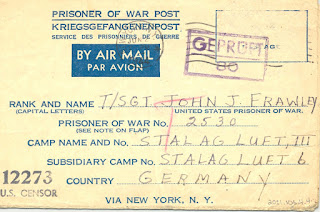
One of the things that the Elmira Red Cross Prisoner of War Committee did, in addition to providing emotional support, was to help teach the families of POWs how to ensure that their letters and packages actually made it to the prisoners. Packages could not weigh more than 11 pounds and had to be clearly labeled with the prisoner’s name, rank, prisoner of war number, and camp number. Each package and letter was reviewed and censored by the American government and read again and approved by the Germans before being passed on to the prisoners. By 1944, the U.S. government began issuing special stationary for mail to prisoners and only letters which had been typed or written in block capitals were accepted. 

Stationery for letters to POWs

 The captured men and their families were all incredibly grateful to the Red Cross. While still prisoners in Germany, Lt. Frederick F. Loomis and Lt. Edward Wronkoski both had their parents donate $25 from their bank accounts to the Red Cross’s fundraising drive in March 1945. Lt. John McNamara, who had been sent home as part of a wounded prisoner exchange, also donated to the cause. After his return of Elmira in April 1945, Sgt. Henry Pickel spoke before the Elmira Red Cross Prisoner of War Committee, describing his captivity and thanking them for their efforts.

Monday, December 6, 2021

One Foot in Front of the Other

 by Susan Zehnder, Education Director

Runners in the Finger Lakes welcome the arrival of autumn—temperatures are cooler, the humidity is less oppressive, and the colors in the hills can be stunning. Although the Wine Glass Marathon (held since 1981) was virtual last year, this year it returned in person, attracting male and female competitors from more than 41 states. Today we take for granted that both women and men can participate in the event, but a look back at the history of long-distance running shows that women have had an uphill battle when it comes to marathons. The story of one local runner can be an inspiration to keep going.

In 1984, the women’s marathon was added to Olympic events. It was the same year that Molly Huddle and her twin sister Megan were born in Elmira to mom Kathleen, an artist, and dad Robert, a physician. The Huddles, including siblings Christine and Katie Rose, were an active family and Molly enjoyed both school and sports.

Star-Gazette photo of 18 year old Molly running the Elmira-thon in 2002
Huddle attended Notre Dame High School, where in addition to her studies she played on the school’s soccer, basketball, and track teams. During fall of her senior year, she decided to pursue long-distance running. 

Notre Dame didn’t have a cross country team, so after petitioning the district’s athletic governing board, it was arranged that she could run and her father would coach her. She became Notre Dame’s one-person team, representing the school in meets, and the five-foot four-inch Huddle not only won races but broke league records. Huddle went on to attend Notre Dame University, where she continued to set personal bests and win national recognition.

Since then, Huddle has proven herself on the world stage time and again. Her career to date includes 5 world finals, 2 Olympic finals, and 7 personal bests. She was set to compete in this year’s Olympic Games but had to pull out due to hip and ankle injuries.

Early in the 20th century, women were prohibited from entering races due to health concerns that sound strange to us today. One thing some said was that running would cause a woman’s uterus to fall out. The first woman on record to run a marathon was Violet Piercy of Great Britain in the fall of 1926. Her time was 3:40:22, a record which stood unbroken until 1963. Almost one hundred years later, the women’s record in 2021 is 2:14:04. Molly Huddle’s own record is 2:26:33, set in London in 2019.

The Boston Marathon, one of six exclusive world-class races, began in 1897. When marathons became popular amateur sports in the late 1960s and 70s, women were still prohibited from participating. It seems old myths persisted. The Boston race’s rule book did not even mention gender until the late 1960s, after a 23-year-old woman named Bobbi Gibb attempted to enter the 1967 race but was denied on the basis of her gender. She went on to unofficially run and clocked in at 3:21:40, coming in well ahead of many of the male runners.

The following year, Katherine Switzer entered as K. V. Switzer, using her usual signature. This time the officials didn’t notice her application. To run, she wore a baggy sweat suit. When race officials discovered she was a woman, they and other runners physically attacked her, ripping her race number off her jersey. Today almost half the runners qualifying for the Boston Marathon are women.

Boston Herald photo of Katherine Switzer running
Switzer became an advocate for other women runners. She influenced Avon and Nike to lend corporate support for women runners and women’s races, thus elevating the sport. Things were slowly changing. In 1972, NYC Marathon officials allowed six women to enter the race, but insisted they begin ten minutes before the men. The women decided to strike. When the starter pistol fired, they sat down and held up signs pointing out the inequity of the situation. This deeply embarrassed the race officials, and since then, women have been allowed to compete with men and start at the same time.

In 1984 the Olympics added the Women’s Marathon. Molly Huddle first qualified for the 2012 London Olympics. She was now part of an organization very different than a team of one. She has worked hard through injuries and disappointments. Today, in addition to running, she is elevating other women runners through a podcast she’s created called Keeping Track: Women in Sports . In her podcasts, she highlights the stories of women track and field athletes often overlooked in the general media. It’s just the latest part of the impressive career that Molly Huddle has made by putting one foot in front of another, something she clearly loves to do.

2021 from Womensrunning.com
Fun fact: According to her Wikipedia page, Huddle is credited in part for the female runner emoji.