Monday, March 28, 2022

Clothes Make the Man (or Woman)

 by Susan Zehnder, Education Director

Two years ago COVID-19 arrived, and since then we’ve all learned to live with a variety of changes. One of those changes that continues to evolve is how we present ourselves at work. With more meetings happening remotely, some office workers are opting for a more casual look on the job but keep “zoom shirts” or jackets handy to appear more presentable online.

In the past, people in the medical field, transportation, and business professions were expected to wear specific types of clothing to reflect their position, indicate their responsibilities and communicate their status and class. Think of them as work uniforms.

Our current exhibit All in a Day’s Work: Dressed for Success shares examples of how, over the years, different Chemung County professionals have dressed for work.

Three uniforms on display in our exhibit reflect some ongoing changes in our societal expectations for work attire.

A woman’s nursing uniform, like other uniforms in the medical profession, is designed to inspire patients’ confidence and trust. Being attended by someone wearing a dirty uniform is almost hard to imagine, and the importance of wearing a uniform in nursing can be traced back to Florence Nightingale. When Nightingale established the world’s first secular nursing school in 1860, she dressed her nurses in gray uniforms. The outfits helped identify nurses who had training, and the gray didn’t show the color or blood when wet. The uniform was also meant to neutralize the wearer’s appearance and deter unwelcome advances from patients under their care, who were commonly young male soldiers far from home.

At the beginning of the 20th century, nurses shifted to wearing white. There were strict protocols and expectations for them to keep their uniforms starched and pristine. Wearing white was “proof” that nurses were clean, sanitary, and offered scientific care. Mid-century nurses wore starched white dresses, white caps, white nylons and white shoes, similar to the example on display from St. Joseph’s Hospital. Often nurses were required to care for their own uniforms which meant time-consuming work to remove from bodily fluids.

When women’s fashion became less restrictive, the style of nursing uniforms followed along. By the 1970s and 80s, nurses began to wear scrubs, and today scrubs are the primary outfit of choice for the profession which includes more male nurses. Scrubs allow the wearer more freedom to move, often come with pockets to carry tools, and can be worn by any gender. Scrubs come in a variety of bright colors and patterns which allows nurses to personalize their look, if their affiliated institution permits it.

Uniforms have also been part of transportation work. Each style of dress indicated what position workers held and informed the public what to expect. Early train and trolley conductors, airline pilots, and bus drivers wore matching uniforms that had a distinct military style. This inspired confidence in their skills and abilities, and helped to make them look competent. The Lackawanna Railroad conductor's uniform from 1954 is a good example of that style. It comes with fancy brass buttons that include the Lackawanna R.R. logo to indicate the wearer was someone of note. Today transportation uniforms vary. Airline pilots still wear military influenced uniforms, often with brimmed hats and epaulets on the shoulder. Bus drivers are more casual and if they wear hats, tend to favor ball cap styles.

Unofficial uniforms have been worn by office workers providing business services since the beginning. In the 1930s, American writer Upton Sinclair called professionals who receive salaries “white collar workers,” referring to the white shirts and business suits many workers wore. The term stuck and is still used today. “Business casual,” or business attire was expected in many professions as a way to command respect from peers and customers, as well as show respect to those they worked with. Male workers who dressed this way communicated an unwritten message of who was in charge, and what position someone aspired to.

For women entering the workforce during the last century, fashion trends shifted from ultra-feminine to more traditionally masculine. Early on, it was unthinkable for women in offices to show up without wearing stockings, heels, skirts or dresses. Women began to wear suits similar to their male colleagues, adding shoulder pads to convey power and authority. The office worker’s outfit we have on display is a man’s suit from 1930, when white-collar workers were expected to wear suits, hats, and dress shoes to the office every day.

Today, advice for anyone interviewing for a job is often to dress for the job level above the one they’re applying for. What we choose to wear is a kind of language. We represent the organizations we work for as well as representing ourselves, and our clothes can say something about us.

Whether or not the more casual styles adopted during the pandemic stay with us, we’ll just have to see.


Monday, March 14, 2022

Elmira and the Widow Bedott

By Rachel Dworkin, Archivist


In 1849, Frances Miriam Berry Whitcher cost her husband his job as pastor of Elmira’s Trinity Episcopal Church. It was a funny story. Actually, it was several funny stories. That was the problem.

Born Frances Miriam Berry (Miriam to her friends), Whitcher (1811-1852) is known as the first female American satirists. Growing up in Whitesboro, New York as the eleventh of fifteen children, she was shy and bookish with wicked sense of humor. After years of writing humorous stories for her friends in the Whitesboro literary society, she submitted several satirical sketches to Neal’s Saturday Gazette of Philadelphia under the pseudonym “Frank” in 1846. They were an instant success.


Frances Miriam Whitcher, 1849

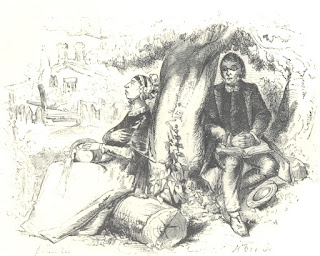
The main character of the tales was the Prissilla “Silly” Bedott, widow of Deacon Hezkiah Bedott and active pursuer of every eligible widower in the fictitious Wiggletown, New York. The sketches focused on the foibles of small town life with particular attention paid to the travails of courtship and women’s social circles. In some ways, Bedott’s life mirrored Miriam’s. Both women ended up marrying preachers and moving with them to a new setting.  

Widow Bedott & Rev. Sniffles

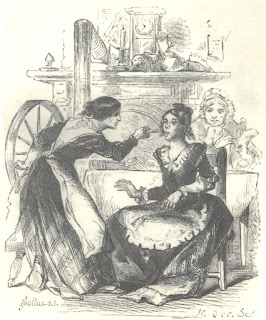
 On January 6, 1847, Miriam married Episcopalian minster Benjamin William Whitcher, just about the same time as her fictional counterpart married Sharack Sniffles of Scrabble Hill. Soon after, Reverend Whitcher was hired as rector of Elmira’s Trinity Church. The couple’s income was meager, just $500 a year, so Miriam continued to supplement it with her writing. Not long after their move, Louis Godey of Godey’s Lady’s Book, America’s first women’s magazine, contacted her and asked her to write a new series for his magazine. Miriam created a new character, Aunt Maguire, the Widow Bedott’s sister in Scrabble Hill. While Bedott was cynical and ambitious, Maguire was a compassionate voice of reason. Her stories were no less funny or popular though.

 The first of the pieces written in Elmira was about a disastrous donation party put on for a new local minister. At the time, it was common to hold a yearly pot-luck fundraiser at the minister’s home to supplement the meager annual income with gifts of household items. The story was inspired by the Whitchers’ own welcome donation party, although theirs involved considerably way less humiliation and property damage. Over the next few years, Miriam wrote a number of Aunt Maguire stories, some of which were re-printed in the local paper.

Aunt Maguire scolds her sister
The trouble came with a story about a sewing circle which was published in Godey’s Lady’s Book in January 1849. It included a fairly incisive take down of “Mrs. Samson Savage.”

“She’s one o’ the big bugs here—that is, she’s got more money than a’most anybody else in town. She was a tailoress when she was a gal, and they say she used to make a dretful sight o’ mischief among the folks where she sewed. But that was when she lived in Vermont. When Mr. Savage married her, he was one o’ these ere specilators…So she sot up for a lady. She was always a coarse, boisterous, high-tempered critter, and when her husband grow’d rich, she grow’d pompous and over-bearin’. She made up her mind she’d rule the roast, no matter what it cost—she’d be the first in Scrabble Hill.”

 All across New York, people were convinced that their local bully was the inspiration for Mrs. Savage. Nearly all of them were wrong, as it turned out she was based on Elmira’s Mrs. John Arnot Sr. The local speculation about Savage’s true identity might have died down if Reverend Whitcher hadn’t confirmed that his wife was the author. The reverend was called before the church vestry in February 1849 in order to justify his continued employment. Miriam, meanwhile, found herself hounded and insulted by Mrs. Arnot and her clique. By June, the couple couldn’t take it anymore. Unable find a new position elsewhere, Reverend Whitcher resigned and the couple moved back to Whitesboro to live with the Berrys.

Over the next few years, Miriam’s writing slowed as her health declined until her death from tuberculosis in January 1852. Not long after, in 1855, her collected writings were gathered together and published in book form as The Widow Bedott Papers. The stories were later turned into a play. While few have heard of her today, she was wildly popular in her heyday. Even the famous Mark Twain was a huge fan.

Monday, February 28, 2022

The Little Engine That Couldn’t: Elmira’s Watrous Automobile

 by Susan Zehnder, Education Director


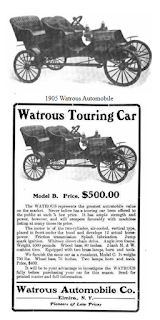
In 1904, Thomas S. Watrous founded the Watrous Automobile Company (WAC) on Main Street, hoping to cash in on the public’s growing desire for automobiles. The new industry was hot. The first American patent for a combustion engine had been filed twenty-five years earlier and now over 3,000 models were on the market. Each car was assembled by hand, making the median price around $1,000. However, the average yearly salary was only $200 - $400. For many the dream of owning their own automobile was still unattainable. Watrous wanted to offer customers more affordable options.

The first car purchased in the county was a Winton Roundabout six years earlier. The buyer was a local doctor William H. Fisher, and the car was manufactured by the Winton Motor Carriage Company, out of Cleveland, Ohio. It was summer when the car finally arrived. The event was announced in the local newspaper and a spontaneous parade was organized to celebrate its arrival. Winton automobiles had a reputation for quality and durability. A few years later, a Winton Roundabout would be driven across the country, successfully completing the nation’s first transcontinental drive. Without connected roads or reliable maps, Dr. H. Nelson of Vermont drove from coast to coast in under 90 days.

Fisher’s Roundabout engine had one cylinder and an advertised speed of 20 mph, which he put to the test.

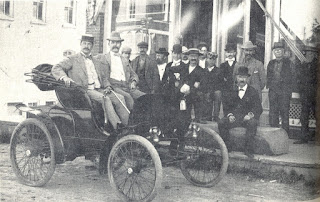
Dr. Fisher and Dr. Carey in Fisher's Winton


Accompanied by Dr. Chauncey Carey, he recorded the county’s first distance drive, visiting Van Etten, Spencer, Owego, and Waverly in one afternoon. In a later attempt to prove his automobile’s prowess, Fisher raced against a horse at the County Fair, only to stall out and be forced to be towed home.

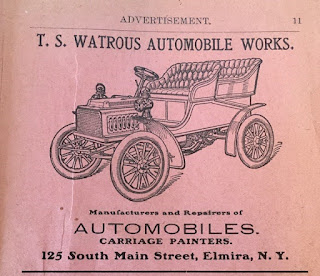
In the spring of 1904, when T.S. Watrous established the Watrous Automobile Company, business headquarters were located at 125 S. Main Street, Elmira, long gone today. His plan was to open a manufacturing plant on 11th Street in Elmira Heights, where WAC would produce two affordable models: the Model B, a Touring Car which would cost $500, and Model C, a Runabout which would cost $400. This was half the cost of other car models at the time. In early 1906 WAC was ready and advertised their vehicles widely. Orders soon rolled in.


To secure a vehicle, potential customers were asked to send cash deposits of $100 - $200. The company began producing inexpensive car parts, getting ready to assemble, but demand soon outstripped their capacity to deliver. Very quickly they gained an undesirable reputation.  The Third Edition Standard Catalog of American Cars 1805 - 1942, a well-regarded catalog, reports the car was "...a noisy car, and a pretty awful one. Local wags dubbed it the waterless, gearless, powerless, useless Watrous.” 

In March 1906, Hilliard Clutch & Machine Company moved into the building occupied by WAC, and by summer WAC was out of business completely. Watrous’s automotive dream was over. Previously, Watrous had been a carriage painter and earlier notices in the newspapers had him claiming to be the inventor of a “revolutionary” fruit preserving process that would change the industry. When WAC folded, he returned to his earlier profession of carriage painter for a few years, then in 1911, moved to Florida.

In the end, the Watrous Automobile Company assembled just one vehicle. After the company folded, the car was sold to a client in Pittsburgh for the sum of $300 in addition to a previously made deposit. It was reported in the Star-Gazette on September 15, 1909, that according to its owner, this Watrous “worked alright.”

This would be the only automobile ever produced in Elmira. Other automotive companies associated with Elmira, like Willys-Morrow produced their cars elsewhere. In 1908, Henry Ford manufactured his Model T in Michigan and created a new kind of production model. He designed an assembly line and changed industry standards and customer expectations. Manufacturers shifted from producing a small number of handmade cars to producing millions. Ford’s approach brought the price of automobiles down and within reach for more Americans.  


Monday, February 14, 2022

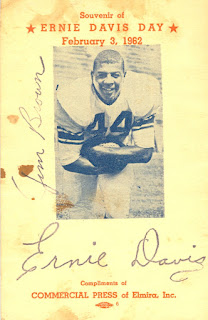
Ernie Davis Day

By Rachel Dworkin, Archivist

On the evening of February 3, 1962, around 1,400 people packed into the Notre Dame High School’s gym for the banquet in honor of Elmira’s favorite son, Ernie Davis. It was the last stop in what had been an action-packed day. The banquet was attended by such notables as state and local officials; teachers and coaches from EFA and Syracuse University; representatives from the Cleveland Browns and, of course, Davis’s mother. They were all there to pay tribute to his accomplishments and toast his up-coming career as a professional football player.

Although Ernie Davis is Elmira’s hometown hero, he wasn’t actually born here. He was born in New Salem, Pennsylvania and grew up in Uniontown. At the age of 12, he moved to Elmira with his mother and step-father. Here, he excelled at baseball, basketball, and football. While playing for Elmira Free Academy, he earned two All-American honors in basketball and football and was heavily recruited by colleges. He ended up attending Syracuse University where he played football and majored in economics and finance. In 1961, he became the first Black player to be awarded the Heisman Trophy. After graduating, he was recruited by the Cleveland Browns, signing the most lucrative contract of any NFL rookie up until that time. The citizens of Elmira could not have been prouder.


Planning for Ernie Davis Day began in late November 1961, shortly after Davis was awarded the Heisman Trophy. The day overall was going to be sponsored by the Elmira Association of Commerce with assistance from various fraternal groups and corporations. For months, the planning committee worked to schedule events, secure venues, and arrange speakers. They raised funds to buy Davis a new 1962 Thunderbird.

Officially, Ernie Davis Day began at 2pm at the YMCA with a youth meet-and-greet sponsored by Pepsi-Cola. Unofficially, kids began to gather on the sidewalk outside as early as noon. By the time Davis and his friend and fellow football player Jim Brown showed up a little after 1:30pm, there were nearly 400 boys running around. By the time the meet-and-greet officially began, the number had swelled to 700. There were speeches by Ernie Davis, Jim Brown, EFA football coach Bill Wipfler, and others. Each child received a card autographed by Davis and Brown. A few lucky ones actually got to shake their hands.


Next, Ernie headed off to an informal press reception at the Notre Dame High School library along with the ever-present Jim Brown, plus coaches Ben Schwartzwalder of Syracuse University and Arthur Modell of the Cleveland Browns. They schmoozed for an hour or so until Governor Nelson Rockefeller arrived around 5:30pm and the real press conference began.  

Around 6pm, the crowd started gathering for the banquet. Speeches began at 9pm after everyone had eaten their fill and there were a lot of speeches. Governor Nelson talked. President Kennedy talked, or at least wired a toast to be read aloud on his behalf. There were toasts by Ernie’s high school and college friends, his teachers and coaches, the mayor, and the Star-Gazette sports writer who had coined the nickname “Elmira Express.”  All of them wanted to celebrate Davis’s accomplishments and the promising start to his pro football career.


Sadly, his promising career never came to be. In the summer of 1962, Davis was diagnosed with leukemia. Ernie Davis died in a Cleveland hospital on May 18, 1963 at the age of 23. His wake at Elmira’s Neighborhood House on May 21 drew over 10,000 mourners. His funeral featured speeches by many of the same teammates, friends, and coaches who had spoken at his banquet. Even President Kennedy sent a statement to be read aloud. It was, in many ways, a dark reflection of the earlier, happier Ernie Davis Day.

Monday, January 31, 2022

Forever: Sending a Letter

 by Susan Zehnder, Education Director

Today “forever” costs fifty-eight cents. At least that’s what sending a one-ounce letter within the United States in 2021 costs. In October this year, the US Postal Service announced that first class mail may take them a little longer to deliver and for us to expect some letters and packages to arrive days later than in the past.

At this time of year, letters and packages keep the Post Office pretty busy. To appreciate how some things have changed, we invite you to view our current exhibit Going Postal. This exhibit is a fun look at mail service in Chemung County. 

Of course, mail was delivered in the colonies before the United States was a country, it was just delivered by anyone you might convince or pressure into carrying a message for you. As the colonies grew, Great Britain set up a mail system modeled after their own public mail service, one which had operated since the time of Henry VIII. The word post refers to the English mail service being carried from post to post. Each post had a master who would sort out and remove his area’s mail and return the rest to a post boy who then resumed delivery.

B. Franklin, Painting by J. Duplessis, 1778

In 1753, the Crown appointed Benjamin Franklin to serve as Joint Postmaster General for the colonies. During his tenure he established new mail routes, and erected sandstone mile markers known as Franklin Markers, to indicate distances. The changes Franklin made resulted in a faster and more reliable mail service. He even worked remotely as he spent much of the late 1750s in England. He audited postal statements and made decisions through the mail. Under his leadership, the postal service in the colonies turned a profit for the first time.

It was all fine until Franklin was implicated in leaking important letters sent between the British Crown and the British Governor of Massachusetts. Franklin, opposed to British rule, was dismissed from his post in 1774. Without his lead, the system began to fail.

In 1775, the Second Continental Congress created the United States Post Office. The drafted constitution of the United States, Article I, Section 8, Clause 7 gave Congress the power “To establish Post Offices and post Roads” to promote interstate communication and establish a source of revenue. Franklin was appointed its first Postmaster General. He was quick to rebuild his previous postal system, and it soon outperformed the British version. Franklin served in this position for a little over a year before he was appointed ambassador to France.

The Postal Service Act, signed by President George Washington in 1792 established unification, rules and regulations, and gave the Postmaster General greater powers under the United States Post Office Department. One of these was the ability to create postal routes to ensure that mail delivery would serve existing communities and expand as the new nation grew. It also allowed newspapers to be carried by the postal system at low rates. This helped spread information and improve communication throughout the young nation.

The title Postmaster General comes from the British model. For most of its existence in the United States, the position was part of the presidential cabinet. In 1971, the Post Office Department was reorganized into the United States Postal Service (USPS) by President Nixon. Since then, the Postmaster General is appointed by the Board of Governors and can only be removed by the board. Members are nominated to the board by the US President with the advice and consent of the Senate. The current Board of Governors consists of nine members in addition to the Postmaster General and the Deputy Postmaster General.

The USPS is the only delivery service that reaches every address in the nation, both personal and business. It receives no tax dollars for operating costs relying on postage sales and services to pay for funding. For the past few years, USPS has operated at a loss. Much of the blame for this is misunderstood.

In 2006, the Postal Accountability and Enhancement Act was passed to address USPS financial issues. The act requires the USPS to deliver mail six days a week; prohibits increasing postage faster than the rate of inflation; and prepays benefits for all their employees for at least fifty years. The prepaid benefits is something no other organization does, and many think it is to blame for their growing deficit. The Postal Service Reform Act (2021) was introduced last May with bi-partisan support to undo some of the 2006 changes.


The USPS is the nation’s 2nd largest civilian employer and there are 15 Post Office branches in the county to serve us. Our Going Postal exhibit has uniform patches, photographs, stamps, and more fun facts about Chemung County’s mail service and is on display Monday through Saturday 10 am – 5 pm through the spring. Seeing some of the history behind receiving a personal letter or package makes that first class stamp even more of a bargain.


Monday, January 17, 2022

The Terror of the Fugitive Slave Act

By Rachel Dworkin, Archivist

Earlier this month I got the coolest gift for my birthday. And by I, I of course mean the museum, but the donation came on my birthday, so I’m counting it. The gift in question was a letter from Mary and Seymour Fairman of Elmira to Mary’s parents in Fredonia, dated July 8, 1845. In the letter, the Fairmans talked about Elmira’s small, but growing, Black community and the problem of slave catchers.

Mary wrote:

We have for citizens in this place some hundred and fifty or two hundred Negros mostly if not all run-away slaves. They are constantly coming away from the south— Last summer six came here together, two on three weeks ago. Some four or five more came, and yesterday five more from Maryland arrived in search of them. The poor fellows have a good many staunch friends all. And last evening two or three of them went around and told all of them of the arrival of the hunters so they might be on their guard. One of the latest arrived Negros has been in the employ of the first man in the place—not an abolitionist, and when he and his family heard of the arrival of these creatures seeking after the poor negroes that they might drag them back again to slavery, they shed tears. The gentleman has given the negro his rifle to defend himself with—We think the southerners will not be able to take the negroes away if they succeed in finding them.  


Seymour recounted the following:

Those slaveholders are making quite the effort to catch their slaves. Judge Dunn has issued precepts for them and the sheriff is attempting to arrest them. Some three of them were sent by their abolition friends into the country about 6 miles to escape detection but the sheriff heard of them and started in pursuit with five slave holders, but one of the leading abolitionists found out that they discovered the negro retreat and mounting his horse he rode about six miles in 30 minutes to warn them of their danger. He arrived about 20 min before the sheriff. It will be impossible to take them.


With the passage of the Fugitive Slave Act of 1793, slave catchers became an ever-present threat to Blacks throughout the United States. Under the law, slave owners and their agents could snatch any Black person they liked after obtaining a warrant from a judge. Armed with a warrant, slave catchers could search and seize with impunity, even in free states and anyone who harbored a fugitive or tried to interfere with an arrest could be charged and fined $500. The law was wildly unpopular throughout the North and many states passed personal liberty laws designed to nullify or at least blunt the impact. New York, for example, enacted a personal liberty law in 1840 which guaranteed anyone accused of being an escaped slave the right to a jury trial and attorney. Despite various Northern state’s attempts to circumvent the laws, hundreds of Blacks, both free-born and fugitive, were kidnapped and forced into slavery.   

In 1850, the new Fugitive Slave Act made the problem exponentially worse. Slave catchers no longer required a warrant and the right to a trial was explicitly stripped. What’s more, state and federal law enforcement were now required to help slave catchers and could be fined $1,000 for refusing to do so. They also received a bonus for each person captured. The fines for those assisting fugitives was bumped up to $1,000 as well.

The act was hugely unpopular throughout the North. Many fugitives and free-born Blacks fled their homes in the North for the safety of Canada. Riots erupted in Massachusetts, New York, Wisconsin and Pennsylvania as angry mobs attempted to prevent slave catchers from kidnapping their targets. One such riot in Christiana, Pennsylvania turned deadly in September 1851. A slave owner by the name of Edward Gorsuch, aided by his son, nephew and a federal marshal, attempted to take four men. The townsfolk defended them in a pitched battle that ended with Gorsuch dead, his son and nephew wounded, and the marshal fled.  

In 1858, a confrontation with a slave owner here in Elmira nearly ended just as badly. An elderly Black man who had fled slavery to settle in Canandaigua was dying and wished to return to the South to be with his family. He wrote to his former master asking him to come and collect him. The pair stopped in Elmira, staying at the Brainard House on the corner of Water and Baldwin. When the town got word of what was happening, a posse of Black and white abolitionists assembled to rescue the man. Local bookseller Frank Hall, attempted to calm the situation declaring, “If this fugitive wishes to return home to his master, he shall go. If he don’t want to go back there is no power on this earth that shall force him from this place for that purpose.”  

Three Black leaders, Sandy Brant, Jefferson Brown, and John W. Jones, spoke with the man to determine his wishes. They explained to the crowd that the fugitive wanted to go, but the mob would not be deterred. A second group headed to the train station to keep them from boarding the train. In the end, Sheriff William Gregg ended up smuggling the man and his master out of the hotel and spiriting the pair away to Southport so they could board the train safely on the far side of the river. 


Both Fugitive Slave Acts were officially repealed in 1864, but their legacy still casts a long shadow.

Monday, January 3, 2022

Posting Blogs

 by Susan Zehnder, Education Director


What do faces of the depression, a shortage of dictionaries, and Arctic explorer Ross Marvin have in common? If you read our blogs, you can easily answer that question because each showed up in one of our blog posts this year.

Most of CCHS's blogs are written on a rotating basis by our archivist, curator and education director and have published weekly since February 6, 2012. Adding the 48 new blog posts from 2021 brings our grand offering to 514 blogs containing different stories of Chemung County history. The collection has been viewed close to 500,000 times. Send us a suggestion if you have a topic we haven't covered and we always appreciate your comments. Here are the top five viewed blogs of 2021, in order of popularity, see if you remember any of these:

1.     February 8th  Elmira’s First Black Fire Fighter A blog profiling the life and accomplishments of Thomas J. Reid, Jr.  In addition to being the first Black Fire Fighter in Elmira, Reid was also known for his inventions.


2.     February 15th The Neighborhood House and E.O. P. shared the history behind this 143 year old organization and its place in our community.


3.     January 4th Capturing the Local Faces of the Great Depression A little known connection between a Chemung County family and Farm Security Administration photographers documenting rural conditions.


4.     A follow up blog published January 25th The Maki Family of Rumsey Hill, revealed more of the story of one of those families photographed.


5.     March 8th Elmira HistoryForge: Discovering Local Stories written by our HistoryForge coordinator Andrea Renshaw, outlined the launch of this exciting project and how to get involved in documenting local history.

It’s not easy to predict which blogs will be the most popular, and we're often surprised. We choose topics because we’ve uncovered something new, or we want to share what's going on at the museum. Sometimes it may take longer for a blog to be discovered.  Years after being published, relatives of Elmiran Edward Brooks came across a blog written about his life. They traveled to Elmira to visit the museum and share his story with their children. It was a moving experience for them and for us. 

Here are blogs from last year which we think deserve another look:

1.     July 12th L. Libbie Adams and her Youthful Enterprise A blog connecting our Printing exhibit and the story of a young girl printer from the late 19th century who battled odds and made a living from writing, editing, and publishing her work.


2.     June 18th Revisiting Juneteenth, was a revised blog outlining the holiday’s origins and meanings.


3.     July 26th Jury Duty look at role of Jury duty in the United States, and how it has been practiced in the county.


4.     Viewing the Civil War, published last May 31st shared the topics and brief background of our three spring speakers and their contributions.


5.     November 8th’s Veterans Day shared some of the important work being done connecting veterans and local history organized by a local elementary school teacher.

     Of all the blogs we've published since 2012, the one which has been viewed the most was written in 2015 by our former Curator Erin Doane. The Holding Point and POWs published in January of that year shared the history of the WWII military camp located in Horseheads, NY.


 Erin was instrumental in putting together Hidden Lives of Chemung County, a book CCHS published this year. On sale at the museum or online, the book contains a collection of lesser known stories of  some amazing people in Chemung’s history.


Sharing our community’s history through blogs, is something we will continue in 2022. We’re happy when our viewers share too, just be sure to give us credit for our work when you do.