Friday, June 24, 2022

Helen Booth Sprecher

By Phoenix Andrews, Alfred University Intern

Helen Booth Sprecher was born in Spangler, Pennsylvania in 1913. She attended Slippery Rock State Teachers College (now Slippery Rock University) where she got her Bachelors of Science and then the University of Pittsburg where she got her Masters of Education. She pursued a career in teaching Physical Education. However, after America entered World War II, she was determined to help in any way she could.

 In June 1942, Booth took the exam to enter the Officer Candidate School for the Women’s Army Auxiliary Corps (WAAC). In August, she was accepted and sent to Fort Des Moines where she would complete her training. At that time, her rank was Third Officer, the equivalent of a 2nd Lieutenant in the regular army. 
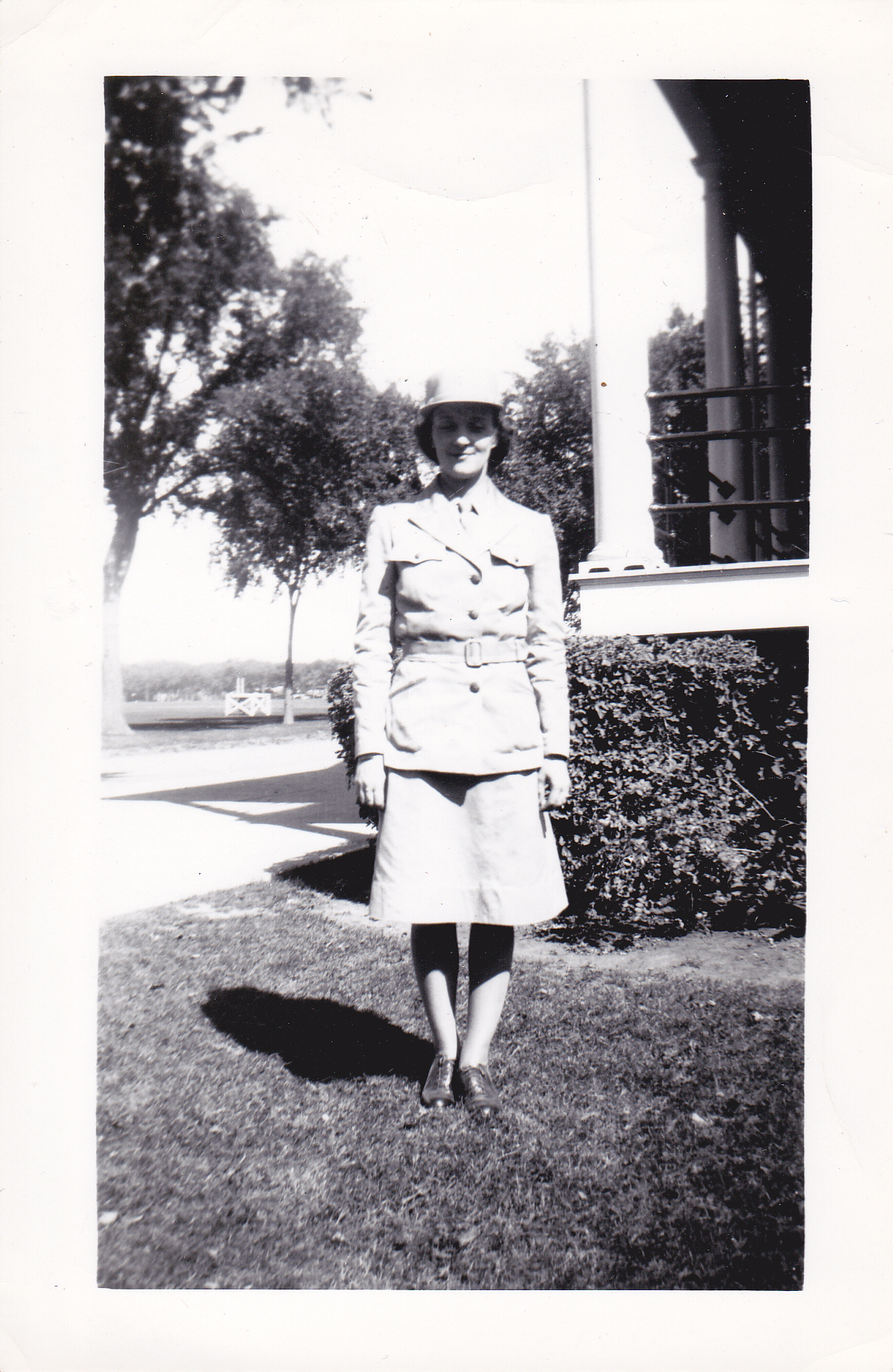

 During her time in the WAAC, she was stationed in various locations in California, Iowa, Florida, and Georgia. In July 1943, the Women’s Army Auxiliary Corps became the Women’s Army Corps (WAC). While WAAC members could only serve stateside, WAC members could be posted overseas. Booth was sent to serve in both in Australia and the Philippines.

Booth held many positions during her service. She had worked as a Unit Commander in the United States and overseas holding the position as Assisting Commanding Officer of the WAAC Headquarters. She worked as a Personnel Officer in the United States. She also received addition training and became an Administration Inspector and WAAC Inspector in both the United States and overseas. Booth had occupational specialty as Non-Tactical Unit Officer and Administrative Inspection.


 Booth would continue to rise in the ranks. While stationed in Santa Maria, California she would become 1st Lieutenant. Later, while stationed overseas in Australia, Booth’s commanding officers would request that she be given temporary rank as Captain, which would be granted and later given to her permanently.

Her time in the WAC would end in January of 1946, four months after then end of the war. She was award the American Campaign Medal, Asiatic-Pacific Campaign Medal, Philippine Liberation Ribbon, and the WAAC Service Medal. After the war ended, Booth taught Physical Education at one of the California naval bases where she would meet her future husband, James Sprecher.


Together they moved to Elmira, New York so Booth could live closer to her family in Pennsylvania. She worked as a Physical Education teacher for the Elmira City School District. In 1950, she joined the Air Force Reserves. In 1996, at the age of 82, Booth died at her home in Elmira.

Monday, June 20, 2022

Half a Century of Computing Technology

 By Monica Groth, Curator

The coming exhibit, When Waters Recede: 50 Years Since the Flood of 1972, will remind visitors how much communications and computing technology has progressed in the past fifty years. When Hurricane Agnes struck Chemung County in 1972, the first commercially available handheld cellphone was still a decade away, and families waited months to hear from loved ones whose telephone lines were down. That year, the new PDP-8F “minicomputer” (which actually weighed 57 lbs.) could process information at a rate of only 0.667 megahertz – 5000 times slower than the computer I’m writing on today.

Technological advancements since then have certainly made monitoring and warning systems more effective, equipping people with accurate tools needed to predict danger and readily communicate emergency plans. Fifteen years after the flood, a system of electronic river level gauges and rain gauges fed data directly to the county’s Emergency Operation Centers through telephone lines and radio transmitters. The data was read by computers, which also received figures from surrounding counties and the National Weather Service. In 1987,
Civil Defense coordinator Gary Angus told the Star Gazette that the communication and computer equipment made it “easier for us to detect and forecast how storms will affect the county”. Flood Warning Service Operations Director Gregory Clark was pleased to announce data was the result of “real-time reporting. Meaning the information is current when called in,” adding that you can “never have enough information”.

Or can you? The computers of 1987 were still hundreds of times slower than they are today, with only a small fraction of the memory of a modern processor. The importance of real-time reporting and enough information storage was widely recognized and over time computer scientists engineered machines with the ability to store and analyze more information faster and more efficiently.

Computers bridging the years from 1972 to 2013 have been generously donated to our collection for the upcoming exhibit. Take a peek at what will be on display. Consider the computers’ specifications to compare their memory (measured as RAM, or short-term data storage in megabytes) and speed (measured as clock-speed, or number of processor cycles/second in megahertz).

PDP-8F  1972 
(This unit, which includes a punch card system and monitor is 5.5 ft tall, 22 in wide, and 30 in. deep)

                                           Memory: 0.000512 MB   

                                             Speed: 0.667 MHz 

Timex 1000  1982

                                      Memory: 0.002 MB (0.0036 MB maximum)

                                          Speed: 3.25 MHz


Compaq LTE Lite/25  1992

                                                   Memory: 2 MB (18 MB maximum)

                                                       Speed: 25 MHz


Compaq C140  1997

                                               Memory: 4 MB (6 MB maximum)

                                                   Speed: 40 MHz


HP Pavilion N3210  2000

                                               Memory: 32 MB (256 MB maximum)

                                                   Speed: 475 MHz


HP Chromebook 14-q010dx  2013

                                                   Memory: 2000 MB

                                                      Speed: 1400 MHz

Monday, June 6, 2022

John M. Diven

 by Susan Zehnder, Education Director

In Chemung County the Diven name is associated with state and local politics, the Civil War, and education, but one Diven received national recognition for his work with water. Fifty years after his death, John Malvina Diven was inducted into the National Water Industry Hall of Fame for his contributions to the field of water management. He had worked in the field for more than half a century despite having no formal engineering training.

John M. Diven

The Divens first arrived in Chemung County in the 1830s, when Alexander S. Diven moved to Elmira to practice law and married a local girl, Amanda Malvina Beers. Among his many accomplishments, he was an officer in the Civil War; Elmira’s 11th mayor; a member of the U.S. House of Representatives from New York’s 27th District; an elected member of the New York Senate; and a board member for various educational institutions and companies. The community and his family were important to him.

When Alexander was 43 years old, his eighth and youngest child, John, was born. It was 1852. Six years later, Alexander and his oldest son, George, made an investment that would change John’s life. They invested in the county’s first water supply system, operated privately by a company known as the Elmira Water Company (EWC) and located at the corner of Baldwin and Water Streets.

The EWC system delivered water to Southside homes and businesses near the Chemung River. In mid-19th century America, there were only 83 public water supply systems in existence. Like Elmira’s, 50 of these were privately operated. It wasn’t that the idea of a reliable water system was new - its importance had been known since Roman times. It was a question of who had responsibility for delivering that water.

The Elmira Water Company had been chartered in 1859, when the NYS legislature incorporated the company allowing them to raise capital. The area’s population was growing, and its 7,000 residents were expecting reliable water. The EWC system relied on gravity to draw water directly from nearby Seeley Creek, using state-of-the-art wooden pipes from Wyckoff Bros. (later Wyckoff & Son’s), a company, based on Water Street in Elmira.

Arcalous Wyckoff, owner, engineer, and founder of the successful pipe company, held patents for a specialized boring machine used to make wooden pipes. He was also an initial investor in the water company and lived with his family in an imposing mansion on the Southside. His home is gone now, but is the current location of Fagan Engineers & Land Surveying, a civil engineering company.

Despite public interest and popularity, the water company faltered. Determined it would succeed, investors including the Diven family then formed the Elmira Water Works Company in 1869. They added another system to supply the city’s Northside and downtown area that would draw water from a Chemung River reservoir near Hoffman Street.

The Diven family bought out other investors and became major stakeholders in the company. They built a 100-million-gallon reservoir on Upper Hoffman Street and added a pumping line down Water Street to assist during dry spells. John had been working at the company, and though he didn’t have training in civil engineering, he was appointed water superintendent in 1875. Under his leadership the company installed a water pumping station and filter plant.

In 1886, hoping the city would take over operations, the Divens offered the water company to the City of Elmira for $400,000. The city turned them down.

Six years later the Municipal Improvement Co. purchased stock in the company and took over operations. John was kept on as superintendent.


In 1896, the Elmira community battled a terrible typhoid outbreak which resulted in 46 deaths. To prevent future outbreaks, the water company added one of the country’s first mechanical filtration plants, locating it next to the reservoir. It included 18 units of rapid sand filters. This barrier process, newly discovered in the 1890s, helped protect municipal water supplies from contamination and avoided spreading waterborne illnesses. It also required less land for operations.

In 1904, all the utilities in the Elmira area were consolidated into the Elmira Water, Light, & Railroad Company. John Diven continued to serve as water superintendent until 1905, when he left Elmira to take a similar position in Charleston, South Carolina. He was there for several years before moving to manage the water system of Troy, New York, for another seven years. During this time, the family suffered the loss of two infant children. Sadly, after moving to New York City to take a break, Susan died in 1921. John married Charlotte Sophia Edgley in 1922 and they returned to Troy, where he managed the water system until a year before he died in 1925.

In addition to being water superintendent, Diven owned a furniture company and was a member of the New York State assembly. He was a founding member of the American Water Works Association and served in leadership positions until 1924.

In 1973, the National Water Industry Hall of Fame, also known as the Water Utility Hall of Fame, honored John M. Diven as the 15th American to make significant contributions to the field of public water. 


A plaque, accepted by his son, was given to the Elmira Water Board to hang in their offices. Today the John M. Diven award from the American Water Works Association is presented yearly to a New York member for outstanding services.

John M. Diven has two headstones. One is part of the family plot located at nearby Woodlawn Cemetery. This stone is next to his first wife, Susan, and infant daughters. A second headstone is in Oakwood Cemetery, Troy, NY, where his second wife Charlotte is buried. She outlived him by 25 years.


Monday, May 23, 2022

The Lindenwald Haus

 by Rachel Dworkin, archivist

Around 7:30pm on the night of March 28, 2022, flames erupted from the Lindenwald Haus at 1526 Grand Central Avenue in Elmira. The fire began in the attic and quickly engulfed the roof. For two hours, firefighters battled the blaze, leaving extensive water damage behind in their wake. The cause of the fire still remains under investigation and the fate of the building is uncertain. 


 While today the home at 1526 Grand Central Avenue is best remembered as a bed and breakfast, it did not begin that way, but rather as a social service. In 1874, Mrs. Sarah Jones proposed a Home for the Aged where Elmira’s elderly citizens without families could live and be cared for in their old age. Jones was involved in a number of charities. During the Civil War, she had volunteered as a nurse and helped to organize the Elmira Sanitary Commission. After the war, she was instrumental in the creation of the Orphan’s Home. The first meeting of the Society for the Home for the Aged was held in her parlor and within three years, Jones and her allies managed to raise enough funds to begin construction of the home. Dr. Edwin Eldridge of Eldridge Park fame donated the land. On July 1, 1880, the Home for the Aged at 1526 Grand Central Avenue opened for residents.

During its 109 years of operation, the Home for the Aged housed over 500 hundred of Elmira’s elderly residents. Anyone over the age of 60 could apply to live there. They would pay an entrance fee and then sign over all of their financial assets to the Home in order to pay for their continued care. Life at the Home was like a cross between a boarding house and a retirement community. Residents had their own bedrooms. There were parlors for socializing and meals were served in a communal dining room. Staff were on hand to provide assistance and nursing as residents’ health deteriorated. In many ways, it was a pre-cursor to the type of assisted living facilities common now.

Over the years, the Home for the Aged struggled to find space for everyone who wanted to live there. In 1906, a 2-story annex was added. The annex brought the total number of available rooms up to 48. In 1989, the Home for the Aged moved to a new facility on the Southside and the house at 1526 Grand Central Avenue soon took on a new purpose and a new name.

The Lindenwald Haus was born from a case of mistaken identity. In 1990, Sharon and Michael Dowd purchased the house at 1526 Grand Central Avenue in the hopes of turning it into a bed and breakfast. During their initial visit, Sharon thought she spotted a linden tree in the front yard and thought Lindenwald (meaning linden forest) would be a nice nod to her German heritage. It turned out the tree was actually a red maple. Shortly after they purchased the house, the couple planted a bunch of linden trees around the property to make the name accurate.

The Dowds opened their Lindenwald Haus for business on February 26, 1992. In the two years since they’d purchased it, they had invested a great deal of time and money renovating the building. Local interior designer Annie Werner redid the dining room and parlors to reflect their original gilded age glory. On the upper floors, the Dowds combined rooms to make larger suites, each with their own bathrooms. In 1998, they sold to Sara and Cortland Woodward who ran it, along with their children, until 2014 when they sold it to the Elmira Jackals to be used as a team boarding house. By 2019, it was back on the market and it has been empty since. 


Given the extensive damage to the roof, it will likely be awhile before the Lindenwald Haus is ready to open again, assuming it ever will. Still, no cultural landmark is dead so long as there’s someone to remember it. If you have images, artifacts, or stories to share about the Lindenwald Haus or Home for the Aged, we would love to add them to our collections. Please call me at (607) 734-4167 ex 207 or e-mail me at archivist@chemungvalleymuseum.org if you have something you’d like to share.

Sunday, May 8, 2022

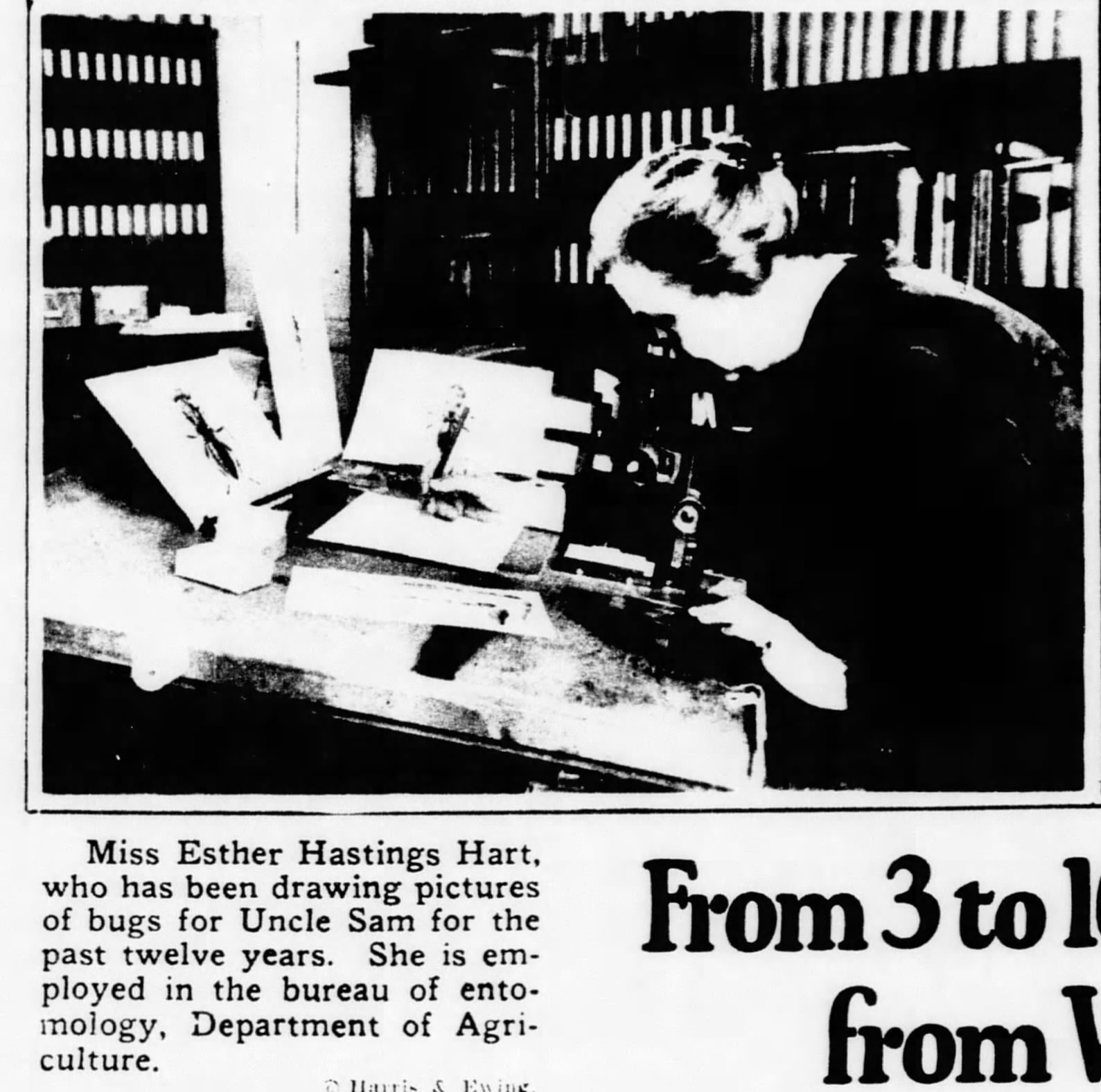
The Bug Lady: Ms. Esther Hart

 By Guest Blogger Melissa Rozengota, a volunteer with Elmira HistoryForge, a project sponsored by the Chemung County Historical Society

Esther Hart

You meet some of the most interesting people transcribing historical census records. I first encountered Miss Esther Hart in the 1910 census during my work as a volunteer with Elmira HistoryForge (https://elmira.historyforge.net/), a project which combines historic maps with census records and photographs to create a unique way to visualize community history.  At first glance, Esther Hart seemed a largely unremarkable individual; she was single, white, female, age 40.  She is listed at 302 E Church Street with her widowed older sister Fannie, niece Frances, nephew Pierson and 80-year-old father, Dr. Ira F Hart at 302 E Church Street. The detail that caught our attention was that she was a clerk in Washington D.C., while living in Elmira.

1910 US Census

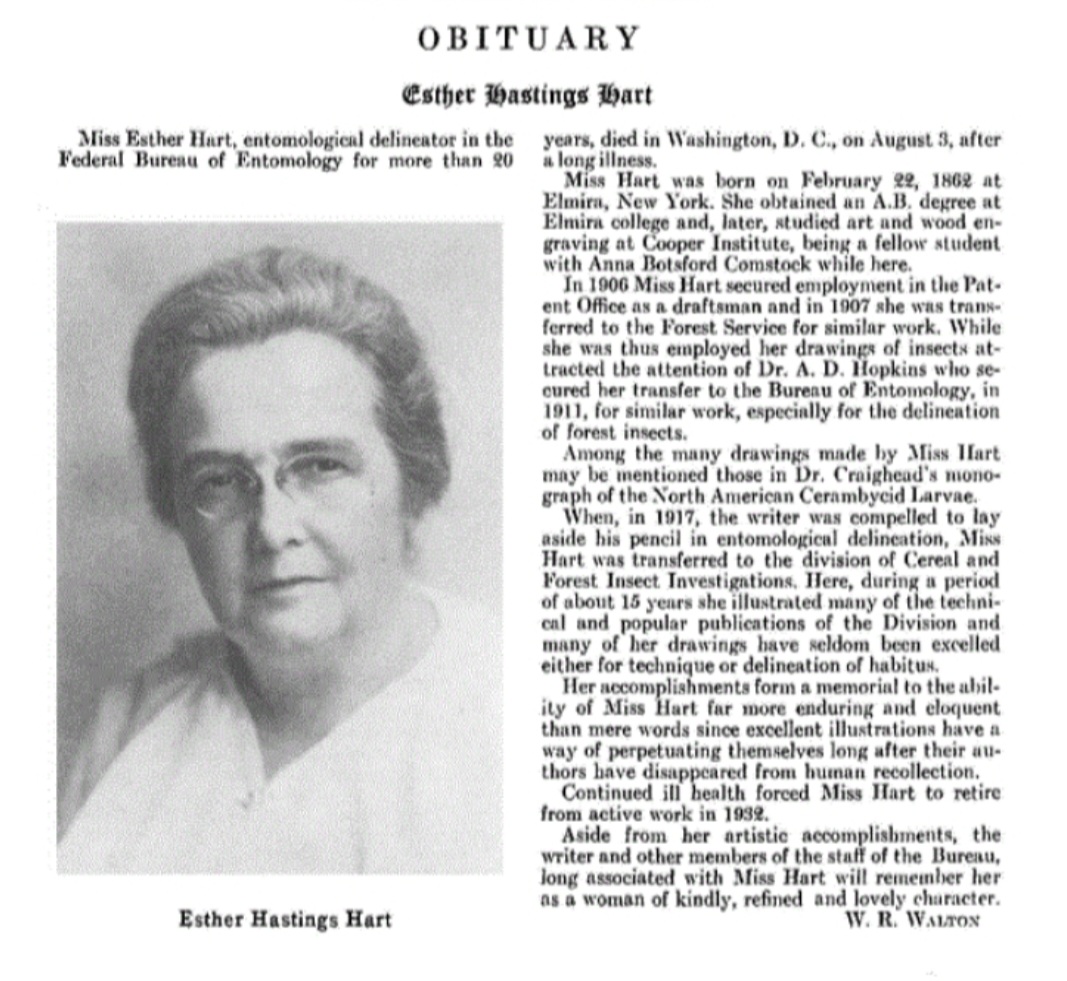
Esther was born February 22, 1862 in Elmira, New York to Dr. Ira Hart and Marion E. Cook Hart, early settlers in the Elmira area. Esther attended Elmira College and graduated with a Bachelors of Arts in 1883. She also later attended The Cooper Institute in New York City and completed a 4-year course in wood engraving and art. It was here that she met fellow student, Mrs. Anna Botsford Comstock, the first woman Professor at Cornell University and an acclaimed author, illustrator, and educator of natural studies. The Elmira city directories list Esther as a wood engraver and teacher from 1887 through 1905. By 1906, she attained her job in D.C.

Esther began her work in D.C. in the Patent Office as a draftsman, transferring from there in 1907 to the Forest Service Dept. It is within this department where her drawings caught the attention of Dr. A.D. Hopkins. Impressed with her natural aptitude, Dr. Hopkins secured a transfer reassigning Esther to the Bureau of Entomology for the Delineation of Forest Insects in 1911. In 1917, when Dr Hopkins retired, she transferred to the Division of Cereal & Forest Insect Investigation where, for 15 more years, she illustrated many publications. Some of Esther’s illustrations are still in use to this day and can be found in Dr. Craighead’s Monograph of The North American Cerambycid Larvae and The Southwestern Corn Borer.


Esther’s ambitions were not relegated to her career. She was involved in many activities and groups that brought her into the influential circles of our nation’s capital. In 1906, Esther was a guest of President & Mrs. Roosevelt’s in honor of the Army & Navy in the Blue Room at the White House.


In 1925, Esther was the hostess of a tea given by the American Association of University Women where she displayed her drawings.

When Esther was a charter member of the Elmira College Club in 1932, she met First Lady Mrs. Herbert Hoover for a ceremonial tree planting. The ceremony was in memory of President George Washington and Esther had her photo taken with the First Lady.


Ironically, we at Elmira HistoryForge should never have “met” her transcribing the 1910 Elmira census because she didn’t truly live here. Esther was listed on two 1910 Census. Not only was she listed in the Elmira census, but the Washington D.C. one as well.  

The D.C. Census listed her, inaccurately, as age 41, born in 1869. She was living with Clara S. Davenport, a government stenographer, age 32, born in 1878). I believe Clara was an acquaintance Esther knew from Elmira or maybe from College. The Elmira Census was taken April 21st & 22nd and the D.C. census was taken April 23rd. It is most likely the Elmira census taker didn’t realize that Esther was just a visitor in Elmira.

Esther was respected and esteemed for her work. According to her obituary from August 3, 1940, she was “a woman of kindly, refined, lovely character.” Despite living away for so long, she had strong ties with her family and Elmira and is buried in her family plot in Elmira's Woodlawn Cemetery.

We hope Miss Esther Hart would think the nickname we gave her is endearing and that she’d be delighted that 82 years after she passed away we found her everyday life in the early part of the 19th century so interesting.

As a woman in the early part of the 19th century she had many opportunities in her education and work and left a name for herself.


(To get involved with this cool project, contact our HistoryForge Coordinator at HistoryForge@ChemungValleyMuseum.org for more details!)