Monday, April 25, 2022

Curating Chemung County's Cool Collection

 By Monica Groth, Curator

The job of a Museum Curator is to safely handle, document, and house an institution’s object collection and design exhibits through which those objects can educate and inspire visitors. I am extremely excited to be joining the dedicated staff at the Chemung County Historical Society as I fulfill this role and I write now to introduce myself to you all!

I come to Chemung County from Aurora, New York, a small village in Cayuga County where I spent my summers finding shards of pottery, rusty nails, and fossils in the lake, gorges, and cemetery by my home. Many years ago, while thinking myself a true archaeologist and with treasures in hand, I visited my local Historical Society at a young age to proudly present my finds. This is when I discovered the purpose and promise of Historical Societies and Museums: to preserve the history of our lives and our homes—the everyday and the unique things that make us who we are and our county what it is to us.

One of my main tasks here at the Museum has been processing new donations whilst exploring the Museum collections. In doing this work I’ve discovered that much of the collection was donated by people very like the younger me. A 16-pound Civil War cannonball donated by Thomas Mallow was found by his father, Glenn Mallow Jr., while digging a WWII victory garden on the site of the Prison Camp. An Eagle Bottling Works Bottle, donated by Elaine Harrington, actually dates to the 1880’s and bears a newspaper clipping suggesting it was unearthed by a curious boy in the town of Chemung.

The donors to our Museum have given many fascinating objects that memorialize the lived experiences of themselves, their families, and their homes. Anne Beattie donated the clothes her parents wore on their wedding in 1939. Larry Bowman donated a collection of gifts received from Horsehead’s sister-city, Bato-Machi, Japan by the 1993 delegation. Betty Clauss donated her husband’s 1960-1964 US Air Force Uniform.

All these donations and more help the Historical Society fulfill its mission, and those donated in 2021 will be on display in the “New to the Vault” exhibit this summer!

A peek into the diverse collections: telephones, typewriters, assorted ladies' fan, shoes, and hats!

I love working as a curator because it allows me to get up close with these historical artifacts and the stories surrounding them. Before working here in Chemung County, I studied at the Mystic Seaport Museum, Connecticut and the National Museum of Bermuda. Some of the coolest maritime objects I studied at these Museums include a whaling harpoon-gun, used on the island of Bermuda; a 200-yr-old figurehead, once mounted on the bow of a ship; and a barometer which used shark liver oil to predict the weather!

I am looking forward to the many interesting objects and stories I’ll be showcasing here at the Chemung Valley History Museum. Visitors are always welcome and I’m eager to meet the community whose stories I’m now privileged to know. Keep exploring. And if you are willing to donate, come on down to the History Museum and add to the amazing collection!

This exhibit case, the newest addition to the Mark Twain's Elmira exhibit, features Mark Twain's quill pen, an c.1890 inkwell, and his thoughts on the area in his own words

Monday, April 11, 2022

Mamie Wood: Horseman's Pride of Elmira

 by Ellen Williams, Guest Blogger

Thomas Schmeck Flood (1844-1908) was a member of the prominent family of Floods whose homes occupied the East Water Street block between DeWitt and Madison Avenues in Elmira. His father and brothers were doctors, and Flood augmented the medical tradition in the family with his drug store on East Water Street. Flood went to medical school like his father and brothers but instead of practicing medicine he chose pharmacy as his career.

Hon. Thomas S. Flood

He had a strong affinity for horses, and he soon had a barn full in the city. In 1870 he married Frances Miller, for whose family Miller Street on the south side of the city was named. Shortly after, her uncle John E. DuBois recruited Flood into his plans for the lumber trade. DuBois, the younger, (son of the Williamsport lumber baron by the same name for whom the Duboistown neighborhood of that city was named) had purchased more than thirty thousand acres of timber, mostly white pine, in western Pennsylvania. It was then a veritable wilderness.

DuBois engaged Flood to move out to Clearfield County, PA, and help manage the lumber takings: mills, railroad lines, labor force, housing, post office and the like. There were few constraints on industry in that era, and the settlement was part of the ever-moving western line of America’s woodlands which at the time appeared to have no end. The town became known as DuBois. White pine was cash, and Flood’s wealth was secured during that decade, by 1880.-(Elmira Advertiser, Oct. 29, 1908) With his wife Frances, young son Chester, and his contingent of horses, Flood returned to the family seat in Elmira. 

Letter to John DuBois, 1884

Flood resumed his drugstore business and ran for city alderman in 1882, and surprised everyone when he won as a Republican in a Democratic ward. He also got involved with showing and racing his horses in the Chemung County Agricultural Society, the predecessor to the Chemung County Fair. Holding office with the Society, Flood applied his business acumen to his political and horse racing pursuits. A popular guy, he was known to be fair in the show ring and fast on the track.

Flood sent his favorite mare, Mary Ann, to Joseph Wood’s farm in Tioga County, Pennsylvania, in the summer of 1883. Wood owned an expensive Hambletonian trotting stallion whose reputation as a sire of record-breaking race horses was well established. Drawn by the Grand Circuit horse racing success of that stallion’s other colts during the previous years, Flood was seeking a race horse of his own.

The next year, Flood’s mare Mary Ann gave birth to a fine filly. Flood named the young filly “Mamie Wood” in tribute to her sire’s pedigree. Her parentage and her older siblings were well known, and Flood had big expectations for Mamie. It was an exciting year for the Floods, as they had a new baby girl born as well. They named their new daughter Frances Mabel, after her mother, but called her Mabel. Their son, Chester, was now about seven years old.

Mamie started her training in harness during the year of 1885-1886, under the hand of Flood’s trainer, John Ryan. Flood was very pleased with her prospects. According to his plans, she was to make her debut as a two-year-old in the New York State Breeders’ Association meet in September of 1886. Just to get some experience, Mamie trotted an exhibition at the Maple Avenue Driving Park in Elmira on June 3rd, going one mile alone against the stopwatch in 2:44½.

Mamie Wood became a star on the race track when she was two years old, making a record of trotting a mile hitched to a two-wheeled sulky in the time of two minutes, twenty-seven and a quarter seconds at Rochester, NY:

…The event of the day was Mamie Woods’ endeavor to break the best two-year-old record of 2:29. She was first sent a slow mile, finishing in 2:43¼.  When she came on the track again she was accompanied by a pacer.  Both came under the wire together, but Mamie began to go ahead, the pacer not seeming to follow her pace.  The first quarter was made in 37¾.  On she sped, without a skip or break….Then she began to go faster, and reached the three-quarter pole in 1:50½.  Everybody who had a watch had it out and was anxiously watching the filly.  On she came, as steady as clockwork.  The pacer began to draw up on her and she trotted faster every moment.  When she passed under the wire the watches said 2:27¼, and the track was instantly filled with a shouting crowd of enthusiasts who wanted to hug the little roan.  This is the fastest mile ever trotted by a two-year-old outside of California. Truly a wonderful performance for a two-year-old.  This closed the sport… Every member is enthusiastic over the meet and particularly so over Mamie Wood’s performance.”-(Rochester Democrat and Chronicle, Friday, Sep. 10, 1886, fultonhistory.com.)

Spirit of the Times, Dec. 18, 1886, p. 632, fultonhistory.com

Thomas S. Flood’s life, career, and adventures with harness racing horses illuminate the city of Elmira during the Gilded Age, when Mark Twain spent summers drafting “The Adventures of Huckleberry Finn” at Quarry Farm and the Langdons’ wealth set the tone for gracious living. For more of the story of Flood’s life, legacy, and the adventures of Mamie Wood who traveled by rail and raced in Grand Circuit venues all across the nation, read the complete version in Out of the Woods: From Deerfield to the Grand Circuit by Ellen Williams, published by Palmetto in 2019.

[This blog is an excerpt from Chapter 5, Mamie Wood: Pride and Politics, Out of the Woods, (Williams, 2019)]


Monday, March 28, 2022

Clothes Make the Man (or Woman)

 by Susan Zehnder, Education Director

Two years ago COVID-19 arrived, and since then we’ve all learned to live with a variety of changes. One of those changes that continues to evolve is how we present ourselves at work. With more meetings happening remotely, some office workers are opting for a more casual look on the job but keep “zoom shirts” or jackets handy to appear more presentable online.

In the past, people in the medical field, transportation, and business professions were expected to wear specific types of clothing to reflect their position, indicate their responsibilities and communicate their status and class. Think of them as work uniforms.

Our current exhibit All in a Day’s Work: Dressed for Success shares examples of how, over the years, different Chemung County professionals have dressed for work.

Three uniforms on display in our exhibit reflect some ongoing changes in our societal expectations for work attire.

A woman’s nursing uniform, like other uniforms in the medical profession, is designed to inspire patients’ confidence and trust. Being attended by someone wearing a dirty uniform is almost hard to imagine, and the importance of wearing a uniform in nursing can be traced back to Florence Nightingale. When Nightingale established the world’s first secular nursing school in 1860, she dressed her nurses in gray uniforms. The outfits helped identify nurses who had training, and the gray didn’t show the color or blood when wet. The uniform was also meant to neutralize the wearer’s appearance and deter unwelcome advances from patients under their care, who were commonly young male soldiers far from home.

At the beginning of the 20th century, nurses shifted to wearing white. There were strict protocols and expectations for them to keep their uniforms starched and pristine. Wearing white was “proof” that nurses were clean, sanitary, and offered scientific care. Mid-century nurses wore starched white dresses, white caps, white nylons and white shoes, similar to the example on display from St. Joseph’s Hospital. Often nurses were required to care for their own uniforms which meant time-consuming work to remove from bodily fluids.

When women’s fashion became less restrictive, the style of nursing uniforms followed along. By the 1970s and 80s, nurses began to wear scrubs, and today scrubs are the primary outfit of choice for the profession which includes more male nurses. Scrubs allow the wearer more freedom to move, often come with pockets to carry tools, and can be worn by any gender. Scrubs come in a variety of bright colors and patterns which allows nurses to personalize their look, if their affiliated institution permits it.

Uniforms have also been part of transportation work. Each style of dress indicated what position workers held and informed the public what to expect. Early train and trolley conductors, airline pilots, and bus drivers wore matching uniforms that had a distinct military style. This inspired confidence in their skills and abilities, and helped to make them look competent. The Lackawanna Railroad conductor's uniform from 1954 is a good example of that style. It comes with fancy brass buttons that include the Lackawanna R.R. logo to indicate the wearer was someone of note. Today transportation uniforms vary. Airline pilots still wear military influenced uniforms, often with brimmed hats and epaulets on the shoulder. Bus drivers are more casual and if they wear hats, tend to favor ball cap styles.

Unofficial uniforms have been worn by office workers providing business services since the beginning. In the 1930s, American writer Upton Sinclair called professionals who receive salaries “white collar workers,” referring to the white shirts and business suits many workers wore. The term stuck and is still used today. “Business casual,” or business attire was expected in many professions as a way to command respect from peers and customers, as well as show respect to those they worked with. Male workers who dressed this way communicated an unwritten message of who was in charge, and what position someone aspired to.

For women entering the workforce during the last century, fashion trends shifted from ultra-feminine to more traditionally masculine. Early on, it was unthinkable for women in offices to show up without wearing stockings, heels, skirts or dresses. Women began to wear suits similar to their male colleagues, adding shoulder pads to convey power and authority. The office worker’s outfit we have on display is a man’s suit from 1930, when white-collar workers were expected to wear suits, hats, and dress shoes to the office every day.

Today, advice for anyone interviewing for a job is often to dress for the job level above the one they’re applying for. What we choose to wear is a kind of language. We represent the organizations we work for as well as representing ourselves, and our clothes can say something about us.

Whether or not the more casual styles adopted during the pandemic stay with us, we’ll just have to see.


Monday, March 14, 2022

Elmira and the Widow Bedott

By Rachel Dworkin, Archivist


In 1849, Frances Miriam Berry Whitcher cost her husband his job as pastor of Elmira’s Trinity Episcopal Church. It was a funny story. Actually, it was several funny stories. That was the problem.

Born Frances Miriam Berry (Miriam to her friends), Whitcher (1811-1852) is known as the first female American satirists. Growing up in Whitesboro, New York as the eleventh of fifteen children, she was shy and bookish with wicked sense of humor. After years of writing humorous stories for her friends in the Whitesboro literary society, she submitted several satirical sketches to Neal’s Saturday Gazette of Philadelphia under the pseudonym “Frank” in 1846. They were an instant success.


Frances Miriam Whitcher, 1849

The main character of the tales was the Prissilla “Silly” Bedott, widow of Deacon Hezkiah Bedott and active pursuer of every eligible widower in the fictitious Wiggletown, New York. The sketches focused on the foibles of small town life with particular attention paid to the travails of courtship and women’s social circles. In some ways, Bedott’s life mirrored Miriam’s. Both women ended up marrying preachers and moving with them to a new setting.  

Widow Bedott & Rev. Sniffles

 On January 6, 1847, Miriam married Episcopalian minster Benjamin William Whitcher, just about the same time as her fictional counterpart married Sharack Sniffles of Scrabble Hill. Soon after, Reverend Whitcher was hired as rector of Elmira’s Trinity Church. The couple’s income was meager, just $500 a year, so Miriam continued to supplement it with her writing. Not long after their move, Louis Godey of Godey’s Lady’s Book, America’s first women’s magazine, contacted her and asked her to write a new series for his magazine. Miriam created a new character, Aunt Maguire, the Widow Bedott’s sister in Scrabble Hill. While Bedott was cynical and ambitious, Maguire was a compassionate voice of reason. Her stories were no less funny or popular though.

 The first of the pieces written in Elmira was about a disastrous donation party put on for a new local minister. At the time, it was common to hold a yearly pot-luck fundraiser at the minister’s home to supplement the meager annual income with gifts of household items. The story was inspired by the Whitchers’ own welcome donation party, although theirs involved considerably way less humiliation and property damage. Over the next few years, Miriam wrote a number of Aunt Maguire stories, some of which were re-printed in the local paper.

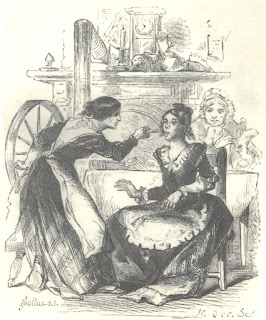
Aunt Maguire scolds her sister
The trouble came with a story about a sewing circle which was published in Godey’s Lady’s Book in January 1849. It included a fairly incisive take down of “Mrs. Samson Savage.”

“She’s one o’ the big bugs here—that is, she’s got more money than a’most anybody else in town. She was a tailoress when she was a gal, and they say she used to make a dretful sight o’ mischief among the folks where she sewed. But that was when she lived in Vermont. When Mr. Savage married her, he was one o’ these ere specilators…So she sot up for a lady. She was always a coarse, boisterous, high-tempered critter, and when her husband grow’d rich, she grow’d pompous and over-bearin’. She made up her mind she’d rule the roast, no matter what it cost—she’d be the first in Scrabble Hill.”

 All across New York, people were convinced that their local bully was the inspiration for Mrs. Savage. Nearly all of them were wrong, as it turned out she was based on Elmira’s Mrs. John Arnot Sr. The local speculation about Savage’s true identity might have died down if Reverend Whitcher hadn’t confirmed that his wife was the author. The reverend was called before the church vestry in February 1849 in order to justify his continued employment. Miriam, meanwhile, found herself hounded and insulted by Mrs. Arnot and her clique. By June, the couple couldn’t take it anymore. Unable find a new position elsewhere, Reverend Whitcher resigned and the couple moved back to Whitesboro to live with the Berrys.

Over the next few years, Miriam’s writing slowed as her health declined until her death from tuberculosis in January 1852. Not long after, in 1855, her collected writings were gathered together and published in book form as The Widow Bedott Papers. The stories were later turned into a play. While few have heard of her today, she was wildly popular in her heyday. Even the famous Mark Twain was a huge fan.

Monday, February 28, 2022

The Little Engine That Couldn’t: Elmira’s Watrous Automobile

 by Susan Zehnder, Education Director


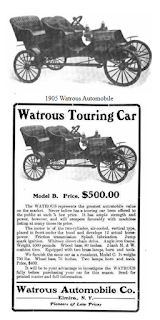
In 1904, Thomas S. Watrous founded the Watrous Automobile Company (WAC) on Main Street, hoping to cash in on the public’s growing desire for automobiles. The new industry was hot. The first American patent for a combustion engine had been filed twenty-five years earlier and now over 3,000 models were on the market. Each car was assembled by hand, making the median price around $1,000. However, the average yearly salary was only $200 - $400. For many the dream of owning their own automobile was still unattainable. Watrous wanted to offer customers more affordable options.

The first car purchased in the county was a Winton Roundabout six years earlier. The buyer was a local doctor William H. Fisher, and the car was manufactured by the Winton Motor Carriage Company, out of Cleveland, Ohio. It was summer when the car finally arrived. The event was announced in the local newspaper and a spontaneous parade was organized to celebrate its arrival. Winton automobiles had a reputation for quality and durability. A few years later, a Winton Roundabout would be driven across the country, successfully completing the nation’s first transcontinental drive. Without connected roads or reliable maps, Dr. H. Nelson of Vermont drove from coast to coast in under 90 days.

Fisher’s Roundabout engine had one cylinder and an advertised speed of 20 mph, which he put to the test.

Dr. Fisher and Dr. Carey in Fisher's Winton


Accompanied by Dr. Chauncey Carey, he recorded the county’s first distance drive, visiting Van Etten, Spencer, Owego, and Waverly in one afternoon. In a later attempt to prove his automobile’s prowess, Fisher raced against a horse at the County Fair, only to stall out and be forced to be towed home.

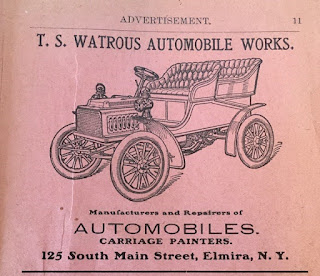
In the spring of 1904, when T.S. Watrous established the Watrous Automobile Company, business headquarters were located at 125 S. Main Street, Elmira, long gone today. His plan was to open a manufacturing plant on 11th Street in Elmira Heights, where WAC would produce two affordable models: the Model B, a Touring Car which would cost $500, and Model C, a Runabout which would cost $400. This was half the cost of other car models at the time. In early 1906 WAC was ready and advertised their vehicles widely. Orders soon rolled in.


To secure a vehicle, potential customers were asked to send cash deposits of $100 - $200. The company began producing inexpensive car parts, getting ready to assemble, but demand soon outstripped their capacity to deliver. Very quickly they gained an undesirable reputation.  The Third Edition Standard Catalog of American Cars 1805 - 1942, a well-regarded catalog, reports the car was "...a noisy car, and a pretty awful one. Local wags dubbed it the waterless, gearless, powerless, useless Watrous.” 

In March 1906, Hilliard Clutch & Machine Company moved into the building occupied by WAC, and by summer WAC was out of business completely. Watrous’s automotive dream was over. Previously, Watrous had been a carriage painter and earlier notices in the newspapers had him claiming to be the inventor of a “revolutionary” fruit preserving process that would change the industry. When WAC folded, he returned to his earlier profession of carriage painter for a few years, then in 1911, moved to Florida.

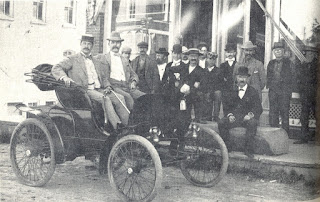
In the end, the Watrous Automobile Company assembled just one vehicle. After the company folded, the car was sold to a client in Pittsburgh for the sum of $300 in addition to a previously made deposit. It was reported in the Star-Gazette on September 15, 1909, that according to its owner, this Watrous “worked alright.”

This would be the only automobile ever produced in Elmira. Other automotive companies associated with Elmira, like Willys-Morrow produced their cars elsewhere. In 1908, Henry Ford manufactured his Model T in Michigan and created a new kind of production model. He designed an assembly line and changed industry standards and customer expectations. Manufacturers shifted from producing a small number of handmade cars to producing millions. Ford’s approach brought the price of automobiles down and within reach for more Americans.  


Monday, February 14, 2022

Ernie Davis Day

By Rachel Dworkin, Archivist

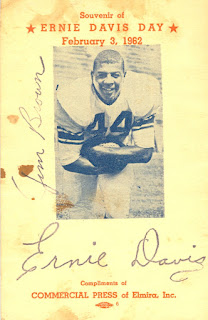
On the evening of February 3, 1962, around 1,400 people packed into the Notre Dame High School’s gym for the banquet in honor of Elmira’s favorite son, Ernie Davis. It was the last stop in what had been an action-packed day. The banquet was attended by such notables as state and local officials; teachers and coaches from EFA and Syracuse University; representatives from the Cleveland Browns and, of course, Davis’s mother. They were all there to pay tribute to his accomplishments and toast his up-coming career as a professional football player.

Although Ernie Davis is Elmira’s hometown hero, he wasn’t actually born here. He was born in New Salem, Pennsylvania and grew up in Uniontown. At the age of 12, he moved to Elmira with his mother and step-father. Here, he excelled at baseball, basketball, and football. While playing for Elmira Free Academy, he earned two All-American honors in basketball and football and was heavily recruited by colleges. He ended up attending Syracuse University where he played football and majored in economics and finance. In 1961, he became the first Black player to be awarded the Heisman Trophy. After graduating, he was recruited by the Cleveland Browns, signing the most lucrative contract of any NFL rookie up until that time. The citizens of Elmira could not have been prouder.


Planning for Ernie Davis Day began in late November 1961, shortly after Davis was awarded the Heisman Trophy. The day overall was going to be sponsored by the Elmira Association of Commerce with assistance from various fraternal groups and corporations. For months, the planning committee worked to schedule events, secure venues, and arrange speakers. They raised funds to buy Davis a new 1962 Thunderbird.

Officially, Ernie Davis Day began at 2pm at the YMCA with a youth meet-and-greet sponsored by Pepsi-Cola. Unofficially, kids began to gather on the sidewalk outside as early as noon. By the time Davis and his friend and fellow football player Jim Brown showed up a little after 1:30pm, there were nearly 400 boys running around. By the time the meet-and-greet officially began, the number had swelled to 700. There were speeches by Ernie Davis, Jim Brown, EFA football coach Bill Wipfler, and others. Each child received a card autographed by Davis and Brown. A few lucky ones actually got to shake their hands.


Next, Ernie headed off to an informal press reception at the Notre Dame High School library along with the ever-present Jim Brown, plus coaches Ben Schwartzwalder of Syracuse University and Arthur Modell of the Cleveland Browns. They schmoozed for an hour or so until Governor Nelson Rockefeller arrived around 5:30pm and the real press conference began.  

Around 6pm, the crowd started gathering for the banquet. Speeches began at 9pm after everyone had eaten their fill and there were a lot of speeches. Governor Nelson talked. President Kennedy talked, or at least wired a toast to be read aloud on his behalf. There were toasts by Ernie’s high school and college friends, his teachers and coaches, the mayor, and the Star-Gazette sports writer who had coined the nickname “Elmira Express.”  All of them wanted to celebrate Davis’s accomplishments and the promising start to his pro football career.


Sadly, his promising career never came to be. In the summer of 1962, Davis was diagnosed with leukemia. Ernie Davis died in a Cleveland hospital on May 18, 1963 at the age of 23. His wake at Elmira’s Neighborhood House on May 21 drew over 10,000 mourners. His funeral featured speeches by many of the same teammates, friends, and coaches who had spoken at his banquet. Even President Kennedy sent a statement to be read aloud. It was, in many ways, a dark reflection of the earlier, happier Ernie Davis Day.

Monday, January 31, 2022

Forever: Sending a Letter

 by Susan Zehnder, Education Director

Today “forever” costs fifty-eight cents. At least that’s what sending a one-ounce letter within the United States in 2021 costs. In October this year, the US Postal Service announced that first class mail may take them a little longer to deliver and for us to expect some letters and packages to arrive days later than in the past.

At this time of year, letters and packages keep the Post Office pretty busy. To appreciate how some things have changed, we invite you to view our current exhibit Going Postal. This exhibit is a fun look at mail service in Chemung County. 

Of course, mail was delivered in the colonies before the United States was a country, it was just delivered by anyone you might convince or pressure into carrying a message for you. As the colonies grew, Great Britain set up a mail system modeled after their own public mail service, one which had operated since the time of Henry VIII. The word post refers to the English mail service being carried from post to post. Each post had a master who would sort out and remove his area’s mail and return the rest to a post boy who then resumed delivery.

B. Franklin, Painting by J. Duplessis, 1778

In 1753, the Crown appointed Benjamin Franklin to serve as Joint Postmaster General for the colonies. During his tenure he established new mail routes, and erected sandstone mile markers known as Franklin Markers, to indicate distances. The changes Franklin made resulted in a faster and more reliable mail service. He even worked remotely as he spent much of the late 1750s in England. He audited postal statements and made decisions through the mail. Under his leadership, the postal service in the colonies turned a profit for the first time.

It was all fine until Franklin was implicated in leaking important letters sent between the British Crown and the British Governor of Massachusetts. Franklin, opposed to British rule, was dismissed from his post in 1774. Without his lead, the system began to fail.

In 1775, the Second Continental Congress created the United States Post Office. The drafted constitution of the United States, Article I, Section 8, Clause 7 gave Congress the power “To establish Post Offices and post Roads” to promote interstate communication and establish a source of revenue. Franklin was appointed its first Postmaster General. He was quick to rebuild his previous postal system, and it soon outperformed the British version. Franklin served in this position for a little over a year before he was appointed ambassador to France.

The Postal Service Act, signed by President George Washington in 1792 established unification, rules and regulations, and gave the Postmaster General greater powers under the United States Post Office Department. One of these was the ability to create postal routes to ensure that mail delivery would serve existing communities and expand as the new nation grew. It also allowed newspapers to be carried by the postal system at low rates. This helped spread information and improve communication throughout the young nation.

The title Postmaster General comes from the British model. For most of its existence in the United States, the position was part of the presidential cabinet. In 1971, the Post Office Department was reorganized into the United States Postal Service (USPS) by President Nixon. Since then, the Postmaster General is appointed by the Board of Governors and can only be removed by the board. Members are nominated to the board by the US President with the advice and consent of the Senate. The current Board of Governors consists of nine members in addition to the Postmaster General and the Deputy Postmaster General.

The USPS is the only delivery service that reaches every address in the nation, both personal and business. It receives no tax dollars for operating costs relying on postage sales and services to pay for funding. For the past few years, USPS has operated at a loss. Much of the blame for this is misunderstood.

In 2006, the Postal Accountability and Enhancement Act was passed to address USPS financial issues. The act requires the USPS to deliver mail six days a week; prohibits increasing postage faster than the rate of inflation; and prepays benefits for all their employees for at least fifty years. The prepaid benefits is something no other organization does, and many think it is to blame for their growing deficit. The Postal Service Reform Act (2021) was introduced last May with bi-partisan support to undo some of the 2006 changes.


The USPS is the nation’s 2nd largest civilian employer and there are 15 Post Office branches in the county to serve us. Our Going Postal exhibit has uniform patches, photographs, stamps, and more fun facts about Chemung County’s mail service and is on display Monday through Saturday 10 am – 5 pm through the spring. Seeing some of the history behind receiving a personal letter or package makes that first class stamp even more of a bargain.